Inquire: Call 0086-755-23203480, or reach out via the form below/your sales contact to discuss our design, manufacturing, and assembly capabilities.
Quote: Email your PCB files to Sales@pcbsync.com (Preferred for large files) or submit online. We will contact you promptly. Please ensure your email is correct.
Notes: For PCB fabrication, we require PCB design file in Gerber RS-274X format (most preferred), *.PCB/DDB (Protel, inform your program version) format or *.BRD (Eagle) format. For PCB assembly, we require PCB design file in above mentioned format, drilling file and BOM. Click to download BOM template To avoid file missing, please include all files into one folder and compress it into .zip or .rar format.
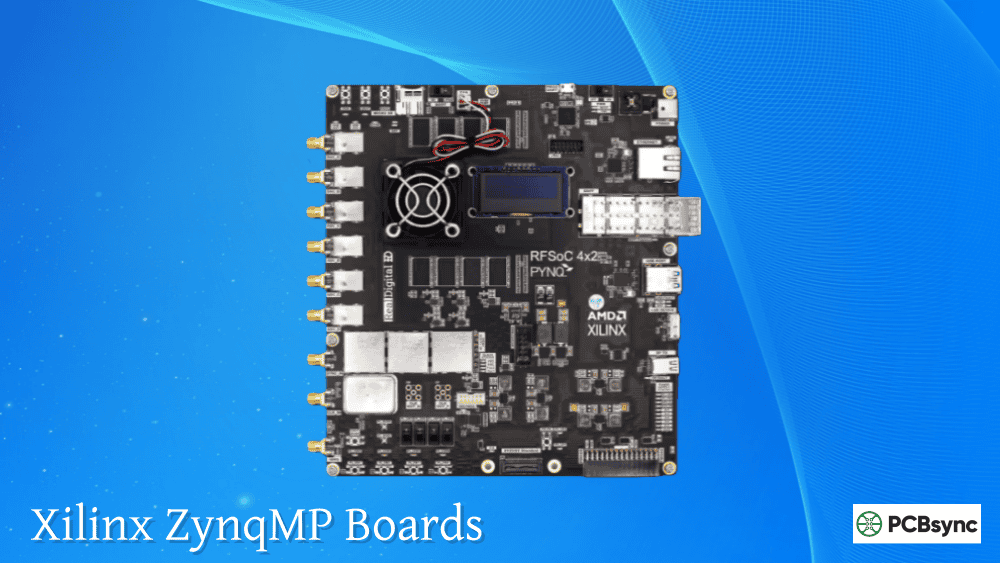
The ZCU111 represents a paradigm shift in RF system design. Having spent considerable time with various FPGA platforms, the moment I connected the ZCU111 evaluation board to a spectrum analyzer and saw clean multi-gigasample signals coming directly from the chip—without external ADCs or DACs—I understood why AMD calls this device revolutionary.
This guide covers everything engineers need to know about the ZCU111 XilinxRFSoC platform for 5G wireless infrastructure, phased array radar, and other high-performance RF applications.
Traditional RF systems require separate ADCs, DACs, FPGA, and processor chips interconnected via high-speed JESD204B interfaces. The ZCU111 eliminates this complexity by integrating everything onto a single device—the XCZU28DR RFSoC.
For 5G massive MIMO systems with 32, 64, or even 128+ antenna elements, eliminating discrete data converters dramatically simplifies design and reduces system cost.
ZCU111 Hardware Specifications
The ZCU111 evaluation board provides comprehensive access to the XCZU28DR’s capabilities.
RF Data Converter Specifications
Parameter
RF-ADC
RF-DAC
Channels
8
8
Resolution
12-bit
14-bit
Sample Rate
4.096 GSPS
6.554 GSPS
Nyquist Zone
Up to 2 GHz
Up to 3.2 GHz
Input/Output
Differential
Differential
These specifications enable direct RF sampling in many frequency bands, eliminating intermediate frequency (IF) stages and associated mixers.
Processing Architecture
Component
Specification
Application Processor
Quad-core ARM Cortex-A53 @ 1.5 GHz
Real-Time Processor
Dual-core ARM Cortex-R5F @ 600 MHz
Programmable Logic
930K logic cells
DSP Slices
4,272
Block RAM
38 Mb
UltraRAM
22.5 Mb
SD-FEC Cores
8 (LDPC/Turbo)
The SD-FEC (Soft-Decision Forward Error Correction) cores are hardened IP blocks providing over 1 Gb/s throughput for LDPC and Turbo decoding—essential for 5G NR and LTE-Advanced baseband processing.
Memory Configuration
Interface
Capacity
Configuration
PS DDR4 SODIMM
4 GB
64-bit @ 2400 MT/s
PL DDR4 Component
4 GB
64-bit @ 2666 MT/s
Quad-SPI Flash
256 MB
Dual x4
Dual DDR4 banks enable separation of control plane operations (PS) from data plane signal processing (PL).
High-Speed Connectivity
Interface
Specification
SFP28 Cages
4× (ganged)
FMC+
12× GTY @ 33 Gb/s
RFMC
ADC and DAC connectors
Ethernet
Gigabit RJ45
USB
USB 3.0
The four SFP28 cages support up to 100 Gb/s aggregate bandwidth for fronthaul/backhaul connectivity in 5G deployments.
Understanding Direct RF Sampling
The ZCU111 Xilinx platform enables direct RF sampling—a technique that digitizes RF signals without analog downconversion.
Traditional vs Direct RF Architecture
Stage
Traditional
Direct RF (ZCU111)
RF Input
Antenna
Antenna
LNA
Required
Required
Mixer
Required
Eliminated
IF Filter
Required
Eliminated
IF Amplifier
Required
Eliminated
ADC
External
Integrated
Digital Interface
JESD204B
Internal
By sampling directly at RF frequencies, the ZCU111 simplifies the analog signal chain while moving filtering and frequency translation into the digital domain where it’s more flexible and repeatable.
Nyquist Zone Operation
The 4.096 GSPS ADCs can operate in multiple Nyquist zones:
Nyquist Zone
Frequency Range
Application
1st
DC – 2.048 GHz
Sub-6 GHz 5G
2nd
2.048 – 4.096 GHz
n77, n78 bands
3rd
4.096 – 6.144 GHz
Extended range
Higher Nyquist zones use undersampling, where the ADC captures aliased representations of higher-frequency signals.
The ZCU111 evaluation board addresses multiple 5G infrastructure use cases.
Massive MIMO Radio Units
For 5G massive MIMO with 64 antenna elements, traditional designs would require 64 discrete ADCs and 64 DACs. Using RFSoC devices like the XCZU28DR, eight devices provide complete coverage with dramatically reduced complexity.
What is the difference between ZCU111 and standard Zynq UltraScale+ boards?
The ZCU111 features the XCZU28DR RFSoC with integrated RF data converters (8× ADCs, 8× DACs) and SD-FEC cores, while standard MPSoC boards like ZCU102/104/106 lack these RF-specific features. The ZCU111 evaluation board targets wireless infrastructure, radar, and test equipment applications requiring direct RF sampling.
Can the ZCU111 Xilinx board handle 5G NR frequencies?
Yes, the ZCU111 Xilinx platform supports 5G NR sub-6 GHz bands through direct RF sampling or undersampling techniques. The 4.096 GSPS ADCs provide up to 2 GHz instantaneous bandwidth, covering n77, n78, and other 5G bands. The integrated SD-FEC cores accelerate LDPC coding required by 5G NR.
What is the XM500 balun card used for?
The XM500 RFMC balun card converts between the RFSoC’s differential RF signals and single-ended SMA connections for test equipment. It provides access to 4 ADC and 4 DAC channels through baluns, plus 4 additional channels through direct SMA connections for custom balun implementations.
Does the ZCU111 support MATLAB/Simulink development?
Yes, MathWorks provides comprehensive support for the ZCU111 through SoC Blockset and HDL Coder. Reference designs include wideband radar signal detection, demonstrating the complete workflow from simulation to hardware deployment. The RF Data Converter block enables configuration of ADC/DAC settings directly from Simulink models.
What applications benefit most from the ZCU111?
The ZCU111 evaluation board excels in applications requiring wideband RF processing: 5G massive MIMO radio units, wireless backhaul, phased array radar, electronic warfare systems, DOCSIS cable access, satellite communications, and high-speed test and measurement equipment. Any application eliminating discrete data converters benefits from the RFSoC integration.
Building Next-Generation RF Systems
The ZCU111 fundamentally changes RF system design by integrating what previously required dozens of discrete components. For 5G infrastructure, the combination of direct RF sampling, hardened SD-FEC, and flexible FPGA fabric enables radio units that would have been impractical with traditional architectures. For radar systems, the tight integration eliminates timing uncertainties that plague multi-chip designs.
Development Tools and Ecosystem
The ZCU111 evaluation board benefits from comprehensive tool support:
PYNQ support for RFSoC enables Jupyter notebook-based development, dramatically accelerating algorithm exploration before committing to optimized HDL implementations.
Practical Considerations
When designing with the ZCU111 Xilinx platform, consider these factors:
Thermal Management: High sample rate operation generates significant heat. The evaluation board includes active cooling, and production designs must account for thermal dissipation.
Clock Distribution: Multi-tile synchronization (MTS) requires careful clock planning for coherent multi-channel operation in radar and MIMO applications.
Power Sequencing: The RFSoC has specific power-up requirements. Follow the reference design power architecture for custom boards.
Success with the ZCU111 Xilinx platform requires understanding both RF fundamentals and digital signal processing. Start with the evaluation tool to characterize ADC/DAC performance, then progressively build toward your target application using the provided reference designs as foundations.
Inquire: Call 0086-755-23203480, or reach out via the form below/your sales contact to discuss our design, manufacturing, and assembly capabilities.
Quote: Email your PCB files to Sales@pcbsync.com (Preferred for large files) or submit online. We will contact you promptly. Please ensure your email is correct.
Notes: For PCB fabrication, we require PCB design file in Gerber RS-274X format (most preferred), *.PCB/DDB (Protel, inform your program version) format or *.BRD (Eagle) format. For PCB assembly, we require PCB design file in above mentioned format, drilling file and BOM. Click to download BOM template To avoid file missing, please include all files into one folder and compress it into .zip or .rar format.