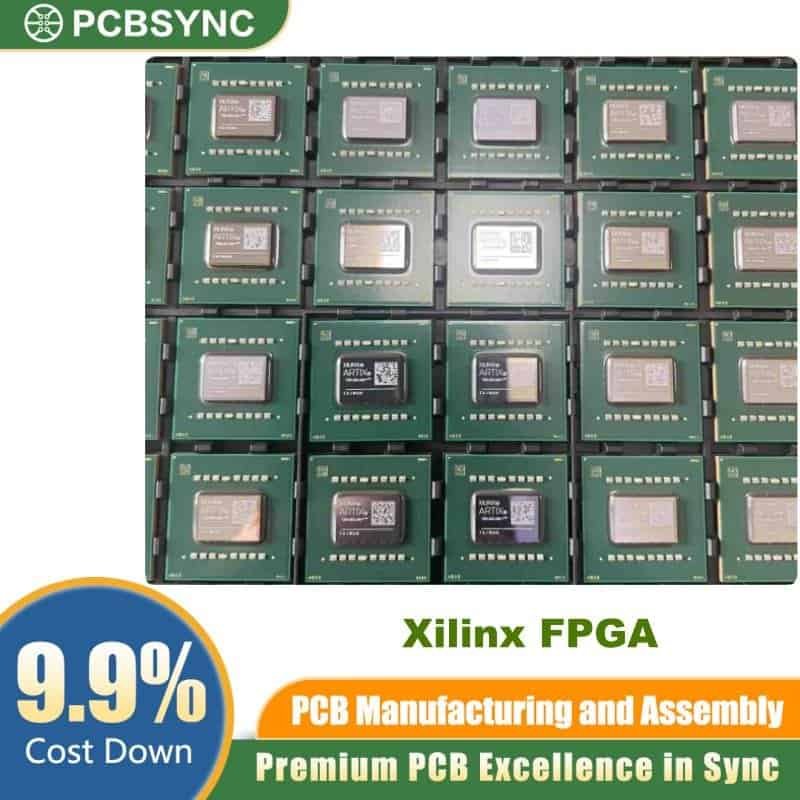
The XCS20-3PQG208I is a powerful Field Programmable Gate Array (FPGA) from AMD’s renowned Spartan® family, designed to deliver exceptional performance for complex embedded applications. This industrial-grade FPGA combines 20,000 gates with 160 I/O pins, making it an ideal solution for digital signal processing, control systems, and custom logic implementations.
Product Overview
The XCS20-3PQG208I represents a sophisticated programmable logic device engineered for demanding industrial and commercial applications. With its robust architecture and extensive I/O capabilities, this FPGA enables engineers to implement custom digital designs with remarkable flexibility and reliability.
Key Features
The XCS20-3PQG208I delivers exceptional capabilities through its advanced architecture:
- 20,000 system gates providing substantial logic capacity for complex designs
- 160 configurable I/O pins enabling extensive connectivity options
- 400 configurable logic blocks (CLBs) offering flexible design implementation
- 950 logic cells delivering efficient resource utilization
- 12,800 bits of distributed RAM for embedded memory applications
- Industrial temperature range (-40°C to +100°C) ensuring reliable operation in harsh environments
- 208-PQFP package offering excellent thermal performance and routing density
Technical Specifications
Core Architecture Details
| Specification |
Value |
| Product Family |
Spartan® FPGA |
| Total System Gates |
20,000 |
| Logic Cells/Elements |
950 |
| Configurable Logic Blocks |
400 |
| Total RAM Bits |
12,800 |
| User I/O Pins |
160 |
| Speed Grade |
-3 (Industrial) |
Electrical Characteristics
| Parameter |
Specification |
| Supply Voltage Range |
4.5V to 5.5V |
| Operating Temperature |
-40°C to +100°C (Junction) |
| Logic Family |
CMOS |
| Power Consumption |
Application-dependent |
Package Information
| Package Details |
Specification |
| Package Type |
208-BFQFP (Plastic Quad Flat Pack) |
| Package Dimensions |
28mm x 28mm |
| Pin Count |
208 pins |
| Mounting Type |
Surface Mount Technology (SMT) |
| Lead Pitch |
0.5mm |
Applications and Use Cases
The XCS20-3PQG208I FPGA excels in diverse application scenarios where programmable logic provides competitive advantages:
Industrial Control Systems
Implement sophisticated control algorithms for manufacturing equipment, robotics, and process automation. The industrial temperature rating ensures reliable operation in factory environments where ambient temperatures fluctuate significantly.
Digital Signal Processing
Process real-time signals for audio, video, or instrumentation applications. The distributed RAM and high gate count enable implementation of filters, FFT algorithms, and custom DSP functions.
Communications Infrastructure
Design custom protocol handlers, interface converters, and data routing solutions. The 160 I/O pins provide ample connectivity for multi-channel communication systems.
Test and Measurement Equipment
Create flexible instrumentation platforms that can be reconfigured for different test scenarios. The programmable nature allows for field upgrades and customization.
Legacy System Integration
Bridge modern digital systems with legacy equipment using custom interface logic. The Xilinx FPGA architecture supports a wide range of interface standards and protocols.
Design Advantages
Flexibility and Reconfigurability
Unlike fixed-function ASICs, the XCS20-3PQG208I can be reprogrammed to accommodate design changes, feature additions, or bug fixes without hardware modifications. This flexibility significantly reduces development costs and time-to-market.
Integration Capabilities
Consolidate multiple discrete logic components into a single FPGA device, reducing board space, power consumption, and manufacturing complexity. The 20,000-gate capacity supports substantial logic integration.
Parallel Processing Architecture
Execute multiple operations simultaneously, unlike sequential microprocessors. This parallel architecture delivers superior performance for time-critical applications requiring deterministic response times.
Pin Configuration and I/O Standards
The 208-PQFP package provides comprehensive I/O options distributed across the package perimeter:
| I/O Feature |
Capability |
| Total User I/O |
160 pins |
| I/O Standards Support |
TTL, CMOS, LVTTL |
| I/O Banking |
Multiple independent banks |
| Programmable Drive Strength |
Yes |
| Input Hysteresis |
Programmable |
Development and Programming
Design Tools Compatibility
The XCS20-3PQG208I integrates seamlessly with industry-standard FPGA development environments, enabling efficient design capture, synthesis, and implementation.
Programming Options
Multiple programming methods support both development and production scenarios:
- JTAG boundary-scan for in-system programming and debugging
- Serial programming for configuration memory devices
- Slave parallel programming for high-speed configuration
Quality and Reliability
Industrial-Grade Construction
The XCS20-3PQG208I meets stringent quality standards for industrial applications:
- Extended temperature qualification (-40°C to +100°C junction temperature)
- Comprehensive electrical testing and characterization
- Long-term reliability validation
- RoHS compliant manufacturing processes
Design Verification
Implement reliable systems with confidence using proven silicon technology backed by extensive characterization data and application notes from AMD.
Comparison Table: Spartan Family Overview
| Model |
System Gates |
Logic Cells |
RAM Bits |
I/O Pins |
Package |
| XCS10 |
10,000 |
466 |
6,400 |
112-160 |
Various |
| XCS20 |
20,000 |
950 |
12,800 |
160 |
208-PQFP |
| XCS30 |
30,000 |
1,368 |
18,432 |
192 |
Various |
| XCS40 |
40,000 |
1,862 |
25,088 |
205 |
Various |
Getting Started
Design Considerations
When implementing designs with the XCS20-3PQG208I, consider these best practices:
Power Supply Design: Implement robust power distribution with adequate decoupling capacitance. The 5V supply should maintain regulation within the specified 4.5V-5.5V range across all operating conditions.
Thermal Management: Although the industrial temperature rating provides substantial margin, proper PCB thermal design ensures optimal performance. Consider copper area, airflow, and heat sinking requirements based on utilization.
Signal Integrity: The 208-pin package requires careful PCB layout to maintain signal integrity. Follow AMD’s layout guidelines for controlled impedance routing, ground planes, and via placement.
Ordering Information
| Part Number |
Description |
Temperature Range |
Package Type |
| XCS20-3PQ208I |
Industrial Grade |
-40°C to +100°C |
208-PQFP |
| XCS20-3PQ208C |
Commercial Grade |
0°C to +85°C |
208-PQFP |
Product Status and Availability
Important Note: The XCS20-3PQG208I is classified as an obsolete product that is no longer in active production. Organizations currently using this device in production systems should consider long-term availability planning, including last-time-buy opportunities and migration strategies to current AMD FPGA families.
For new designs, AMD recommends evaluating modern FPGA families that offer enhanced features, improved power efficiency, and guaranteed long-term availability.
Support Resources
Engineers working with the XCS20-3PQG208I have access to comprehensive technical resources:
- Detailed datasheets with complete electrical specifications
- Application notes covering common design scenarios
- Reference designs demonstrating best practices
- Technical forums for community support
- EDA tool integration documentation
Conclusion
The XCS20-3PQG208I represents a capable FPGA solution for industrial applications requiring programmable logic with substantial gate capacity and I/O resources. While classified as obsolete, existing installations benefit from the device’s proven reliability and industrial-grade specifications. Organizations maintaining legacy systems can leverage the extensive documentation and community knowledge surrounding this established FPGA family.
For applications requiring programmable logic solutions, the Spartan architecture continues to demonstrate the advantages of FPGA technology in providing flexible, reliable, and cost-effective alternatives to fixed-function logic implementations.