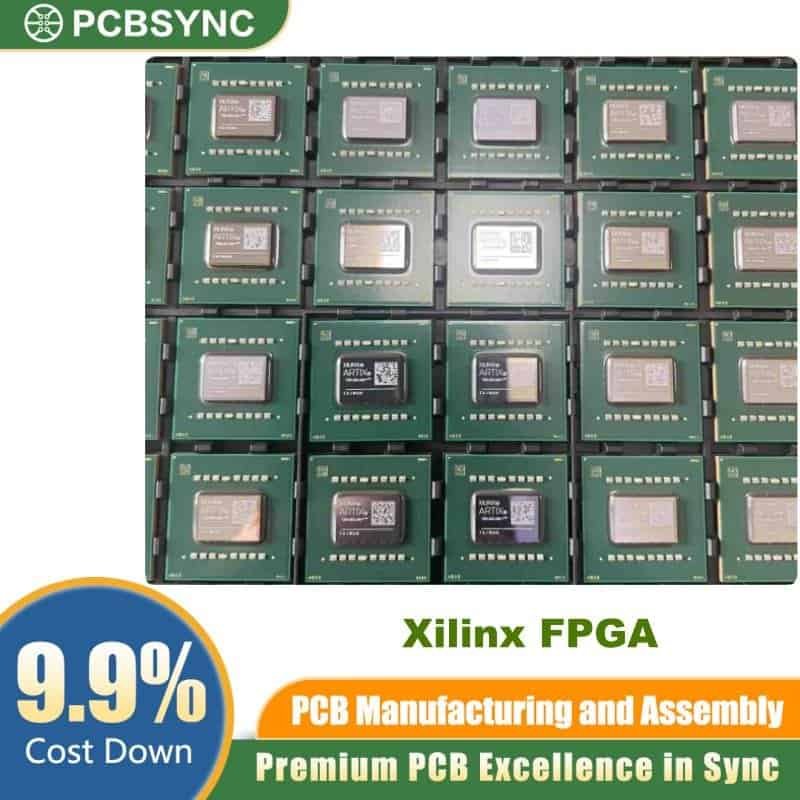
Product Overview: XCS30-4TQ144C Field Programmable Gate Array
The XCS30-4TQ144C is a high-performance Field Programmable Gate Array (FPGA) from AMD’s renowned Spartan family, specifically designed for high-volume production environments and ASIC replacement applications. This commercial-grade FPGA delivers exceptional processing capabilities with 30,000 system gates, making it an ideal solution for industrial automation, telecommunications, and embedded system designs.
As part of the legendary Spartan series, the XCS30-4TQ144C represents the perfect balance between performance, cost-effectiveness, and reliability. This Xilinx FPGA offers designers a flexible, reprogrammable solution that eliminates the high initial costs and long development cycles associated with traditional ASIC implementations.
Technical Specifications
Core Architecture Features
| Specification |
Details |
| Part Number |
XCS30-4TQ144C |
| Manufacturer |
AMD (formerly Xilinx) |
| Product Family |
Spartan Series |
| Logic Cells |
1,368 cells |
| System Gates |
30,000 gates |
| Total RAM Bits |
18,432 bits |
| Speed Grade |
-4 (Standard performance) |
| Operating Voltage |
5V tolerant I/O |
Package and Pin Configuration
| Parameter |
Value |
| Package Type |
144-LQFP (Low-profile Quad Flat Pack) |
| Total Pins |
144 pins |
| User I/O Pins |
113 I/O |
| Package Dimensions |
Compact LQFP footprint |
| Mounting Type |
Surface Mount Technology (SMT) |
Performance Characteristics
| Feature |
Specification |
| Maximum Frequency |
Up to 100 MHz+ system performance |
| Configuration Memory |
SRAM-based architecture |
| Programming Cycles |
Unlimited reprogrammability |
| Power Consumption |
Low power consumption design |
| Temperature Range |
Commercial grade (0°C to +70°C) |
Key Features and Advantages
High-Density Logic Integration
The XCS30-4TQ144C integrates 1,368 logic cells within a compact 144-pin package, providing substantial processing capability for complex digital designs. With 30,000 system gates, this FPGA supports sophisticated logic implementations including:
- Multi-function state machines
- Complex arithmetic operations
- Protocol controllers and interfaces
- Custom peripheral implementations
- Digital signal processing functions
Flexible Memory Architecture
Equipped with 18,432 RAM bits, the XCS30-4TQ144C provides ample on-chip memory resources for data buffering, lookup tables, and temporary storage. This integrated memory eliminates the need for external RAM in many applications, reducing system costs and board complexity.
Extensive I/O Capabilities
With 113 user-configurable I/O pins, the XCS30-4TQ144C offers exceptional connectivity options for interfacing with various peripherals, sensors, and communication protocols. The 5V-tolerant I/O design ensures compatibility with legacy systems while supporting modern 3.3V logic standards.
Cost-Effective ASIC Replacement
The Spartan family was specifically engineered for ASIC replacement in high-volume production environments. The XCS30-4TQ144C delivers:
- Elimination of NRE (Non-Recurring Engineering) costs
- Reduced time-to-market compared to ASIC development
- Field-upgradeable functionality
- Lower inventory risks with single-SKU flexibility
- Production-volume pricing competitive with gate arrays
Application Areas
Industrial Control Systems
The XCS30-4TQ144C excels in industrial automation applications requiring:
- Motor control algorithms
- PLC (Programmable Logic Controller) functions
- Industrial protocol implementations (Profibus, Modbus, CANbus)
- Sensor data acquisition and processing
- Real-time monitoring and control
Communications Infrastructure
Telecommunications equipment benefits from the XCS30-4TQ144C’s capabilities:
- Protocol conversion and bridging
- Data multiplexing/demultiplexing
- Error detection and correction
- Frame processing and filtering
- Interface adaptation
Embedded System Design
Embedded applications leverage this FPGA for:
- Custom peripheral controllers
- State machine implementations
- Glue logic replacement
- System timing and control
- Interface expansion
Consumer Electronics
Consumer products utilize the XCS30-4TQ144C for:
- Video/audio processing
- Display controllers
- User interface management
- System integration functions
- Power management control
Development and Programming
Design Tools Compatibility
The XCS30-4TQ144C is fully supported by industry-standard development tools:
- Xilinx ISE Design Suite: Complete design entry, synthesis, and implementation
- Vivado Design Suite: Modern design environment with enhanced features
- VHDL/Verilog: Standard HDL language support
- Schematic Entry: Visual design capture options
- Third-Party Tools: Compatible with major EDA platforms
Configuration Methods
Multiple configuration options provide design flexibility:
- JTAG Programming: In-system programming and debugging
- Master Serial Mode: Boot from serial PROM
- Slave Serial Mode: Configuration from external controller
- Boundary Scan: IEEE 1149.1 compliant testing
Package Information and PCB Design Considerations
144-LQFP Package Details
The Low-profile Quad Flat Pack (LQFP) offers several advantages:
- Compact footprint: Space-efficient PCB layout
- Good thermal characteristics: Enhanced heat dissipation
- Reliable connections: Proven surface-mount technology
- Automated assembly: Compatible with standard pick-and-place equipment
- Visual inspection: External leads facilitate quality control
Layout Recommendations
For optimal performance, PCB designers should consider:
- Power supply decoupling: Place 0.1μF capacitors near each power pin
- Ground plane: Solid ground plane for noise reduction
- Signal integrity: Proper trace impedance matching for high-speed signals
- Thermal management: Adequate copper pour for heat spreading
- Configuration interface: Accessible JTAG connector for programming
Comparison with Related Models
XCS30 Family Variants
| Model |
Speed Grade |
Package |
Key Difference |
| XCS30-3TQ144C |
-3 (Faster) |
144-LQFP |
Higher performance timing |
| XCS30-4TQ144C |
-4 |
144-LQFP |
Standard performance |
| XCS30-5TQ144C |
-5 |
144-LQFP |
Lower power option |
Alternative Package Options
The XCS30 die is available in multiple packages to suit different board requirements:
- VQ100: 100-pin VQFP for reduced pin count applications
- PQ208: 208-pin PQFP for maximum I/O access
- BG256: Ball Grid Array for high-density designs
Procurement and Availability
Current Market Status
Important Notice: The XCS30-4TQ144C is classified as an obsolete/discontinued product by AMD. However, it remains available through:
- Authorized distributors with remaining inventory
- Electronic component brokers specializing in legacy parts
- Surplus and excess inventory channels
Sourcing Recommendations
When sourcing the XCS30-4TQ144C:
- Verify authenticity: Purchase only from reputable suppliers
- Check date codes: Ensure recent manufacturing dates when available
- Request CoC: Certificate of Conformance for quality assurance
- Consider alternatives: Evaluate pin-compatible replacements for new designs
- Stock strategically: Maintain adequate inventory for product lifetime support
Migration Path and Alternative Solutions
Modern Spartan Replacements
For new designs, consider these current AMD/Xilinx FPGA families:
- Spartan-7: Latest generation with enhanced features
- Artix-7: Higher performance with lower power consumption
- Spartan-6: Intermediate upgrade path
- Cost-optimized devices: Budget-friendly alternatives
Design Conversion Considerations
Migrating from XCS30-4TQ144C to newer devices involves:
- HDL code typically requires minimal modification
- Pin assignments need remapping to new packages
- Timing constraints should be re-verified
- Power supply requirements may differ
- Configuration interfaces might need adaptation
Quality and Reliability
Manufacturing Standards
The XCS30-4TQ144C was manufactured to rigorous quality standards:
- RoHS Compliance: Lead-free options available
- MSL Rating: Moisture Sensitivity Level classification
- ESD Protection: Built-in electrostatic discharge protection
- Temperature Testing: Full temperature range validation
- Long-term Reliability: Proven field performance record
Testing and Validation
Each device undergoes comprehensive testing:
- Functional testing of all logic resources
- Speed grading verification
- I/O pin continuity and voltage level testing
- Boundary scan validation
- Environmental stress screening (where applicable)
Technical Support Resources
Documentation
Essential documents for working with XCS30-4TQ144C:
- Datasheet: Complete electrical and timing specifications
- User Guide: Detailed architecture and design information
- Application Notes: Implementation guidelines and best practices
- Package Drawings: Mechanical specifications and footprints
- PCN Archive: Product Change Notifications history
Online Resources
Additional support available through:
- AMD/Xilinx technical forums and communities
- Third-party FPGA design websites
- Engineering reference designs and examples
- Video tutorials and webinars
- Design consulting services
Frequently Asked Questions
What is the maximum operating frequency?
The XCS30-4TQ144C’s maximum frequency depends on the specific design implementation, typically ranging from 50-100+ MHz for internal logic, with I/O interfaces supporting various standard protocols.
Is this FPGA suitable for new designs?
While functionally capable, being an obsolete part makes it challenging for new product designs. Consider evaluating current Spartan-7 or Artix-7 families for new projects to ensure long-term availability.
What configuration memory type does it use?
The XCS30-4TQ144C utilizes SRAM-based configuration, requiring reprogramming after each power cycle. External configuration memory (PROM or Flash) is typically used for automatic startup.
Can I program it with a standard JTAG cable?
Yes, the device supports standard JTAG programming using Xilinx Platform Cable or compatible third-party programmers through the IEEE 1149.1 boundary scan interface.
What development software is required?
Xilinx ISE Design Suite (version 14.7 or earlier) is the primary development environment. Vivado does not support this legacy device family.
Conclusion: Proven FPGA Solution for Legacy Applications
The XCS30-4TQ144C represents a mature, battle-tested FPGA solution that has powered countless industrial, commercial, and embedded applications. With its 30,000-gate capacity, 113 I/O pins, and robust 144-LQFP package, it continues to serve as a reliable choice for maintaining existing product lines and providing ASIC-alternative solutions.
While newer FPGA families offer enhanced features and performance, the XCS30-4TQ144C’s proven track record, extensive documentation, and established supply chains make it a valuable component for legacy system support and cost-sensitive applications. For designers working with existing implementations, understanding this device’s capabilities and limitations ensures successful product maintenance and potential future migrations.
Whether you’re supporting a mature product line or evaluating FPGA solutions for specific applications, the XCS30-4TQ144C demonstrates the enduring value of AMD’s Spartan FPGA architecture in delivering reliable, flexible, and cost-effective programmable logic solutions.