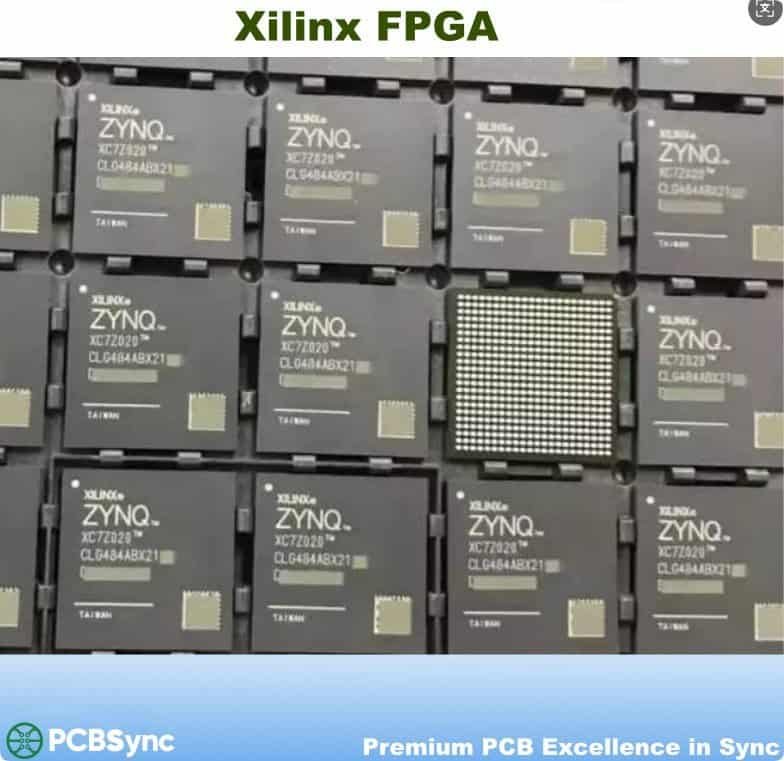
Overview of XCV600E-8HQ240C FPGA
The XCV600E-8HQ240C represents a powerful field-programmable gate array from AMD Xilinx’s renowned Virtex-E family. This advanced FPGA delivers exceptional performance for complex digital designs, telecommunications infrastructure, and high-speed data processing applications. With 600,000 system gates and versatile I/O capabilities, the XCV600E-8HQ240C stands as a reliable solution for demanding embedded systems.
Key Features and Specifications
Core Technical Specifications
| Parameter |
Specification |
| Part Number |
XCV600E-8HQ240C |
| Manufacturer |
AMD (Xilinx) |
| Product Family |
Virtex-E |
| System Gates |
600,000 gates |
| Logic Elements/Cells |
13,824 |
| Total RAM Bits |
229,376 |
| I/O Count |
166 |
| Package Type |
240-CQFP (Ceramic Quad Flat Pack) |
| Speed Grade |
-8 (High Performance) |
| Operating Temperature |
0°C to +85°C (Commercial) |
| Supply Voltage |
1.8V, 2.5V, 3.3V |
Logic Architecture
| Feature |
Details |
| Configurable Logic Blocks (CLBs) |
1,728 CLBs |
| Logic Cells |
13,824 |
| Block RAM |
28 blocks (18kb each) |
| Distributed RAM |
Available |
| Multipliers |
Embedded multipliers |
| Clock Management |
Delay-Locked Loops (DLLs) |
Performance Characteristics
| Metric |
Value |
| Maximum Frequency |
Up to 200 MHz (design dependent) |
| Speed Grade |
-8 (fastest in Virtex-E series) |
| Power Consumption |
Low to moderate (application dependent) |
| Propagation Delay |
Optimized for high-speed applications |
| Configuration Time |
Fast configuration via SelectMAP/JTAG |
XCV600E-8HQ240C Applications
Primary Use Cases
The XCV600E-8HQ240C excels in multiple application domains:
- Telecommunications Equipment: Base stations, routers, and switching systems
- Digital Signal Processing: Real-time audio/video processing and filtering
- Industrial Automation: Motor control, sensor interfacing, and PLC systems
- Medical Imaging: Ultrasound processing and diagnostic equipment
- Aerospace & Defense: Radar systems and secure communications
- Test & Measurement: High-speed data acquisition and protocol analysis
- Networking Infrastructure: Packet processing and network acceleration
Industry Applications
This Xilinx FPGA solution delivers robust performance across diverse sectors including automotive electronics, broadcast video equipment, and scientific instrumentation.
Technical Advantages
High-Density Logic Resources
With 13,824 logic cells, the XCV600E-8HQ240C provides ample resources for implementing complex algorithms, state machines, and custom interfaces. The generous logic capacity enables single-chip solutions that previously required multiple devices.
Flexible I/O Configuration
The 166 user I/O pins support multiple voltage standards including LVTTL, LVCMOS, and differential signaling (LVDS, LVPECL). This flexibility ensures compatibility with various external components and legacy systems.
Embedded Memory Architecture
Featuring 229,376 total RAM bits distributed across block RAM and distributed RAM, this FPGA efficiently handles data buffering, lookup tables, and temporary storage requirements without external memory components.
Speed Grade Performance
The -8 speed grade designation indicates this is the fastest variant in the XCV600E family, making it ideal for timing-critical applications requiring maximum performance.
Package Details: 240-CQFP
Package Specifications
| Attribute |
Description |
| Package Type |
240-pin CQFP (Ceramic Quad Flat Pack) |
| Pin Pitch |
0.5mm |
| Body Size |
32mm × 32mm (nominal) |
| Mounting Type |
Surface Mount Technology (SMT) |
| Material |
Ceramic (superior thermal properties) |
| Moisture Sensitivity |
Level 1 (unlimited floor life) |
Thermal Management
The ceramic package provides excellent heat dissipation characteristics, crucial for high-performance FPGA applications. The thermal resistance allows efficient cooling through:
- Direct PCB thermal vias
- Heat sinks attachment
- Forced air cooling systems
- Natural convection in many applications
Design Considerations
Power Supply Requirements
The XCV600E-8HQ240C requires multiple power rails:
- VCCINT (1.8V): Core logic power supply
- VCCIO (2.5V/3.3V): I/O banks power supply
- VCCAUX (2.5V): Auxiliary circuits power supply
Proper decoupling capacitors and power sequencing are essential for reliable operation.
Configuration Options
Multiple configuration modes are supported:
- Master Serial Mode: Direct configuration from PROM
- Slave Serial Mode: External controller configuration
- SelectMAP Mode: Fast parallel configuration
- JTAG Mode: Development and boundary scan
Clock Distribution
The integrated Delay-Locked Loop (DLL) resources provide:
- Clock de-skewing for improved timing performance
- Clock multiplication and division
- Phase shifting capabilities
- Low-jitter clock distribution
Comparison: XCV600E vs Other Virtex-E Devices
Virtex-E Family Positioning
| Device |
System Gates |
Logic Cells |
Block RAM |
I/O Pins |
| XCV300E |
300,000 |
6,912 |
114,688 |
166 |
| XCV600E |
600,000 |
13,824 |
229,376 |
166 |
| XCV1000E |
1,000,000 |
27,648 |
458,752 |
404 |
| XCV2000E |
2,000,000 |
55,296 |
917,504 |
804 |
The XCV600E-8HQ240C occupies the mid-range position, offering excellent balance between logic resources and cost-effectiveness.
Development Tools and Support
Design Software
Compatible with industry-standard FPGA development tools:
- Vivado Design Suite: Modern AMD Xilinx development environment
- ISE Design Suite: Legacy tool chain for Virtex-E devices
- Third-party synthesis tools: Synplify, Precision RTL
Programming Languages
Supports multiple hardware description languages:
- VHDL
- Verilog
- SystemVerilog
- Schematic entry
IP Cores and Libraries
Access to extensive intellectual property libraries:
- DSP functions
- Communication protocols
- Memory controllers
- Interface standards
Quality and Reliability
Manufacturing Standards
The XCV600E-8HQ240C is manufactured to the highest quality standards:
- RoHS compliant
- Lead-free (indicated by ‘C’ suffix)
- Automotive-grade options available
- Extended temperature variants
Testing and Validation
Each device undergoes rigorous testing:
- Full functional testing
- Speed binning verification
- Temperature characterization
- Quality assurance protocols
Ordering Information and Availability
Part Number Breakdown
XCV600E-8HQ240C decodes as:
- XC: Xilinx commercial product
- V600E: Virtex-E 600K gates
- -8: Speed grade (fastest)
- HQ240: Package type (240-pin CQFP)
- C: Commercial temperature range, RoHS/lead-free
Related Part Numbers
| Part Number |
Difference |
| XCV600E-6HQ240C |
-6 speed grade (slower, lower cost) |
| XCV600E-8HQ240I |
Industrial temperature range (-40°C to +100°C) |
| XCV600E-8BG432C |
Different package (432-BGA) |
| XCV600E-8FG456C |
Different package (456-FBGA) |
Installation and Implementation Guidelines
PCB Design Recommendations
For optimal performance:
- Use dedicated power planes for VCCINT and VCCIO
- Implement proper ground plane strategy
- Place decoupling capacitors within 5mm of power pins
- Route high-speed signals with controlled impedance
- Minimize trace lengths for critical paths
Thermal Design
Ensure adequate cooling through:
- Thermal vias beneath the package
- Copper pour on top layer for heat spreading
- Heat sink attachment points if required
- Airflow consideration in enclosure design
Frequently Asked Questions
What makes the -8 speed grade special?
The -8 speed grade represents the fastest timing performance in the Virtex-E family, with lower propagation delays and higher maximum frequencies compared to -6 and -7 grades.
Is the XCV600E-8HQ240C still in production?
While newer FPGA families are available, the Virtex-E series remains in production for legacy system support and specific applications where its characteristics are well-suited.
Can I use this FPGA for new designs?
Yes, though AMD Xilinx recommends evaluating newer families (7 Series, UltraScale) for new designs to benefit from improved performance, lower power, and enhanced features.
What configuration PROM should I use?
The XCV600E-8HQ240C typically requires 4Mbit to 8Mbit configuration PROMs depending on design utilization and compression settings.
What’s the difference between XCV600E and XC2V600?
The XCV600E is from the Virtex-E family (older generation), while XC2V600 belongs to Virtex-II (newer architecture with improved features and performance).
Conclusion
The XCV600E-8HQ240C delivers proven FPGA technology for applications requiring substantial logic resources, flexible I/O, and reliable performance. Its balance of features, ceramic packaging durability, and comprehensive development tool support make it an enduring choice for industrial, telecommunications, and embedded system designs.
Whether you’re maintaining existing equipment or developing new systems with established requirements, this AMD Xilinx FPGA provides the performance and reliability demanded by professional applications.