Inquire: Call 0086-755-23203480, or reach out via the form below/your sales contact to discuss our design, manufacturing, and assembly capabilities.
Quote: Email your PCB files to Sales@pcbsync.com (Preferred for large files) or submit online. We will contact you promptly. Please ensure your email is correct.
Notes: For PCB fabrication, we require PCB design file in Gerber RS-274X format (most preferred), *.PCB/DDB (Protel, inform your program version) format or *.BRD (Eagle) format. For PCB assembly, we require PCB design file in above mentioned format, drilling file and BOM. Click to download BOM template To avoid file missing, please include all files into one folder and compress it into .zip or .rar format.
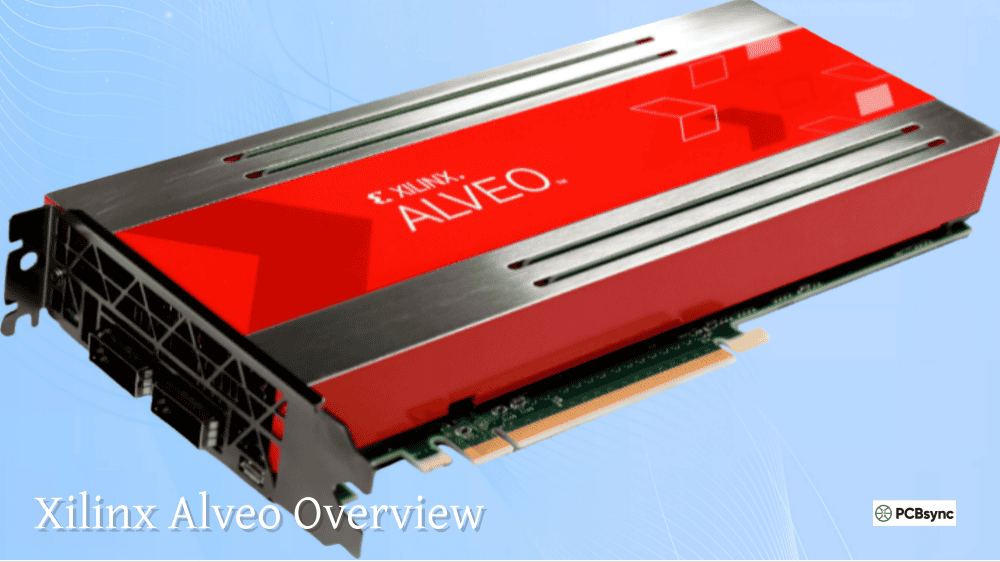
If you’ve been researching FPGA accelerator cards for your data center, you’ve probably come across the Xilinx Alveo U200 and U250. Having worked with both cards on several deployment projects, I can tell you the choice between them isn’t always obvious. Both are built on the same 16nm UltraScale+ architecture and share the same form factor, but the differences in their logic resources and performance characteristics can significantly impact your workload efficiency.
In this guide, I’ll break down the technical specifications, real-world performance differences, and practical considerations that should drive your decision between the Xilinx Alveo U200 and Xilinx U200’s bigger sibling, the U250.
The Alveo accelerator card family was introduced by Xilinx (now part of AMD) in October 2018 at the Xilinx Developer Forum. These cards were designed specifically for data center deployment, targeting workloads that traditional CPUs struggle to handle efficiently. Both the Xilinx Alveo U200 and U250 use PCIe Gen3 x16 interfaces and feature dual QSFP28 ports for 100Gbps networking capabilities.
What makes the Alveo series stand out from traditional FPGA development boards is the deployment shell architecture. This pre-configured static region handles all the PCIe communication, memory controllers, and board management, leaving you with a clean “dynamic region” where you can deploy your accelerated kernels without worrying about low-level infrastructure.
Xilinx Alveo U200 vs U250 Technical Specifications
Here’s where the rubber meets the road. The fundamental difference between these two cards comes down to the FPGA silicon inside. The Xilinx U200 uses the XCU200 FPGA with three Super Logic Regions (SLRs), while the U250 packs the XCU250 with four SLRs.
Performance Benchmarks: Where the U250 Pulls Ahead
The additional logic resources in the U250 translate to measurable performance gains in compute-intensive applications. Based on published benchmarks and my own testing experience, here’s what you can expect.
Machine Learning Inference Performance
Metric
U200 Performance
U250 Performance
Peak INT8 TOPS
18.6
33.3
GoogLeNet v1 Throughput
~2,400 images/s
~4,100 images/s
ResNet-50 Throughput
Baseline
~50% higher
The U250’s additional DSP slices (nearly double the U200) make a substantial difference when you’re deploying neural network inference engines. Those extra 5,500+ DSPs directly translate to more parallel MAC operations, which is exactly what you need for CNN layers.
Video Transcoding Capabilities
For video processing workloads, both cards can handle multiple 4K streams simultaneously. However, the U250’s larger logic fabric allows for more complex pipelines or higher stream counts. In practice, I’ve seen the U250 handle roughly 50% more concurrent transcoding operations than the U200 at equivalent quality settings.
Database and Analytics Acceleration
Both cards can deliver up to 90x performance improvements over CPUs for database search and analytics workloads (as demonstrated with RYFT Elasticsearch benchmarks). The U250’s advantage here comes from its ability to implement larger search indices in on-chip memory, reducing DDR4 access latency.
When to Choose the Xilinx Alveo U200
The Xilinx Alveo U200 isn’t just a “lesser” version of the U250. There are legitimate reasons to choose it over its larger sibling.
Budget-Conscious Deployments
The U200 typically costs 30-40% less than the U250. If your workload fits within the U200’s resource envelope, you’re spending money on silicon you won’t use by going with the U250. I’ve seen U200 cards available in the $2,000-$4,000 range on the secondary market, while U250s command $4,500-$6,500.
Lower Complexity Designs
If your accelerated kernel fits comfortably within three SLRs, you’ll actually see simpler timing closure and potentially better clock frequencies on the U200. Crossing SLR boundaries introduces additional routing delays, and the U250’s four-SLR design means more potential for these crossings in larger designs.
Thermal Constraints
While both cards share the same 225W TDP, the U200 often runs slightly cooler in practice because it has less active silicon. In dense server deployments where thermal headroom is precious, this can matter.
Ideal U200 Use Cases
The Xilinx U200 works excellently for: network packet processing and firewall acceleration, moderate-scale video transcoding (up to 8-10 concurrent 1080p streams), financial tick-to-trade latency optimization, and genomics sequence alignment with smaller reference databases.
The U250 justifies its premium when your workload genuinely needs the extra resources.
Large Neural Network Deployments
If you’re deploying models like ResNet-152, VGG-19, or transformer-based architectures, the U250’s additional DSP slices and memory bandwidth will show real throughput improvements. The extra on-chip SRAM (54 MB vs 35 MB) also helps when you need to cache weight parameters closer to the compute units.
Multi-Tenant Acceleration
When a single card needs to serve multiple independent acceleration workloads, the U250’s four SLRs can be partitioned more flexibly. You could theoretically run four independent kernels, each in its own SLR, whereas the U200 limits you to three.
Future-Proofing
If your workload complexity is growing and you expect to need more resources within the card’s deployment lifecycle (typically 3-5 years), starting with the U250 saves you from a hardware refresh.
Ideal U250 Use Cases
The Xilinx U250 excels at: high-throughput ML inference at scale, real-time 4K/8K video processing pipelines, large-scale database acceleration with complex query patterns, and computational storage with encryption/compression.
Software Development Environment
Both cards share the same software stack, which simplifies the development decision. You’ll use the Vitis unified software platform for high-level synthesis development or Vivado for traditional RTL flows.
Required Software Components
The development environment includes: Xilinx Runtime (XRT) for host-FPGA communication, Vitis or Vivado for design development, deployment target platforms specific to each card, and Vitis AI for machine learning workloads.
ML Framework Support
Both cards support TensorFlow, PyTorch, and Caffe through the Vitis AI toolchain. The DPUCADX8G DPU (Deep Processing Unit) overlay works on both U200 and U250, though the U250 can run larger or multiple DPU instances.
Installation Considerations for PCB Engineers
From a hardware integration perspective, both cards have identical installation requirements. The key considerations include: ensuring your server has an x16 PCIe Gen3 slot (x8 electrical will work but reduces bandwidth), verifying your chassis has the 150W AUX power connector available, and ensuring adequate airflow for the passive-cooled variant.
For passive cards in rack servers, you’ll need approximately 300 LFM (linear feet per minute) of airflow through the card slot at sea level. Active-cooled variants are recommended for workstations or servers with inadequate airflow.
Server Compatibility
Both cards have been validated on servers from Dell EMC, HPE, Fujitsu, IBM, and Supermicro. If you’re using a non-validated server, pay close attention to PCIe slot power delivery capabilities. Some older servers limit auxiliary power per slot below the 150W these cards require.
Cost Analysis and ROI Considerations
When evaluating total cost of ownership, consider more than just the card purchase price. The U250’s higher compute density can actually result in lower cost-per-inference or cost-per-transaction when your workload is bottlenecked by FPGA resources rather than memory or I/O.
For workloads that fit comfortably on the U200, forcing a U250 deployment wastes capital. But for resource-hungry applications, the U250’s roughly 50% higher logic resources for a 30-40% price premium makes it the more economical choice per LUT.
Important Note on Product Status
AMD now recommends the Alveo V80 compute accelerator card for new designs. Both the U200 and U250 remain actively supported for current users, but if you’re starting a greenfield project, it’s worth evaluating the newer V80 alongside these established options.
The Xilinx/AMD Community Forums have active Alveo-specific sections where engineers share deployment experiences and troubleshooting tips. The Alveo Debug Guide on GitHub is particularly useful for installation issues.
FAQs About Xilinx Alveo U200 and U250
Can I migrate my design from U200 to U250 or vice versa?
Yes, the Vitis and Vivado toolchains support targeting both platforms from the same source code. However, you’ll need to recompile your kernels for the target platform since the SLR count and resource mapping differ. Designs optimized for U200’s three SLRs may need restructuring to take full advantage of U250’s four SLRs.
What operating systems support the Xilinx Alveo U200 and U250?
Both cards officially support Red Hat Enterprise Linux 7.x/8.x, CentOS 7.x/8.x, and Ubuntu 18.04/20.04 LTS. Windows support is limited to embedded development flows only. The acceleration flow (Vitis with data center cards) requires a Linux environment.
How do the U200 and U250 compare to GPUs for machine learning?
FPGAs like the Alveo cards excel at low-latency, deterministic inference with lower batch sizes. GPUs typically win on raw throughput when batching is acceptable. The Alveo U250 demonstrates 3x lower latency than NVIDIA P4 on speech-to-text workloads, while the P4 may achieve higher peak throughput with large batches.
Do I need FPGA development experience to use Alveo cards?
Not necessarily. For deployment of pre-built applications from the Alveo ecosystem partners (video codecs, database accelerators, ML inference), you can operate at the application level. Custom kernel development does require understanding of parallel hardware design, whether through HLS (C/C++) or traditional RTL.
What cooling solution should I choose between passive and active?
Choose passive cooling for rack-mounted servers with front-to-back airflow. The passive version is three-quarter length and fits more server configurations. Select active cooling only for workstations or servers without adequate chassis airflow. Active versions are full-length and include an onboard fan.
Making Your Decision
After working with both cards extensively, my recommendation comes down to this: measure your workload’s resource requirements before purchasing. If you have an existing Vitis/Vivado design, compile it for both targets and check the utilization reports. If you’re starting fresh, prototype on the U200 first. Its lower cost makes it a reasonable development investment, and you can always scale to the U250 for production if needed.
The Xilinx Alveo U200 delivers excellent value for medium-scale acceleration needs, while the U250 is the right choice when you need maximum compute density in a single card slot. Both remain capable platforms despite their 2018 launch, and the mature software ecosystem means you’ll spend less time fighting tools and more time deploying solutions.
———————————————————————————————————————-
This comparison is based on specifications available as of 2024. Check AMD’s official Alveo product pages for the most current information and software releases.
Inquire: Call 0086-755-23203480, or reach out via the form below/your sales contact to discuss our design, manufacturing, and assembly capabilities.
Quote: Email your PCB files to Sales@pcbsync.com (Preferred for large files) or submit online. We will contact you promptly. Please ensure your email is correct.
Notes: For PCB fabrication, we require PCB design file in Gerber RS-274X format (most preferred), *.PCB/DDB (Protel, inform your program version) format or *.BRD (Eagle) format. For PCB assembly, we require PCB design file in above mentioned format, drilling file and BOM. Click to download BOM template To avoid file missing, please include all files into one folder and compress it into .zip or .rar format.