Inquire: Call 0086-755-23203480, or reach out via the form below/your sales contact to discuss our design, manufacturing, and assembly capabilities.
Quote: Email your PCB files to Sales@pcbsync.com (Preferred for large files) or submit online. We will contact you promptly. Please ensure your email is correct.
Notes: For PCB fabrication, we require PCB design file in Gerber RS-274X format (most preferred), *.PCB/DDB (Protel, inform your program version) format or *.BRD (Eagle) format. For PCB assembly, we require PCB design file in above mentioned format, drilling file and BOM. Click to download BOM template To avoid file missing, please include all files into one folder and compress it into .zip or .rar format.
ZCU208 and ZCU216: High-Performance RF Development Platforms
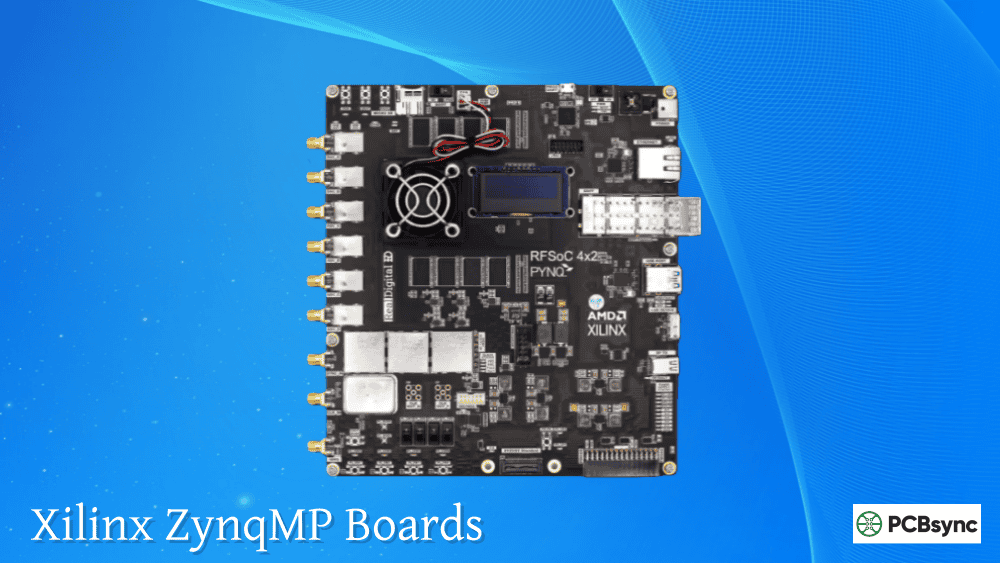
When AMD released the RFSoC Gen 3 evaluation boards, engineers finally had access to development platforms capable of addressing the most demanding RF applications. Having worked with both the ZCU208 and ZCU216, I can confirm these boards represent the cutting edge of integrated RF system development.
This guide compares the Xilinx ZCU208 and Xilinx ZCU216 platforms, helping engineers select the right board for 5G massive MIMO, phased array radar, satellite communications, and other high-performance RF applications.
Both the ZCU208 and ZCU216 feature RFSoC Gen 3 devices—a significant upgrade from the first-generation ZCU111. Gen 3 delivers higher sample rates, improved resolution, and enhanced digital signal processing capabilities.
Gen 3 vs Gen 1 Comparison
Parameter
Gen 1 (ZCU111)
Gen 3 (ZCU208/ZCU216)
ADC Resolution
12-bit
14-bit
DAC Resolution
14-bit
14-bit
Max ADC Rate
4.096 GSPS
5.0 GSPS
Max DAC Rate
6.554 GSPS
10.0 GSPS
Package
Standard
Lidless (improved thermal)
Frequency Coverage
Sub-4 GHz
Full sub-6 GHz + mmWave IF
The lidless package on Gen 3 devices provides improved thermal dissipation—critical when running multiple high-speed converters simultaneously.
ZCU208 Specifications and Features
The ZCU208 features the XCZU48DR RFSoC, optimized for applications requiring maximum instantaneous bandwidth per channel.
Xilinx ZCU208 RF Data Converter Specifications
Parameter
Specification
Device
XCZU48DR-2FSVG1517E
RF-ADC Channels
8
RF-ADC Resolution
14-bit
RF-ADC Sample Rate
5.0 GSPS
RF-DAC Channels
8
RF-DAC Resolution
14-bit
RF-DAC Sample Rate
10.0 GSPS*
SD-FEC Cores
8
*Interpolation modes enable effective rates up to 10 GSPS.
ZCU208 Processing Architecture
Component
Specification
Application Processor
Quad-core ARM Cortex-A53
Real-Time Processor
Dual-core ARM Cortex-R5F
Logic Cells
425K
DSP Slices
4,272
Block RAM
38 Mb
UltraRAM
22 Mb
ZCU208 Memory Configuration
Interface
Capacity
Configuration
PS DDR4 SODIMM
4 GB
64-bit @ 2400 MT/s
PL DDR4 C0
2 GB
32-bit @ 2666 MT/s
PL DDR4 C1
4 GB
32-bit @ 2666 MT/s
The Xilinx ZCU208 provides dual PL DDR4 interfaces, enabling independent memory banks for ADC capture and DAC playback operations.
ZCU216 Specifications and Features
The ZCU216 features the XCZU49DR RFSoC, providing double the channel count for massive MIMO and large-scale phased array applications.
Xilinx ZCU216 RF Data Converter Specifications
Parameter
Specification
Device
XCZU49DR-2FFVF1760
RF-ADC Channels
16
RF-ADC Resolution
14-bit
RF-ADC Sample Rate
2.5 GSPS
RF-DAC Channels
16
RF-DAC Resolution
14-bit
RF-DAC Sample Rate
10.0 GSPS*
SD-FEC Cores
8
ZCU216 Processing Architecture
Component
Specification
Application Processor
Quad-core ARM Cortex-A53
Real-Time Processor
Dual-core ARM Cortex-R5F
Logic Cells
930K
DSP Slices
4,272
Block RAM
34.6 Mb
UltraRAM
22.5 Mb
The Xilinx ZCU216 provides significantly more logic cells than the ZCU208, enabling more complex digital signal processing implementations.
What is the main difference between ZCU208 and ZCU216?
The ZCU208 provides 8 channels with 5.0 GSPS ADCs for maximum bandwidth per channel, while the ZCU216 provides 16 channels with 2.5 GSPS ADCs for maximum channel count. Both deliver the same 40 GSPS aggregate ADC bandwidth, distributed differently. Choose Xilinx ZCU208 for wideband applications; choose Xilinx ZCU216 for massive MIMO and large phased arrays.
Can the ZCU208 and ZCU216 support 5G NR applications?
Yes, both platforms fully support 5G NR sub-6 GHz bands. The ZCU216 is optimal for 16T16R configurations common in 5G massive MIMO base stations. The ZCU208 excels at mmWave IF processing and wideband backhaul. Both include SD-FEC cores supporting LDPC coding required by 5G NR.
What is the XM655 breakout card used for?
The XM655 provides direct SMA access to all RF-ADC and RF-DAC channels, enabling connection to external test equipment like spectrum analyzers and signal generators. It also supports multi-tile synchronization (MTS) testing, essential for coherent multi-channel operation in phased array and MIMO applications.
Do the ZCU208 and ZCU216 require special power supplies?
Both boards require 12V DC power via a 6-pin mini-fit connector (J50). Critical warning: Do NOT use PC ATX 6-pin connectors—they have different pinouts and will damage the board. The included power supply provides the correct configuration.
Which platform is better for phased array radar development?
For radar applications requiring maximum instantaneous bandwidth (wideband waveforms, high range resolution), the ZCU208 with 5.0 GSPS ADCs is preferred. For large phased arrays with 16+ elements where channel count matters more than per-channel bandwidth, the ZCU216 provides better scalability. Both support multi-tile synchronization for coherent operation.
Making the Right Choice
The ZCU208 and ZCU216 represent complementary approaches to RF system development. The Xilinx ZCU208 maximizes bandwidth per channel for applications where signal bandwidth dominates design requirements. The Xilinx ZCU216 maximizes channel count for applications where antenna element count or spatial diversity drives the architecture.
Development Workflow Considerations
When planning RF system development on either platform, consider these practical factors:
Multi-Tile Synchronization (MTS): Both boards support MTS for coherent multi-channel operation. The ZCU216 with 16 channels makes MTS configuration more complex but also more powerful for beamforming applications. Plan adequate time for MTS characterization.
Clock Distribution: The CLK104 add-on card provides low-jitter clocking essential for high-performance RF applications. External reference clocks up to 10 GHz are supported, enabling synchronization with external systems.
Thermal Management: Gen 3 lidless packages improve thermal dissipation, but sustained high-throughput operation still generates significant heat. Ensure adequate airflow in your test setup.
Software Ecosystem: Both platforms use identical RF Data Converter IP and evaluation tools. The rftool Linux application and Windows GUI provide immediate access to converter configuration without custom development.
Both platforms share the same add-on card ecosystem, development tools, and software infrastructure—meaning skills developed on one platform transfer directly to the other. For organizations developing both wideband and multi-channel systems, having access to both boards provides maximum flexibility for addressing diverse RF challenges.
Inquire: Call 0086-755-23203480, or reach out via the form below/your sales contact to discuss our design, manufacturing, and assembly capabilities.
Quote: Email your PCB files to Sales@pcbsync.com (Preferred for large files) or submit online. We will contact you promptly. Please ensure your email is correct.
Notes: For PCB fabrication, we require PCB design file in Gerber RS-274X format (most preferred), *.PCB/DDB (Protel, inform your program version) format or *.BRD (Eagle) format. For PCB assembly, we require PCB design file in above mentioned format, drilling file and BOM. Click to download BOM template To avoid file missing, please include all files into one folder and compress it into .zip or .rar format.