Inquire: Call 0086-755-23203480, or reach out via the form below/your sales contact to discuss our design, manufacturing, and assembly capabilities.
Quote: Email your PCB files to Sales@pcbsync.com (Preferred for large files) or submit online. We will contact you promptly. Please ensure your email is correct.
Notes: For PCB fabrication, we require PCB design file in Gerber RS-274X format (most preferred), *.PCB/DDB (Protel, inform your program version) format or *.BRD (Eagle) format. For PCB assembly, we require PCB design file in above mentioned format, drilling file and BOM. Click to download BOM template To avoid file missing, please include all files into one folder and compress it into .zip or .rar format.
Xilinx KC705 Evaluation Kit: Unboxing, Setup & First Project
The Xilinx KC705 evaluation kit has been my go-to development platform for prototyping high-speed transceiver designs since it first landed on my bench years ago. Whether you’re evaluating the Kintex-7 architecture for a production design or learning FPGA development, the KC705 delivers serious capability in a well-documented package. This guide walks through everything from initial unboxing to running your first custom project—covering the practical details that official documentation often glosses over.
What is the Xilinx Kintex-7 FPGA KC705 Evaluation Kit?
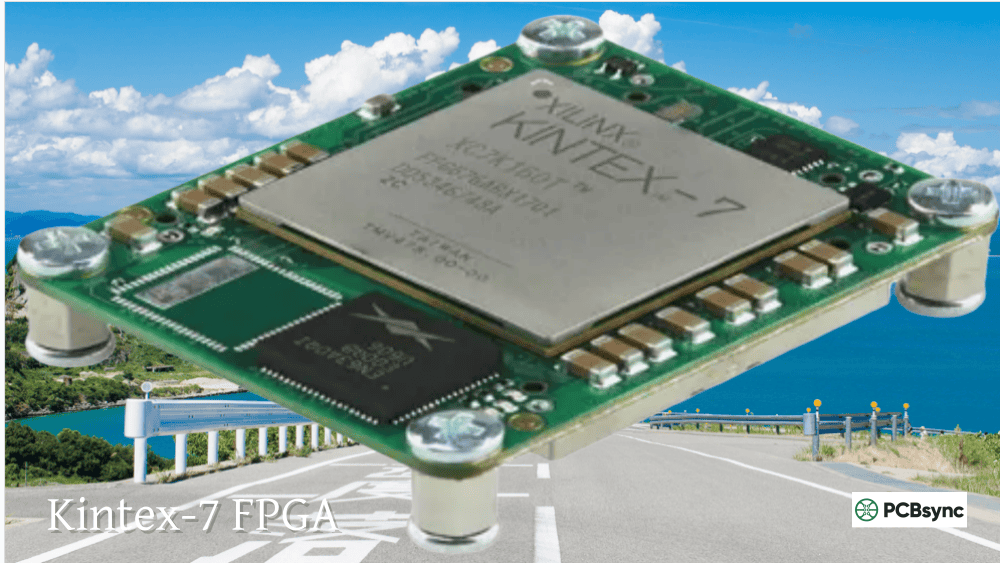
The EK-K7-KC705-G (the official part number you’ll need for purchasing) is AMD/Xilinx’s flagship development platform for the Kintex-7 FPGA family. Built around the XC7K325T-2FFG900C FPGA, this board provides comprehensive access to the device’s capabilities including high-speed transceivers, DDR3 memory interfaces, PCIe connectivity, and extensive I/O expansion through FMC connectors.
What separates the KC705 from budget-friendly boards is the complete ecosystem: pre-verified reference designs, board design files (schematics, layout, BOM), and ready-to-run demonstrations that actually work out of the box. For teams evaluating Kintex-7 for production hardware, having known-good reference implementations accelerates the learning curve dramatically.
KC705 Board Specifications
Feature
Specification
FPGA Device
XC7K325T-2FFG900C
Logic Cells
326,080
DSP Slices
840
Block RAM
16,020 Kb
GTX Transceivers
16 (up to 12.5 Gb/s)
DDR3 Memory
1GB SODIMM
Configuration Flash
128MB BPI + 16MB Quad SPI
PCIe Interface
Gen2 x8 edge connector
Ethernet
Tri-mode 10/100/1000 (Marvell 88E1111)
Video Output
HDMI
FMC Connectors
1x HPC (partial), 1x LPC
High-Speed I/O
SFP+ connector, SMA pairs
Board Dimensions
175mm × 265mm
KC705 Kit Contents: What’s in the Box
When your EK-K7-KC705-G arrives, verify all components before powering anything up. Missing cables or cards can delay your evaluation by weeks while waiting for replacements.
Complete KC705 Kit Contents
Item
Description
KC705 Board
Main evaluation board with XC7K325T FPGA
AMS101 Card
Analog Mixed Signal evaluation daughter card
Power Supply
12V universal adapter with regional plugs
USB Cable
Type-A to Micro-B for JTAG/UART
Ethernet Cable
Cat5e patch cable
HDMI Cable
For video output demonstrations
Documentation
Getting started guide, quick reference card
License Voucher
Device-locked Vivado license for XC7K325T
The included Vivado license voucher is particularly valuable—it provides full access to Vivado Design Suite features for the XC7K325T device, saving significant cost compared to purchasing a standalone license.
Xilinx KC705 Board Features and Connectors
Understanding the KC705 board layout before powering up prevents confusion and potential damage from incorrect connections. The board packs considerable functionality into a standard ATX form factor.
Key KC705 Interface Locations
Connector/Component
Location
Purpose
J46 (Power)
Bottom left
12V DC input
SW15
Near power jack
Main power switch
J11/J12
Top edge
User SMA clock inputs
P5
Right edge
SFP+ cage for 10G optical
P3
Right edge
RJ-45 Gigabit Ethernet
J43
Bottom edge
PCIe x8 edge connector
J22
Center left
FMC HPC connector
J30
Center left
FMC LPC connector
J26/J27
Bottom left
USB JTAG/UART
SW13
Near FPGA
Configuration mode DIP switch
Configuration Mode Settings (SW13)
The 5-position DIP switch SW13 controls how the FPGA loads its bitstream. Getting this wrong is the most common reason for “my board won’t program” issues.
Config Mode
SW13 Position (1-2-3-4-5)
Use Case
JTAG
X-X-1-0-1
Programming via USB/Vivado
Master BPI
A25-A24-0-1-0
Boot from linear flash
Quad SPI
X-X-0-0-1
Boot from SPI flash
Positions 1 and 2 select which of four bitstreams loads from BPI flash (address bits A25/A24). For initial setup and development, use JTAG mode (SW13 positions 3=ON, 4=OFF, 5=ON).
KC705 Initial Hardware Setup
Before connecting power, complete these preparation steps to ensure safe operation and successful communication with your development PC.
Pre-Power Checklist
Start by verifying jumper settings. The KC705 ships with default settings appropriate for most evaluations, but confirm these critical jumpers:
Jumper
Default Setting
Function
J46
12V input
Power source selection
J70
1-2
VADJ voltage (1.8V default)
J49/J50
Installed
FMC VADJ enable
Connect the USB cable (J26/J27) to your PC before applying power. This provides both JTAG programming access and USB-UART communication for serial console output. Windows will detect a Silicon Labs CP2103 USB-UART bridge—install drivers from Silicon Labs if not automatically recognized.
Power-On Sequence
With SW13 set for JTAG mode and USB connected:
Slide SW15 to ON position
Observe the power LEDs illuminate (multiple voltage rails)
Watch for the DONE LED (DS6) to remain off (no bitstream loaded yet)
Verify USB enumeration completes in Device Manager
The board draws approximately 2-3A at 12V with no design loaded, increasing to 4-6A depending on FPGA utilization. Use only the included power supply or an equivalent rated for at least 72W continuous.
The Xilinx KC705 requires two driver sets for full functionality: JTAG programming (handled by Vivado/cable drivers) and USB-UART communication.
USB-UART Driver Installation
The Silicon Labs CP210x driver enables serial console communication:
Download CP210x Universal Windows Driver from Silicon Labs
Extract and run the installer
Connect KC705 via USB
Verify COM port assignment in Device Manager (Ports → Silicon Labs CP210x)
Note the COM port number for terminal software configuration
JTAG Driver Installation
Vivado installs JTAG drivers automatically, but manual installation may be required:
Navigate to C:\Xilinx\Vivado\<version>\data\xicom\cable_drivers\nt64
Run install_drivers.cmd as Administrator
Reconnect USB cable
Verify “Xilinx USB Cable” appears in Device Manager
Running the Built-In Self Test (BIST) on KC705
The KC705 ships with a comprehensive BIST stored in BPI flash. This validates board functionality before investing time in custom development.
BIST Hardware Setup
Set SW13 for Master BPI mode (positions 3=OFF, 4=ON, 5=OFF)
Set SW13 positions 1 and 2 both to OFF (selects first bitstream)
Open terminal software (TeraTerm, PuTTY) at 115200 baud, 8N1
Power on the board
Watch the FPGA DONE LED illuminate as bitstream loads
Observe BIST menu on serial terminal
BIST Test Menu Options
Test
Description
DDR3
Memory read/write verification
IIC
I2C bus device enumeration
Flash
BPI and SPI flash ID verification
GPIO
LED and switch functionality
Ethernet
PHY initialization and loopback
XADC
Voltage and temperature monitoring
All tests should pass on a functioning board. Failures indicate shipping damage, ESD events, or configuration issues requiring support contact.
Setting Up Vivado for KC705 Development
While the KC705 includes an ISE license voucher historically, modern development uses Vivado Design Suite exclusively. The XC7K325T requires a paid license—the kit’s device-locked voucher covers this.
Vivado Installation Steps
Download Vivado from AMD’s website (Vivado ML Standard or Enterprise)
Run installer, select “Vivado” product (not Vitis unless needed)
Choose device families: ensure “Kintex-7” is selected
Complete installation (allow 2-4 hours, requires 50GB+ disk space)
Redeem license voucher through AMD licensing portal
Install license file via Vivado License Manager
Creating a KC705 Project in Vivado
Launch Vivado and create your first KC705 project:
File → Project → New
Name project (e.g., “kc705_first_project”)
Select RTL Project, check “Do not specify sources”
Click Boards tab, search “KC705”
Select “Kintex-7 FPGA KC705 Evaluation Platform”
Finish wizard
Selecting the board (rather than just the part) pre-populates constraint files and enables board-aware IP configuration in the Block Design flow.
Your First KC705 Project: LED Blinker
The “Hello World” of FPGA development is blinking an LED. This validates your entire toolchain from RTL through bitstream download.
AMD provides extensive reference designs demonstrating KC705 capabilities. These serve as both learning resources and starting points for production development.
Available Reference Designs
Design
Description
Document
Base TRD
MicroBlaze system with BIST
UG882
Embedded TRD
Video demonstration system
UG913
PCIe DMA
High-performance DMA over PCIe
UG920
10G Ethernet
SFP+ MAC/PHY reference
Application Note
DDR3 MIG
Memory interface example
UG586
Download designs from the KC705 product page Documentation tab or the AMD Adaptive Computing Wiki.
The EK-K7-KC705-G includes a device-locked Vivado license voucher valid for the XC7K325T-2FFG900C. This covers synthesis, implementation, and all design features for this specific device. The license does not expire but only works with the KC705’s FPGA. For multi-device development or different Kintex-7 variants, a separate Vivado license is required.
Can I use ISE instead of Vivado with the KC705?
While the XC7K325T is technically supported in ISE 14.7, AMD recommends Vivado for all 7 Series development. Vivado offers significantly better timing closure, faster compile times, and continued IP support. The kit originally shipped with ISE licenses, but modern kits include Vivado vouchers. Use Vivado unless you have specific legacy requirements.
Why won’t my KC705 program via JTAG?
The most common causes are incorrect SW13 settings (must be in JTAG mode: 3=ON, 4=OFF, 5=ON), missing cable drivers, or USB hub issues. Connect directly to a PC USB port rather than through a hub. Verify the JTAG cable appears in Vivado Hardware Manager. If “No hardware targets” appears, reinstall cable drivers from the Vivado installation directory.
How do I restore the factory BIST after overwriting flash?
Download the KC705 BIST recovery files from the product page. Use Vivado’s Hardware Manager to program the .mcs file to BPI flash. Set SW13 for Master BPI mode and power cycle. The original factory demonstration should boot. Detailed recovery instructions are in UG883.
Is the KC705 still recommended for new designs in 2024?
Yes, the KC705 remains relevant for Kintex-7 development and is supported through AMD’s 2040 device lifecycle commitment. For applications requiring higher performance, consider the KCU105 (Kintex UltraScale) or KCU116 (Kintex UltraScale+). The KC705’s extensive documentation and proven reference designs make it valuable for learning FPGA development regardless of target device.
KC705 Troubleshooting Common Issues
Even with careful setup, you may encounter issues during KC705 development. These troubleshooting tips address the problems I’ve seen most frequently.
Power-Related Problems
If the power LED doesn’t illuminate or the board behaves erratically, verify the 12V supply delivers adequate current. Some generic laptop adapters share the same barrel connector but can’t source the 4-6A the KC705 demands under load. The included adapter is rated appropriately—use it or an equivalent 72W+ supply. Check that no FMC cards are installed that might have shorts or excessive current draw.
Programming Failures
When Vivado shows “No hardware targets found,” the issue is usually driver-related. Reinstall cable drivers, try a different USB port (avoid USB 3.0 ports initially—some have compatibility issues), and ensure no other Xilinx tools are running simultaneously. If programming succeeds but the design doesn’t run, verify your constraints file matches the actual KC705 pinout—pin assignments from other boards won’t work.
DDR3 Memory Issues
The MIG (Memory Interface Generator) IP requires specific timing constraints and board parameters. When creating MIG instances for KC705, select the board preset rather than manually entering parameters. The preset includes the correct SODIMM configuration, timing, and termination values. Custom configurations require careful attention to UG586 guidelines.
Expanding KC705 Capability with FMC Cards
The KC705’s FMC connectors enable significant capability expansion through daughter cards. The VITA-57 standard defines pinouts for both high-pin-count (HPC) and low-pin-count (LPC) configurations.
Popular FMC Expansion Cards
Card
Function
Connector
FMC-ADC-1000
Dual 1GSPS ADC
HPC
FMC-DAC-1600
Dual 1.6GSPS DAC
HPC
FMC-HDMI
HDMI input capture
LPC
FMC-XM105
Debug/connectivity
LPC
FMC-SDI
3G-SDI video I/O
HPC
The HPC connector (J22) provides 4 GTX transceiver lanes plus extensive LVDS I/O, while the LPC connector (J30) offers 1 GTX lane and reduced I/O count. Note that the KC705’s HPC connector is partially populated—not all HPC-spec pins are present.
Conclusion
The Xilinx KC705 evaluation kit provides a comprehensive platform for Kintex-7 FPGA development, from initial learning through production prototyping. The combination of high-speed transceivers, DDR3 memory, and extensive connectivity options in a well-documented package accelerates development timelines significantly.
Start with the BIST to verify board functionality, then work through the LED blinker project to validate your toolchain. From there, explore the reference designs matching your application—whether that’s PCIe DMA, 10G Ethernet, or embedded MicroBlaze systems. The investment in learning the KC705 platform pays dividends across the entire Kintex-7 and broader 7 Series FPGA family.
For teams evaluating Kintex-7 for production, the KC705 board files (schematics, layout, BOM) provide a proven starting point for custom carrier board development. The XC7K325T’s balance of logic density, DSP capability, and transceiver performance addresses demanding applications from wireless infrastructure to video processing to medical imaging.
Inquire: Call 0086-755-23203480, or reach out via the form below/your sales contact to discuss our design, manufacturing, and assembly capabilities.
Quote: Email your PCB files to Sales@pcbsync.com (Preferred for large files) or submit online. We will contact you promptly. Please ensure your email is correct.
Notes: For PCB fabrication, we require PCB design file in Gerber RS-274X format (most preferred), *.PCB/DDB (Protel, inform your program version) format or *.BRD (Eagle) format. For PCB assembly, we require PCB design file in above mentioned format, drilling file and BOM. Click to download BOM template To avoid file missing, please include all files into one folder and compress it into .zip or .rar format.