Inquire: Call 0086-755-23203480, or reach out via the form below/your sales contact to discuss our design, manufacturing, and assembly capabilities.
Quote: Email your PCB files to Sales@pcbsync.com (Preferred for large files) or submit online. We will contact you promptly. Please ensure your email is correct.
Notes: For PCB fabrication, we require PCB design file in Gerber RS-274X format (most preferred), *.PCB/DDB (Protel, inform your program version) format or *.BRD (Eagle) format. For PCB assembly, we require PCB design file in above mentioned format, drilling file and BOM. Click to download BOM template To avoid file missing, please include all files into one folder and compress it into .zip or .rar format.
If you’ve been searching for an affordable entry point into FPGA-based compute acceleration, the Xilinx C1100 deserves serious consideration. Originally marketed as the Varium C1100 and targeted at blockchain applications, this card has found a second life among engineers and researchers looking for HBM-equipped FPGA hardware at reasonable prices.
The Xilinx FPGA C1100 is built on the UltraScale+ architecture, featuring 8GB of High Bandwidth Memory and dual QSFP28 networking ports. What makes it particularly interesting right now is the secondary market—with Ethereum mining no longer viable, these cards are available at significant discounts from their original MSRP.
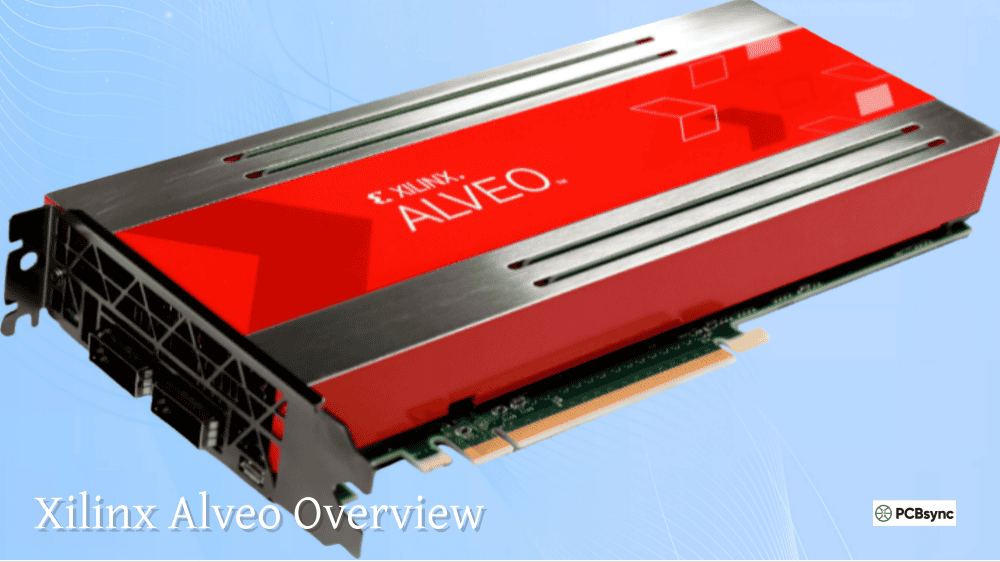
For those of us who’ve worked with FPGA accelerator cards for years, the C1100 represents an unusual opportunity. You’re getting essentially the same silicon found in the more expensive Alveo U55N, but packaged for a different market segment. The card uses the XCU55N FPGA (same as the U55N), which means you can leverage much of the existing development infrastructure.
The Xilinx C1100 is built around the XCU55N FPGA, which sits in a package designated FSVH2892. This is a significant device with resources suitable for serious compute workloads. When you’re creating designs in Vivado, you’ll select XCU55N-FSVH2892-2L-E as your target part.
From a PCB layout perspective, the card follows a clean single-slot, full-height, half-length (FHHL) form factor. The passive cooling design means you’ll need adequate server airflow—this isn’t a card you want running in a poorly ventilated desktop chassis. I’ve seen temperatures spike quickly when airflow is insufficient.
Xilinx C1100 Technical Specifications
Specification
Xilinx C1100 Value
FPGA Device
Virtex UltraScale+ XCU55N
Part Number
V-C1100-P00G-PQ-G
HBM2 Memory
8 GB
Memory Bandwidth
Up to 460 GB/s
Network Interface
2x QSFP28 (200 Gbps total)
Network Configurations
8x25GbE, 2x100GbE, 2x40GbE
PCIe Interface
Gen3 x16 or Dual Gen4 x8
Form Factor
Single Slot, Full Height, Half Length
Maximum Power
75W (Passive Cooling)
Programming Interface
Micro-USB (JTAG/UART)
Warranty
1 Year (standard operation)
High Bandwidth Memory (HBM2) Configuration
The 8GB HBM2 on the Xilinx FPGA C1100 provides the memory bandwidth necessary for compute-intensive applications. While it’s half the capacity of the U55C’s 16GB, the bandwidth characteristics remain impressive—up to 460 GB/s theoretical maximum.
For memory-bound algorithms like those used in cryptocurrency mining, scientific computing, and data analytics, this HBM bandwidth is what makes the C1100 competitive. You’re not fighting DDR4 refresh cycles or dealing with rank switching latency—HBM just delivers consistent bandwidth.
200 Gbps Networking with Dual QSFP28 Ports
The dual QSFP28 cages on the Xilinx C1100 support multiple configurations: 8x25GbE, 2x100GbE, or 2x40GbE. Each port comes with its own set of 8 MAC addresses (total of 8 per card), which you can access via the Card Management Solution IP or read from the physical label.
This networking capability transforms the C1100 from a simple compute accelerator into something resembling a very capable SmartNIC. You can process data directly from network interfaces without involving the host CPU—critical for applications requiring line-rate packet processing.
Xilinx C1100 Price: New vs Secondary Market
Understanding the Xilinx C1100 price landscape requires looking at both official channels and the secondary market. The pricing situation has shifted dramatically since Ethereum moved to proof-of-stake, making mining unprofitable and flooding the market with used cards.
Current Xilinx C1100 Pricing Overview
Source
Price Range
Condition
Official Distributors
$2,500 – $3,500+
New, Full Warranty
eBay (Used)
$800 – $1,200
Used, No Warranty
Specialty Retailers
$1,500 – $2,500
New/Refurbished
The secondary market, particularly eBay, has become the go-to place for engineers looking to buy Xilinx C1100 cards at reasonable prices. Cards that originally sold for over $3,000 are now available for under $1,200 used. Some listings include custom cooling solutions, which is actually helpful given the card’s passive cooling design.
Applications and Use Cases for the Xilinx FPGA C1100
While AMD originally positioned the C1100 for blockchain workloads, the underlying hardware supports a much broader range of applications. The Xilinx FPGA C1100 is essentially general-purpose FPGA compute hardware with HBM and networking.
Blockchain and Cryptocurrency Applications
The card was designed for accelerating Proof of Work (PoW) algorithms and transaction validation in Proof of Stake (PoS) protocols. Xilinx demonstrated impressive results accelerating Hyperledger Fabric transaction validation compared to Intel Xeon Silver 4114 CPUs.
For Ethereum (before the merge), the C1100 achieved approximately 78 MH/s on EtHash at around 104W—competitive efficiency compared to GPUs. Other supported algorithms include CryptoNight variants used by privacy coins.
Research and Academic Applications
The affordable Xilinx C1100 price on the secondary market has made it attractive for university research labs. Use cases include:
Custom Processor Development: Projects like the EPU (Ethereum Processing Unit) demonstrate building custom 256-bit stack-based processors
Algorithm Acceleration: HBM bandwidth enables memory-intensive algorithm research
ASIC Prototyping: Validate custom silicon designs before tape-out
General Compute Acceleration
Beyond blockchain, the C1100 handles the same workloads as other Alveo-class accelerators:
Data analytics and database acceleration
Financial computing and risk analysis
Signal processing applications
Machine learning inference
Network function virtualization
Development Tools: Vivado and Vitis for the C1100
Setting Up the Development Environment
Getting started with the Xilinx C1100 requires installing the Vitis toolchain, which includes Vivado. AMD provides full end-to-end flow support for the Varium C1100 starting with Vitis 2021.2.
Key development resources:
Vitis Unified Software Platform: High-level C/C++ development without RTL expertise
Vivado Design Suite: Traditional FPGA development flow for maximum control
Xilinx Runtime (XRT): Facilitates communication between host and FPGA over PCIe
XDC Constraints File: Available from the official product page for pin mapping
Programming and Debug Access
The C1100 includes a Micro-USB maintenance port for JTAG programming and UART debug access. This connects to an FT4232H chip providing quad UART/FIFO functionality. You’ll need a Micro-USB cable (not included with the card) to access these features.
A practical tip: when setting up Linux development, check for the FTDI device with ‘lsusb | grep 0403:6011’ to confirm the connection is working.
Xilinx C1100 vs Alveo U55N vs Alveo U50 Comparison
Understanding how the Xilinx C1100 compares to other Alveo cards helps inform purchasing decisions.
Feature
C1100
Alveo U55N
Alveo U50
FPGA
XCU55N
XCU55N
XCU50
HBM2
8 GB
8 GB
8 GB
Network I/O
2x QSFP28
2x QSFP28
1x QSFP28
Max Power
75W
75W
75W
Form Factor
FHHL
HHHL Slim
HHHL
New Price
~$2,500+
~$4,100+
~$2,000+
The key insight here is that the C1100 and U55N share the same FPGA silicon. The primary differences are packaging, cooling approach, and target market positioning. For engineers comfortable with passive cooling requirements, the C1100 offers excellent value.
Thermal Management and Cooling Requirements
The Xilinx C1100 uses passive cooling, which is both a feature and a challenge. Without adequate airflow, the card will throttle or potentially sustain damage.
Practical thermal management tips:
Server Environment: The card is designed for high-airflow server chassis, not desktop PCs
Custom Cooling: Some eBay sellers include aftermarket fans (like San Ace B97) which can help in desktop deployments
Airflow Direction: Ensure consistent front-to-back airflow across the heatsink
Power Limiting: For marginal cooling situations, consider limiting power consumption in your designs
Useful Resources and Downloads for Xilinx C1100
Essential documentation and tools for working with the Xilinx FPGA C1100:
1. Is the Xilinx C1100 the same as the Alveo U55N?
The Xilinx C1100 uses the same XCU55N FPGA as the Alveo U55N, making them silicon-equivalent. The differences are in form factor (C1100 is FHHL, U55N is HHHL slim), cooling design, and market positioning. In Vivado, you target the same part: XCU55N-FSVH2892-2L-E. Many U55N development resources work with the C1100.
2. What is the current Xilinx C1100 price on the secondary market?
The Xilinx C1100 price on the secondary market (primarily eBay) ranges from $800 to $1,200 for used cards as of late 2024. This is significantly lower than the original MSRP of $2,500+ due to the end of profitable Ethereum mining. New cards from official distributors remain in the $2,500-$3,500 range with extended lead times.
3. Can I use the Xilinx C1100 in a standard desktop PC?
Technically yes, but with important caveats. The card is passively cooled and designed for high-airflow server environments. In a desktop, you’ll need to add active cooling (aftermarket fan solutions are available) and ensure adequate airflow. Many users on the secondary market sell cards with custom cooling already installed.
4. What development tools do I need for the Xilinx FPGA C1100?
You’ll need the Vitis Unified Software Platform (which includes Vivado) version 2021.2 or later for full C1100 support. Additionally, install the Xilinx Runtime (XRT) for host-FPGA communication. The XDC constraints file for pin mapping is available from the official product page. A Micro-USB cable is required for JTAG/UART access.
5. Where can I buy Xilinx C1100 cards with confidence?
For new cards with warranty, buy Xilinx C1100 from authorized distributors: DigiKey, Mouser, or AMD directly. For used cards at lower prices, eBay is the primary source—look for sellers with good ratings and clear return policies. Specialty retailers like Jabitaxe also carry these cards. Always verify the part number V-C1100-P00G-PQ-G matches your order.
Conclusion: Is the Xilinx C1100 Right for Your Project?
The Xilinx C1100 occupies an interesting position in the FPGA accelerator market. Originally designed for blockchain, it now offers excellent value for engineers seeking HBM-equipped FPGA compute at accessible prices.
If you’re looking to buy Xilinx C1100 hardware, the secondary market presents a compelling opportunity. Cards that cost $3,000+ new are available for under $1,200 used. For research, prototyping, or learning FPGA development with real HBM hardware, this price point removes significant barriers to entry.
The practical considerations—passive cooling requirements, the need for proper development tools, and understanding the silicon is shared with the U55N—are manageable for most engineers. The Xilinx FPGA C1100 delivers genuine data center-class acceleration capability at a fraction of typical costs.
For production deployments requiring warranty support and guaranteed availability, the official distribution channels remain the safer choice despite higher costs and lead times. But for development, evaluation, and research applications, the current market conditions make the C1100 one of the most accessible paths to HBM-equipped FPGA acceleration available today.
Inquire: Call 0086-755-23203480, or reach out via the form below/your sales contact to discuss our design, manufacturing, and assembly capabilities.
Quote: Email your PCB files to Sales@pcbsync.com (Preferred for large files) or submit online. We will contact you promptly. Please ensure your email is correct.
Notes: For PCB fabrication, we require PCB design file in Gerber RS-274X format (most preferred), *.PCB/DDB (Protel, inform your program version) format or *.BRD (Eagle) format. For PCB assembly, we require PCB design file in above mentioned format, drilling file and BOM. Click to download BOM template To avoid file missing, please include all files into one folder and compress it into .zip or .rar format.