Inquire: Call 0086-755-23203480, or reach out via the form below/your sales contact to discuss our design, manufacturing, and assembly capabilities.
Quote: Email your PCB files to Sales@pcbsync.com (Preferred for large files) or submit online. We will contact you promptly. Please ensure your email is correct.
Notes: For PCB fabrication, we require PCB design file in Gerber RS-274X format (most preferred), *.PCB/DDB (Protel, inform your program version) format or *.BRD (Eagle) format. For PCB assembly, we require PCB design file in above mentioned format, drilling file and BOM. Click to download BOM template To avoid file missing, please include all files into one folder and compress it into .zip or .rar format.
Xilinx XQ-Grade FPGAs: Automotive & Industrial Qualified Parts
Selecting FPGAs for harsh environment applications is never straightforward. After dealing with failed prototypes in temperature chamber tests and explaining to project managers why commercial-grade parts won’t survive under the hood of a vehicle, I’ve learned to appreciate what XQ-grade qualification actually means. This guide covers the Xilinx XQ-grade portfolio, focusing on the popular XQ7A100T, XQ7A200T, XQ7Z020, and XQ7Z045 devices that keep showing up in aerospace, defense, and industrial control designs.
The “XQ” prefix on AMD/Xilinx part numbers signifies defense-grade qualification. These aren’t just commercial parts with a different label—they undergo additional testing, use ruggedized packaging, and come with documentation that satisfies MIL-STD requirements. For engineers working on anything from missile guidance systems to industrial robots operating in foundries, understanding what separates XQ parts from their XC (commercial) and XA (automotive) counterparts is essential.
Temperature Grade Classifications
XQ-grade devices are offered in two primary temperature ranges:
Grade
Temperature Range
Typical Applications
Industrial (I)
-40°C to +100°C
Factory automation, industrial controls
Military (M)
-55°C to +125°C
Aerospace, defense, extreme environments
These are junction temperatures, not ambient. That’s an important distinction because your actual PCB operating environment will be considerably cooler than the die temperature under load. Plan your thermal management accordingly.
MIL-STD-883 Group D Qualification
XQ devices undergo rigorous qualification testing that commercial parts never see:
Test
MIL-STD-883 Method
Conditions
Thermal Shock
TM 1011
Condition B, 15 cycles
Temperature Cycling
TM 1010
Condition C, 100 cycles
Moisture Resistance
TM 1004
Per specification
Vibration (Variable Freq.)
TM 2007
Condition A minimum
Constant Acceleration
TM 2001
Condition D minimum
Salt Atmosphere
TM 1009
Condition A minimum
Physical Dimensions
TM 2016
Per specification
This qualification testing happens before production release. AMD tests 100% of all die at wafer sort and 100% of finished devices during final production testing across the full temperature range.
XQ7A100T and XQ7A200T: Artix-7Q FPGA Specifications
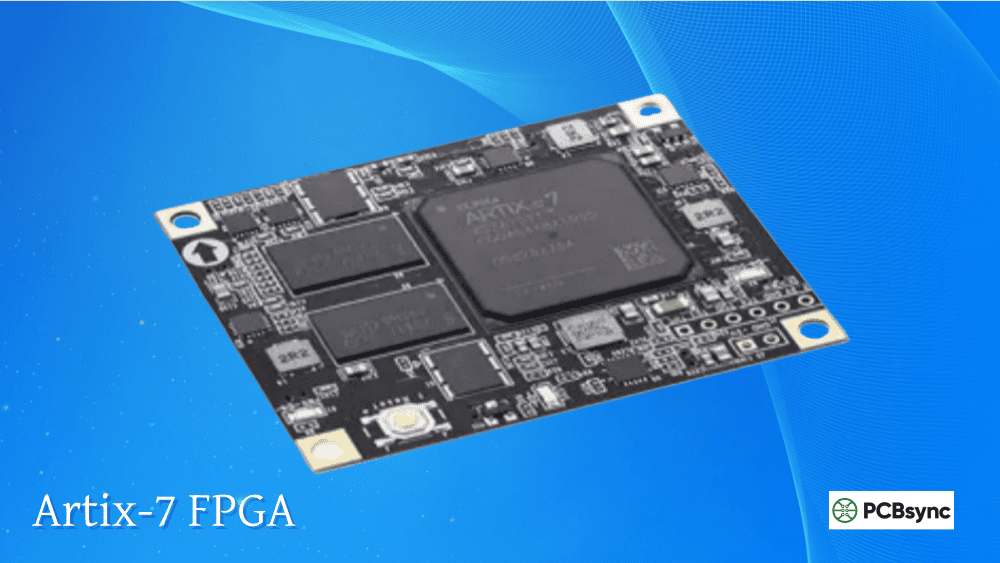
The Artix-7Q family targets applications where size, weight, and power (SWaP) optimization matters most. The XQ7A100T and XQ7A200T sit at the higher end of the Artix-7Q lineup, offering substantial logic density while maintaining the low-power characteristics the family is known for.
XQ7A100T Technical Specifications
Parameter
Specification
Logic Cells
101,440
CLB Slices
15,850
Block RAM
4.9 Mb
DSP48E1 Slices
240
GTP Transceivers
Up to 8
Max I/O Pins
300
Process Node
28nm
Core Voltage
1.0V (standard), 0.95V (-1L grade)
The XQ7A100T appears in numerous defense programs where moderate logic density meets strict SWaP budgets. I’ve seen it used in radar signal processing, encrypted communications modules, and UAV flight controllers.
The XQ7A200T doubles the logic capacity and significantly increases DSP resources. When your signal processing chain outgrows the XQ7A100T but you can’t justify the cost and power of Kintex-7Q, this device fills the gap nicely.
Speed Grades for Artix-7Q Devices
Speed Grade
Voltage
Temperature Grade
Notes
-1I
1.0V
Industrial
Standard performance
-2I
1.0V
Industrial
Higher performance
-1M
1.0V
Military
Standard performance
-1LI
0.95V
Industrial
Reduced power
The -1L variants operate at 0.95V core voltage, reducing both static and dynamic power consumption. This comes with a slight performance penalty, but for battery-powered or thermally constrained applications, the tradeoff makes sense.
XQ7Z020 and XQ7Z045: Defense-Grade Zynq SoC
The Zynq-7000Q family combines ARM Cortex-A9 processors with programmable logic in a single device. The XQ7Z020 and XQ7Z045 represent the lower and higher ends of this defense-grade SoC lineup, and they’ve become increasingly popular as embedded designs move toward heterogeneous computing architectures.
Processing System Features (Common to Both)
Both the XQ7Z020 and XQ7Z045 share the same processing system architecture:
Feature
Specification
CPU Cores
Dual-core ARM Cortex-A9 MPCore
CPU Frequency
Up to 766 MHz (XQ7Z020), 800 MHz (XQ7Z045)
L1 Cache
32KB I-cache, 32KB D-cache per core
L2 Cache
512KB shared
On-Chip Memory
256KB
NEON Engine
Yes, per processor
FPU
Single/Double precision per processor
XQ7Z020 Programmable Logic Specifications
Parameter
Specification
PL Architecture
Artix-7Q equivalent
Logic Cells
85,000 (~1.3M system gates)
Block RAM
4.9 Mb
DSP48E1 Slices
220
Peak DSP Performance
276 GMACs
Max PL I/O
200
The XQ7Z020 is the workhorse of many defense embedded systems. Its Artix-equivalent programmable logic provides enough resources for sophisticated signal processing while the dual Cortex-A9 handles operating system tasks and high-level application code.
XQ7Z045 Programmable Logic Specifications
Parameter
Specification
PL Architecture
Kintex-7Q equivalent
Logic Cells
350,000 (~5.2M system gates)
Block RAM
19.1 Mb
DSP48E1 Slices
900
Peak DSP Performance
1,334 GMACs
GTX Transceivers
Up to 16
Max PL I/O
362
The XQ7Z045 brings Kintex-class programmable logic to the Zynq platform. When you need serious DSP horsepower combined with processor flexibility—think software-defined radio or advanced EW systems—this device delivers.
Memory Interface Capabilities
Interface
XQ7Z020
XQ7Z045
DDR3/DDR3L
1066 Mb/s
1066 Mb/s
DDR2
Supported
Supported
LPDDR2
Supported
Supported
Quad-SPI
2x
2x
NAND Flash
Supported
Supported
NOR Flash
Supported
Supported
Integrated Peripherals
The processing system includes a comprehensive peripheral set:
XQ devices use ruggedized packages with features specifically designed for harsh environments:
Ruggedized Package Features
The XQ package design includes several enhancements over commercial equivalents:
Feature
Benefit
4-Corner Lid
Wider vent openings for conformal coating
<97% Sn Solder
Eliminates tin whisker risk
Pb-containing Option
Available for high-vibration applications
Unique Laser Marking
Anti-counterfeiting protection
Common Package Options
Device
Package
Ball Pitch
I/O Count
XQ7A100T
FG484
1.0mm
285
XQ7A100T
FG676
1.0mm
400
XQ7A200T
FG676
1.0mm
400
XQ7A200T
FBG484
1.0mm
285
XQ7Z020
CL484
1.0mm
200
XQ7Z045
RF676
1.0mm
362
XQ7Z045
RF900
1.0mm
362
Packages with the same footprint identifier (e.g., FG484) are footprint compatible across XC and XQ product lines. This allows prototyping with commercial parts before committing to qualified devices.
Design Migration from Commercial to XQ-Grade
One question that comes up constantly: can I prototype with commercial XC parts and migrate to XQ for production? The short answer is yes, but there are considerations.
Pin Compatibility
XQ devices maintain pin compatibility with their XC equivalents within the same package:
Commercial Part
XQ Equivalent
Package Compatibility
XC7A100T
XQ7A100T
Same footprint
XC7A200T
XQ7A200T
Same footprint
XC7Z020
XQ7Z020
Same footprint
XC7Z045
XQ7Z045
Same footprint
Timing Considerations
The timing characteristics between commercial and defense-grade parts at the same speed grade are identical. A design meeting timing on XC7A100T-1 will meet timing on XQ7A100T-1I. However, military temperature grades may require different timing constraints due to the extended operating range.
Key Migration Steps
Verify speed grade availability in target temperature range
Update part number in Vivado project
Re-run timing analysis for target temperature extremes
Encrypted key stored in battery-backed RAM or eFUSE
Secure Boot
RSA authentication of first-stage boot loader
The Zynq-7000Q devices add software security features through ARM TrustZone technology, enabling secure and non-secure world separation in the processing system.
XQ Product Selection Guide: Available from AMD website
Vivado Design Suite: Required for XQ device support
Xilinx Power Estimator (XPE): Power analysis tool
Distributor Resources
Major distributors (Digi-Key, Mouser, Arrow) stock XQ devices, though lead times can be longer than commercial parts. For defense programs, consider establishing a relationship with AMD’s aerospace and defense team for allocation and long-term supply agreements.
Frequently Asked Questions
What’s the difference between XQ and XA grade parts?
XA (Automotive) grade parts are qualified to AEC-Q100 standards for automotive applications, typically covering -40°C to +125°C. XQ (Defense) grade parts are qualified to MIL-STD-883 Group D standards with additional environmental testing including salt atmosphere, vibration, and thermal shock. XQ parts also feature anti-counterfeiting measures and locked mask-set control throughout the product lifecycle.
Can I use XQ parts for non-defense applications?
Absolutely. XQ parts work perfectly well in any application requiring extended temperature operation, high reliability, or long product lifecycles. Industrial equipment manufacturers often specify XQ parts for critical infrastructure applications even without defense requirements. The primary considerations are cost (XQ parts carry a premium) and lead time.
How long is the expected product lifecycle for XQ devices?
AMD commits to long product lifecycles for XQ devices, typically 15+ years from initial production. This is critical for defense programs where system lifespans can extend decades. AMD provides formal product change notifications (PCNs) well in advance of any end-of-life decisions, and the locked mask-set policy ensures consistency throughout production.
Do I need special tools to work with XQ devices?
No special tools required. XQ devices are fully supported in the standard Vivado Design Suite. You select the XQ part number during project creation, and Vivado applies the appropriate timing models and constraints for your selected temperature grade. The same IP cores and design flows work across commercial and defense-grade parts.
What happens if my XQ device fails temperature testing?
First, verify your thermal design—junction temperature often exceeds expectations due to inadequate heat sinking or airflow. If the device truly fails within specified limits, AMD provides failure analysis services for qualified defense programs. Document test conditions thoroughly, including ambient temperature, airflow, and power consumption, when requesting support.
Design Considerations for Harsh Environments
Beyond device selection, successful XQ designs require attention to the complete system:
Power Supply Design
XQ devices require clean, well-regulated power supplies. The power-on sequence matters—VCCINT must be applied before or simultaneously with VCCAUX and VCCO. Power supply ripple should stay below 50mV peak-to-peak on all rails.
PCB Layout Guidelines
For military temperature range operation, consider:
Use high-Tg PCB materials (Tg > 170°C minimum)
Increase via counts for thermal relief
Consider embedded coin or heat spreader for high-power designs
Account for CTE mismatch at temperature extremes
Configuration and Boot
XQ devices support the same configuration modes as commercial parts, but consider:
Use qualified configuration PROMs for the full temperature range
Implement configuration error detection and recovery
Consider redundant configuration images for critical applications
Conclusion
The Xilinx XQ-grade portfolio—including the XQ7A100T, XQ7A200T, XQ7Z020, and XQ7Z045—provides proven solutions for demanding aerospace, defense, and industrial applications. These devices combine the flexibility of programmable logic with the reliability required for mission-critical systems. While they carry a price premium over commercial equivalents, the extended temperature operation, rigorous qualification testing, and long-term availability commitments justify the investment for applications where failure isn’t an option.
Suggested Meta Description:
Explore Xilinx XQ-grade FPGAs including XQ7A100T, XQ7A200T, XQ7Z020, and XQ7Z045. Complete guide covering MIL-STD-883 qualification, temperature grades, specifications, and design considerations for aerospace and industrial applications.
Inquire: Call 0086-755-23203480, or reach out via the form below/your sales contact to discuss our design, manufacturing, and assembly capabilities.
Quote: Email your PCB files to Sales@pcbsync.com (Preferred for large files) or submit online. We will contact you promptly. Please ensure your email is correct.
Notes: For PCB fabrication, we require PCB design file in Gerber RS-274X format (most preferred), *.PCB/DDB (Protel, inform your program version) format or *.BRD (Eagle) format. For PCB assembly, we require PCB design file in above mentioned format, drilling file and BOM. Click to download BOM template To avoid file missing, please include all files into one folder and compress it into .zip or .rar format.