Inquire: Call 0086-755-23203480, or reach out via the form below/your sales contact to discuss our design, manufacturing, and assembly capabilities.
Quote: Email your PCB files to Sales@pcbsync.com (Preferred for large files) or submit online. We will contact you promptly. Please ensure your email is correct.
Notes: For PCB fabrication, we require PCB design file in Gerber RS-274X format (most preferred), *.PCB/DDB (Protel, inform your program version) format or *.BRD (Eagle) format. For PCB assembly, we require PCB design file in above mentioned format, drilling file and BOM. Click to download BOM template To avoid file missing, please include all files into one folder and compress it into .zip or .rar format.
Alveo U55C: Financial & HPC FPGA Accelerator Deep Dive
A comprehensive technical analysis for engineers evaluating the Xilinx U55C, Xilinx U55N, and Xilinx Alveo U55C accelerator cards for data center deployment.
Introduction to the Xilinx Alveo U55C
Having worked with various FPGA platforms over the years, I can tell you that the Xilinx Alveo U55C represents a significant leap forward for data center acceleration. When AMD (formerly Xilinx) announced this card at the SC21 supercomputing conference, it immediately caught the attention of engineers working on memory-bound applications.
The Xilinx U55C addresses a real pain point we’ve faced in the industry: getting enough memory bandwidth to the programmable logic without burning through your power budget. The integration of 16GB HBM2 memory with 460 GB/s bandwidth, combined with 200 Gbps networking, makes this card genuinely useful for production HPC and financial computing deployments.
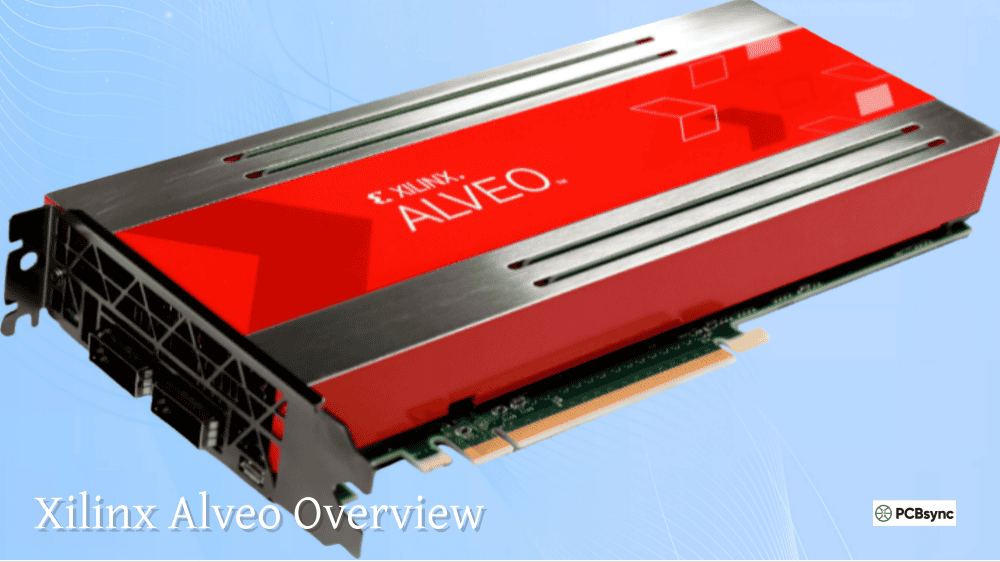
What sets this card apart from its predecessor, the Alveo U280, is the dramatic reduction in form factor. Going from a dual-slot design to a single-slot configuration while doubling the HBM capacity is impressive engineering. For those of us designing dense compute clusters, this means more acceleration capability per rack unit.
At the heart of the Xilinx Alveo U55C sits the XCU55C FPGA, a custom-built UltraScale+ device that runs exclusively on the Alveo architecture. This chip uses AMD’s stacked silicon interconnect (SSI) technology, combining three super logic regions (SLRs) to deliver breakthrough capacity and bandwidth.
From a PCB design perspective, the integration approach here is noteworthy. The HBM2 memory is co-located on the XCU55C device itself, connecting directly to SLR0. This eliminates the traditional memory interface challenges we face with external DDR4 and gives you consistent, predictable latency characteristics.
Xilinx U55 Technical Specifications Table
Specification
Xilinx Alveo U55C Value
FPGA Architecture
Virtex UltraScale+ XCU55C
Logic Units (LUTs)
1,304,000
Registers
2,607,000
DSP Slices
9,024
HBM2 Memory
16 GB
Memory Bandwidth
460 GB/s
Network Interface
2x QSFP28 (2×100 Gb/s or 8×25 Gb/s)
PCIe Interface
Gen3 x16 or Dual Gen4 x8
Form Factor
Single Slot, Full Height, Half Length
Typical Power
115W (Max 150W)
Cooling
Passive (requires server airflow)
High Bandwidth Memory (HBM2) Architecture
The 16GB HBM2 subsystem on the Xilinx U55 is what makes this card compelling for memory-bound workloads. Unlike traditional DDR4 implementations where you’re fighting with refresh cycles and rank switching, HBM2 provides consistent bandwidth through its wide interface.
The 460 GB/s aggregate bandwidth comes from 32 independent pseudo-channels, each running at approximately 1.8 Gbps per pin. For engineers designing data pipelines, this means you can feed multiple parallel compute engines without hitting memory bottlenecks.
One practical consideration: the HBM2 is directly attached to SLR0, so your memory-intensive logic should be placed close to that region to minimize crossing SLR boundaries and impacting timing closure.
200 Gbps Networking and QSFP28 Implementation
The dual QSFP28 ports on the Xilinx Alveo U55C support both 2x100GbE and 8x25GbE configurations. The QSFP ports are mapped to specific GT quads in the FPGA fabric, and the Vitis platform provides pre-defined GT indices for software developers.
What’s particularly useful is the RoCE v2 (RDMA over Converged Ethernet) support combined with Data Center Bridging. This enables card-to-card communication that competes with InfiniBand in terms of latency, but uses standard Ethernet infrastructure. For HPC cluster deployments, this eliminates the need for proprietary networking hardware.
The card ships with eight unique MAC IDs, accessible both from the physical label and programmatically through the Card Management Solution IP. This simplifies network provisioning in large-scale deployments.
Xilinx U55C vs U55N vs U280: Choosing the Right Card
Understanding the differences between the Xilinx U55N and Xilinx U55C variants is important for making the right procurement decision. The U55N is a slim, half-height variant designed primarily for network-centric applications, while the U55C is the full-featured HPC card.
While AMD offers dedicated ultra-low latency cards like the Alveo UL3524 for tick-to-trade applications, the Xilinx U55C fills an important role in financial computing for risk analysis, market data processing, and algorithmic strategy backtesting.
The combination of high memory bandwidth and 200 Gbps networking makes it suitable for processing market data feeds in real-time. Investment banks have historically used FPGAs as a stepping stone to port their codes onto gate arrays, and the U55C provides a modern platform for these workloads.
High Performance Computing (HPC) Workloads
The U55C excels in several HPC domains:
Computer Aided Engineering (CAE): Finite Element Method simulations with LS-DYNA have shown 5x speedups over CPUs by pipelining data and optimizing sparse matrix queries.
Signal Processing: CSIRO’s Square Kilometre Array uses 420 U55C cards to process data from 131,072 antennas in real-time at 15 Tb/s throughput.
Molecular Dynamics: The parallel data paths and HBM bandwidth enable complex particle simulations.
Graph Analytics: TigerGraph demonstrated 96x faster query times compared to CPU clusters for recommendation engines.
Big Data Analytics and Database Acceleration
The Xilinx Alveo U55C accelerates graph databases and analytical queries from minutes to milliseconds. When running Cosine Similarity algorithms for recommendation engines across millions of patient records, benchmark testing showed 96x improvement over CPU implementations.
For fraud detection using Louvain clustering algorithms, the card achieved 45x faster performance compared to CPU-based clusters while improving score quality by up to 35%.
Development Tools: Vitis Platform and Vivado
Vitis Unified Software Platform
AMD has invested heavily in making the Xilinx U55C accessible to software developers who don’t have traditional FPGA expertise. The Vitis platform allows developers to write accelerated applications in C, C++, Python, and OpenCL without dealing with RTL or Verilog.
The platform includes pre-optimized libraries for common operations and supports major AI frameworks including PyTorch and TensorFlow. For HPC developers, MPI integration enables scaling Alveo data pipelining across large workloads.
Traditional FPGA Development with Vivado
For engineers who want full control over the FPGA fabric, the Vivado Design Suite provides the traditional development flow. You get access to pre-validated base designs that map directly to the Alveo hardware, along with the complete IP catalog.
Note that for customers using U55N or U55C devices, Xilinx recommends installing Vivado 2020.1.1 or later for optimal device support.
Thermal Design and Power Requirements
The Xilinx U55C is a passively-cooled card that depends on server airflow for thermal management. This is an important consideration for system integrators—you need adequate chassis cooling to maintain stable operation.
Power configuration options include:
PCIe Slot Power Only: 75W baseline from the slot
6-pin AUX Connector: Additional power for higher performance
8-pin AUX Connector: Maximum configuration (up to 225W supply, though card consumes max 150W)
The typical power draw of 115W and maximum of 150W represents a significant reduction from the U280’s 225W maximum. For power-constrained deployments like the CSIRO radio telescope array (running on solar power), the cards can operate at as low as 90W.
One of the most compelling features of the Xilinx Alveo U55C is the standards-based clustering solution that enables deployment at 1000+ node scale. The API-driven approach uses RoCE v2 and Data Center Bridging to create an Alveo network that competes with InfiniBand in performance and latency.
Key benefits of this architecture:
No Proprietary Hardware: Uses existing data center Ethernet infrastructure
No Vendor Lock-in: Standard protocols ensure flexibility
Shared Workloads and Memory: Enables data pipelining across hundreds of cards
MPI Integration: Familiar programming model for HPC developers
Useful Resources and Downloads
Here are essential resources for engineers working with the Xilinx U55C:
Frequently Asked Questions About the Xilinx Alveo U55C
1. What is the difference between Xilinx U55C and Xilinx U55N?
The Xilinx U55C is a full-height, half-length card designed for HPC and big data applications with 16GB HBM2 and 150W maximum power. The Xilinx U55N is a slim, half-height variant with 8GB HBM2 optimized for network-centric applications with a 75W power envelope. Choose the U55C for compute-intensive workloads and U55N for space-constrained networking deployments.
2. Does the Xilinx Alveo U55C require external DDR4 memory?
No, the U55C does not include external DDR4 memory. It relies entirely on the 16GB of integrated HBM2 memory with 460 GB/s bandwidth. This is a deliberate design choice—the HBM2 provides sufficient capacity and bandwidth for memory-bound workloads without the power and complexity overhead of external DIMM interfaces.
3. Can software developers program the Xilinx U55C without FPGA experience?
Yes, AMD’s Vitis Unified Software Platform enables C, C++, Python, and OpenCL development without requiring HDL expertise. The platform includes pre-optimized libraries, AI framework support (PyTorch, TensorFlow), and domain-specific APIs. However, for maximum performance optimization, some understanding of FPGA architecture is beneficial.
4. What cooling requirements does the Alveo U55C have?
The card is passively cooled and requires adequate server chassis airflow. Refer to the data sheet for specific CFM requirements at various ambient temperatures. The card is designed for deployment in standard data center servers and is qualified on multiple OEM server platforms listed on AMD’s website.
5. How much does the Xilinx Alveo U55C cost and where can I buy it?
The U55C (part number A-U55C-P00G-PQ-G) typically costs between $5,500 and $6,000 depending on the vendor. It’s available directly from AMD, authorized distributors like DigiKey and CDW, as well as through cloud-based FPGA-as-a-Service providers for evaluation. For volume purchases (2+ units), contact AMD sales representatives for pricing.
Conclusion: Is the Xilinx Alveo U55C Right for Your Project?
The Xilinx Alveo U55C represents a mature, well-engineered solution for organizations facing memory-bound compute challenges. Its combination of high HBM bandwidth, integrated networking, and accessible development tools makes it a compelling choice for HPC, financial computing, and big data analytics.
If you’re evaluating the Xilinx U55C for your data center, consider these factors: the single-slot form factor enables higher deployment density, the 150W power envelope is more manageable than previous generation cards, and the RoCE v2 clustering solution eliminates InfiniBand infrastructure costs.
For engineers coming from the CPU or GPU world, the learning curve is real but significantly flattened by the Vitis platform. Start with the pre-optimized libraries for your domain, validate the performance gains on your specific workload, and then consider custom optimizations as needed.
The adaptive computing approach AMD is pushing with the Alveo line isn’t just marketing—it’s a genuine architectural advantage for workloads that don’t fit neatly into fixed-function accelerator patterns. The Xilinx U55 family, particularly the U55C and U55N variants, provides the flexibility to adapt your acceleration strategy as algorithms and requirements evolve.
Inquire: Call 0086-755-23203480, or reach out via the form below/your sales contact to discuss our design, manufacturing, and assembly capabilities.
Quote: Email your PCB files to Sales@pcbsync.com (Preferred for large files) or submit online. We will contact you promptly. Please ensure your email is correct.
Notes: For PCB fabrication, we require PCB design file in Gerber RS-274X format (most preferred), *.PCB/DDB (Protel, inform your program version) format or *.BRD (Eagle) format. For PCB assembly, we require PCB design file in above mentioned format, drilling file and BOM. Click to download BOM template To avoid file missing, please include all files into one folder and compress it into .zip or .rar format.