Inquire: Call 0086-755-23203480, or reach out via the form below/your sales contact to discuss our design, manufacturing, and assembly capabilities.
Quote: Email your PCB files to Sales@pcbsync.com (Preferred for large files) or submit online. We will contact you promptly. Please ensure your email is correct.
Notes: For PCB fabrication, we require PCB design file in Gerber RS-274X format (most preferred), *.PCB/DDB (Protel, inform your program version) format or *.BRD (Eagle) format. For PCB assembly, we require PCB design file in above mentioned format, drilling file and BOM. Click to download BOM template To avoid file missing, please include all files into one folder and compress it into .zip or .rar format.
Having worked with numerous FPGA accelerator cards in production data centers, I can say that the Alveo U50 hits a sweet spot that many engineers have been waiting for. This card packs HBM2 memory, PCIe Gen4 connectivity, and 100GbE networking into a half-height, half-length form factor that fits virtually any server. Whether you are researching the Xilinx Alveo U50 for financial trading, machine learning inference, or computational storage, this guide covers everything you need to know about specifications, pricing, and real-world deployment.
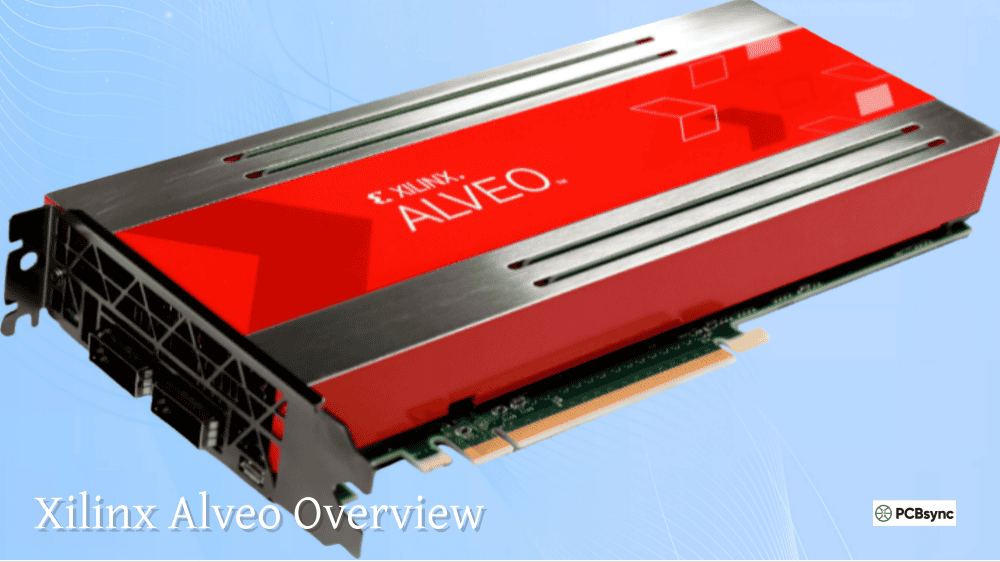
The Xilinx Alveo U50 is a data center accelerator card built on the UltraScale+ architecture. What makes this card stand out in the Alveo lineup is its compact form factor. At just 75 watts TDP with passive cooling, it draws power entirely from the PCIe slot without requiring auxiliary power connectors. This means you can drop an Alveo U50 into servers that previously could not accommodate FPGA acceleration.
AMD (formerly Xilinx) designed the Alveo U50 to compete directly with the NVIDIA Tesla T4 in the inference accelerator space. Both cards share similar power envelopes and form factors, but the FPGA architecture offers something GPUs cannot: true hardware adaptability. You can reprogram the Alveo U50 for completely different workloads without changing physical hardware.
Xilinx Alveo U50 Key Features
8GB HBM2 memory with up to 316 GB/s peak bandwidth
PCIe Gen3 x16 or Gen4 x8 with CCIX support
100GbE QSFP28 networking (4x25G, 4x10G, 1x40G, or 1x100G)
Half-height, half-length single-slot form factor
75W TDP with passive cooling (no auxiliary power required)
872K LUTs and 5,952 DSP slices for custom logic
Alveo U50 Technical Specifications
For engineers evaluating the Xilinx Alveo U50 against other accelerators, here are the complete technical specifications.
Complete Xilinx Alveo U50 Specifications Table
Specification
Alveo U50
Architecture
Xilinx UltraScale+ XCU50
Process Technology
16nm FinFET+
Logic Cells (LUTs)
872,000
Registers
1,743,000
DSP Slices
5,952
Block RAM
5MB (BRAM)
UltraRAM
20MB
HBM2 Capacity
8GB (2x 4GB stacks)
HBM2 Bandwidth (Peak)
316 GB/s
HBM2 Bandwidth (Nominal)
201 GB/s
HBM AXI Interfaces
32 channels
PCIe Interface
Gen3 x16 / Gen4 x8 / CCIX
Network Interface
1x QSFP28 (100GbE capable)
Form Factor
Half-Height, Half-Length, Single Slot
Maximum Power
75W (passive cooling)
Typical Power
50W
Configuration Memory
1Gb Quad SPI Flash
Alveo U50 HBM2 Memory Architecture
The high-bandwidth memory implementation on the Alveo U50 deserves special attention. Unlike traditional DDR4-based cards in the Alveo lineup (U200, U250), the U50 uses two 4GB HBM2 stacks mounted directly on the silicon interposer adjacent to the FPGA die. This architecture eliminates the off-chip memory bottleneck that plagues many accelerator designs.
Why HBM2 Matters for the Xilinx Alveo U50
The XCU50 FPGA provides 32 AXI interfaces to the HBM2 memory, each operating independently. A built-in crossbar switch allows any AXI port to access any address in either HBM stack. This flexibility simplifies floorplanning and timing closure compared to DDR-based designs where physical placement constraints can limit memory access patterns.
For memory-bound workloads like machine learning inference, the 316 GB/s peak bandwidth (201 GB/s nominal) provides approximately 4x the bandwidth of a typical DDR4-based solution. Combined with ~7 TB/s to the 5MB of BRAM and ~6 TB/s to the 20MB of UltraRAM, the Alveo U50 delivers exceptional on-chip memory performance for data-intensive applications.
PCIe Gen4 and CCIX Connectivity
The Alveo U50 was launched alongside AMD EPYC Rome processors, making it the first Alveo card with production PCIe Gen4 support. The card supports multiple configurations:
PCIe Gen3 x16: Maximum compatibility with existing servers
PCIe Gen4 x8: Double per-lane bandwidth on supported platforms
CCIX: Cache-coherent interconnect for tighter CPU-FPGA integration
100GbE Network Integration
The single QSFP28 port supports multiple networking configurations including 4x25GbE, 4x10GbE, 1x40GbE, or 1x100GbE depending on the optical module or DAC cable installed. This enables inline network processing where data flows directly from the network through the FPGA without CPU involvement, critical for applications like NVMe over Fabrics or algorithmic trading.
AMD offers two variants of the Xilinx Alveo U50 targeting different workloads. The hardware is identical, but the core voltage setting differs.
Specification
U50 (A-U50-P00G-PQ-G)
U50LV (A-U50-P00G-LV-G)
Core Voltage (VCCINT)
0.85V (VNOM)
0.72V (VLOW)
PCIe Support
Gen3 x16, Gen4 x8, CCIX
Gen3 x4 only
Target Workloads
Database, Video, FinTech, Storage
ML Inference (Vitis AI)
Performance
Higher clock frequencies
Optimized for efficiency
Power Efficiency
Standard
Better performance/watt
The U50LV runs at a lower core voltage, reducing power consumption but also limiting PCIe bandwidth to Gen3 x4. This makes it ideal for machine learning inference deployments using Vitis AI where the DPU (Deep Learning Processing Unit) overlays do not require full PCIe bandwidth. If you are deploying for general-purpose acceleration or need maximum PCIe throughput, choose the standard U50.
Xilinx Alveo U50 Price Guide
The Xilinx Alveo U50 price positions it as an accessible entry point into HBM-equipped FPGA acceleration. Here are representative pricing from authorized distributors.
Current Xilinx Alveo U50 Price Comparison
Model
Part Number
Approx. Price (USD)
Alveo U50 (Standard)
A-U50-P00G-PQ-G
$2,995 – $3,500
Alveo U50LV (Low Voltage)
A-U50-P00G-LV-G
$2,995 – $3,500
Alveo Programming Cable
HW-DMB-1-G
$494
Note: The Xilinx Alveo U50 price varies by distributor and volume. Academic and volume discounts are available. Prices shown reflect typical retail pricing from authorized distributors as of late 2024.
Xilinx Alveo U50 Price vs Competition
At around $3,000, the Xilinx Alveo U50 price competes directly with the NVIDIA Tesla T4 inference GPU. While GPUs offer broader framework support and easier programming for common deep learning tasks, the Alveo U50 delivers advantages in:
Deterministic sub-microsecond latency for financial applications
Custom data types and precision beyond standard floating-point
The compact form factor and HBM bandwidth make the Xilinx Alveo U50 suitable for diverse data center workloads.
Financial Trading and FinTech
Electronic trading firms deploy the Alveo U50 for tick-to-trade latency under 500 nanoseconds. The 100GbE port receives market data directly into the FPGA fabric, where custom logic parses messages and generates orders without CPU involvement. This architecture delivers 20x lower latency compared to software implementations.
Machine Learning Inference with Vitis AI
Vitis AI provides DPU (Deep Learning Processing Unit) overlays optimized for the Alveo U50. The DPUCAHX8H IP targets high throughput inference, while DPUCAHX8L optimizes for MobileNet models with ultra-low latency. Supported frameworks include TensorFlow and PyTorch through quantization and compilation tools.
Computational Storage
NVMe over Fabrics implementations use the Alveo U50 to offload storage protocols. Network requests arrive via 100GbE, the FPGA handles protocol processing and performs inline compression or encryption, then initiates peer-to-peer NVMe transfers. This architecture dramatically reduces CPU overhead and latency for storage-intensive applications.
Database Acceleration
Query acceleration using the Alveo U50 can improve TPC-H benchmark performance by orders of magnitude. The HBM bandwidth enables efficient scanning and filtering of large datasets, while custom logic implements database-specific operations like hash joins and aggregations directly in hardware.
Installing and Configuring the Alveo U50
Hardware Requirements
PCIe x16 slot (physical) with Gen3 or Gen4 support
Minimum 75W slot power delivery (no auxiliary power needed)
Adequate server airflow for passive cooling
Linux server (Ubuntu 18.04/20.04 or CentOS 7/8 recommended)
What is the difference between Xilinx U50C and Alveo U50?
There is no product called ‘Xilinx U50C’ in the official Alveo lineup. You may be thinking of the Alveo U55C, which is a different card with 16GB HBM2 (vs 8GB on U50), 1.3M LUTs (vs 872K), and dual 100GbE ports. The U50 is the compact, single-slot entry point, while the U55C offers higher capacity at a higher price point.
Does the Alveo U50 require auxiliary power?
No. The Alveo U50 draws its full 75W from the PCIe slot and does not require 6-pin or 8-pin auxiliary power connectors. This is one of its key advantages for deployment in dense servers where auxiliary power may not be available.
Can I use Alveo U50 in a consumer workstation?
Technically yes, but the Alveo U50 uses passive cooling designed for data center airflow. In a workstation without directed airflow, the card may overheat and throttle or shut down. You would need to ensure adequate case fans provide direct airflow over the card heatsink.
What is the Xilinx Alveo U50 price for academic use?
AMD offers academic pricing through the Xilinx University Program. Academic institutions can receive significant discounts on Alveo hardware. Contact your AMD/Xilinx academic representative for current pricing, which is typically 30-50% below retail.
Is the Alveo U50 still in production or has it been discontinued?
As of late 2024, the Alveo U50 remains available from AMD and authorized distributors. However, AMD has announced end-of-life for some older Alveo cards. Check current availability with distributors and consider the U55C or V80 for new designs requiring longer product lifecycle support.
Conclusion
The Xilinx Alveo U50 delivers HBM-powered FPGA acceleration in a form factor that fits virtually any server. At a competitive Xilinx Alveo U50 price point around $3,000, it provides a compelling alternative to GPU accelerators for workloads requiring deterministic latency, custom data types, or integrated networking.
Whether you choose the standard U50 for general-purpose acceleration or the U50LV for efficient ML inference, the compact design and low power consumption make it an accessible entry point into data center FPGA deployment. The mature Vitis ecosystem and extensive documentation lower the barrier to development compared to traditional FPGA workflows.
Inquire: Call 0086-755-23203480, or reach out via the form below/your sales contact to discuss our design, manufacturing, and assembly capabilities.
Quote: Email your PCB files to Sales@pcbsync.com (Preferred for large files) or submit online. We will contact you promptly. Please ensure your email is correct.
Notes: For PCB fabrication, we require PCB design file in Gerber RS-274X format (most preferred), *.PCB/DDB (Protel, inform your program version) format or *.BRD (Eagle) format. For PCB assembly, we require PCB design file in above mentioned format, drilling file and BOM. Click to download BOM template To avoid file missing, please include all files into one folder and compress it into .zip or .rar format.