Inquire: Call 0086-755-23203480, or reach out via the form below/your sales contact to discuss our design, manufacturing, and assembly capabilities.
Quote: Email your PCB files to Sales@pcbsync.com (Preferred for large files) or submit online. We will contact you promptly. Please ensure your email is correct.
Notes: For PCB fabrication, we require PCB design file in Gerber RS-274X format (most preferred), *.PCB/DDB (Protel, inform your program version) format or *.BRD (Eagle) format. For PCB assembly, we require PCB design file in above mentioned format, drilling file and BOM. Click to download BOM template To avoid file missing, please include all files into one folder and compress it into .zip or .rar format.
Alveo U280: HBM2-Equipped FPGA for Memory-Intensive Workloads
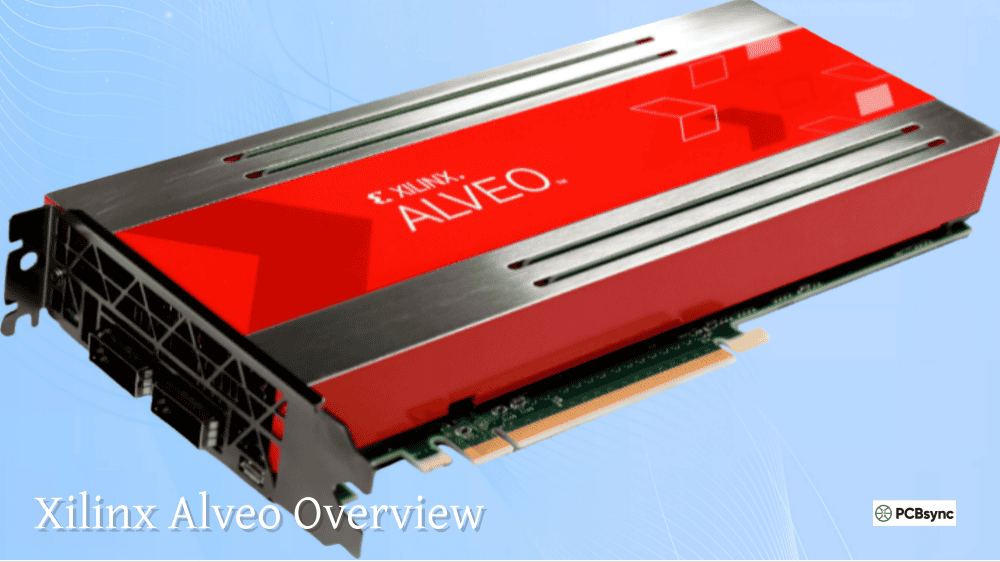
When Xilinx announced the Xilinx Alveo U280 at SC18 in late 2018, it marked a significant shift in how we approach memory-bound acceleration problems. Having deployed several U280 cards in production environments for database analytics and ML inference, I can confirm that this card delivers on its promise of breaking through memory bandwidth bottlenecks that plague traditional DDR-based solutions.
The Xilinx U280 brings 8GB of High Bandwidth Memory (HBM2) operating at up to 460 GB/s directly onto the FPGA package. That’s roughly 6x the memory bandwidth of the DDR4-equipped U200 and U250 cards. For workloads where memory access patterns dominate performance, this changes everything.
The fundamental challenge with FPGA acceleration has always been feeding data to the compute fabric fast enough. Traditional DDR4 memory, even with multiple channels, caps out around 77 GB/s on the Alveo platform. When your accelerated kernel can process data faster than memory can supply it, you’re leaving performance on the table.
The Xilinx Alveo U280 solves this by integrating Samsung HBM2 memory stacks directly onto the FPGA die using Xilinx’s Stacked Silicon Interconnect (SSI) technology. This co-location eliminates the off-package routing delays and allows for massively parallel memory interfaces that traditional DIMM-based solutions simply cannot match.
HBM2 Architecture on the Xilinx U280
The U280’s HBM subsystem consists of two 4GB memory stacks, providing 8GB total capacity. What makes this interesting from a design perspective is the 32 pseudo-channel architecture. Each pseudo-channel provides independent access to a 256MB memory region, and a built-in switch mechanism allows any of the 32 HBM AXI interfaces to access any memory address across either stack.
This flexibility is crucial for complex acceleration kernels that need non-uniform memory access patterns. Unlike traditional memory architectures where you’d need to carefully partition data across channels to avoid contention, the HBM switch handles this routing automatically.
Xilinx Alveo U280 Technical Specifications
Let me break down the complete specifications for the Xilinx U280, as I’ve found the official documentation sometimes buries the practical details engineers actually need.
FPGA and Logic Resources
Specification
Xilinx Alveo U280
FPGA Device
XCU280
Architecture
UltraScale+
Process Node
16nm
Super Logic Regions (SLRs)
3
Look-up Tables (LUTs)
1,079,000
Registers
2,158,000
DSP Slices
9,024
Block RAM
2,016 (36 Mb)
UltraRAM
800 (25 Mb)
Memory Subsystem Specifications
Feature
Specification
HBM2 Capacity
8 GB (2 x 4GB stacks)
HBM2 Bandwidth
Up to 460 GB/s
HBM2 Pseudo-Channels
32
HBM AXI Interfaces
32
DDR4 Capacity
32 GB (2 x 16GB RDIMMs)
DDR4 Speed
2400 MT/s
DDR4 Bandwidth
~38 GB/s per channel
Total Global Memory
40 GB (HBM + DDR4)
Interface and Connectivity
Interface
Specification
PCIe
Gen3 x16 / Gen4 x8
CCIX Support
Yes (16 GT/s x8)
Network Ports
2x QSFP28 (100G each)
USB Port
Micro-USB maintenance
Maximum Power
225W
Form Factor (Passive)
Full Height, 3/4 Length, Dual Slot
Form Factor (Active)
Full Height, Full Length, Dual Slot
Understanding the Three-SLR Architecture
The XCU280 FPGA on the Xilinx Alveo U280 uses a three Super Logic Region (SLR) design. This is where things get interesting from a hardware design perspective, and understanding the SLR layout is critical for achieving optimal performance.
SLR0: The HBM and PCIe Hub
SLR0 sits at the bottom of the die and integrates the HBM controller that interfaces with both 4GB HBM stacks. This SLR also hosts the 16-lane PCIe interface supporting up to Gen4 speeds at 16 GT/s. If your kernel is heavily memory-bound and doesn’t need extensive logic resources, keeping everything in SLR0 minimizes latency.
SLR1: The Middle Ground
SLR1 connects to one of the 16GB DDR4 DIMMs alongside SLR0. This gives you flexibility for designs that need a mix of ultra-high bandwidth (HBM) for working sets and larger DDR4 capacity for bulk data storage.
SLR2: Network Connectivity
The top SLR connects to the two QSFP28 connectors, making it the natural home for networking-related logic. For designs that need to move data between network interfaces and HBM-accelerated processing, you’ll want to carefully plan your SLR-crossing paths.
Published research and my own measurements show that the U280’s HBM subsystem delivers on its theoretical promises. The Shuhai benchmarking tool demonstrated that the HBM achieves approximately 425 GB/s sustained throughput when utilizing all 32 pseudo-channels. That’s about 92% of the 460 GB/s theoretical maximum, which is excellent for a parallel memory system.
Latency Characteristics
One detail that matters for latency-sensitive applications: HBM access latency varies based on which AXI channel accesses which pseudo-channel. Accessing a “local” pseudo-channel (where the AXI interface is directly connected) yields approximately 55 clock cycles for page-hit transactions. Cross-switch accesses can add up to 22 additional cycles. Smart data placement can minimize these penalties.
HBM vs DDR4 Comparison
Metric
HBM2
DDR4
Theoretical Bandwidth
450 GB/s
38.4 GB/s
Measured Bandwidth
~425 GB/s
~36 GB/s
Capacity
8 GB
32 GB
Pseudo-Channels/Channels
32
2
Access Granularity
256 MB per PC
16 GB per DIMM
Target Applications for the Xilinx Alveo U280
The U280’s HBM2 memory makes it particularly suited for workloads where data movement, not computation, is the bottleneck.
Database Analytics Acceleration
Hash join operations, which are fundamental to SQL query processing, benefit enormously from HBM bandwidth. Xilinx demonstrated 8x acceleration for database hash join queries on the U280 at its SC18 launch. The random-access patterns inherent to hash table lookups are exactly where HBM shines over DDR4.
Machine Learning Inference
Neural network inference, particularly for models with large weight matrices, can be memory-bound on traditional architectures. The U280 supports Xilinx’s DPUCAHX8H and DPUCAHX8L DPU overlays through Vitis AI, optimized specifically for HBM-equipped cards.
Financial Trading and Risk Modeling
Low-latency trading systems benefit from the U280’s combination of HBM bandwidth for order book processing and QSFP28 ports for ultra-low-latency network connectivity. The CCIX support also enables cache-coherent operation with compatible host processors.
High-Performance Computing
Scientific computing workloads with irregular memory access patterns, such as graph processing and sparse matrix operations, see significant speedups on HBM-based platforms. The ability to sustain high bandwidth even with non-sequential access patterns is transformative for these applications.
Key Value Store Acceleration
Algo-Logic’s Key Value Store implementation on the U280 demonstrates substantial throughput improvements over Xeon-class servers, leveraging HBM’s parallel access capabilities to serve millions of lookups per second.
PCIe Gen4 and CCIX Support
The Xilinx U280 was ahead of its time in supporting both PCIe Gen4 and CCIX protocols. The PCIE4C block in the XCU280 FPGA supports: PCIe Gen3 x16 (8 GT/s) for maximum legacy compatibility, PCIe Gen4 x8 (16 GT/s) for newer server platforms, and CCIX at 16 GT/s x8 for cache-coherent acceleration.
Note that PCIe Gen4 support in the Vitis software environment has some limitations. The Vivado tools fully support Gen4, but the Vitis target platforms historically defaulted to Gen3 operation. Check the latest platform documentation for current support status.
Both passive and active cooling versions of the Xilinx Alveo U280 are available. The passive version requires front-to-back airflow in a properly ventilated server chassis. From my experience, you need approximately 300 LFM of airflow for reliable operation at 35°C inlet temperature.
Power Budget
The card draws up to 225W total: 65W from the PCIe slot’s 12V supply and 150W from the auxiliary power connector. Your server needs a 150W-rated PCIe AUX cable (the 6+2 pin connectors commonly used for GPUs work fine).
Environmental Specifications
Condition
Operating
Storage
Temperature
Up to 45°C inlet
-40°C to 75°C
Humidity
8% to 90% RH
5% to 95% RH
ASHRAE Compliance
A1, A2, A3
N/A
Software Development with Vitis and Vivado
The U280 supports both traditional RTL design flows through Vivado and the higher-level Vitis application acceleration flow.
Vitis Flow
For most software developers coming from a CPU/GPU background, Vitis provides the more accessible entry point. You write kernels in C/C++ or OpenCL, and the tools handle the hardware synthesis. The Vitis AI toolchain extends this with quantization and optimization for neural network deployment.
Vivado Flow
Traditional FPGA developers who want maximum control can use Vivado with the provided XDC constraint files and board support packages. This is essential for custom networking applications or designs that need to push the limits of timing closure.
Required Software Components
To get started with the Xilinx U280, you’ll need: Xilinx Runtime (XRT) for host-FPGA communication, the Vitis or Vivado development environment, and the U280 deployment target platform.
AMD provides installation packages for RHEL/CentOS 7.x/8.x and Ubuntu 18.04/20.04. The deployment packages can be installed directly from AMD’s package repositories.
U280 vs Other Alveo Cards
Here’s how the U280 compares to its DDR4-based siblings:
Feature
Alveo U200
Alveo U250
Alveo U280
Memory Type
DDR4
DDR4
HBM2 + DDR4
Memory Bandwidth
77 GB/s
77 GB/s
460 GB/s (HBM)
Memory Capacity
64 GB
64 GB
8 GB HBM + 32 GB DDR4
LUTs
892K
1,341K
1,079K
DSP Slices
5,943
11,508
9,024
PCIe Gen4
No
No
Yes
Best For
Video transcoding
Large ML models
Memory-bound compute
The choice comes down to your workload characteristics. If you need maximum memory capacity and your access patterns are sequential, the U250’s 64GB DDR4 might serve you better. If your workload is random-access intensive or bandwidth-limited, the U280’s HBM is the clear winner.
Useful Resources for Alveo U280 Development
Official AMD/Xilinx Documentation
Document
Purpose
DS963 – U280 Data Sheet
Complete hardware specifications
UG1314 – U280 User Guide
Installation and configuration
UG1301 – Getting Started
Initial setup procedures
UG1120 – Platforms User Guide
Platform architecture details
PG276 – HBM Controller Guide
HBM AXI interface programming
Software Downloads
Component
Location
XRT (Xilinx Runtime)
AMD Alveo Downloads page
Vitis Development Platform
AMD Unified Installer
U280 Deployment Platform
AMD Alveo U280 Support page
Vitis AI for HBM cards
GitHub Xilinx/Vitis-AI
Cloud Development Options
You can develop for the U280 without purchasing hardware by using cloud instances. The Vitis 2023.1 Developer AMI on AWS includes full toolchain support for U280 development and simulation.
FAQs About the Xilinx Alveo U280
Why does the U280 have less logic (LUTs) than the U250?
The XCU280 FPGA dedicates significant die area to the HBM controller and the SSI interface to the HBM stacks. This is a deliberate trade-off. The U280 is optimized for memory-bound workloads where the bottleneck is data movement, not compute capacity. For pure logic-intensive applications, the U250’s 1,341K LUTs may be more appropriate.
Can I use both HBM and DDR4 simultaneously on the Xilinx U280?
Yes. The U280 provides 8GB HBM2 and 32GB DDR4 as separate memory subsystems. A common design pattern is to use HBM for hot data requiring random access and DDR4 for larger datasets accessed sequentially. The Vitis platform exposes both memory systems to your kernels.
What servers are compatible with the Alveo U280?
The U280 has been validated on servers from Dell EMC, HPE, Lenovo, and Supermicro. For production deployments, check the official Alveo Qualified Servers Catalog on AMD’s website. The card requires a full x16 PCIe slot with auxiliary power capability.
How does HBM2 compare to HBM3 in newer cards?
The U280 uses HBM2, which was leading-edge at its 2018 launch. Newer Alveo cards (like the V80) feature HBM3 with higher bandwidth. However, the U280 remains a cost-effective option for workloads that don’t require the absolute latest memory technology, and its mature software ecosystem is a significant advantage.
Is the Xilinx Alveo U280 suitable for real-time video processing?
While the U280 can handle video workloads, it’s not specifically optimized for this use case. The Alveo MA35D and U30 cards target video transcoding with dedicated media engines. The U280’s strength is in compute-intensive data processing where HBM bandwidth unlocks performance that DDR4 cannot provide.
Practical Deployment Considerations
Before deploying U280 cards in production, consider these practical factors. First, verify your server’s PCIe slot can deliver the full 75W slot power plus 150W auxiliary power. Some older servers limit per-slot power below these requirements.
Second, the passive-cooled version absolutely requires proper chassis airflow. I’ve seen cards throttle or shut down in workstations with inadequate cooling. If you’re not using a validated rack server, go with the active-cooled variant.
Third, plan your HBM pseudo-channel assignments carefully during design. While the switch allows any-to-any access, there are latency penalties for cross-switch accesses. Xilinx recommends using a maximum of 31 HBM ports for kernels, leaving one port for host DMA traffic.
The Bottom Line on the Xilinx Alveo U280
The Xilinx Alveo U280 represents a specialized tool for a specific class of problems. If your workload is genuinely memory-bandwidth limited, whether that’s database analytics, certain ML inference patterns, or scientific computing with irregular access patterns, the 460 GB/s HBM2 bandwidth is transformative.
It’s not the right choice for every FPGA acceleration project. The reduced logic resources compared to the U250, the smaller total memory capacity versus DDR4-based cards, and the higher complexity of HBM-aware design all factor into the decision. But for the workloads it targets, the U280 remains one of the most capable FPGA accelerators available.
Specifications and software support are subject to change. Always verify current capabilities on AMD’s official Alveo product pages before making deployment decisions.
Inquire: Call 0086-755-23203480, or reach out via the form below/your sales contact to discuss our design, manufacturing, and assembly capabilities.
Quote: Email your PCB files to Sales@pcbsync.com (Preferred for large files) or submit online. We will contact you promptly. Please ensure your email is correct.
Notes: For PCB fabrication, we require PCB design file in Gerber RS-274X format (most preferred), *.PCB/DDB (Protel, inform your program version) format or *.BRD (Eagle) format. For PCB assembly, we require PCB design file in above mentioned format, drilling file and BOM. Click to download BOM template To avoid file missing, please include all files into one folder and compress it into .zip or .rar format.