Inquire: Call 0086-755-23203480, or reach out via the form below/your sales contact to discuss our design, manufacturing, and assembly capabilities.
Quote: Email your PCB files to Sales@pcbsync.com (Preferred for large files) or submit online. We will contact you promptly. Please ensure your email is correct.
Notes: For PCB fabrication, we require PCB design file in Gerber RS-274X format (most preferred), *.PCB/DDB (Protel, inform your program version) format or *.BRD (Eagle) format. For PCB assembly, we require PCB design file in above mentioned format, drilling file and BOM. Click to download BOM template To avoid file missing, please include all files into one folder and compress it into .zip or .rar format.
When your design outgrows the XC9572XL but doesn’t justify jumping to an FPGA, the Xilinx XC95144XL hits that middle ground perfectly. With double the macrocells and more I/O options, this device handles moderate-complexity digital logic without the overhead of SRAM-based solutions.
I’ve deployed the XC95144XL across numerous projects, from telecommunications interface boards to industrial automation controllers. Its combination of sufficient logic density, instant-on capability, and straightforward development flow makes it a go-to choice when designs need more horsepower than smaller CPLDs can deliver.
This guide walks through the specifications, pinouts, and practical applications of the XC95144XL to help you determine if it fits your next project.
The XC95144XL belongs to Xilinx’s XC9500XL family of Complex Programmable Logic Devices. It occupies the mid-range position in this family, sitting between the 72-macrocell XC9572XL and the larger 288-macrocell XC95288XL.
Built on 0.35-micron CMOS FastFLASH technology, the device provides 144 macrocells organized into eight function blocks. This translates to approximately 3,200 usable gates, enough capacity for implementing substantial state machines, complex address decoding schemes, or consolidating multiple discrete logic functions into a single programmable device.
The non-volatile Flash-based configuration means your design loads instantly at power-up without external configuration memory. For applications requiring deterministic startup behavior or where external EEPROM adds unwanted complexity, this characteristic proves valuable.
XC95144XL Core Specifications
Parameter
Specification
Macrocells
144
Function Blocks
8 (54V18 each)
Usable Gates
3,200
Registers
144
Pin-to-Pin Delay
5 ns (fastest grade)
System Frequency
Up to 178 MHz
Setup Time (TSU)
3.7 ns
Clock-to-Output (TCO)
3.5 ns
Core Voltage
3.3V
I/O Voltage
3.3V or 2.5V selectable
Input Tolerance
5V, 3.3V, 2.5V compatible
Programming Cycles
10,000+ minimum
Data Retention
20 years
XC95144XL Architecture Details
Understanding the internal architecture helps you write efficient designs and predict resource utilization before committing to hardware.
Function Blocks and Macrocells
The XC95144XL contains eight function blocks, each housing 18 macrocells. Every function block receives 54 inputs from the FastCONNECT II switch matrix, providing exceptional flexibility in signal routing.
Each macrocell can implement either:
Combinatorial logic using up to 90 product terms (with allocation from neighboring cells)
Registered logic with a configurable D-type flip-flop
The product term allocator allows borrowing unused terms from adjacent macrocells within the same function block. This feature lets you implement wider logic functions without consuming additional macrocells, though it does add small timing increments.
FastCONNECT II Switch Matrix
The switch matrix forms the backbone of internal routing. It connects all function block outputs and I/O feedback paths to every function block input. This architecture ensures excellent routability and pin-locking capability, meaning you can usually keep your pinout stable even as your design evolves.
Global Control Signals
The XC95144XL provides more global resources than its smaller siblings:
Signal Type
Quantity
Function
GCK (Global Clock)
3
Low-skew clock distribution
GSR (Global Set/Reset)
1
Synchronous reset of all flip-flops
GTS (Global Tri-State)
4
Device-wide output disable
The four GTS signals, double what the XC9572XL offers, provide more flexibility for bus-oriented designs where multiple tri-state control signals are needed.
Package selection significantly impacts your PCB design and available I/O count. The XC95144XL offers three package options, each suited to different board constraints.
The larger device size compared to XC9572XL means power distribution requires more attention. Multiple supply pins need proper decoupling to ensure reliable operation.
Voltage Requirements
Supply
Voltage Range
Function
VCCINT
3.0V to 3.6V
Core logic and input buffers
VCCIO
3.0V to 3.6V
3.3V I/O operation
VCCIO
2.3V to 2.7V
2.5V I/O operation
Decoupling Strategy
For the TQ100 package with three VCCINT pins and four VCCIO pins:
Location
Capacitor
Type
Each VCCINT pin
100nF
Ceramic (X7R or better)
Each VCCIO pin
100nF
Ceramic (X7R or better)
Power entry
10µF to 47µF
Tantalum or ceramic
Place ceramic capacitors within 5mm of their associated power pins. The bulk capacitor should sit near where power enters the board, providing energy storage for transient demands.
Power Consumption Estimation
Current consumption depends heavily on operating frequency and design complexity. The datasheet provides the following estimation formula:
ICC varies with macrocell configuration (high-speed vs. low-power), product term usage, clock frequency, and flip-flop toggle rate. At moderate frequencies (50 MHz) with typical designs, expect 50-80mA ICC. Always verify power consumption with your actual design during prototyping.
Programming the XC95144XL
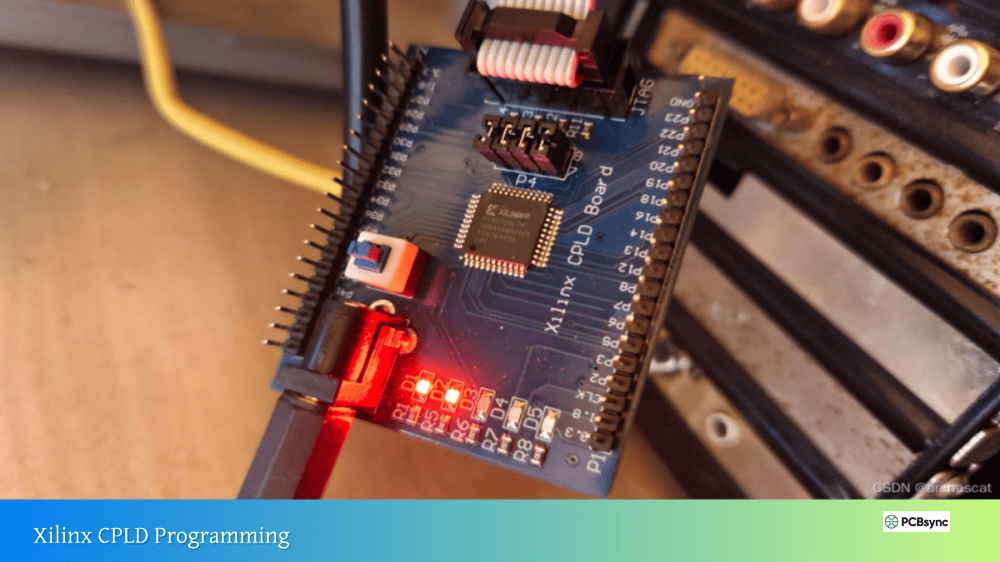
The programming workflow mirrors other XC9500XL family members but handles the larger device size transparently.
Required Development Tools
Xilinx ISE WebPack 14.7: This remains the primary development environment. While older than current Vivado, ISE fully supports the XC9500XL family and provides all necessary synthesis, implementation, and programming tools.
JTAG Programmer Options:
Programmer
Compatibility
Notes
Xilinx Platform Cable USB
Native ISE support
Official solution
Digilent HS2/HS3
Native ISE support
Reliable alternative
FT2232-based cables
Via SVF/XSVF
Budget option
Raspberry Pi GPIO
Via xc3sprog
DIY solution
Programming Workflow Steps
Create design using Verilog, VHDL, or schematic entry
Assign pin constraints in UCF file
Synthesize design
Implement design (fit to CPLD architecture)
Generate .jed programming file
Program via JTAG using iMPACT or external tools
Programming time runs approximately 12-15 seconds for a full device program through standard JTAG interfaces. The in-system programmability means you can update designs without removing the chip from your board.
The 144-macrocell capacity opens applications that smaller CPLDs cannot address efficiently.
Complex State Machines
With 144 flip-flops available, you can implement substantial state machines for protocol handling, motor control sequencing, or industrial automation. The device handles designs with 50+ states comfortably, leaving headroom for combinatorial logic.
Bus Interface Controllers
Memory controllers, peripheral interfaces, and bus bridges fit naturally in the XC95144XL. The 81-117 I/O pins (package dependent) accommodate wide data buses plus address and control signals.
Protocol Converters
Converting between serial protocols (SPI, I2C, UART variants) or implementing custom communication interfaces leverages the device’s speed and I/O flexibility. The 5V tolerant inputs simplify interfacing with legacy systems.
Multi-Function Glue Logic
Instead of scattering 74-series logic across your board, consolidate address decoders, clock dividers, interrupt controllers, and reset generators into a single XC95144XL. This approach reduces BOM complexity and allows post-fabrication modifications.
Test and Measurement Equipment
Automated test equipment often requires programmable logic for signal routing, timing generation, and data capture. The instant-on operation and deterministic timing suit these applications.
XC95144XL vs Other XC9500XL Family Members
Choosing the right device size balances cost, capability, and board space.
XC9500XL Family Comparison
Parameter
XC9536XL
XC9572XL
XC95144XL
XC95288XL
Macrocells
36
72
144
288
Usable Gates
800
1,600
3,200
6,400
Max I/O
36
72
117
192
TPD (ns)
5
5
5
6
fSYSTEM (MHz)
178
178
178
208
Function Blocks
2
4
8
16
GTS Signals
2
2
4
4
When to Choose XC95144XL
Select the XC95144XL when:
Your design exceeds 60-70% utilization on XC9572XL
You need more than 52 I/O pins
Design requires 4 global tri-state controls
Future expansion headroom is important
Cost difference from XC95288XL is significant
When to Step Up to XC95288XL
Consider the larger device when:
Design exceeds 120 macrocells
Maximum I/O count (192) is required
Design complexity justifies higher cost
Pin-compatible migration path needed from XC95144XL (TQ144 package)
Useful Resources for XC95144XL Development
Documentation Downloads
Document
Description
DS056
XC95144XL Device Datasheet
DS054
XC9500XL Family Datasheet
XAPP111
Using the XC9500XL Timing Model
XAPP114
Understanding XC9500XL CPLD Power
XAPP784
Bulletproof CPLD Design Practices
Software and Tools
Resource
Purpose
Xilinx ISE WebPack 14.7
Design entry, synthesis, implementation
iMPACT
Programming utility
xc3sprog
Open-source programmer (supports Raspberry Pi)
UrJTAG
SVF file playback
Component Distributors
The XC95144XL remains available from major distributors including Digi-Key, Mouser, Newark, and Farnell. Verify lead times and pricing, as availability fluctuates with demand.
FAQs About the XC95144XL
What is the difference between XC95144XL and XC95144 (without XL)?
The XC95144 is the older 5V core version, while the XC95144XL operates on 3.3V. The XL version offers lower power consumption and works with modern 3.3V systems while maintaining 5V input tolerance. For new designs, always choose the XL variant.
Can I migrate designs from XC9572XL to XC95144XL?
Yes, designs are source-compatible since both use the same architecture and development tools. However, you’ll need to update your UCF constraint file for the new pinout and verify timing closure. The TQ100 package provides a reasonable migration path for designs that fit in 81 I/O pins.
How does the XC95144XL compare to CoolRunner-II CPLDs?
CoolRunner-II devices offer lower power consumption and additional features like built-in clock dividers and multiple I/O voltage banks. However, CoolRunner-II requires a 1.8V core supply, adding board complexity. The XC95144XL’s single 3.3V supply simplifies power design. Performance is comparable for most applications.
Is the XC95144XL still in production?
Yes, as of 2025, AMD (which acquired Xilinx) continues to produce the XC9500XL family. However, development tools are limited to the legacy ISE WebPack, which no longer receives updates. The devices remain fully supported for existing designs and new production.
What happens to outputs during in-system programming?
During programming, all I/O pins enter a high-impedance state with internal bus-hold circuitry pulling signals to their previous levels. If specific pins must remain low during programming, add external pull-down resistors. Plan your system design to tolerate this brief tri-state condition during configuration updates.
Final Thoughts
The Xilinx XC95144XL fills an important niche between small CPLDs and FPGAs. Its 144 macrocells handle moderate-complexity designs that would overflow an XC9572XL without requiring the configuration infrastructure of SRAM-based alternatives.
For engineers working on bus interfaces, protocol converters, complex state machines, or consolidated glue logic, the XC95144XL delivers a practical balance of capability, simplicity, and cost. The instant-on operation, straightforward development flow, and 5V tolerant I/O make it particularly valuable for industrial and embedded applications where reliability and legacy compatibility matter.
If your design fits within 3,200 gates and 117 I/O pins, this device deserves serious consideration before stepping up to FPGA territory.
Inquire: Call 0086-755-23203480, or reach out via the form below/your sales contact to discuss our design, manufacturing, and assembly capabilities.
Quote: Email your PCB files to Sales@pcbsync.com (Preferred for large files) or submit online. We will contact you promptly. Please ensure your email is correct.
Notes: For PCB fabrication, we require PCB design file in Gerber RS-274X format (most preferred), *.PCB/DDB (Protel, inform your program version) format or *.BRD (Eagle) format. For PCB assembly, we require PCB design file in above mentioned format, drilling file and BOM. Click to download BOM template To avoid file missing, please include all files into one folder and compress it into .zip or .rar format.