Inquire: Call 0086-755-23203480, or reach out via the form below/your sales contact to discuss our design, manufacturing, and assembly capabilities.
Quote: Email your PCB files to Sales@pcbsync.com (Preferred for large files) or submit online. We will contact you promptly. Please ensure your email is correct.
Notes: For PCB fabrication, we require PCB design file in Gerber RS-274X format (most preferred), *.PCB/DDB (Protel, inform your program version) format or *.BRD (Eagle) format. For PCB assembly, we require PCB design file in above mentioned format, drilling file and BOM. Click to download BOM template To avoid file missing, please include all files into one folder and compress it into .zip or .rar format.
If you’ve been hunting for a high-frequency laminate that doesn’t require the hassle of PTFE-style processing, Rogers TMM 6 PCB material deserves your attention. I’ve worked with various microwave substrates over the years, and TMM 6 stands out for its unique balance of electrical performance and fabrication simplicity.
Whether you’re designing satellite transponders, 5G base station components, or automotive radar modules, selecting the right PCB substrate can make or break your project. TMM 6 addresses many of the pain points engineers face when working with high-frequency materials—poor dimensional stability, complex surface treatments, and unreliable plated through-holes.
This guide covers everything you need to know about TMM 6—from its core specifications to real-world design tips that’ll save you headaches down the road. We’ll examine the material’s electrical and thermal properties, explore practical applications, discuss fabrication considerations, and compare TMM 6 against other popular high-frequency laminates.
Rogers TMM 6 is a ceramic-filled thermoset polymer composite specifically engineered for stripline and microstrip applications. Unlike traditional PTFE-based laminates, TMM 6 uses a thermoset resin system that doesn’t soften during thermal processing. This means you can perform wire bonding and soldering operations without worrying about pad lifting or substrate deformation.
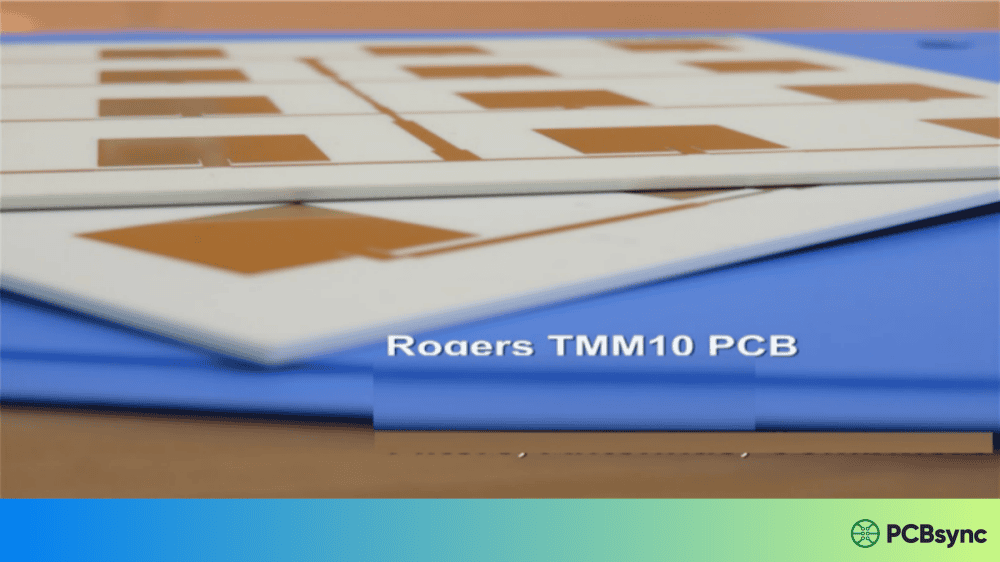
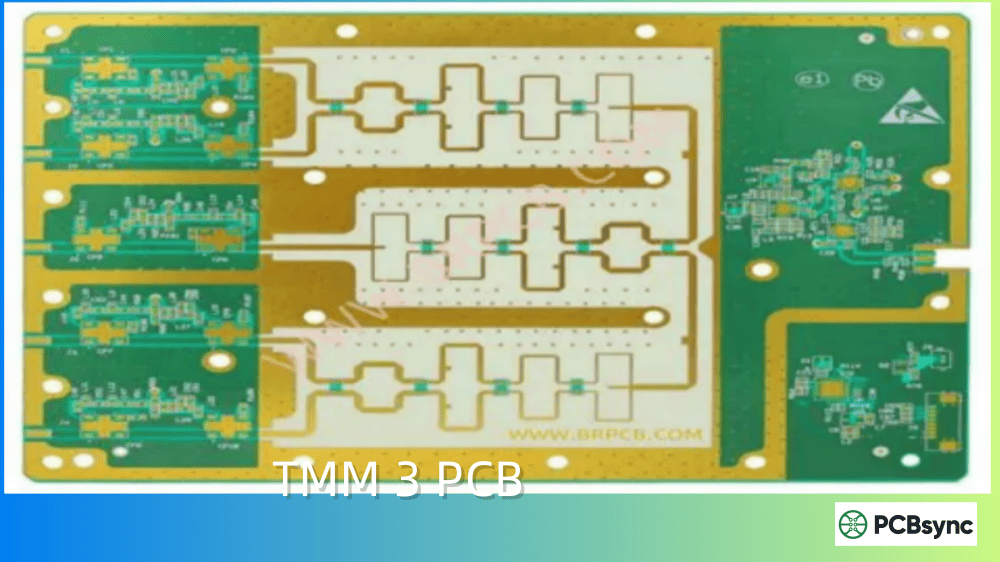
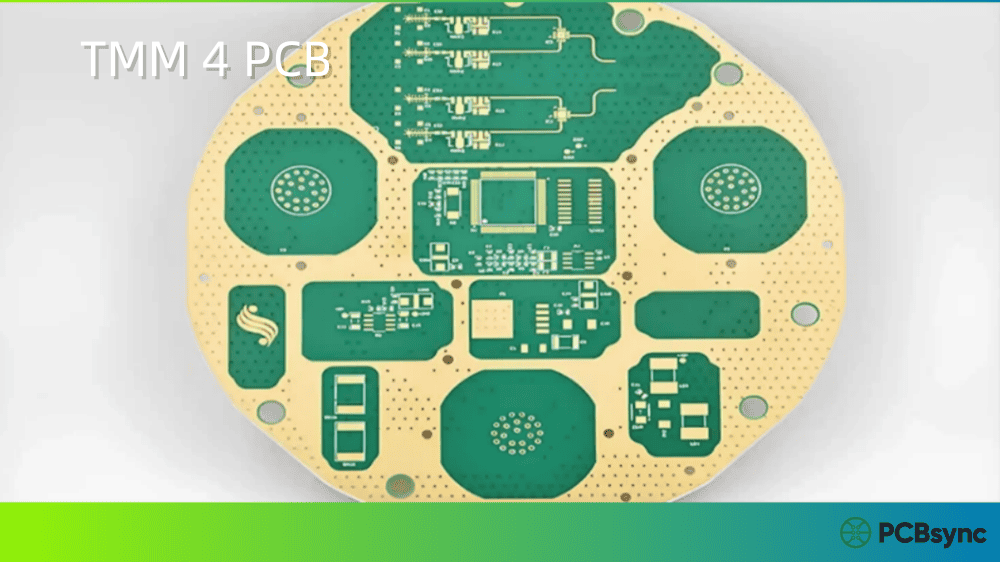
The “6” in TMM 6 refers to its nominal dielectric constant of 6.0, which sits in a sweet spot for many RF and microwave designs. It’s part of the broader TMM family from Rogers Corporation, which includes TMM 3, TMM 4, TMM 10, TMM 10i, and TMM 13i—each targeting different Dk requirements.
What makes TMM 6 particularly attractive is that it combines the best properties of both ceramic and PTFE microwave laminates. You get excellent high-frequency performance without the specialized production techniques those materials typically demand.
TMM 6 PCB Material Specifications
Before diving into design considerations, let’s look at what TMM 6 actually brings to the table. These specifications come directly from Rogers’ official datasheet and represent typical values at standard test conditions.
A few things worth noting here. The “process” Dk of 6.0 is what you’ll measure using standard cavity resonator methods. The “design” Dk of 6.3 is what you should actually use in your transmission line calculations—it accounts for real-world circuit behavior at operating frequencies.
The dissipation factor of 0.0023 at 10 GHz is quite respectable. While it’s not as low as some pure PTFE materials, it’s more than adequate for most commercial RF applications up to 40 GHz.
The in-plane CTE values of 18 ppm/K closely match copper’s expansion coefficient (approximately 17 ppm/K). This copper-matched expansion is critical for maintaining plated through-hole reliability across thermal cycles. You won’t see the barrel cracking and pad lifting issues that plague mismatched CTE systems.
Thermal conductivity of 0.72 W/m·K is roughly twice what you’d get from traditional PTFE/ceramic laminates. In power amplifier designs, this improved heat dissipation can be the difference between a design that works reliably and one that suffers from thermal drift.
Mechanical Properties of TMM 6
Property
Value
Direction
Test Conditions
Test Method
Copper Peel Strength
5.7 lb/inch (1.0 N/mm)
X, Y
After solder float, 1 oz EDC
IPC-TM-650 2.4.8
Flexural Strength
15.02 kpsi
X, Y
—
ASTM D790
Flexural Modulus
1.75 Mpsi
X, Y
—
ASTM D790
Physical Properties and Availability
Property
Value
Test Conditions
Test Method
Moisture Absorption (1.27mm)
0.06%
D/24/23
ASTM D570
Moisture Absorption (3.18mm)
0.20%
D/24/23
ASTM D570
Specific Gravity
2.37
—
ASTM D792
Lead-Free Process Compatible
Yes
—
—
TMM 6 is available in standard thicknesses ranging from 0.015″ (0.381mm) to 0.500″ (12.70mm), all with a tolerance of ±0.0015″. Standard panel sizes include 18″ × 12″ and 18″ × 24″, with copper cladding options from ½ oz to 2 oz electrodeposited copper foil.
Key Features and Benefits of TMM 6 PCB
Having listed the raw numbers, let me explain why these specifications matter in practical terms.
No Sodium Naphthenate Treatment Required
If you’ve worked with PTFE-based materials, you know the pain of surface preparation for electroless plating. Traditional PTFE laminates require sodium naphthenate treatment—a messy, time-consuming process that adds cost and complexity. TMM 6 skips this entirely. The material’s thermoset surface bonds well with standard plating chemistries right out of the box.
Exceptional Plated Through-Hole Reliability
The copper-matched CTE in the X and Y directions (18 ppm/K) means your PTHs will survive thermal cycling without the barrel cracking common in high-CTE systems. For designs requiring high reliability—military, aerospace, medical—this is non-negotiable.
Wire Bonding Compatibility
Because TMM 6 doesn’t soften when heated, you can perform wire bonding directly to circuit traces without worrying about substrate deformation or pad lifting. This opens up hybrid circuit designs that would be problematic with other materials.
Chemical Resistance
The base substrate resists the etchants and solvents commonly used in PCB production. You won’t see the material degradation that can occur with some sensitive laminates during aggressive etching or cleaning processes.
Twice the Thermal Conductivity
At 0.72 W/m·K, TMM 6 conducts heat roughly twice as efficiently as traditional PTFE/ceramic laminates. For power amplifiers, this translates to lower junction temperatures and improved reliability.
Where does TMM 6 actually get used? The material finds its way into a surprisingly wide range of high-frequency applications.
RF and Microwave Circuits
This is TMM 6’s bread and butter. The stable dielectric constant and low loss make it ideal for:
Filter networks requiring predictable frequency response
Couplers and power dividers
Matching networks for antenna feeds
Microstrip and stripline transmission lines operating up to 40 GHz
Satellite Communication Systems
Satellite equipment demands materials that perform consistently across wide temperature ranges. TMM 6’s low thermal coefficient of Dk (-11 ppm/°K) keeps electrical parameters stable whether you’re dealing with eclipse cooling or solar heating.
5G Infrastructure
Base station antennas and power amplifiers in 5G deployments benefit from TMM 6’s combination of low loss and good thermal management. The material supports the high power densities common in massive MIMO installations.
Radar Systems
Both automotive and aerospace radar applications use TMM 6. The material’s consistent Dk supports the tight phase control required for beam-forming arrays.
GPS and Navigation Antennas
Patch antennas for GPS receivers commonly use TMM 6. The higher Dk (compared to lower-Dk alternatives) allows for more compact antenna geometries while maintaining acceptable efficiency.
Power Amplifiers and Combiners
The improved thermal conductivity helps manage heat in power amp modules. Combined with the wire bonding compatibility, TMM 6 works well for hybrid PA designs. Whether you’re building a single-stage driver or a multi-stage power module, the material’s ability to handle thermal stress without softening makes it a reliable choice. Power combiners that merge multiple PA outputs also benefit from TMM 6’s consistent Dk across the board area.
Test and Measurement Equipment
Chip testers and probe cards benefit from TMM 6’s stable electrical properties and dimensional stability. When you’re characterizing devices at microwave frequencies, the last thing you want is substrate-induced measurement uncertainty. TMM 6’s tight Dk tolerance (±0.080) helps ensure repeatable test results.
Filters and Couplers
Microwave filters require precise control over resonant frequencies. TMM 6’s stable dielectric constant across temperature ensures your filter’s center frequency doesn’t drift excessively during operation. Directional couplers, Lange couplers, and branch-line couplers all work well on TMM 6 substrate.
Automotive Radar Systems
Modern vehicles increasingly rely on 24 GHz and 77 GHz radar for advanced driver assistance systems (ADAS). TMM 6’s performance at these frequencies, combined with its ability to withstand automotive temperature cycling (-40°C to +125°C), makes it suitable for radar module substrates. The material’s dimensional stability helps maintain antenna pattern integrity over the vehicle’s lifetime.
TMM 6 PCB Design Guidelines
Getting good results from TMM 6 requires attention to a few key design practices. These aren’t unique to TMM 6, but they’re worth reviewing if you’re new to the material.
Impedance Control and Transmission Line Design
For 50Ω microstrip on TMM 6 (Dk = 6.3), expect trace widths roughly half what you’d use on FR-4 at the same thickness. Use a field solver or impedance calculator to determine exact dimensions—rules of thumb only get you in the ballpark.
When calculating impedance, use the design Dk of 6.3 rather than the process Dk of 6.0. The design value accounts for fringing fields and other real-world effects that affect your actual circuit impedance.
For microstrip transmission lines, remember that the effective dielectric constant will be lower than the substrate Dk due to the air above the trace. A 50Ω microstrip on 25-mil (0.635mm) TMM 6 will require approximately 0.6mm trace width, but always verify with a calculator for your specific stackup.
Stripline designs benefit from TMM 6’s consistent Dk through the material thickness. The symmetric dielectric environment eliminates the dispersion issues that can plague microstrip at higher frequencies.
Minimizing Signal Loss
While TMM 6’s Df of 0.0023 is quite good, signal loss adds up over long traces. Keep RF paths as short as practical. Use smooth copper foils (rolled annealed rather than electrodeposited) if your fabricator offers them—surface roughness contributes significantly to conductor loss at microwave frequencies.
Avoid unnecessary bends and transitions. Each discontinuity introduces some reflection and radiation loss. When bends are necessary, use curved traces or mitered corners rather than 90-degree angles.
Layer Stackup Considerations
TMM 6 works well in both single-layer and multilayer configurations. For multilayer boards, Rogers offers bonding materials compatible with TMM 6. Consult Rogers’ bondply selection guide for specific recommendations.
A typical two-layer TMM 6 PCB stackup might look like:
Layer
Material
Thickness
Top Copper
1 oz ED Copper
35 µm
Core
Rogers TMM 6
0.635 mm (25 mil)
Bottom Copper
1 oz ED Copper
35 µm
Grounding and Via Placement
As with any RF design, keep ground return paths short and low-inductance. Via stitching around RF traces helps control fields and reduces coupling. For TMM 6’s thickness range, standard mechanical drilling works fine—no laser drilling required for typical via sizes.
Thermal Management
While TMM 6’s thermal conductivity is good for a laminate, it’s still no substitute for metal core or direct die attachment in high-power applications. For power amp designs, consider attaching the TMM 6 laminate to an aluminum or brass carrier for improved heat spreading.
TMM 6 Fabrication and Processing
One of TMM 6’s major selling points is its compatibility with standard PCB fabrication processes. Unlike PTFE-based materials that require specialized handling, TMM 6 can be processed using equipment and techniques familiar to any competent RF PCB shop. Here’s what you need to know for successful manufacturing.
Material Handling and Storage
TMM 6 has a shelf life of one year from the date of shipment when stored properly. Keep the material in a cool, dry environment in unopened packaging. Once opened, store with desiccant to prevent moisture absorption. While TMM 6’s moisture absorption is relatively low (0.06% for 1.27mm thickness), accumulated moisture can affect electrical properties and cause issues during thermal processing.
Drilling
Standard carbide drill bits work fine for TMM 6. The ceramic filler does cause more tool wear than FR-4, so expect to change bits more frequently. Entry and exit materials help reduce burring.
For best results, use entry material specifically designed for hard substrates. Drill speeds and feeds should be optimized for the ceramic-filled composite—slightly slower than FR-4 parameters typically work well. Back drilling for controlled depth is also possible when needed for specific high-frequency applications.
Routing and Scoring
TMM 6 can be routed using standard carbide tooling. Diamond-coated bits extend tool life when processing large quantities. Scoring and V-groove techniques work but require attention to prevent edge chipping due to the ceramic content.
Etching
TMM 6 is compatible with both ammoniacal and cupric chloride etchants. Cupric chloride provides faster etch rates. The base substrate resists these chemistries, so you won’t see the material attack that occurs with some sensitive laminates.
For best results, use proper process control to achieve consistent edge profiles. Undercut can be an issue if etch parameters aren’t dialed in.
Plating
As mentioned earlier, TMM 6 doesn’t require sodium naphthenate treatment before electroless plating. Standard electroless copper processes work directly on the prepared surface. Follow up with electrolytic copper to build pad thickness.
Lamination (for Multilayer)
Rogers recommends lamination pressure of approximately 200 psi for bonding multilayer boards with TMM-compatible prepregs. Follow Rogers’ technical bulletins for specific temperature profiles.
For wire bonding applications, gold plating is typically required.
TMM 6 vs. Other Rogers Materials
How does TMM 6 stack up against other popular Rogers PCB materials? Here’s a quick comparison.
TMM 6 vs. RO4350B
Parameter
TMM 6
RO4350B
Dielectric Constant
6.0
3.48
Dissipation Factor (10 GHz)
0.0023
0.0037
Thermal Conductivity
0.72 W/m·K
0.69 W/m·K
CTE (X/Y)
18 ppm/K
14 ppm/K
Best For
Higher Dk applications, size reduction
General RF, cost-sensitive designs
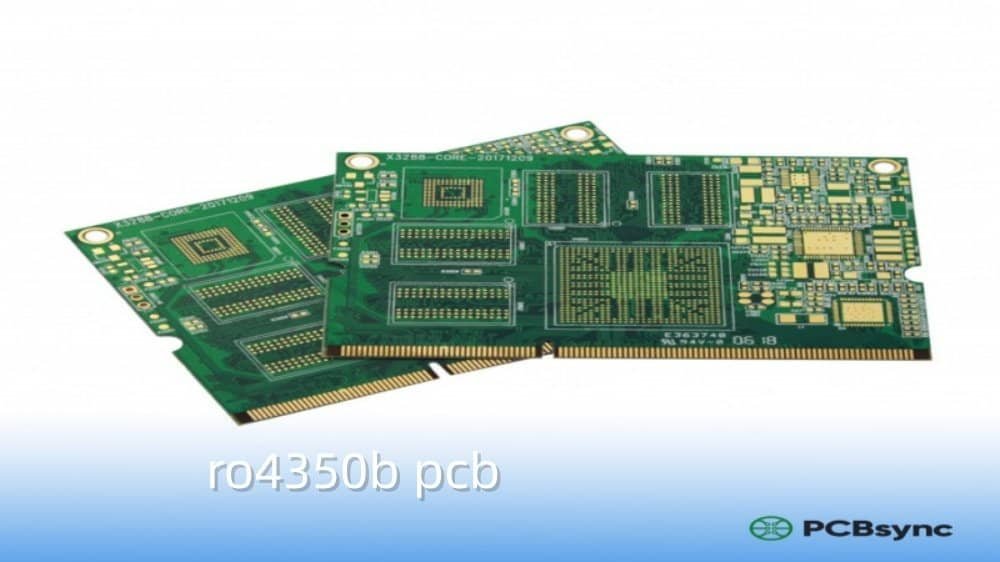
RO4350B is probably the most widely used Rogers material due to its lower cost and excellent overall performance. Choose TMM 6 when you specifically need higher Dk (for size reduction) or slightly lower loss.
TMM 6 vs. TMM 3/TMM 4/TMM 10
All TMM family materials share similar processing characteristics. The primary difference is dielectric constant:
Material
Dk (Process)
Typical Use Case
TMM 3
3.27
Lower Dk applications, wider traces
TMM 4
4.50
Mid-range Dk requirements
TMM 6
6.00
Compact designs, higher Dk needs
TMM 10
9.20
Miniaturized antennas, dielectric resonators
TMM 10i
9.80
Alumina replacement
TMM 13i
12.85
Very high Dk applications
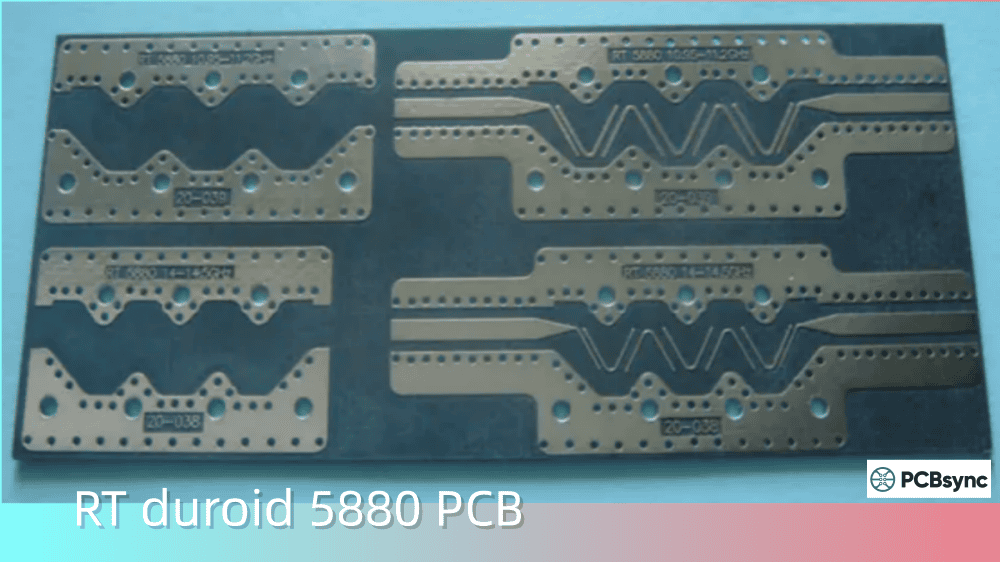
TMM 6 vs. RT/duroid 5880
RT/duroid 5880 offers lower Dk (2.2) and lower loss (Df = 0.0009), making it the go-to choice for ultra-low-loss applications like aerospace and defense. However, PTFE-based 5880 requires specialized processing. TMM 6 is easier to fabricate when its higher Dk and slightly higher loss are acceptable.
Frequently Asked Questions About TMM 6 PCB
What is the dielectric constant of TMM 6?
TMM 6 has a process dielectric constant of 6.00 ± 0.080 measured at 10 GHz using IPC-TM-650 method 2.5.5.5. For design calculations involving transmission lines and impedance matching, use the design Dk of 6.3, which accounts for real-world circuit behavior across the 8 GHz to 40 GHz range.
Is TMM 6 suitable for lead-free soldering?
Yes, TMM 6 is fully compatible with lead-free assembly processes. The material’s high decomposition temperature (Td = 425°C) provides adequate margin for lead-free reflow profiles, which typically peak around 260°C. The thermoset resin system doesn’t soften during these thermal excursions.
What thickness options are available for TMM 6?
Rogers offers TMM 6 in standard thicknesses from 0.015″ (0.381mm) to 0.500″ (12.70mm), all with ±0.0015″ tolerance. Common thicknesses include 0.025″ (0.635mm), 0.030″ (0.762mm), 0.050″ (1.270mm), and 0.060″ (1.524mm). Custom thicknesses may be available on request.
Can TMM 6 be used in multilayer PCB constructions?
Yes, TMM 6 works well in multilayer constructions. Rogers offers compatible bondply materials for laminating multiple TMM 6 layers or for hybrid stackups combining TMM 6 with other materials. Follow Rogers’ recommended lamination parameters (approximately 200 psi pressure) for best results.
How does TMM 6 compare to FR-4 for RF applications?
TMM 6 significantly outperforms FR-4 in RF applications. FR-4’s Dk varies with frequency and has much higher loss (Df ~0.02 vs. 0.0023 for TMM 6). FR-4 is generally acceptable only up to about 6 GHz for non-critical RF paths. TMM 6 maintains stable performance to 40 GHz and beyond. The cost premium for TMM 6 is justified in any design where signal integrity at microwave frequencies matters.
Useful Resources for TMM 6 PCB Design
Here are some resources that’ll help you get the most out of TMM 6:
TMM 6 occupies a useful niche in the RF laminate landscape. It delivers genuine high-frequency performance—stable Dk, low loss, excellent thermal management—while remaining compatible with standard PCB fabrication processes. For designs requiring Dk around 6, it’s hard to beat.
The material won’t be the cheapest option on your BOM, but the fabrication simplicity compared to PTFE alternatives often makes the total cost competitive. And for applications demanding reliability across thermal cycles, the copper-matched CTE provides peace of mind.
If you’re evaluating TMM 6 for your next project, start with Rogers’ datasheet and impedance calculator. Get samples through your PCB vendor to verify fabrication compatibility before committing to production quantities. And don’t hesitate to reach out to Rogers’ application engineering team—they’re generally responsive and helpful with material selection questions.
Ready to start your TMM 6 PCB project? Request quotes from fabricators experienced with Rogers materials, and specify TMM 6 explicitly in your documentation to ensure proper handling.
Inquire: Call 0086-755-23203480, or reach out via the form below/your sales contact to discuss our design, manufacturing, and assembly capabilities.
Quote: Email your PCB files to Sales@pcbsync.com (Preferred for large files) or submit online. We will contact you promptly. Please ensure your email is correct.
Notes: For PCB fabrication, we require PCB design file in Gerber RS-274X format (most preferred), *.PCB/DDB (Protel, inform your program version) format or *.BRD (Eagle) format. For PCB assembly, we require PCB design file in above mentioned format, drilling file and BOM. Click to download BOM template To avoid file missing, please include all files into one folder and compress it into .zip or .rar format.