Inquire: Call 0086-755-23203480, or reach out via the form below/your sales contact to discuss our design, manufacturing, and assembly capabilities.
Quote: Email your PCB files to Sales@pcbsync.com (Preferred for large files) or submit online. We will contact you promptly. Please ensure your email is correct.
Notes: For PCB fabrication, we require PCB design file in Gerber RS-274X format (most preferred), *.PCB/DDB (Protel, inform your program version) format or *.BRD (Eagle) format. For PCB assembly, we require PCB design file in above mentioned format, drilling file and BOM. Click to download BOM template To avoid file missing, please include all files into one folder and compress it into .zip or .rar format.
If you’ve been working on RF or microwave circuit designs, chances are you’ve come across the challenge of selecting the right substrate material. Standard FR4 just doesn’t cut it when you’re pushing frequencies into the GHz range. That’s where Rogers TMM 4 PCB material enters the picture.
After years of working with high-frequency laminates, I can tell you that TMM 4 occupies a unique position in the Rogers lineup. It’s not as well-known as RO4350B, but for certain applications, it outperforms nearly everything else on the market. Let me walk you through everything you need to know about this material.
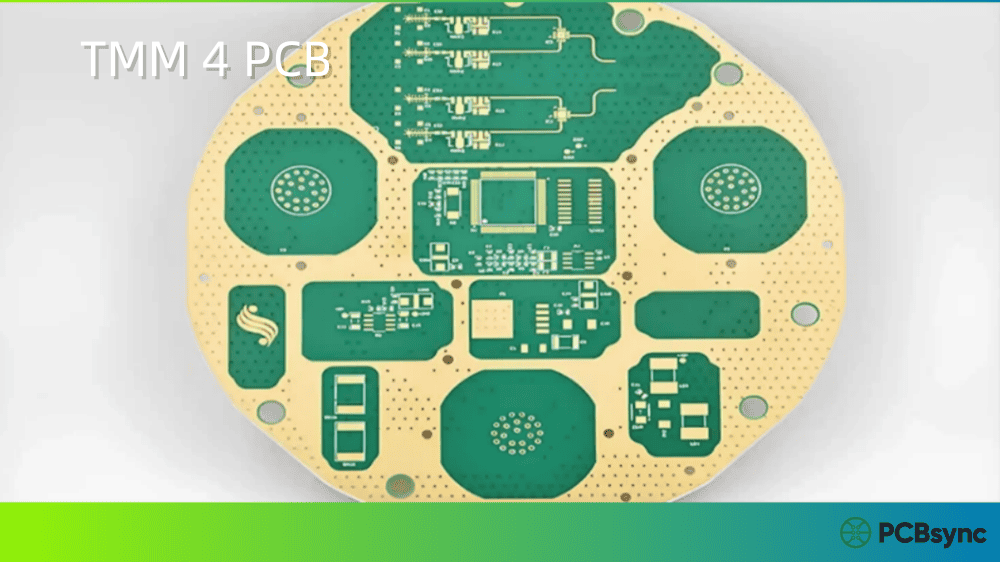
Rogers TMM 4 is a thermoset microwave laminate manufactured by Rogers Corporation. The “TMM” stands for Thermoset Microwave Material, and the “4” refers to its nominal dielectric constant of 4.5.
Unlike PTFE-based materials that require specialized processing, TMM 4 PCB is a ceramic-filled, hydrocarbon-based thermoset polymer composite. This combination gives it some interesting properties that make it particularly attractive for high-reliability applications.
The material was specifically engineered for stripline and microstrip applications where plated through-hole (PTH) reliability is critical. If you’ve ever dealt with PTH failures in high-frequency boards, you’ll appreciate why this matters.
TMM 4 Material Composition
The composition of TMM 4 PCB includes three main components:
Ceramic fillers: Provide dimensional stability and thermal conductivity
Thermoset polymer matrix: Ensures mechanical stability under heat
This thermoset nature is crucial. Unlike thermoplastic materials that soften when heated, TMM 4 maintains its rigidity during soldering and wire bonding operations. You won’t see pad lifting or substrate deformation during assembly—a common headache with some other high-frequency materials.
Key Material Characteristics
What sets TMM 4 apart from other high-frequency materials is its unique combination of properties:
Isotropic CTE: The thermal expansion characteristics are consistent in all directions, which prevents warping and ensures predictable behavior during thermal cycling. This is particularly important for large-format boards and precision antenna applications.
Low Moisture Absorption: At just 0.16% moisture absorption, TMM 4 maintains stable electrical properties even in humid environments. This makes it reliable for outdoor installations and applications where environmental sealing may not be perfect.
Chemical Resistance: The base substrate resists etchants and solvents commonly used in PCB fabrication. This chemical stability simplifies processing and reduces the risk of material degradation during manufacturing.
Consistent Dk Across the Board: Unlike some woven-glass reinforced materials that can exhibit “weave effect” variations in Dk, TMM 4’s filled composition provides more uniform properties across the laminate surface.
TMM 4 PCB Technical Specifications
Understanding the specifications is essential for proper design. Here’s a comprehensive breakdown of TMM 4 properties based on the official Rogers datasheet:
Electrical Properties
Property
Value
Test Condition
Dielectric Constant (Dk)
4.50 ± 0.045
10 GHz
Dissipation Factor (Df)
0.0020
10 GHz
Thermal Coefficient of Dk
<30 ppm/°C
-55°C to +125°C
Volume Resistivity
10^8 MΩ·cm
C96/35/90
Surface Resistivity
10^7 MΩ
C96/35/90
Thermal Properties
Property
Value
Notes
Thermal Conductivity
0.70 W/m/K
Approximately 2x PTFE/ceramic
CTE (X-axis)
16 ppm/°C
Matched to copper
CTE (Y-axis)
16 ppm/°C
Matched to copper
CTE (Z-axis)
20 ppm/°C
Low for reliability
Decomposition Temperature (Td)
425°C
TGA
Mechanical Properties
Property
Value
Test Method
Tensile Modulus
2413 MPa
ASTM D638
Flexural Strength
83 MPa
IPC-TM-650
Peel Strength
1.05 N/mm
After solder float
Density
1.95 g/cm³
–
Moisture Absorption
0.16%
D24/23
Available Thicknesses and Copper Cladding
TMM 4 PCB material comes in a range of standard and non-standard thicknesses:
Standard Thicknesses
Non-Standard Thicknesses
20 mil (0.508 mm)
15 mil (0.381 mm)
30 mil (0.762 mm)
25 mil (0.635 mm)
50 mil (1.270 mm)
75 mil (1.905 mm)
60 mil (1.524 mm)
125 mil (3.175 mm)
Copper cladding options range from 1/2 oz/ft² to 2 oz/ft² electrodeposited copper foil. TMM 4 can also be bonded directly to brass or aluminum plates for applications requiring enhanced thermal management.
After testing dozens of high-frequency laminates, I’ve found that TMM 4 hits a sweet spot that other materials often miss. Here’s why:
Advantage 1: Exceptional PTH Reliability
The coefficient of thermal expansion (CTE) of TMM 4 closely matches copper. This is huge for multilayer designs. When your substrate and copper expand at the same rate during thermal cycling, you get reliable plated through holes that don’t crack or separate over time.
I’ve seen aerospace applications where TMM 4 boards survived thousands of thermal cycles without PTH failures. Try that with standard FR4 in a high-frequency design.
Advantage 2: No Special Processing Required
Here’s something that will save you money and headaches: TMM 4 doesn’t require sodium naphthenate treatment before electroless plating. Many PTFE-based materials need this chemical treatment to promote adhesion, adding cost and complexity to fabrication.
With TMM 4 PCB, you can use standard PWB fabrication processes. Your manufacturer doesn’t need specialized equipment or training, which translates to lower costs and faster turnaround.
Advantage 3: Thermoset Stability
Because TMM 4 is based on thermoset resins, it doesn’t soften during reflow soldering. Wire bonding operations can be performed directly to circuit traces without worrying about pad lifting or substrate deformation. For hybrid module assemblies, this characteristic is invaluable.
Advantage 4: Superior Thermal Conductivity
The thermal conductivity of TMM 4 (0.70 W/m/K) is approximately twice that of traditional PTFE/ceramic laminates. Better heat dissipation means your power amplifiers and other high-power components run cooler and last longer.
TMM 4 vs Other PCB Materials: Detailed Comparison
Choosing the right material requires understanding how TMM 4 stacks up against alternatives. Here’s an honest comparison:
TMM 4 vs FR4
Parameter
TMM 4
FR4
Dielectric Constant
4.50 (stable)
~4.5 (varies with frequency)
Dissipation Factor
0.0020
0.02-0.03
Dk Stability
Excellent
Poor at high frequency
PTH Reliability
Excellent
Moderate
Cost
Higher
Lower
Processing
Standard
Standard
When to choose TMM 4: Any application above 1 GHz where signal integrity matters. The stable Dk and low loss of TMM 4 PCB will dramatically improve your circuit performance.
TMM 4 vs RO4350B
Parameter
TMM 4
RO4350B
Dielectric Constant
4.50
3.48
Dissipation Factor
0.0020
0.0037
Thermal Conductivity
0.70 W/m/K
0.69 W/m/K
CTE Match to Copper
Excellent
Good
Wire Bonding
Excellent
Good
Cost
Moderate
Moderate
When to choose TMM 4: When you need the higher Dk for miniaturization, require excellent wire bonding capability, or prioritize PTH reliability. RO4350B is better when you need lower Dk for wider transmission lines.
TMM 4 vs Other TMM Series
Grade
Dk Value
Best For
TMM 3
3.27
Lower Dk applications, GPS
TMM 4
4.50
General RF, balanced properties
TMM 6
6.00
Higher Dk, miniaturization
TMM 10
9.20
High Dk, compact designs
TMM 10i
9.80
Isotropic CTE, space applications
TMM 13i
12.85
Highest Dk, maximum miniaturization
TMM 4 PCB Applications
The properties of TMM 4 make it suitable for a wide range of high-frequency applications. Here’s where I’ve seen it excel:
RF and Microwave Circuits
TMM 4 PCB is commonly used in RF circuit design where signal integrity is paramount. The stable dielectric constant ensures consistent impedance across temperature variations, which is critical for filters, couplers, and matching networks.
Satellite Communication Systems
Space-grade applications demand extreme reliability. TMM 4’s low outgassing, radiation resistance, and thermal stability make it an excellent choice for satellite transponders and communication links. The material can handle the harsh temperature swings encountered in orbital environments.
GPS Antennas and Receivers
Global positioning systems require precise frequency response and phase stability. TMM 4 provides the consistency needed for GPS patch antennas and receiver front-ends. Many commercial and military GPS systems rely on TMM series materials.
Power Amplifiers and Combiners
The enhanced thermal conductivity of TMM 4 helps manage heat in power amplifier designs. Combined with its excellent electrical properties, this makes it ideal for PA modules and power combiners in base stations and radar systems.
Radar Systems
Military and automotive radar applications benefit from TMM 4’s stable performance across frequency and temperature. The material maintains its properties in the challenging environments where radar systems operate.
Patch Antennas and Antenna Arrays
The dimensional stability of TMM 4 PCB ensures consistent antenna element spacing and radiation patterns. This is particularly important for phased array antennas where phase coherence between elements is critical.
Filters and Couplers
High-performance RF filters demand materials with consistent dielectric properties. TMM 4’s tight Dk tolerance (±0.045) ensures filter responses remain within specification from unit to unit. Whether you’re building bandpass filters for cellular infrastructure or waveguide-to-microstrip transitions, TMM 4 provides the predictability your designs require.
Medical Device Applications
Medical imaging and diagnostic equipment increasingly rely on RF and microwave technology. TMM 4 PCB finds use in MRI systems, wireless patient monitoring devices, and therapeutic RF equipment. The material’s reliability and biocompatibility with standard conformal coatings make it suitable for medical-grade applications.
Industrial Sensors and IoT
With the growth of Industrial IoT, sensors operating at 2.4 GHz, 5.8 GHz, and millimeter-wave frequencies are becoming commonplace. TMM 4 provides the stable performance these sensors need to function reliably in harsh industrial environments with wide temperature variations.
Automotive Electronics
Beyond radar, TMM 4 is used in vehicle-to-everything (V2X) communication systems, keyless entry modules, and tire pressure monitoring systems. The automotive industry’s stringent reliability requirements align well with TMM 4’s proven performance characteristics.
TMM 4 PCB Design Considerations
Designing with TMM 4 requires attention to several key factors. Getting these right from the start will save you time and money during prototyping and production.
Impedance Control
With a Dk of 4.50, TMM 4 produces narrower transmission lines compared to lower-Dk materials at the same impedance. For a 50-ohm microstrip line on 20 mil TMM 4:
Trace width: approximately 38 mils
This allows more compact designs but requires tighter manufacturing tolerances
Use Rogers’ MWI calculator or your preferred field solver to determine exact dimensions for your stackup. Always verify calculated dimensions with your fabricator, as actual Dk can vary slightly based on copper roughness and measurement methodology.
For critical applications, consider specifying controlled impedance testing on your fabrication drawing. Most experienced high-frequency PCB shops can measure and report actual impedance values on test coupons.
Stackup Planning
For multilayer TMM 4 PCB designs, consider:
Bonding materials: Use compatible prepregs like Rogers 3001 or Arlon CuClad 6700
Hybrid stackups: TMM 4 can be combined with FR4 for mixed-technology boards
Thermal management: Consider direct bonding to aluminum or brass for heat-critical designs
Layer count: TMM 4 supports complex multilayer structures, though costs increase with layer count
When creating hybrid stackups, pay attention to the Dk mismatch between TMM 4 and other materials. This can affect impedance in stripline configurations where signals are referenced to layers of different materials.
Ground Plane Considerations
Solid ground planes are essential for controlled impedance and EMI management. With TMM 4’s higher Dk, your transmission lines will couple more tightly to the ground plane. Ensure adequate ground via stitching around RF traces and at board edges.
For stripline configurations, maintain consistent dielectric thickness above and below the signal layer. Asymmetric stackups can cause impedance discontinuities and mode conversion issues.
Design for Manufacturing
Keep these DFM guidelines in mind:
Parameter
Recommended Value
Minimum trace width
6 mil (0.15 mm)
Minimum spacing
8 mil (0.20 mm)
Minimum hole size
0.35 mm (14 mil)
Copper weight
1 oz standard, up to 2 oz available
Maximum panel size
400 mm × 500 mm typical
Thermal Management Tips
Place thermal vias under high-power components
Consider thick metal backings for extreme thermal requirements
Use the excellent CTE match to copper for reliable thermal cycling
TMM 4 PCB Fabrication Guidelines
Working with your PCB manufacturer? Here’s what they need to know:
Drilling Recommendations
TMM 4 contains ceramic fillers that can be abrasive. Proper drilling parameters are essential:
Use carbide drill bits designed for ceramic-filled materials
Limit stack height to prevent excessive drill wear
Monitor hole wall quality during production runs
Entry and backup materials should be appropriate for the material
Routing and Machining
Surface speed should stay below 400 SFM to prevent excessive tool wear
Carbide tools with appropriate geometries work well
Tool life of 250+ linear inches is achievable with proper methods
Plating Process
Unlike PTFE materials, TMM 4 PCB does not require sodium naphthenate treatment before electroless copper deposition. Standard electroless copper and electrolytic plating processes work well.
However, note that if TMM 4 is laminated with fluoropolymer bonding films (like FEP), sodium etching of those layers may still be required.
Surface Finishes
TMM 4 is compatible with all common surface finishes:
ENIG (Electroless Nickel Immersion Gold)
HASL (Hot Air Solder Leveling)
Immersion Silver
Immersion Tin
OSP (Organic Solderability Preservative)
Hard Gold for wire bonding applications
Storage and Handling
Store TMM 4 laminates at room temperature (13-32°C) and moderate humidity. The dielectric materials are inert to humidity, but copper cladding can oxidize if exposed to high humidity for extended periods.
Where to Source TMM 4 PCB Materials and Services
Finding the right supplier is crucial for quality results:
Material Distributors
Rogers Corporation works with authorized distributors worldwide. Contact Rogers directly or check their website for current distribution partners in your region.
PCB Fabricators
Not all PCB manufacturers have experience with high-frequency materials. Look for fabricators that:
Have documented experience with Rogers TMM series
Understand high-frequency design requirements
Can provide controlled impedance testing
Offer appropriate electrical testing
For comprehensive information on Rogers PCB materials and fabrication options, manufacturers with high-frequency expertise can guide you through material selection and design optimization.
Rogers MWI Calculator: Free online impedance calculator for Rogers materials
Laminate Properties Tool: Interactive tool on Rogers website for comparing material properties
Frequently Asked Questions About TMM 4 PCB
What is the dielectric constant of TMM 4?
TMM 4 has a dielectric constant (Dk) of 4.50 ± 0.045 measured at 10 GHz. What makes this particularly valuable is the low thermal coefficient of Dk, typically less than 30 ppm/°C. This means your circuit’s electrical performance remains stable across a wide temperature range from -55°C to +125°C, which is critical for applications like aerospace and automotive electronics.
Can TMM 4 be processed with standard PCB manufacturing methods?
Yes, TMM 4 PCB can be fabricated using all common PWB processes. Unlike many PTFE-based high-frequency materials, TMM 4 does not require sodium naphthenate treatment before electroless plating. Standard drilling, routing, plating, and finishing processes apply, though carbide tooling is recommended due to the ceramic filler content. This compatibility with standard processes typically results in lower fabrication costs and faster turnaround compared to specialty PTFE materials.
Is TMM 4 suitable for multilayer PCB construction?
Absolutely. TMM 4 is specifically designed for high-reliability multilayer applications including stripline constructions. The material’s CTE closely matches copper (16 ppm/°C in X and Y axes), which ensures reliable plated through holes even under thermal cycling. For multilayer builds, TMM 4 can be bonded using compatible prepreg materials. The thermoset nature of TMM 4 also prevents substrate softening during lamination, maintaining dimensional accuracy.
What is the difference between TMM 4 and RO4350B?
The primary differences are in dielectric constant and loss characteristics. TMM 4 has a Dk of 4.50 with Df of 0.0020, while RO4350B has Dk of 3.48 with Df of 0.0037. TMM 4 offers better wire bonding capability due to its thermoset nature and slightly superior PTH reliability due to its optimized CTE match to copper. RO4350B is often preferred when lower Dk is needed for wider transmission lines or when glass-reinforced construction is desired. Both materials are excellent choices for high-frequency applications; the selection depends on your specific design requirements.
What frequency range is TMM 4 suitable for?
TMM 4 PCB performs well from low frequencies through millimeter-wave applications, typically up to 40 GHz and beyond. The stable dielectric constant and low dissipation factor ensure consistent performance across this range. For applications above 10 GHz, careful attention to fabrication tolerances and surface roughness becomes increasingly important. TMM 4 is commonly used in applications ranging from GPS (1.5 GHz) to automotive radar (77 GHz) and satellite communications (Ku, Ka bands).
Cost Considerations for TMM 4 PCB Projects
Budget is always a factor in material selection. Here’s what to expect with TMM 4:
Material Cost
TMM 4 costs more than FR4 but is generally comparable to or slightly less expensive than many PTFE-based alternatives. The exact pricing depends on:
Panel size and thickness
Copper weight requirements
Order quantity
Regional availability
Fabrication Cost
Because TMM 4 processes like a standard laminate, fabrication costs are often lower than PTFE materials that require specialized treatment. However, the ceramic filler content means tool wear is higher than FR4, which can add to processing costs for large production runs.
Total Cost of Ownership
Don’t evaluate TMM 4 solely on material cost. Consider:
Lower rejection rates due to better PTH reliability
Reduced field failures in deployed systems
Simplified fabrication process with more supplier options
Consistent performance reducing the need for extensive testing
For high-reliability applications, the slightly higher material cost is often justified by improved yield and field performance.
Conclusion
Rogers TMM 4 PCB represents an excellent balance of electrical performance, mechanical reliability, and manufacturing simplicity. Its thermoset nature, stable dielectric properties, and CTE match to copper make it a dependable choice for high-frequency applications where failure is not an option.
Whether you’re designing satellite communication systems, radar modules, or precision RF instrumentation, TMM 4 delivers the performance consistency that demanding applications require. The fact that it processes like a conventional laminate—without the specialized treatments needed for PTFE materials—makes it accessible to a wider range of manufacturers and keeps costs reasonable.
The material shines brightest in applications requiring:
High PTH reliability over thermal cycling
Wire bonding capability
Stable electrical properties across temperature
Standard PWB fabrication compatibility
For your next high-frequency project, give TMM 4 a serious look. The combination of proven reliability and straightforward fabrication might be exactly what your design needs. Start by reviewing the official Rogers datasheets, running your impedance calculations, and discussing fabrication requirements with your preferred PCB supplier. With proper attention to design guidelines and manufacturing parameters, TMM 4 can deliver outstanding results for even the most demanding RF and microwave applications.
Inquire: Call 0086-755-23203480, or reach out via the form below/your sales contact to discuss our design, manufacturing, and assembly capabilities.
Quote: Email your PCB files to Sales@pcbsync.com (Preferred for large files) or submit online. We will contact you promptly. Please ensure your email is correct.
Notes: For PCB fabrication, we require PCB design file in Gerber RS-274X format (most preferred), *.PCB/DDB (Protel, inform your program version) format or *.BRD (Eagle) format. For PCB assembly, we require PCB design file in above mentioned format, drilling file and BOM. Click to download BOM template To avoid file missing, please include all files into one folder and compress it into .zip or .rar format.