Inquire: Call 0086-755-23203480, or reach out via the form below/your sales contact to discuss our design, manufacturing, and assembly capabilities.
Quote: Email your PCB files to Sales@pcbsync.com (Preferred for large files) or submit online. We will contact you promptly. Please ensure your email is correct.
Notes: For PCB fabrication, we require PCB design file in Gerber RS-274X format (most preferred), *.PCB/DDB (Protel, inform your program version) format or *.BRD (Eagle) format. For PCB assembly, we require PCB design file in above mentioned format, drilling file and BOM. Click to download BOM template To avoid file missing, please include all files into one folder and compress it into .zip or .rar format.
If you’ve been working with RF and microwave circuits, you’ve probably run into the limitations of standard FR4 at some point. Signal losses creeping up, impedance going haywire with temperature swings, or just not getting the miniaturization you need for that compact filter design. That’s where Rogers TMM 10 PCB comes into play.
I’ve spent years designing high-frequency circuits, and TMM 10 has become one of my go-to materials when the application demands a high dielectric constant with solid thermal stability. This guide covers everything you need to know about TMM 10 PCB, from raw specifications to practical fabrication tips that’ll save you headaches down the road.
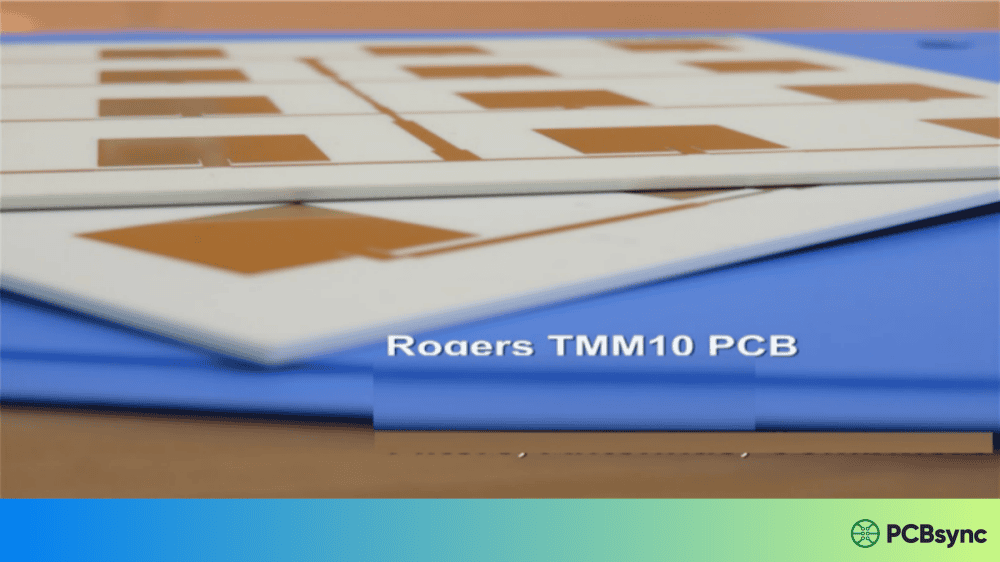
Rogers TMM 10 is a ceramic-filled thermoset polymer composite laminate specifically engineered for high-frequency strip-line and microstrip applications. The “TMM” stands for Thermoset Microwave Materials, and the “10” refers to its nominal dielectric constant of approximately 9.2 (design Dk).
Unlike traditional PTFE-based materials that can be tricky to process, TMM 10 PCB combines the excellent electrical properties of ceramic substrates with the ease of standard PCB fabrication techniques. You get the best of both worlds without needing specialized equipment or sodium naphthalene surface treatments before electroless plating.
What makes TMM 10 particularly useful is its high Dk value. When you’re designing compact filters, couplers, or miniaturized antenna elements, that high dielectric constant lets you shrink your circuit dimensions significantly. A microstrip line on TMM 10 will be much narrower than the same impedance line on FR4 or RO4003C.
TMM 10 Within the Rogers TMM Family
Rogers Corporation manufactures the TMM series in several variants, each targeting specific dielectric constant ranges:
TMM Variant
Dielectric Constant (Dk)
Primary Use Case
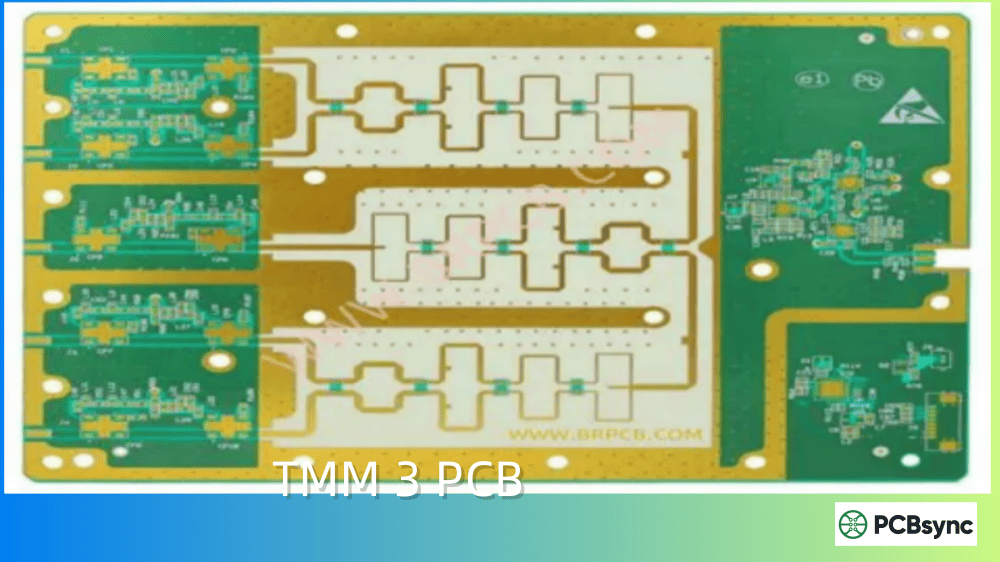
TMM 3
3.27
General RF, antennas requiring larger features
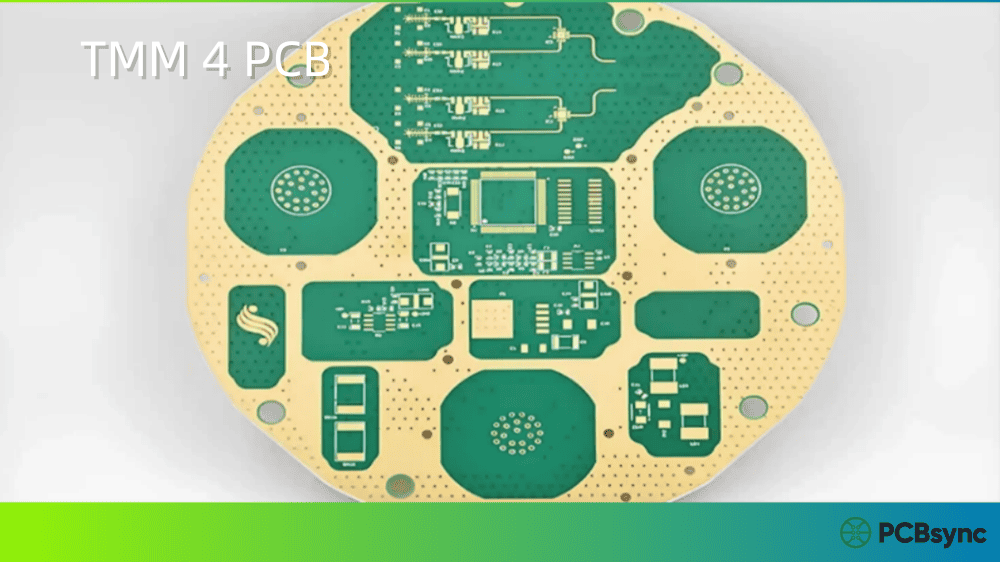
TMM 4
4.50
Balanced performance, moderate miniaturization
TMM 6
6.00
Filter applications, medium-Dk designs
TMM 10
9.20
High miniaturization, compact filters/couplers
TMM 10i
9.80 (isotropic)
Applications requiring isotropic Dk
TMM 13i
12.85 (isotropic)
Maximum miniaturization, dielectric resonators
TMM 10 sits in that sweet spot where you need significant size reduction without jumping to the extremely high Dk materials that can introduce additional design complexity.
TMM 10 PCB Key Specifications and Properties
Understanding the detailed specifications of TMM 10 PCB helps you determine whether it’s the right choice for your project. Here’s the complete breakdown based on Rogers’ official datasheet.
Electrical Properties of TMM 10
The electrical characteristics are what make TMM 10 PCB stand out for RF and microwave applications:
Property
Value
Test Condition
Dielectric Constant (Dk)
9.20 ± 0.23
10 GHz, 23°C
Dissipation Factor (Df)
0.0022
10 GHz
Thermal Coefficient of Dk
-38 ppm/°C
-55°C to +125°C
Volume Resistivity
10^7 MΩ·cm
C-96/35/90
Surface Resistivity
10^7 MΩ
C-96/35/90
That dissipation factor of 0.0022 at 10 GHz is excellent for a high-Dk material. For comparison, standard FR4 typically shows Df values around 0.02 at the same frequency, which is roughly ten times higher. The lower the Df, the less signal energy gets converted to heat in your traces.
The thermal coefficient of Dk (TCDk) at -38 ppm/°C deserves attention. This value falls well within the desirable range of less than |50| ppm/°C, meaning your circuit’s electrical characteristics remain stable across temperature variations. This stability is crucial for automotive electronics, outdoor base stations, or any application where the operating temperature fluctuates significantly.
Mechanical Properties of TMM 10
Beyond electrical performance, the mechanical characteristics affect both fabrication and long-term reliability:
Property
Value
Test Method
Tensile Modulus
1240 kpsi
IPC-TM-650 2.4.1.2
Tensile Strength
4.50 kpsi
IPC-TM-650 2.4.1.2
Flexural Strength
13.62 kpsi
IPC-TM-650
Flexural Modulus
1.79 Mpsi
IPC-TM-650
Specific Gravity
2.77
—
TMM 10 is based on thermoset resin, which means it doesn’t soften when heated like thermoplastic materials. This characteristic is particularly important for wire bonding operations. You can bond component leads directly to circuit traces without worrying about pad lifting or substrate deformation, a common headache with softer substrates.
Thermal Properties of TMM 10 PCB
Thermal management capability often gets overlooked during material selection, but it can make or break your design:
Property
Value
Notes
Thermal Conductivity
0.76 W/m/K
Approximately 2× traditional PTFE
CTE (X-axis)
21 ppm/°C
Matched to copper
CTE (Y-axis)
21 ppm/°C
Matched to copper
CTE (Z-axis)
23 ppm/°C
Excellent PTH reliability
Decomposition Temperature (Td)
425°C
TGA method
Moisture Absorption
0.09% (1.27mm)
24 hours immersion
The coefficient of thermal expansion (CTE) numbers are critical. TMM 10’s CTE closely matches copper (approximately 17 ppm/°C), which means your plated through-holes won’t experience the stress fractures that can occur with mismatched expansion rates during thermal cycling. This matching is why Rogers markets TMM 10 specifically for “high plated through-hole reliability.”
The thermal conductivity of 0.76 W/m/K might not seem impressive compared to metal-core PCBs, but it’s roughly twice what you get from traditional ceramic-filled PTFE laminates. Better heat dissipation means your power amplifier designs run cooler and more reliably.
TMM 10 PCB vs FR4 and PTFE: Material Comparison
Before diving into TMM variants, let’s address the fundamental question: why choose TMM 10 PCB over standard FR4 or traditional PTFE materials?
TMM 10 vs FR4 for High-Frequency Applications
FR4 remains the workhorse of the PCB industry for good reason. It’s affordable, widely available, and works perfectly fine for most digital designs. However, once you push frequencies above 1-2 GHz, FR4’s limitations become apparent.
The dissipation factor difference is particularly striking. At 10 GHz, FR4’s high Df translates to substantial insertion loss over even short trace lengths. A 2-inch microstrip on FR4 might lose 1-2 dB of signal, while the same trace on TMM 10 loses a fraction of that.
TMM 10 vs Traditional PTFE Laminates
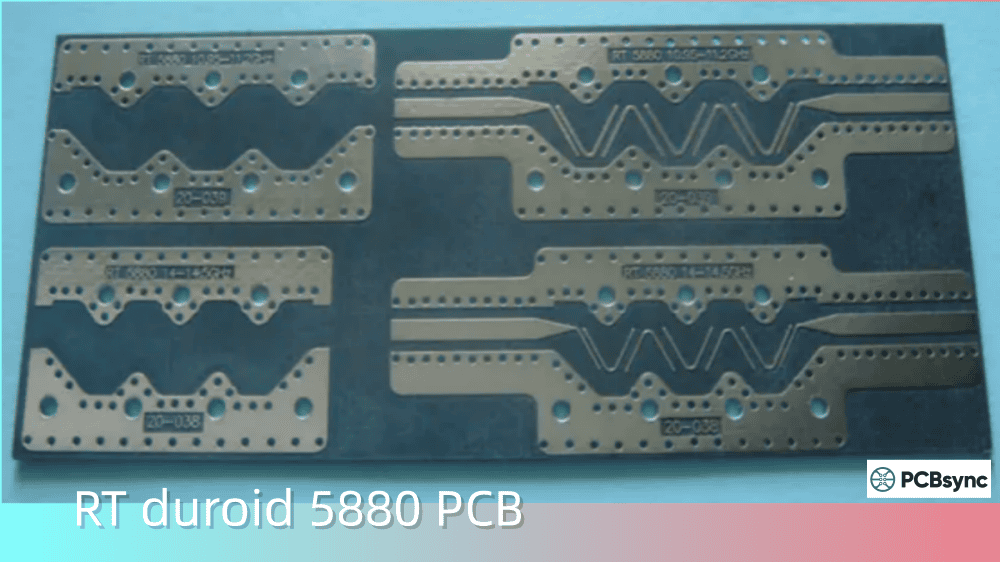
PTFE-based materials like RT5880 or TLY-5 offer excellent low-loss performance but come with processing challenges. Here’s how TMM 10 compares:
Aspect
TMM 10
PTFE (RT5880)
Winner
Processing Ease
Standard PCB methods
Requires special treatment
TMM 10
Dk Value
9.20
2.20
Depends on application
Dk Stability
Excellent
Very good
Tie
Cost
Moderate premium
High premium
TMM 10
Miniaturization
Excellent
Poor
TMM 10
The key advantage of TMM 10 over pure PTFE is processing simplicity. PTFE substrates typically require sodium naphthalate surface treatment before electroless plating can adhere properly. TMM 10 eliminates this step entirely, reducing processing time and potential failure points.
A common question I get is whether to use TMM 10 or TMM 10i. The “i” designation indicates an isotropic version of the material.
What Does Isotropic Mean for PCB Design?
In standard TMM 10, the dielectric constant can vary slightly depending on the direction of measurement relative to the material’s structure. This anisotropy is typically minor but can matter in precision applications.
TMM 10i provides an isotropic dielectric constant, meaning Dk remains consistent regardless of measurement orientation. This uniformity becomes important when you’re designing:
Circular or conformal patch antennas
3D molded microwave structures
Applications where signal paths aren’t strictly planar
Characteristic
TMM 10
TMM 10i
Dk Value
9.20
9.80
Dk Isotropy
Slightly anisotropic
Isotropic
Processing
Standard
Standard
Cost
Lower
Slightly higher
Best For
Stripline, microstrip
Conformal antennas, 3D shapes
For most conventional PCB designs using standard microstrip or stripline topologies, TMM 10 works perfectly fine. Reserve TMM 10i for specialized applications where isotropic properties genuinely matter.
Applications for TMM 10 PCB
The high dielectric constant and excellent thermal stability of TMM 10 PCB make it suitable for demanding RF and microwave applications. Here’s where engineers typically deploy this material:
Satellite Communication Systems
Satellite communications demand materials that maintain performance across extreme temperature ranges and can handle the vacuum of space without outgassing. TMM 10’s low moisture absorption (0.09%) and stable Dk across temperature make it a solid choice for transponder circuits and microwave components.
The material’s resistance to creep and cold flow means circuits maintain their dimensional stability even after years of thermal cycling in orbit.
Power Amplifiers and Combiners
Power amplifiers generate significant heat, especially in Class AB or push-pull configurations. TMM 10’s thermal conductivity helps move that heat away from active devices, while its high Dk enables compact matching networks.
The thermoset nature of the material ensures that solder joints and wire bonds remain reliable even when the board sees repeated thermal stress from power cycling.
Filters and Couplers
This is probably where TMM 10 PCB shines brightest. The high dielectric constant lets you design physically smaller filter elements. A hairpin filter on TMM 10 takes up significantly less board space than the same electrical design on lower-Dk materials.
The tight Dk tolerance (±0.23) ensures your filter response stays where you designed it, without the frequency shifts that plague designs on less controlled materials.
GPS and Global Navigation Antennas
GPS patch antennas benefit from TMM 10’s combination of high Dk and thermal stability. The high dielectric constant allows smaller antenna footprints, while the stable TCDk ensures center frequency doesn’t drift with ambient temperature changes.
Automotive Radar Systems
Modern automotive radar systems operating at 77 GHz demand materials with consistent high-frequency performance. While TMM 10 isn’t the primary choice for 77 GHz (materials like RT5880 dominate there), it’s commonly used in lower-frequency automotive applications and hybrid designs where different functions require different Dk values.
Microstrip and Patch Antenna Arrays
Phased array antennas and electronically scanned arrays (ESA/AESA) often use TMM 10 for feed networks and radiating elements where size reduction matters. The material’s compatibility with standard PCB processes makes it economical for medium-volume antenna production.
Design Considerations for TMM 10 PCB Projects
Working with TMM 10 PCB requires some adjustments to your typical design workflow. Here are practical tips from real-world experience.
Stack-Up Design for TMM 10
When designing multilayer boards with TMM 10, consider hybrid constructions that use TMM 10 only where needed. You might use TMM 10 for your RF layers while using lower-cost FR4 or Rogers PCB materials like RO4003C for digital and power distribution layers.
For bonding TMM layers in multilayer constructions, Rogers recommends their bonding films such as:
Rogers 3001 bondply for lower temperature processing (220°C)
Rogers PEF films for higher temperature requirements (300°C)
The key is ensuring your bonding material’s Dk is compatible with your overall impedance requirements. A mismatch can create discontinuities at layer transitions.
Impedance Control and Line Width Calculations
TMM 10’s high Dk means your microstrip traces will be narrower than you might expect. For a 50-ohm microstrip on 20 mil TMM 10, the trace width calculates to approximately 18 mils, compared to about 45 mils on FR4.
This miniaturization is a double-edged sword. You get smaller circuits but also tighter manufacturing tolerances. Make sure your fabricator can hold the line width and spacing tolerances your design requires.
Use Rogers’ free online calculation tools to determine accurate line widths for your specific stack-up. Don’t rely on generic formulas that don’t account for TMM 10’s actual Dk behavior across frequency.
Thermal Management in High-Power Designs
Even though TMM 10 has better thermal conductivity than traditional PTFE materials, high-power designs still need thermal planning. Consider:
Adding thermal vias under power devices
Using metal-backed constructions where TMM 10 bonds directly to aluminum or brass heat spreaders
Placing ground planes on both sides of RF signal layers to help spread heat
TMM 10 is available bonded directly to brass or aluminum plates for applications requiring enhanced thermal management. These metal-backed versions are common in power amplifier modules where heat dissipation is critical.
Via Design for Reliable PTH
TMM 10’s copper-matched CTE gives you inherently reliable plated through-holes, but good via design practices still apply:
Maintain proper aspect ratios (typically 8:1 or better for standard drilling)
Use appropriate pad-to-hole ratios for your copper weight
Consider via fill requirements for high-reliability applications
The material’s resistance to process chemicals means standard electroless copper and electroplating processes work without special surface treatments.
Grounding and Shielding Strategies
Effective grounding is critical in any RF design, and TMM 10 PCB projects are no exception. The high dielectric constant actually works in your favor here. Ground via spacing can be wider than on low-Dk materials while still maintaining effective shielding, because the wavelength in the dielectric is shorter.
For microstrip designs on TMM 10:
Place ground vias at intervals no greater than λ/10 in the dielectric
Use continuous ground planes under RF signal traces
Consider coplanar waveguide with ground (CPWG) for improved isolation
For stripline configurations, the symmetric ground planes inherent to the topology provide excellent shielding. TMM 10’s stable Dk ensures consistent wave velocity, making phase-matched trace routing more predictable.
Managing Parasitic Effects
The compact trace geometries enabled by TMM 10’s high Dk concentrate electromagnetic fields more intensely than lower-Dk designs. This concentration can increase coupling between adjacent traces if you’re not careful.
Design guidelines for managing parasitics:
Increase trace-to-trace spacing compared to low-Dk designs (at least 3× trace width for critical signals)
Use ground traces or coplanar ground between coupled lines
Pay attention to via placement near trace transitions to minimize inductance discontinuities
Simulate your layout with accurate material models before committing to fabrication
TMM 10 PCB Manufacturing and Fabrication Guidelines
Not every PCB fabricator has experience with TMM 10. Here’s what to look for and what to specify.
Drilling Parameters for TMM 10
TMM 10’s ceramic filler content makes it more abrasive than standard FR4. Carbide drill bits are mandatory, and you’ll see shorter tool life than with softer materials.
Parameter
Recommended Value
Spindle Speed
15,000 – 25,000 RPM
Feed Rate
Match to chip load recommendations
Drill Material
Solid carbide
Maximum Aspect Ratio
8:1 for standard drilling
Entry and backup materials should be selected to minimize burr formation. The ceramic content can cause more aggressive drilling debris, so proper vacuum evacuation is important.
Routing and Milling Considerations
For routing TMM 10, standard carbide end mills work well, but pay attention to surface speed. Excessive surface speeds (above 400 SFM) accelerate tool wear significantly.
Rogers’ testing shows that tools designed for standard FR4 milling (like single-flute upcut geometry) actually outperform tools specifically designed for PTFE when used on TMM materials. The harder ceramic-filled thermoset composition benefits from standard geometries.
Plating and Surface Finishes
One major advantage of TMM 10 over PTFE-based materials is the elimination of sodium naphthalate treatment before electroless plating. The thermoset surface accepts electroless copper directly, simplifying your fabrication process.
Standard surface finishes work well:
ENIG (Electroless Nickel Immersion Gold)
Immersion Silver
HASL (for applications where planarity isn’t critical)
OSP (for applications with short storage requirements)
For wire bonding applications, ENIG provides the most reliable bond surface.
Chemical Resistance During Processing
TMM 10 resists common PCB processing chemicals, including:
Copper etchants (acidic and alkaline)
Photoresist developers
Flux cleaners
Common solvents
This chemical resistance means you can use your standard process flow without worrying about material degradation.
Cost Factors and Procurement Tips
Let’s talk about what TMM 10 PCB actually costs and how to manage your material budget.
Material Cost Comparison
TMM 10 falls into the premium material category, significantly more expensive than FR4 but competitive with other high-frequency laminates:
Material
Relative Cost
Dk Range
Standard FR4
1× (baseline)
4.2 – 4.8
Rogers RO4003C
3-5×
3.38
Rogers TMM 10
4-7×
9.20
Rogers RT5880
8-12×
2.20
The actual cost depends on thickness, copper weight, panel size, and order quantity. Minimum order quantities (MOQ) often apply, especially for less common configurations.
Strategies to Reduce TMM 10 PCB Costs
Based on years of optimizing RF board costs, here are practical approaches:
Use hybrid constructions. Reserve TMM 10 for layers where you actually need the high Dk. Combining TMM 10 RF layers with FR4 support layers can cut your material cost by 40-50% on multilayer designs.
Optimize panel utilization. TMM 10 comes in standard panel sizes. Design your board outline and array configuration to maximize panels per sheet, minimizing waste.
Specify standard thicknesses. TMM 10 is readily available in thicknesses from 15 mils to 500 mils, with common values being 20, 25, 30, 50, and 60 mils. Specifying standard thicknesses avoids custom lamination charges.
Consider lead time in your planning. Rush orders on specialty materials carry significant premiums. Standard lead times for TMM 10 typically run 2-4 weeks for material, plus fabrication time.
Ordering and Supplier Selection
When selecting a fabricator for TMM 10 PCB projects:
Verify they have actual experience with TMM materials, not just general RF capabilities
Ask for DFM review before committing to production
Request impedance test coupons for controlled impedance designs
Ensure they have proper storage facilities for moisture-sensitive materials
Useful Resources and Downloads
Here are the essential resources for working with TMM 10 PCB:
Official Rogers Corporation Resources
Resource
Description
Link
TMM Datasheet
Complete specifications for TMM 3, 4, 6, 10, 10i, 13i
Rogers MWI Calculator: Free online tool for microstrip, stripline, and coplanar waveguide calculations
Saturn PCB Design Toolkit: Includes impedance calculators supporting Rogers materials
Altium Designer / Cadence Allegro: Both support Rogers material libraries for accurate simulation
Technical Papers and Application Notes
Rogers publishes technical papers covering specific design challenges with TMM materials. Search their resources library for topics including:
Hybrid multilayer construction techniques
Thermal management strategies
Processing guidelines for thermoset materials
Frequently Asked Questions About TMM 10 PCB
What is the dielectric constant (Dk) of Rogers TMM 10?
Rogers TMM 10 has a process dielectric constant of 9.20 ± 0.23 when measured at 10 GHz and 23°C. This high Dk value enables significant circuit miniaturization compared to lower-Dk materials like FR4 (Dk ~4.5) or RO4003C (Dk ~3.38). The tight tolerance of ±0.23 ensures predictable RF performance without frequency trimming.
Can TMM 10 be used in multilayer PCB constructions?
Yes, TMM 10 works well in multilayer constructions. Rogers offers compatible bonding materials (3001 bondply, PEF films) specifically designed for laminating TMM layers. Many designers create hybrid stack-ups combining TMM 10 for RF layers with FR4 or other Rogers materials for digital and power layers. This approach optimizes both performance and cost.
Is TMM 10 suitable for lead-free soldering?
TMM 10 is fully compatible with lead-free assembly processes. With a decomposition temperature (Td) of 425°C, it easily withstands the higher temperatures required for lead-free soldering profiles (typically peaking around 260°C). The thermoset resin base provides dimensional stability through multiple reflow cycles.
What frequency range is TMM 10 best suited for?
TMM 10 PCB performs well from low RF frequencies through approximately 40 GHz, though it’s most commonly used in designs operating below 20 GHz. For applications above 40 GHz, engineers typically move to lower-Dk materials like RT5880 (Dk ~2.2) where the narrower trace widths of high-Dk materials become impractical. TMM 10’s sweet spot includes L-band through Ku-band applications.
How does TMM 10 compare to alumina ceramic substrates?
TMM 10 was specifically developed as an alternative to alumina substrates. Both offer high dielectric constants and good thermal stability, but TMM 10 provides significant advantages in processing. Alumina requires specialized cutting, drilling, and metallization equipment, while TMM 10 uses standard PCB fabrication processes. TMM 10 also offers larger available panel sizes and tighter thickness tolerances than typical alumina substrates.
Final Thoughts on TMM 10 PCB Selection
Choosing TMM 10 PCB makes sense when your design genuinely benefits from its high dielectric constant and you need the thermal stability for demanding applications. It’s not the cheapest material, and it’s not the right choice for every RF design, but for compact filters, miniaturized antenna elements, and high-reliability microwave circuits, TMM 10 delivers performance that’s hard to match.
The key is matching material capabilities to actual design requirements. If you need high Dk for miniaturization and you’re working in environments with temperature variation, TMM 10 should be on your short list. If you just need general RF performance and cost is a primary driver, look at the RO4000 series first.
Whatever you choose, make sure your fabrication partner has real experience with the material. TMM 10 isn’t difficult to process, but it does require attention to drilling parameters, proper bonding materials for multilayer work, and appropriate handling for moisture-sensitive materials.
The investment in premium materials pays off when your circuit works the first time and keeps working reliably in the field. That’s ultimately what we’re all after.
Inquire: Call 0086-755-23203480, or reach out via the form below/your sales contact to discuss our design, manufacturing, and assembly capabilities.
Quote: Email your PCB files to Sales@pcbsync.com (Preferred for large files) or submit online. We will contact you promptly. Please ensure your email is correct.
Notes: For PCB fabrication, we require PCB design file in Gerber RS-274X format (most preferred), *.PCB/DDB (Protel, inform your program version) format or *.BRD (Eagle) format. For PCB assembly, we require PCB design file in above mentioned format, drilling file and BOM. Click to download BOM template To avoid file missing, please include all files into one folder and compress it into .zip or .rar format.