Inquire: Call 0086-755-23203480, or reach out via the form below/your sales contact to discuss our design, manufacturing, and assembly capabilities.
Quote: Email your PCB files to Sales@pcbsync.com (Preferred for large files) or submit online. We will contact you promptly. Please ensure your email is correct.
Notes: For PCB fabrication, we require PCB design file in Gerber RS-274X format (most preferred), *.PCB/DDB (Protel, inform your program version) format or *.BRD (Eagle) format. For PCB assembly, we require PCB design file in above mentioned format, drilling file and BOM. Click to download BOM template To avoid file missing, please include all files into one folder and compress it into .zip or .rar format.
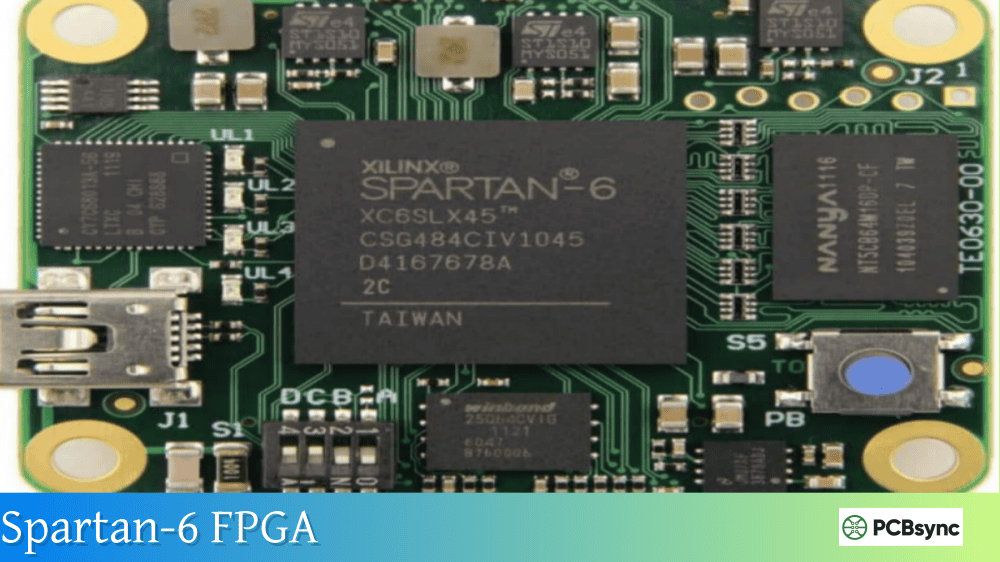
The XC6SLX9 has become one of the most popular FPGAs for learning digital design and building embedded systems. As a member of the Xilinx Spartan 6 family, this device hits a sweet spot between capability and accessibility that makes it ideal for students, hobbyists, and professionals working on cost-sensitive projects. I’ve used this chip across numerous prototypes over the years, and this tutorial will share everything you need to get started—from understanding the pinout to programming your first project.
Whether you’re picking up your first Xilinx Spartan 6 XC6SLX9 FPGA development board or migrating from microcontrollers to programmable logic, this guide provides the practical knowledge you need.
The XC6SLX9 is a member of the Xilinx Spartan-6 LX family, manufactured on a 45nm process. It sits in the lower-middle of the Spartan-6 lineup, offering enough resources for real projects while remaining affordable for educational purposes.
Unlike a microcontroller that executes sequential instructions, the Xilinx XC6SLX9 implements actual digital circuits in programmable logic. This means you can create custom hardware—parallel processing, precise timing control, and dedicated peripherals—all reconfigurable with a simple bitstream upload.
XC6SLX9 Key Specifications
Specification
Value
Logic Cells
9,152
CLB Slices
1,430
Slice Registers (Flip-Flops)
11,440
Slice LUTs
5,720
Block RAM
576 Kb (32 × 18 Kb blocks)
DSP48A1 Slices
16
CMTs (Clock Management Tiles)
2
Maximum User I/O
200
Global Clock Buffers
16
Process Technology
45nm
Core Voltage
1.0V (-1L) or 1.2V (-2, -3)
The 9,152 logic cells provide enough capacity for implementing UART controllers, VGA drivers, SPI/I2C masters, simple processors, and various signal processing blocks. The 16 DSP slices handle multiplication and accumulation operations efficiently for filter implementations.
Xilinx Spartan 6 SLX9 Package Options
The Xilinx Spartan 6 SLX9 comes in several package variants. Your choice affects PCB layout complexity, available I/O count, and whether you can hand-solder the device.
Package
Pins
Max User I/O
Body Size
Ball Pitch
TQG144
144
102
20 × 20 mm
TQFP 0.5mm
CSG225
225
160
13 × 13 mm
BGA 0.8mm
CSG324
324
200
15 × 15 mm
BGA 0.8mm
FTG256
256
186
17 × 17 mm
BGA 1.0mm
For hobbyists and prototyping, the TQG144 package is the go-to choice. It’s a standard TQFP with 0.5mm pin pitch—challenging but achievable with a fine-tip soldering iron and flux. The BGA packages require reflow soldering equipment.
XC6SLX9 Pinout Overview
Understanding the XC6SLX9 pinout is essential for both custom PCB design and working with development boards. The 144-pin TQFP variant (TQG144) organizes pins into distinct categories.
Pin Categories
Pin Type
Count (TQG144)
Description
User I/O
102
General-purpose programmable I/O
Power (VCCINT)
8
1.2V core supply
Power (VCCAUX)
8
2.5V or 3.3V auxiliary supply
Power (VCCO)
12
I/O bank supply (1.2V–3.3V)
Ground (GND)
12
Ground connections
Configuration
6
JTAG, PROGRAM_B, DONE, etc.
Clock
4
Dedicated clock inputs
I/O Bank Organization
The XC6SLX9 TQG144 package includes two I/O banks, each with independent VCCO power:
Bank
User I/O Count
VCCO Options
Notes
Bank 0
34
1.2V–3.3V
Contains configuration pins
Bank 2
68
1.2V–3.3V
Main user I/O bank
Each bank supports different I/O standards based on the VCCO voltage:
VCCO Voltage
Supported Standards
3.3V
LVCMOS33, LVTTL
2.5V
LVCMOS25, SSTL25
1.8V
LVCMOS18, SSTL18
1.5V
LVCMOS15, SSTL15
1.2V
LVCMOS12
Essential Configuration Pins
These pins control FPGA configuration and must be properly connected:
Pin Name
Pin Number (TQG144)
Function
PROGRAM_B
P38
Active-low reconfiguration trigger
DONE
P53
Configuration complete indicator
INIT_B
P40
Initialization status
TCK
P109
JTAG clock input
TDI
P110
JTAG data input
TDO
P106
JTAG data output
TMS
P107
JTAG mode select
CCLK
P70
Configuration clock
For SPI flash configuration (common on development boards), additional pins come into play:
Xilinx Spartan 6 XC6SLX9 FPGA Development Board Options
Rather than designing a custom PCB, most people start with a Xilinx Spartan 6 XC6SLX9 FPGA development board. Several affordable options exist:
Board
Price Range
Key Features
Mimas (Numato)
~$40
USB config, 70 I/O, SPI flash
ALINX AX309
~$50
SDRAM, VGA, 7-segment, UART
easyFPGA-Spartan-6
~$35
SDRAM, VGA, PS/2, ADC
EDGE Spartan 6
~$60
WiFi, Bluetooth, VGA, LCD
XC6SLX9 Mini Board
~$25
72 I/O, USB-UART, compact
Mojo V3 (Embedded Micro)
~$80
Arduino shield compatible
What to Look for in a Development Board
When selecting a Xilinx Spartan 6 XC6SLX9 FPGA development board, consider:
Programming interface: USB-based programming (via onboard controller) is most convenient. JTAG headers allow use with Xilinx Platform Cable USB if needed.
Configuration storage: Onboard SPI flash enables boot-from-power-on functionality. Without it, you’ll need to reprogram after every power cycle.
Clock source: A 50 MHz oscillator is standard. Some boards include multiple clock options.
Power supply: USB-powered boards simplify setup. Some designs require external 5V for peripherals.
Programming the XC6SLX9: ISE Design Suite Setup
The XC6SLX9 requires Xilinx ISE Design Suite for development. Unlike newer Xilinx devices that use Vivado, Spartan-6 is only supported in ISE.
Installing ISE 14.7
ISE 14.7 is the final release and remains available for free download:
Component
Details
Software
ISE Design Suite 14.7
License
WebPACK (free)
Download Size
~6.5 GB
OS Support
Windows 7 (native), Windows 10/11 (VM)
ISE doesn’t install cleanly on Windows 10/11. The recommended approach is using the pre-configured virtual machine image AMD provides, which runs under VirtualBox.
Creating Your First Project
Here’s the workflow for implementing a design on the Xilinx XC6SLX9:
Step 1: Create New Project
Open ISE Project Navigator
File → New Project
Set project name and location
Select device: Family = Spartan6, Device = XC6SLX9, Package = TQG144 (or your board’s package), Speed = -2
Step 2: Add HDL Source Files
Create new source (VHDL or Verilog)
Write your design
Step 3: Create UCF Constraints File
Add new source → Implementation Constraints File
Map logical signals to physical pins
Step 4: Synthesize and Implement
Double-click “Synthesize – XST”
Double-click “Implement Design”
Double-click “Generate Programming File”
Step 5: Program the FPGA
Use iMPACT (JTAG) or board-specific tool (USB)
Select the generated .bit file
UCF File Format
The User Constraints File (UCF) maps your HDL ports to physical XC6SLX9 pins:
# Clock input (50 MHz oscillator)
NET “clk” LOC = P126;
NET “clk” IOSTANDARD = LVCMOS33;
# Push buttons
NET “btn<0>” LOC = P124;
NET “btn<1>” LOC = P123;
NET “btn<0>” IOSTANDARD = LVCMOS33;
NET “btn<1>” IOSTANDARD = LVCMOS33;
# LEDs
NET “led<0>” LOC = P44;
NET “led<1>” LOC = P43;
NET “led<0>” IOSTANDARD = LVCMOS33;
NET “led<1>” IOSTANDARD = LVCMOS33;
Pin numbers vary between development boards—always reference your board’s schematic or provided UCF template.
XC6SLX9 Beginner Projects
Learning FPGA development is best done through hands-on projects. Here are progressive examples suitable for the XC6SLX9:
Project 1: LED Blinker
The “Hello World” of FPGA—blink an LED using a clock divider:
module led_blink(
input clk, // 50 MHz clock
output reg led // LED output
);
reg [25:0] counter;
always @(posedge clk) begin
counter <= counter + 1;
if (counter == 0)
led <= ~led;
end
endmodule
This creates approximately 1.3-second blink period from a 50 MHz clock.
Resource usage: ~30 LUTs, ~27 registers
Project 2: Button Debouncer with LED Control
Physical buttons bounce—the contact makes and breaks multiple times during a press. This project implements proper debouncing:
module button_led(
input clk,
input btn,
output reg led
);
reg [19:0] debounce_counter;
reg btn_stable;
reg btn_prev;
always @(posedge clk) begin
if (btn != btn_stable) begin
debounce_counter <= debounce_counter + 1;
if (debounce_counter == 20’hFFFFF) begin
btn_stable <= btn;
debounce_counter <= 0;
end
end else begin
debounce_counter <= 0;
end
btn_prev <= btn_stable;
if (btn_stable && !btn_prev) // Rising edge
led <= ~led;
end
endmodule
Resource usage: ~50 LUTs, ~45 registers
Project 3: UART Transmitter
Serial communication is fundamental. This implements a basic 115200 baud transmitter:
if (h_count < H_VISIBLE && v_count < V_VISIBLE) begin
case (h_count[9:7]) // 8 vertical bars
3’d0: begin red <= 4’hF; green <= 4’hF; blue <= 4’hF; end // White
3’d1: begin red <= 4’hF; green <= 4’hF; blue <= 4’h0; end // Yellow
3’d2: begin red <= 4’h0; green <= 4’hF; blue <= 4’hF; end // Cyan
3’d3: begin red <= 4’h0; green <= 4’hF; blue <= 4’h0; end // Green
3’d4: begin red <= 4’hF; green <= 4’h0; blue <= 4’hF; end // Magenta
3’d5: begin red <= 4’hF; green <= 4’h0; blue <= 4’h0; end // Red
3’d6: begin red <= 4’h0; green <= 4’h0; blue <= 4’hF; end // Blue
3’d7: begin red <= 4’h0; green <= 4’h0; blue <= 4’h0; end // Black
endcase
end else begin
red <= 4’h0; green <= 4’h0; blue <= 4’h0;
end
end
endmodule
Resource usage: ~120 LUTs, ~45 registers
Project 5: Seven-Segment Display Multiplexer
Drive multiple 7-segment digits with time-multiplexing:
Resource usage: ~90 LUTs, ~50 registers
These projects form a solid foundation. From here, you can explore SPI flash interfaces, I2C sensors, PWM motor control, and even soft processor implementations like PicoBlaze.
Advanced XC6SLX9 Applications
Once comfortable with basics, the Xilinx Spartan 6 SLX9 supports more sophisticated projects:
Application
Typical Resource Usage
Notes
PicoBlaze Processor
~100 LUTs
Simple 8-bit soft processor
I2C Master
~150 LUTs
Interface to sensors, EEPROMs
SPI Master
~80 LUTs
Flash, ADC, DAC interfaces
PWM Controller
~50 LUTs per channel
Motor control, LED dimming
PS/2 Keyboard
~100 LUTs
Keyboard/mouse interface
SD Card Controller
~400 LUTs
FAT filesystem access
Audio DAC (PWM)
~60 LUTs
Simple audio output
Frequency Counter
~200 LUTs
Measurement applications
The 576 Kb of Block RAM enables frame buffers, lookup tables, and data buffering. The 16 DSP slices efficiently implement FIR filters, audio processing, and mathematical functions.
Useful Resources and Downloads
Official Documentation
Document
Content
DS160
Spartan-6 Family Overview
DS162
DC and AC Switching Characteristics
UG380
Configuration User Guide
UG381
SelectIO Resources
UG382
Clocking Resources
UG383
Block RAM Resources
UG384
Configurable Logic Block
UG385
Packaging and Pinouts
UG388
Memory Controller User Guide
UG389
DSP48A1 Slice User Guide
Software Downloads
ISE Design Suite 14.7 WebPACK — AMD/Xilinx Archive Downloads
ISE Virtual Machine — Pre-configured VM for Windows 10/11
Platform Cable USB II Drivers — For JTAG programming
Community Resources
GitHub: ALINX-AX309 Projects — Lab examples for XC6SLX9 boards
GitHub: spartan-6-xc6slx9-rz-easyfpga-x1 — Pin definitions and examples
AllAboutFPGA.com — Tutorials and EDGE board resources
Numato Lab Help Center — Mimas board documentation
FPGA4Fun.com — General FPGA tutorials
Development Board Resources
Most board manufacturers provide:
Schematic PDFs
UCF constraint files
Example projects
User manuals
Download these before starting development—the UCF file alone saves hours of pin mapping work.
Frequently Asked Questions
Can I program the XC6SLX9 with Vivado?
No. The XC6SLX9 and all Spartan-6 devices require ISE Design Suite. Vivado only supports 7 Series and newer FPGAs. ISE 14.7 WebPACK is free and includes all necessary tools for Spartan-6 development.
What’s the difference between XC6SLX9-2TQG144C and XC6SLX9-2TQG144I?
The suffix indicates temperature grade: “C” is commercial (0°C to +85°C) and “I” is industrial (-40°C to +100°C). The “-2” indicates speed grade. For most hobbyist and development work, commercial grade is sufficient and typically lower cost.
How do I store my design permanently on the XC6SLX9?
The XC6SLX9 uses SRAM-based configuration—it loses programming when powered off. To make designs persistent, program an external SPI flash (like M25P16 or W25Q64). Most development boards include this flash and boot automatically from it. In ISE, generate an MCS file using iMPACT’s PROM File Formatter, then program the flash via JTAG.
Is the XC6SLX9 suitable for learning FPGA development?
Yes, the Xilinx XC6SLX9 is an excellent learning device. Its 9,152 logic cells handle meaningful projects without being overwhelming. The availability of inexpensive development boards (under $50) and free tools makes it accessible. The main drawback is ISE’s age—newer devices use Vivado, which offers a better development experience.
What programming cable do I need for the XC6SLX9?
It depends on your development board. Many modern boards include USB-based configuration and don’t require an external programmer. For boards with only JTAG headers, you’ll need a Xilinx Platform Cable USB or compatible clone. Some boards work with generic FTDI-based JTAG adapters using third-party tools like xc3sprog.
Conclusion
The XC6SLX9 remains a capable and affordable entry point into FPGA development. While it’s built on older technology and requires legacy tools, the fundamental concepts you learn apply directly to newer devices. The wealth of available development boards, documentation, and community projects makes it straightforward to get started.
Start with the LED blinker, progress through UART and VGA projects, and you’ll develop an intuition for hardware description that transfers to any FPGA family. The investment in learning pays dividends when you need custom digital logic that no microcontroller can match.
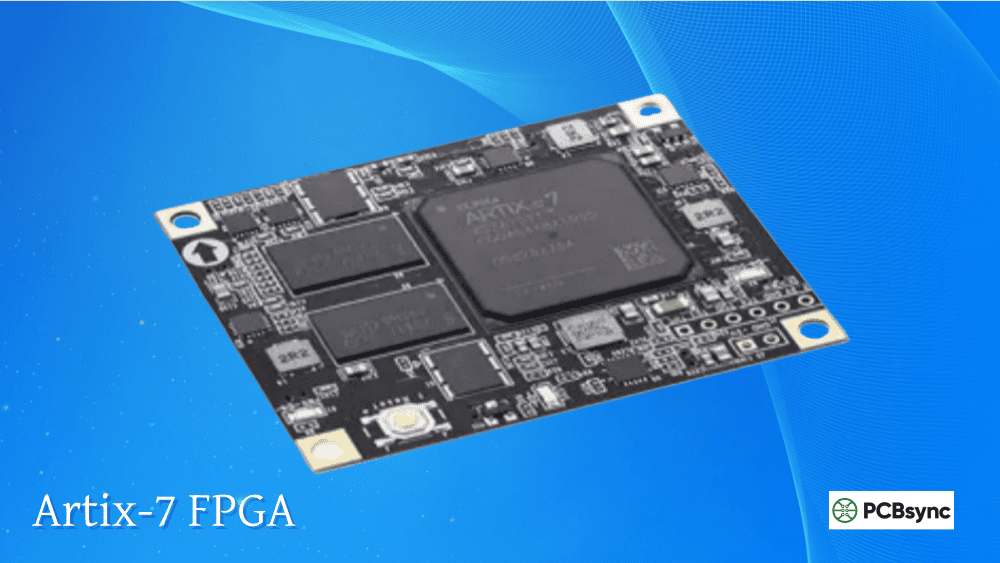
For those ready to move beyond the Xilinx Spartan 6 SLX9, the natural progression is to Spartan-7 or Artix-7 devices, which offer improved performance, lower power consumption, and the modern Vivado toolchain—but the design principles remain the same.
Inquire: Call 0086-755-23203480, or reach out via the form below/your sales contact to discuss our design, manufacturing, and assembly capabilities.
Quote: Email your PCB files to Sales@pcbsync.com (Preferred for large files) or submit online. We will contact you promptly. Please ensure your email is correct.
Notes: For PCB fabrication, we require PCB design file in Gerber RS-274X format (most preferred), *.PCB/DDB (Protel, inform your program version) format or *.BRD (Eagle) format. For PCB assembly, we require PCB design file in above mentioned format, drilling file and BOM. Click to download BOM template To avoid file missing, please include all files into one folder and compress it into .zip or .rar format.