Inquire: Call 0086-755-23203480, or reach out via the form below/your sales contact to discuss our design, manufacturing, and assembly capabilities.
Quote: Email your PCB files to Sales@pcbsync.com (Preferred for large files) or submit online. We will contact you promptly. Please ensure your email is correct.
Notes: For PCB fabrication, we require PCB design file in Gerber RS-274X format (most preferred), *.PCB/DDB (Protel, inform your program version) format or *.BRD (Eagle) format. For PCB assembly, we require PCB design file in above mentioned format, drilling file and BOM. Click to download BOM template To avoid file missing, please include all files into one folder and compress it into .zip or .rar format.
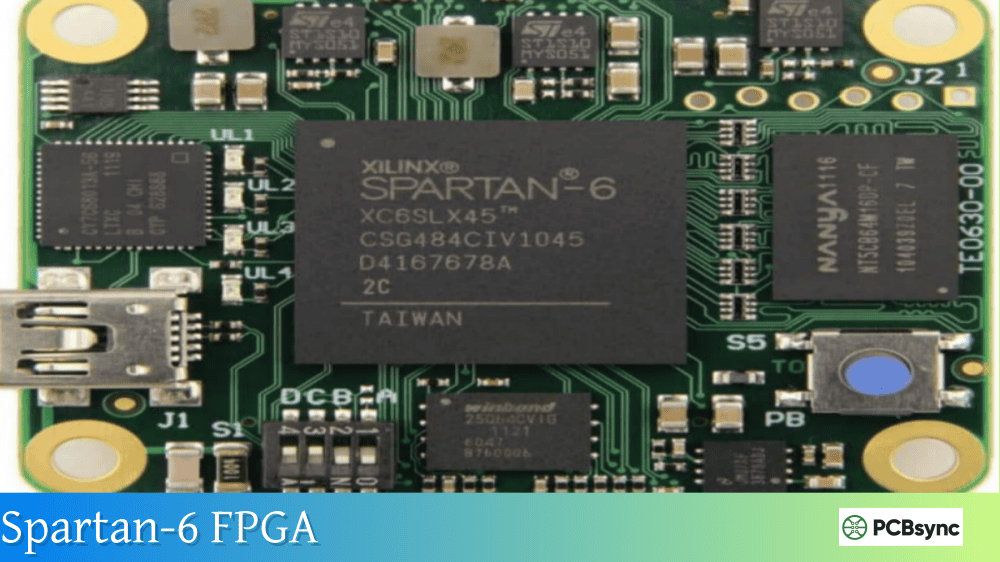
When a project outgrows the mid-range Spartan-6 devices but doesn’t warrant the cost of the XC6SLX75 or larger, the XC6SLX45 and XC6SLX45T hit the sweet spot. With 43,661 logic cells, 58 DSP slices, and over 2 Mb of block RAM, these devices handle serious workloads—video processing, multi-channel signal processing, and complex embedded systems. I’ve used the XC6SLX45 on several video processing boards where it comfortably handled 1080p pipelines that would have choked smaller devices.
This guide covers both variants in detail: the logic-optimized XC6SLX45 (LX series) and the transceiver-equipped XC6SLX45T (LXT series), helping you determine which fits your application and how to get the most from these high-capacity Spartan-6 FPGAs.
Understanding the XC6SLX45 vs XC6SLX45T Difference
The fundamental distinction between these two devices comes down to high-speed serial transceivers. Both share identical logic resources, but the XC6SLX45T adds GTP transceivers and a hard PCIe endpoint block—features that justify the “T” suffix and higher price point.
XC6SLX45 vs XC6SLX45T Comparison
Feature
XC6SLX45 (LX)
XC6SLX45T (LXT)
Logic Cells
43,661
43,661
CLB Slices
6,822
6,822
Block RAM
2,088 Kb
2,088 Kb
DSP48A1 Slices
58
58
GTP Transceivers
None
4
Maximum GTP Speed
N/A
3.2 Gb/s
PCIe Hard Block
No
Yes (x1 Gen1)
Memory Controllers
2 MCBs
2 MCBs
Maximum User I/O
358
296
Price Range
Lower
Higher
Choose the XC6SLX45 when your design needs maximum I/O count and doesn’t require high-speed serial interfaces. Select the XC6SLX45T when you need PCIe connectivity, SATA, Aurora, or other protocols requiring the GTP transceivers.
XC6SLX45 Complete Specifications
Core Logic Resources
Resource
Quantity
Notes
Logic Cells
43,661
Equivalent gate count
CLB Slices
6,822
Configurable Logic Blocks
Slice Registers
54,576
Flip-flops
Slice LUTs
27,288
6-input lookup tables
LUTs as Logic
27,288
Combinatorial functions
LUTs as Memory
6,408
Distributed RAM capability
Maximum Distributed RAM
401 Kb
Across all SLICEMs
The XC6SLX45 provides nearly triple the logic capacity of the XC6SLX16, making it suitable for complex state machines, multi-protocol interfaces, and designs requiring significant parallel processing.
Block RAM Configuration
Specification
Value
Block RAM Tiles
116
Total Block RAM
2,088 Kb
RAM per Tile
18 Kb (configurable as 2 × 9 Kb)
Maximum Data Width
36 bits per port
True Dual-Port
Yes
Built-in FIFO Logic
Yes
The substantial block RAM capacity enables frame buffering for video applications, large lookup tables, and multi-channel audio processing without external memory.
DSP48A1 Slice Details
Feature
Specification
DSP Slice Count
58
Multiplier Size
18 × 18 signed
Accumulator Width
48-bit
Pre-adder
18-bit
Maximum Frequency
250 MHz
Cascade Chain
Yes
With 58 DSP slices, the XC6SLX45 supports complex signal processing applications including multi-channel FIR filters, FFT implementations, and image processing algorithms requiring substantial multiply-accumulate throughput.
Clock Management Resources
Resource
Count
Description
Clock Management Tiles
4
CMT blocks
DCMs per CMT
2
Digital Clock Managers
PLLs per CMT
1
Phase-Locked Loops
Total DCMs
8
Frequency synthesis
Total PLLs
4
High-frequency generation
Global Clock Networks
16
Low-skew distribution
The four CMTs provide extensive clocking flexibility for multi-clock-domain designs common in video processing and communication applications.
The integrated PCIe endpoint block in the XC6SLX45T eliminates the need for soft PCIe IP, saving significant logic resources and simplifying timing closure.
Package Options for XC6SLX45 and XC6SLX45T
XC6SLX45 Available Packages
Package
Pins
Body Size
Ball Pitch
Max I/O
MCBs
CSG324
324
15 × 15 mm
0.8 mm
218
2
CSG484
484
19 × 19 mm
0.8 mm
316
2
FGG484
484
23 × 23 mm
1.0 mm
316
2
FGG676
676
27 × 27 mm
1.0 mm
358
2
FGG900
900
31 × 31 mm
1.0 mm
358
2
XC6SLX45T Available Packages
Package
Pins
Body Size
Ball Pitch
Max I/O
GTPs
MCBs
CSG324
324
15 × 15 mm
0.8 mm
190
2
2
CSG484
484
19 × 19 mm
0.8 mm
250
4
2
FGG484
484
23 × 23 mm
1.0 mm
296
4
2
FGG676
676
27 × 27 mm
1.0 mm
296
4
2
Note that the XC6SLX45T in CSG324 package only provides 2 GTP transceivers—the smaller package cannot route all four. For full transceiver access, use CSG484 or larger.
Speed Grades and Power Considerations
Available Speed Grades
Speed Grade
Performance
Power Mode
Availability
-3
Highest
Standard
LX and LXT
-3N
Highest (lead-free)
Standard
LX and LXT
-2
Standard
Standard
LX and LXT
-1L
Reduced
Low power (1.0V)
LX only
The -3 speed grade achieves maximum performance with internal logic exceeding 500 MHz for simple paths. The -1L option reduces core voltage to 1.0V for power-sensitive applications but is not available for the XC6SLX45T.
Power Supply Requirements
Rail
Voltage
Typical Current (XC6SLX45)
VCCINT
1.2V (1.0V for -1L)
3.0 mA quiescent
VCCAUX
2.5V or 3.3V
Per CMT/PLL usage
VCCO
1.2V to 3.3V
Per I/O bank
MGTAVCC
1.2V
GTP analog (LXT only)
MGTAVTT
1.2V
GTP termination (LXT only)
The XC6SLX45T requires additional power rails (MGTAVCC, MGTAVTT) for the GTP transceivers—plan your power distribution accordingly.
Both the XC6SLX45 and XC6SLX45T include two hard Memory Controller Blocks, enabling high-performance DDR3/DDR2/DDR/LPDDR interfaces without consuming logic resources.
MCB Specifications
Feature
Specification
MCB Count
2
Memory Types
DDR3, DDR2, DDR, LPDDR
Maximum Data Rate
800 Mb/s (DDR3-800)
Data Width Options
4, 8, or 16 bits
Port Architecture
Multi-port with FIFOs
ECC Support
Optional
Calibration
Automatic on power-up
Each MCB supports independent memory devices, enabling configurations like dual 256 MB DDR3 banks or a single wider interface with interleaving.
Practical Applications for XC6SLX45 and XC6SLX45T
Video Processing Applications
The XC6SLX45 excels in video processing thanks to its substantial block RAM and DSP resources:
Application
Resource Usage
Notes
1080p frame buffer
External DDR via MCB
Block RAM for line buffers
Image stabilization
~15,000 LUTs
Real-time motion estimation
Color space conversion
~2,000 LUTs + DSP
YCbCr to RGB pipelines
Video scaling
DSP slices
Bilinear/bicubic interpolation
OSD overlay
Block RAM
Character/graphics storage
Research implementations have demonstrated real-time digital image stabilization on the XC6SLX45 achieving 104 frames per second for 480p video with only 24 mW power consumption in the FPGA fabric.
Communication and Networking
Application
Device Choice
Key Features Used
PCIe data acquisition
XC6SLX45T
Hard PCIe endpoint, DDR3 MCB
Gigabit Ethernet MAC
XC6SLX45
Soft MAC, external PHY
SATA controller
XC6SLX45T
GTP transceivers
Multi-protocol bridge
XC6SLX45
Logic + MCB
Software Defined Radio
XC6SLX45T
DSP slices, GTP for data
Industrial Control Systems
Application
Typical Resource Usage
Multi-axis motor control
~8,000 LUTs, 12 DSP slices
PLC coprocessor
~15,000 LUTs, Block RAM
Industrial Ethernet
~20,000 LUTs
Sensor fusion
DSP slices, distributed RAM
Real-time control loops
~5,000 LUTs per axis
Development Boards Featuring XC6SLX45 and XC6SLX45T
Several development platforms support prototyping with these devices:
Board
FPGA
Key Features
Use Case
Digilent Atlys
XC6SLX45-CSG324
DDR2, HDMI, Ethernet, Audio
Video/Audio processing
Numato Galatea
XC6SLX45T-FGG484
PCIe x1, 2GB DDR3, SATA
PCIe development
ALINX AX545
XC6SLX45-CSG324
Gigabit Ethernet, VGA, PMOD
General development
Various Chinese boards
XC6SLX45
DDR3, VGA, expansion
Budget prototyping
The Digilent Atlys was particularly popular for academic video processing projects, offering HDMI input/output alongside the XC6SLX45 FPGA.
Configuration and Programming
Configuration File Sizes
Device
Uncompressed Bitstream
Typical Compressed
XC6SLX45
~11.9 Mb
~3.5 MB
XC6SLX45T
~11.9 Mb
~3.5 MB
Recommended Configuration Flash
Flash Type
Capacity
Notes
SPI Flash
16 Mb minimum
M25P16 or equivalent
BPI Flash
32 Mb minimum
Parallel for faster boot
Platform Flash
XCF32P
Xilinx solution
Configuration time from SPI flash at 33 MHz CCLK takes approximately 350 ms for the XC6SLX45—acceptable for most applications but consider BPI mode for faster startup requirements.
Design Considerations and Best Practices
Power Distribution
The XC6SLX45 and XC6SLX45T require careful power sequencing:
VCCINT must ramp before or with VCCAUX
VCCO banks can power independently
For LXT devices, MGTAVCC and MGTAVTT require dedicated regulators
Use bulk and bypass capacitors per Xilinx recommendations (UG393)
PCB Layout Guidelines
Consideration
Recommendation
Layer count
Minimum 6 layers for FGG484
Power planes
Dedicated VCCINT and VCCAUX planes
GTP routing
Matched differential pairs, ground shielding
DDR3 interface
Length-matched, impedance-controlled
Decoupling
0402/0603 capacitors close to package
Useful Resources and Documentation
Official AMD/Xilinx Documentation
Document
Description
DS160
Spartan-6 Family Overview
DS162
DC and AC Switching Characteristics
UG380
Configuration User Guide
UG381
SelectIO Resources
UG382
Clocking Resources
UG383
Block RAM Resources
UG386
GTP Transceivers (LXT only)
UG388
Memory Controller User Guide
UG389
DSP48A1 Slice User Guide
UG393
PCB Design Guide
Software and IP Downloads
ISE Design Suite 14.7 WebPACK — Free download from AMD/Xilinx
ISE Windows 10/11 VM — Pre-configured virtual machine
What’s the main advantage of XC6SLX45T over XC6SLX45?
The XC6SLX45T includes four GTP transceivers capable of 3.2 Gb/s and a hard PCIe Gen1 endpoint block. If your design requires PCIe, SATA, DisplayPort, or other high-speed serial protocols, the LXT variant eliminates the need for external PHY devices and saves substantial logic resources. The standard XC6SLX45 offers more user I/O pins (358 vs 296) and lower cost when transceivers aren’t needed.
Can I use Vivado with the XC6SLX45 or XC6SLX45T?
No, Vivado does not support any Spartan-6 devices. You must use ISE Design Suite 14.7, available free as WebPACK edition. ISE runs on Windows 7 natively or via AMD’s provided virtual machine image on Windows 10/11. While ISE lacks modern features like incremental compilation, it remains stable and well-documented for Spartan-6 development.
How does the XC6SLX45 compare to Spartan-7 devices?
The XC6SLX45 offers more logic cells than the XC7S50 (43,661 vs 52,160) but uses older 45nm technology versus Spartan-7’s 28nm. Key differences include Spartan-6’s hard memory controller (absent in Spartan-7), different block RAM architecture (18Kb vs 36Kb granularity), and ISE versus Vivado tool support. Spartan-6 typically costs less for equivalent logic but consumes more power.
What applications are best suited for the XC6SLX45?
The XC6SLX45 excels in video processing (frame buffers, image processing, scaling), industrial control (multi-axis motor control, PLC coprocessing), communication systems (protocol bridging, Ethernet MAC), and embedded systems requiring substantial logic with DDR3 memory interface. The 58 DSP slices and 2 Mb block RAM enable demanding signal processing applications.
Is the XC6SLX45 still in production and available?
Yes, both the XC6SLX45 and XC6SLX45T remain in production under AMD’s extended Spartan-6 lifecycle through at least 2030. However, lead times can be extended due to fab constraints on mature process nodes. For new designs, verify current availability with distributors and consider long-term supply when planning production volumes.
Conclusion
The XC6SLX45 and XC6SLX45T represent the high-capacity sweet spot in the Spartan-6 family—substantial logic resources, generous block RAM, and powerful DSP capabilities at a price point below the XC6SLX75 tier. The LX variant serves pure logic applications with maximum I/O count, while the LXT variant adds GTP transceivers and PCIe for high-speed serial connectivity.
For video processing, industrial control, and embedded systems requiring more than mid-range devices can offer, these FPGAs deliver proven performance backed by mature tools and extensive documentation. The hard memory controller blocks simplify DDR3 integration, and the four clock management tiles support complex multi-domain designs.
Whether you’re maintaining existing products, developing new embedded systems, or prototyping high-speed interfaces, the XC6SLX45 and XC6SLX45T provide capable, cost-effective platforms that continue to serve the FPGA community well into the current decade.
Inquire: Call 0086-755-23203480, or reach out via the form below/your sales contact to discuss our design, manufacturing, and assembly capabilities.
Quote: Email your PCB files to Sales@pcbsync.com (Preferred for large files) or submit online. We will contact you promptly. Please ensure your email is correct.
Notes: For PCB fabrication, we require PCB design file in Gerber RS-274X format (most preferred), *.PCB/DDB (Protel, inform your program version) format or *.BRD (Eagle) format. For PCB assembly, we require PCB design file in above mentioned format, drilling file and BOM. Click to download BOM template To avoid file missing, please include all files into one folder and compress it into .zip or .rar format.