Inquire: Call 0086-755-23203480, or reach out via the form below/your sales contact to discuss our design, manufacturing, and assembly capabilities.
Quote: Email your PCB files to Sales@pcbsync.com (Preferred for large files) or submit online. We will contact you promptly. Please ensure your email is correct.
Notes: For PCB fabrication, we require PCB design file in Gerber RS-274X format (most preferred), *.PCB/DDB (Protel, inform your program version) format or *.BRD (Eagle) format. For PCB assembly, we require PCB design file in above mentioned format, drilling file and BOM. Click to download BOM template To avoid file missing, please include all files into one folder and compress it into .zip or .rar format.
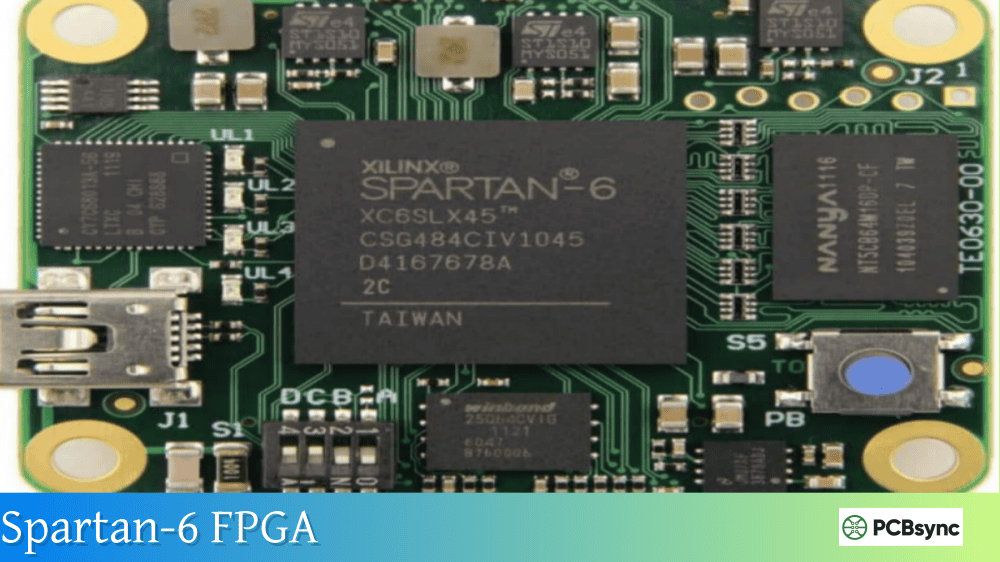
The XC6SLX16 occupies a strategic position in the Spartan-6 family—offering significantly more resources than the entry-level XC6SLX9 while remaining more affordable than larger devices. For engineers designing embedded systems, industrial controls, or academic projects, this mid-range FPGA often represents the optimal balance between capability and cost. I’ve specified this device on multiple production designs where the XC6SLX9 ran out of headroom but the XC6SLX25 was overkill.
This guide covers the complete Xilinx Spartan 6 XC6SLX16 specifications, package options, performance characteristics, and practical applications to help you determine if this device fits your project requirements.
The XC6SLX16 belongs to Xilinx’s Spartan-6 LX (logic-optimized) family, built on 45nm process technology. With 14,579 logic cells, it provides roughly 60% more logic capacity than the XC6SLX9 while consuming only marginally more power. This makes it particularly attractive for designs that need room to grow or require more complex signal processing.
Where XC6SLX16 Fits in the Spartan-6 Family
Device
Logic Cells
Block RAM
DSP Slices
Position
XC6SLX4
3,840
216 Kb
8
Entry-level
XC6SLX9
9,152
576 Kb
16
Budget
XC6SLX16
14,579
576 Kb
32
Mid-range
XC6SLX25
24,051
936 Kb
38
Upper mid-range
XC6SLX45
43,661
2,088 Kb
58
High-density
The XC6SLX16 doubles the DSP slice count compared to the XC6SLX9 while maintaining the same block RAM capacity. This makes it well-suited for applications requiring more digital signal processing without necessarily needing additional memory.
XC6SLX16 Detailed Specifications
Core Logic Resources
Resource
Quantity
Notes
Logic Cells
14,579
Equivalent logic gates
CLB Slices
2,278
Configurable Logic Blocks
Slice Registers
18,224
Flip-flops
Slice LUTs
9,112
6-input lookup tables
LUTs as Logic
9,112
Combinatorial functions
LUTs as Memory
2,278
Distributed RAM
Maximum Distributed RAM
136 Kb
Across all SLICEMs
Each CLB slice contains four 6-input LUTs and eight flip-flops. The Xilinx Spartan 6 XC6SLX16 includes three slice types: SLICEM (with distributed RAM capability), SLICEL (logic-only), and SLICEX (compact logic). Approximately 25% of slices are SLICEMs, enabling efficient distributed memory implementation.
Block RAM Resources
Specification
Value
Block RAM Tiles
32
Total Block RAM
576 Kb
Maximum Data Width
36 bits per port
RAM Configuration
True dual-port
FIFO Support
Yes, with built-in logic
The block RAM in the XC6SLX16 can be configured as:
The XC6SLX16 includes 32 DSP48A1 slices—double the count of the XC6SLX9. Each slice provides:
Feature
Specification
Multiplier
18 × 18 signed
Accumulator
48-bit
Pre-adder
18-bit (for symmetric filters)
Maximum Frequency
250 MHz
Cascade Capability
Yes, for large filters/multipliers
The doubled DSP count makes the Xilinx Spartan 6 XC6SLX16 suitable for implementing:
Multiple FIR filter channels
Audio processing (multiple codecs)
Basic image processing algorithms
Digital down-converters
Servo control loops with complex calculations
Clock Management Resources
Resource
Quantity
Description
Clock Management Tiles
2
CMT blocks
DCMs per CMT
2
Digital Clock Managers
PLLs per CMT
1
Phase-Locked Loops
Total DCMs
4
Clock synthesis/conditioning
Total PLLs
2
High-frequency synthesis
Global Clock Networks
16
Low-skew distribution
Regional Clock Networks
8
Per-region clocking
The PLL frequency range spans 400 MHz to 1,080 MHz, enabling clock multiplication for high-speed internal logic. DCMs provide frequency synthesis, phase shifting, and clock conditioning for external interfaces.
I/O Resources and Capabilities
Specification
CSG324
FTG256
CSG225
CPG196
Maximum User I/O
232
186
140
106
I/O Banks
4
4
4
4
Differential Pairs
92
72
63
47
Input-Only Pins
6
4
8
6
The XC6SLX16 supports over 40 I/O standards including:
Category
Standards
Single-ended
LVCMOS12/15/18/25/33, LVTTL
Differential
LVDS, BLVDS, RSDS, TMDS, mini-LVDS
Memory
DDR/DDR2/DDR3, LPDDR, SSTL
Legacy
PCI 33/66 MHz
Maximum I/O performance reaches 1,080 Mb/s for differential I/O—sufficient for video interfaces, high-speed data acquisition, and communication protocols.
The XC6SLX16 is available in multiple packages to suit different board constraints:
Package
Pins
Body Size
Ball Pitch
Max I/O
Notes
CSG324
324
15 × 15 mm
0.8 mm
232
Maximum I/O, common choice
FTG256
256
17 × 17 mm
1.0 mm
186
Easier assembly, good I/O
CSG225
225
13 × 13 mm
0.8 mm
140
Compact footprint
CPG196
196
8 × 8 mm
0.5 mm
106
Smallest package
All packages are BGA variants—there’s no TQFP option for the XC6SLX16, unlike the smaller XC6SLX9 which offers TQG144. This means production requires reflow soldering capability.
Package Selection Guidance
Requirement
Recommended Package
Maximum I/O
CSG324
Balanced I/O and size
FTG256
Space-constrained design
CPG196
Easier BGA assembly
FTG256 (1.0mm pitch)
Pin-compatible with XC6SLX25
CSG324
The CSG324 package provides pin compatibility with larger Spartan-6 devices, enabling design migration without PCB changes.
Speed Grades and Operating Conditions
Available Speed Grades
Speed Grade
Performance
Power Mode
Temperature Range
-3
Highest
Standard
Commercial
-3N
Highest
Standard
Industrial
-2
Standard
Standard
Commercial/Industrial
-1L
Lowest
Low power (1.0V core)
Commercial/Industrial
The XC6SLX16 in -3 speed grade achieves clock speeds exceeding 500 MHz for internal logic, though practical designs typically target 200–400 MHz depending on complexity.
Operating Temperature Ranges
Grade
Suffix
Junction Temperature
Commercial
C
0°C to +85°C
Industrial
I
-40°C to +100°C
Power Supply Requirements
Rail
Voltage
Notes
VCCINT
1.2V (1.0V for -1L)
Core logic
VCCAUX
2.5V or 3.3V
Auxiliary circuits
VCCO
1.2V to 3.3V
I/O bank voltage (per bank)
Static power consumption for the Xilinx Spartan 6 XC6SLX16 runs approximately 2.0 mA at VCCINT (quiescent), scaling with design complexity and clock frequency.
XC6SLX16 vs XC6SLX9 vs XC6SLX25
When selecting a Spartan-6 device, understanding the tradeoffs helps optimize cost and capability:
The XC6SLX16 finds use across diverse applications thanks to its balanced resource profile:
Industrial Control and Automation
Application
Key Resources Used
Motor drive control
DSP slices for PWM, LUTs for sequencing
PLC coprocessor
Block RAM for program storage, I/O for field signals
Sensor fusion
DSP slices for filtering, LUTs for protocol handling
Industrial Ethernet
I/O for PHY interface, LUTs for protocol stack
The 32 DSP slices enable multi-axis servo control with real-time PID calculations running at high update rates.
Video and Display Processing
Application
Resource Requirements
VGA controller
~500 LUTs, timing generation
HDMI transmitter
TMDS I/O, serialization logic
Video scaling
DSP slices for interpolation
Frame buffering
External RAM + controller
OSD overlay
Block RAM for character data
The Xilinx Spartan 6 XC6SLX16 handles 720p video processing with appropriate external memory for frame buffers.
Communication Interfaces
Interface
Implementation Notes
Gigabit Ethernet MAC
~2,000 LUTs + external PHY
USB 2.0 device
~3,000 LUTs + external PHY
SPI/I2C bridges
~200–500 LUTs each
CAN controller
~1,000 LUTs
Multi-channel UART
~500 LUTs per channel
Educational and Development
The XC6SLX16 powers several popular development boards:
Board
Features
Use Case
Nexys 3 (Digilent)
16MB Cellular RAM, Ethernet PHY, VGA
Academic training
QM_XC6SLX16_SDRAM
256Mb SDRAM, expansion headers
Prototyping
Various Chinese boards
SDRAM, SPI flash, peripherals
Hobbyist/learning
The Nexys 3, featuring the XC6SLX16-CSG324C, became a standard academic platform for digital design courses, offering extensive I/O for experiments while providing enough logic for MicroBlaze soft processor implementations.
Memory Controller Block (MCB)
The XC6SLX16 includes two hard Memory Controller Blocks—a significant advantage for designs requiring external DRAM:
Feature
Specification
Memory Types
DDR3, DDR2, DDR, LPDDR
Maximum Data Rate
800 Mb/s (DDR3)
Interface Width
4, 8, or 16 bits
Controller Count
2 MCBs
ECC Support
Optional
The hard MCB dramatically simplifies DRAM interface design compared to soft controllers, reducing logic consumption and improving timing margins. Each MCB provides a multi-port interface with independent FIFO buffers.
Configuration and Programming
Configuration Modes
Mode
Description
Use Case
Master SPI
FPGA clocks external flash
Standard boot-from-flash
Slave SPI
External source clocks FPGA
Microcontroller-managed boot
Master BPI
Parallel flash (up to x16)
Fast configuration
JTAG
Boundary scan interface
Development, debugging
Slave SelectMAP
8 or 16-bit parallel
Multi-FPGA systems
Configuration File Sizes
Format
Compressed
Uncompressed
Bitstream (.bit)
~1.4 MB
~3.6 Mb
MCS/PROM file
Varies
~3.6 Mb
Configuration time from SPI flash at 33 MHz CCLK takes approximately 100 ms—fast enough for most applications but consider BPI mode if faster startup is required.
Development Tools
The XC6SLX16 requires Xilinx ISE Design Suite (Vivado does not support Spartan-6):
Tool
Purpose
License
ISE Design Suite 14.7
Synthesis, implementation
WebPACK (free)
ISE Simulator (ISim)
Behavioral/timing simulation
Included
ChipScope Pro
On-chip debugging
Licensed
PlanAhead
Floorplanning, analysis
Included
EDK
MicroBlaze development
Licensed
ISE 14.7 runs natively on Windows 7 or via virtual machine on Windows 10/11.
Useful Resources and Downloads
Official AMD/Xilinx Documentation
Document
Content
DS160
Spartan-6 Family Overview
DS162
DC and AC Switching Characteristics
UG380
Configuration User Guide
UG381
SelectIO Resources
UG382
Clocking Resources
UG383
Block RAM Resources
UG384
Configurable Logic Block
UG385
Packaging and Pinouts
UG388
Memory Controller User Guide
UG389
DSP48A1 Slice User Guide
Software Downloads
ISE Design Suite 14.7 WebPACK — Free download from AMD/Xilinx
ISE Windows 10/11 Virtual Machine — Pre-configured Oracle VirtualBox image
Digilent Adept — Board programming software for Nexys 3 and similar
Generic Spartan-6 boards — GitHub repositories with pinouts and examples
Frequently Asked Questions
Is the XC6SLX16 still available for new designs?
Yes, the XC6SLX16 remains in production with AMD’s extended Spartan-6 lifecycle through at least 2030. However, lead times can be extended due to fab capacity constraints on the 45nm node. For new designs, evaluate whether Spartan-7 offers advantages for your specific requirements—though it lacks the hard memory controller present in Spartan-6.
What development board is best for learning with the XC6SLX16?
The Digilent Nexys 3 was the premier XC6SLX16 development platform for educational use. It’s now discontinued but available on the secondary market. Current alternatives include various Chinese-manufactured boards featuring the Xilinx Spartan 6 XC6SLX16 with SDRAM, VGA output, and expansion headers at budget-friendly prices.
Can I use Vivado with the XC6SLX16?
No, Vivado does not support Spartan-6 devices including the XC6SLX16. You must use ISE Design Suite 14.7, which is available for free as WebPACK edition. ISE can run on Windows 10/11 using AMD’s provided virtual machine image or with some installation workarounds on native installations.
How does XC6SLX16 power consumption compare to newer FPGAs?
The XC6SLX16 on 45nm technology consumes approximately 2× the power of equivalent Spartan-7 devices on 28nm. For battery-powered or thermally constrained applications, newer devices offer significant advantages. However, for line-powered industrial applications where the difference is negligible, the XC6SLX16 remains practical.
What’s the maximum logic utilization I should target?
For timing-critical designs, aim for 70–80% logic utilization on the XC6SLX16. Higher utilization makes place-and-route increasingly difficult, leading to timing failures or extended compile times. If your design consistently exceeds 80% utilization, consider stepping up to the XC6SLX25 for headroom.
Conclusion
The XC6SLX16 delivers a compelling mid-range option in the Spartan-6 lineup—14,579 logic cells, 32 DSP slices, and 576 Kb of block RAM provide substantial capability for industrial controls, video processing, communication interfaces, and educational applications. The hard memory controller blocks simplify DRAM integration, while the mature ISE toolchain offers reliable design flows despite its age.
For new designs, weigh the Xilinx Spartan 6 XC6SLX16 against Spartan-7 alternatives. The older device wins on cost for mature designs and applications requiring the hard MCB. Spartan-7 wins on power efficiency, tool support (Vivado), and long-term supply chain positioning.
Whether you’re maintaining existing products, developing cost-sensitive embedded systems, or learning FPGA development, the XC6SLX16 remains a capable and well-documented platform backed by extensive application knowledge accumulated over more than a decade of production use.
Inquire: Call 0086-755-23203480, or reach out via the form below/your sales contact to discuss our design, manufacturing, and assembly capabilities.
Quote: Email your PCB files to Sales@pcbsync.com (Preferred for large files) or submit online. We will contact you promptly. Please ensure your email is correct.
Notes: For PCB fabrication, we require PCB design file in Gerber RS-274X format (most preferred), *.PCB/DDB (Protel, inform your program version) format or *.BRD (Eagle) format. For PCB assembly, we require PCB design file in above mentioned format, drilling file and BOM. Click to download BOM template To avoid file missing, please include all files into one folder and compress it into .zip or .rar format.