Inquire: Call 0086-755-23203480, or reach out via the form below/your sales contact to discuss our design, manufacturing, and assembly capabilities.
Quote: Email your PCB files to Sales@pcbsync.com (Preferred for large files) or submit online. We will contact you promptly. Please ensure your email is correct.
Notes: For PCB fabrication, we require PCB design file in Gerber RS-274X format (most preferred), *.PCB/DDB (Protel, inform your program version) format or *.BRD (Eagle) format. For PCB assembly, we require PCB design file in above mentioned format, drilling file and BOM. Click to download BOM template To avoid file missing, please include all files into one folder and compress it into .zip or .rar format.
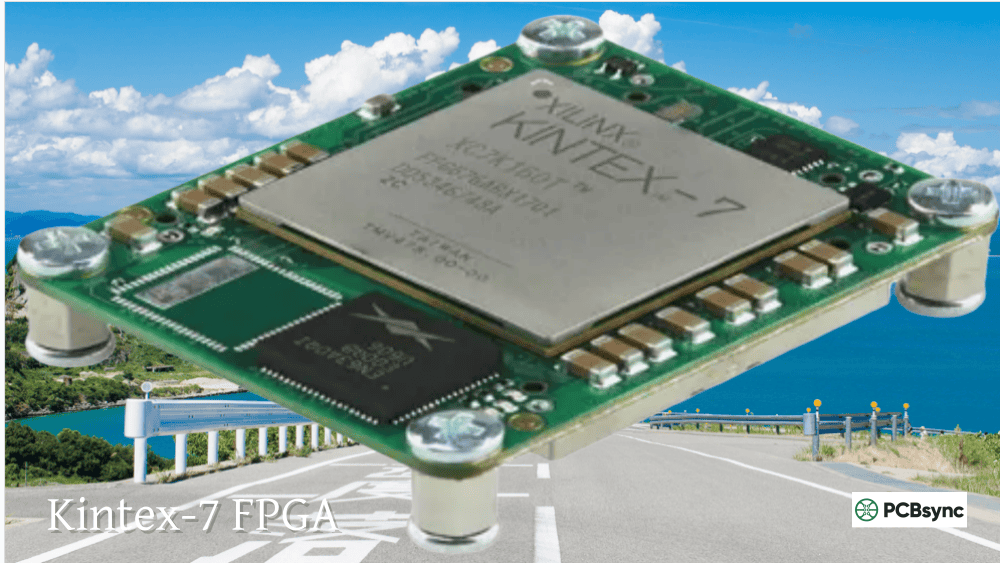
Selecting the right FPGA package and speed grade can make or break a project timeline. After working through multiple XC7K160T designs over the years, I’ve accumulated practical knowledge about this mid-range Kintex-7 device that goes beyond what datasheets tell you. This guide covers the XC7K160T specifications that actually matter for PCB engineers, including package options, speed grade trade-offs, pinout considerations, and real-world design decisions you’ll face when integrating this capable FPGA into your next project.
The XC7K160T occupies a strategic position in the Kintex-7 lineup, providing substantial logic resources without the cost premium of larger devices like the XC7K325T or XC7K410T. Built on Xilinx‘s 28nm High-Performance Low-Power (HPL) process with high-k metal gate (HKMG) technology, the XC7K160T delivers 2x the price-performance ratio of previous-generation 40nm devices while consuming half the power.
Parameter
XC7K160T Specification
Logic Cells
162,240
CLB Slices
25,350
CLB Flip-Flops
202,800
Block RAM (Kb)
11,700
Block RAM (36Kb each)
325
Distributed RAM (Kb)
2,188
DSP48E1 Slices
600
CMTs (Clock Management Tiles)
8
MMCMs
8
PLLs
8
PCIe Hard Blocks
1
XADC Blocks
1
Process Technology
28nm HKMG HPL
Core Voltage (VCCINT)
1.0V nominal
What these numbers mean practically: 162,240 logic cells handle moderate-complexity designs comfortably—think industrial motor controllers, video processing pipelines up to 1080p, or mid-range communications equipment. The 600 DSP slices provide serious signal processing capability for filtering, FFTs, and real-time algorithm execution. The 11.7Mb of block RAM accommodates typical frame buffers and coefficient storage without external memory for many applications.
XC7K160T Package Options and Pinout Details
The XC7K160T ships in multiple package configurations, each with different I/O counts and transceiver availability. Package selection significantly impacts both PCB complexity and system capabilities.
Available XC7K160T Packages
Package
Ball Count
User I/O (HP)
User I/O (HR)
GTX Transceivers
Body Size
FBG484
484
100
185
4
23×23mm
FBG676
676
150
250
8
27×27mm
FFG676
676
150
250
8
27×27mm
The distinction between FBG and FFG packages matters more than you might expect. FBG (Fine-pitch BGA) uses wire bonding internally, while FFG (Flip-chip Fine-pitch BGA) uses flip-chip die attachment. In practice, both share identical pinouts and electrical characteristics for the XC7K160T, but FFG variants sometimes offer slightly better thermal performance due to the flip-chip construction bringing the die closer to the package surface.
HP vs HR I/O Banks Explained
The XC7K160T provides two categories of I/O banks with different voltage and performance characteristics:
I/O Type
Voltage Range
Key Characteristics
High-Performance (HP)
1.2V – 1.8V
DDR3/DDR3L support up to 1866Mb/s, DCI, ODELAY
High-Range (HR)
1.2V – 3.3V
Legacy interface support, wider voltage flexibility
For DDR3 memory interfaces, you must use HP banks. The XC7K160T’s HP banks support memory speeds up to 1866Mb/s with proper signal integrity design. HR banks work perfectly for slower interfaces, GPIO, and legacy 3.3V connections.
XC7K160T Pinout Considerations
When laying out an XC7K160T board, pay attention to these pinout-related constraints:
Bank 0 (Configuration): Reserved for configuration pins. VCCO_0 must be 2.5V or 3.3V depending on configuration mode. Don’t plan to use these as user I/O after configuration.
Bank 14/15 (HR banks): These typically connect to lower-speed interfaces, LEDs, switches, and 3.3V peripherals.
Bank 32/33/34 (HP banks): Reserve these for DDR3 memory interfaces. The MIG (Memory Interface Generator) expects specific bank assignments.
GTX Transceiver Banks: Quad 216 and Quad 218 provide the 4 or 8 GTX channels depending on package. Each quad requires its own MGTAVCC (1.0V) and MGTAVTT (1.2V) supplies.
XC7K160T Speed Grade Selection Guide
Speed grade selection balances timing margin, power consumption, and cost. The XC7K160T comes in five speed grade variants, each with specific trade-offs.
Speed Grade Comparison
Speed Grade
Performance Level
VCCINT
Temperature Range
Primary Use Case
-3
Highest
1.0V
Commercial (0-85°C)
Maximum clock frequency required
-2
High
1.0V
Commercial/Industrial
General high-performance
-1
Standard
1.0V
Commercial/Industrial/Extended
Cost-optimized designs
-2L
Low-power high
0.9V or 1.0V
Extended
Power-sensitive applications
-1L
Low-power standard
0.95V (industrial)
Industrial/Military
Extended temp + low power
The -3 speed grade delivers approximately 15-20% faster timing than -1, which translates directly to achievable clock frequencies. If your design targets 200MHz internal clocks comfortably on -2, you have good margin. Push toward 300MHz+ and you’ll want -3.
Temperature Grade Suffixes
The temperature suffix in part numbers indicates operating range:
Suffix
Temperature Range
Typical Application
C
0°C to +85°C
Commercial/Consumer
I
-40°C to +100°C
Industrial
Q
-40°C to +125°C
Extended (XA Automotive)
M
-55°C to +125°C
Military (XQ Defense)
For industrial applications, always spec the “I” suffix parts. The price premium over commercial parts is minimal compared to the risk of field failures in uncontrolled thermal environments.
Speed Grade Selection Guidelines
From experience, here’s how I approach speed grade selection for XC7K160T designs:
Choose -1 when: Budget is constrained, timing analysis shows 30%+ margin with -1 specs, and operating temperature stays below 85°C.
Choose -2 when: Design requires moderate-to-high performance, industrial temperature operation needed, or you want comfortable timing margin without premium pricing.
Choose -3 when: Pushing maximum clock frequencies, design is timing-critical with little margin, or you’re prototyping and want flexibility to optimize later.
Choose -2L when: Power budget is critical, battery-powered applications, or thermal constraints limit heat dissipation.
Proper power sequencing and voltage accuracy are non-negotiable for reliable XC7K160T operation. Here’s what the device expects:
Supply Rail
Nominal Voltage
Tolerance
Function
VCCINT
1.0V
±3%
Core logic
VCCBRAM
1.0V
±3%
Block RAM
VCCAUX
1.8V
±5%
Auxiliary circuits
VCCAUX_IO
1.8V or 2.0V
±5%
HP I/O pre-drivers
VCCO
1.2V-3.3V
Per standard
I/O buffers (bank-specific)
MGTAVCC
1.0V
±3%
GTX analog supply
MGTAVTT
1.2V
±3%
GTX termination
Power Sequencing
The recommended power-on sequence minimizes inrush current and ensures I/Os remain tri-stated during startup:
VCCINT (can ramp simultaneously with VCCBRAM)
VCCBRAM
VCCAUX (can ramp simultaneously with VCCAUX_IO)
VCCAUX_IO
VCCO banks
Power-off should reverse this sequence. Violating the sequence won’t damage the device but may cause undefined I/O states during transitions.
XC7K160T Development Resources
Essential Documentation
Document
Description
Document Number
DC and AC Switching Characteristics
Complete timing specifications
DS182
7 Series FPGAs Overview
Architecture and feature summary
DS180
Packaging and Pinout Guide
Package drawings, pin tables
UG475
SelectIO Resources Guide
I/O standard specifications
UG471
GTX Transceivers User Guide
High-speed serial design
UG476
Memory Interface Solutions Guide
DDR3/DDR4 implementation
UG586
Development Tools
Vivado Design Suite: Primary development environment for XC7K160T. The free WebPACK edition supports this device fully—no license required for the 160T specifically.
XPower Estimator (XPE): Spreadsheet-based tool for early power estimation. Run this before finalizing your power supply design.
The XC7K160T finds its sweet spot in applications requiring more resources than Artix-7 provides but where XC7K325T would be overkill:
Wireless Infrastructure
Base station front-ends leverage the 600 DSP slices for digital up/down conversion and filtering. The GTX transceivers handle CPRI/OBSAI backhaul interfaces, while the PCIe block enables integration with baseband processing units.
Medical Imaging
Portable ultrasound systems use the XC7K160T for beamforming calculations. The combination of DSP resources and moderate power consumption fits battery-operated equipment requirements. Block RAM stores acoustic line data for real-time image reconstruction.
Industrial Automation
Multi-axis motor control systems benefit from the deterministic timing FPGAs provide. The XC7K160T handles complex control algorithms while its I/O flexibility interfaces with various sensor types and drive electronics.
Video Processing
720p and 1080p video processing pipelines fit comfortably within the XC7K160T’s resources. Applications include video conferencing codecs, machine vision preprocessing, and broadcast format conversion.
ADAS and Automotive
The XA7K160T automotive-qualified variant supports sensor fusion and image processing in advanced driver assistance systems. The industrial temperature range handles under-hood thermal environments.
XC7K160T Frequently Asked Questions
What is the difference between XC7K160T-1FBG676I and XC7K160T-2FFG676I?
The “-1” vs “-2” indicates speed grade, with -2 being faster. “FBG” vs “FFG” indicates package type (wire-bond vs flip-chip), though pinouts are identical. The “I” suffix means industrial temperature range (-40°C to +100°C) for both parts. Choose -2FFG676I for highest performance with industrial temperature support.
Can XC7K160T support DDR4 memory?
No, the XC7K160T only supports DDR3 and DDR3L interfaces up to 1866Mb/s. DDR4 support requires UltraScale or newer architectures. For DDR3, expect the MIG to achieve 1600Mb/s reliably with proper signal integrity design.
What Vivado license is needed for XC7K160T development?
The XC7K160T is supported in the free Vivado WebPACK edition. You do not need a paid license to synthesize, implement, or generate bitstreams for this device. This makes it an accessible choice for budget-conscious projects.
How does XC7K160T compare to XC7K325T?
The XC7K325T offers roughly double the logic cells (326,080 vs 162,240), 40% more DSP slices (840 vs 600), and additional block RAM. Both share identical package options and pin compatibility in many cases. Choose XC7K325T when resource utilization exceeds 70-80% on the 160T, or when future feature growth is anticipated.
What is the maximum GTX transceiver speed on XC7K160T?
GTX transceivers on the XC7K160T support line rates from 500Mb/s to 10.3125Gb/s in standard packages. The FBG484 package limits transceivers to 8.0Gb/s maximum due to package routing constraints. For 10G applications, use FBG676 or FFG676 packages.
XC7K160T PCB Layout Recommendations
After routing several XC7K160T designs, I’ve developed preferences that consistently yield first-spin success. These aren’t in the datasheet but come from practical experience.
Layer Stack Considerations
For BGA-676 packages, a minimum 8-layer stack works, but 10-12 layers provide routing relief that speeds layout completion. Typical stack for XC7K160T designs:
Layer
Function
Top
Components, escape routing
L2
Ground plane
L3
Signal (HP bank routing)
L4
Power plane (VCCINT)
L5
Signal
L6
Ground plane
L7
Signal (HR bank routing)
L8
Power plane (VCCO banks)
Bottom
Components, connectors
Decoupling Strategy
Place 0.1µF capacitors on every VCCINT and VCCBRAM pin with short traces to the nearest ground via. Add 4.7µF bulk caps distributed across the device footprint. For GTX supplies, follow UG476 recommendations precisely—the filtering requirements are specific and validated.
Differential Pair Routing
GTX lanes require 100Ω differential impedance with tight length matching (<5 mils within each pair). Route these on internal layers with solid reference planes. Avoid layer transitions within the high-speed signal path when possible.
Conclusion
The XC7K160T represents a well-balanced mid-range FPGA that delivers genuine value for designs requiring more capability than entry-level parts provide. Its combination of 162K logic cells, 600 DSP slices, and up to 8 GTX transceivers handles a broad range of applications from industrial control to video processing. Understanding the package options, speed grade implications, and power requirements covered in this guide positions you to make informed decisions that keep projects on schedule and on budget.
For most commercial applications, start with the XC7K160T-2FFG676C (commercial temp) or XC7K160T-2FFG676I (industrial temp). This combination provides good performance headroom in the most capable package configuration. Optimize to -1 speed grade or smaller packages only after validating that your design meets requirements with comfortable margin.
Inquire: Call 0086-755-23203480, or reach out via the form below/your sales contact to discuss our design, manufacturing, and assembly capabilities.
Quote: Email your PCB files to Sales@pcbsync.com (Preferred for large files) or submit online. We will contact you promptly. Please ensure your email is correct.
Notes: For PCB fabrication, we require PCB design file in Gerber RS-274X format (most preferred), *.PCB/DDB (Protel, inform your program version) format or *.BRD (Eagle) format. For PCB assembly, we require PCB design file in above mentioned format, drilling file and BOM. Click to download BOM template To avoid file missing, please include all files into one folder and compress it into .zip or .rar format.