Inquire: Call 0086-755-23203480, or reach out via the form below/your sales contact to discuss our design, manufacturing, and assembly capabilities.
Quote: Email your PCB files to Sales@pcbsync.com (Preferred for large files) or submit online. We will contact you promptly. Please ensure your email is correct.
Notes: For PCB fabrication, we require PCB design file in Gerber RS-274X format (most preferred), *.PCB/DDB (Protel, inform your program version) format or *.BRD (Eagle) format. For PCB assembly, we require PCB design file in above mentioned format, drilling file and BOM. Click to download BOM template To avoid file missing, please include all files into one folder and compress it into .zip or .rar format.
IPC Standards Explained: A Comprehensive Guide to PCB & Electronics Assembly Standards
As a PCB engineer with over a decade in the electronics manufacturing industry, I’ve seen firsthand how IPC standards shape every aspect of our work—from initial design concepts to final product inspection. Whether you’re designing your first board or managing quality control for aerospace applications, understanding IPC standards isn’t optional anymore; it’s essential for producing reliable, globally-accepted electronic products.
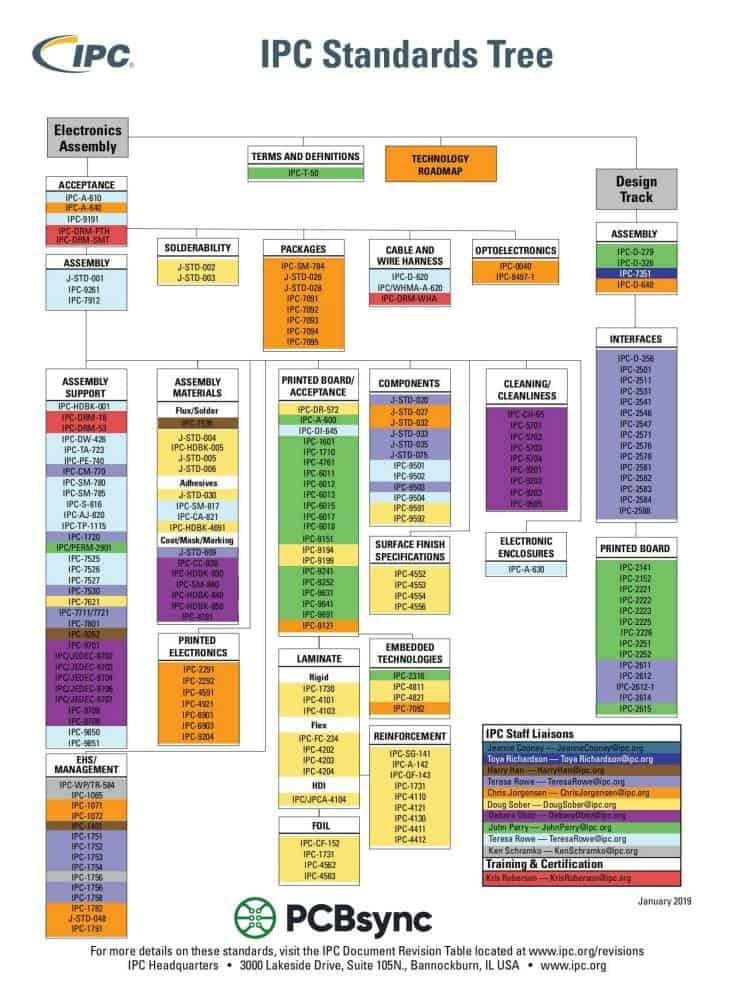
This comprehensive guide covers everything you need to know about IPC standards, including the complete IPC standards tree, classification systems, certification paths, and practical applications. I’ve organized this resource to serve both newcomers looking to understand the basics and experienced professionals seeking specific standard references.
IPC standards are a collection of globally recognized guidelines developed by the Association Connecting Electronics Industries (IPC) that define best practices for the design, manufacturing, assembly, and inspection of electronic products. Originally founded in 1957 as the Institute for Printed Circuits by six PCB manufacturers, IPC has evolved into the leading authority in setting requirements for the entire electronics industry.
Today, IPC boasts over 4,000 member companies across 79 countries, and its standards have become the common language that connects designers, manufacturers, and quality inspectors worldwide. When you specify IPC-A-610 acceptance criteria or design to IPC-2221 requirements, suppliers across the globe understand exactly what you need—no interpretation errors, no ambiguity.
Why IPC Standards Matter in Electronics Manufacturing
The importance of IPC standards extends beyond mere compliance checkboxes. Here’s what these standards actually deliver for your organization:
Reduced Defect Rates: Following standardized processes means fewer errors during production. When your assembly team follows J-STD-001 soldering requirements, they’re applying decades of industry-refined best practices that minimize rework and scrap.
Global Supply Chain Compatibility: IPC standards create a universal quality language. Whether your boards are manufactured in China, assembled in Mexico, or inspected in Germany, everyone references the same criteria.
Regulatory Compliance Support: While IPC standards themselves aren’t legally mandated, they often form the foundation for meeting industry-specific regulations. Medical device manufacturers, for example, use IPC standards to help satisfy FDA Quality Systems requirements.
Cost Efficiency: Standardization reduces the “reinventing the wheel” problem. Instead of developing custom specifications for every project, you reference established standards that suppliers already understand and implement.
Understanding the IPC Standards Development Process
Before diving into specific standards, it’s worth understanding how these documents come to exist. IPC standards aren’t created by a single organization making unilateral decisions—they emerge from a collaborative, consensus-based process involving thousands of industry professionals.
The Volunteer Committee Structure
IPC standards are developed by volunteer committees comprising engineers, quality professionals, and technical experts from member companies. These committees include representatives from OEMs, contract manufacturers, material suppliers, and equipment manufacturers—ensuring that standards reflect real-world needs across the entire supply chain.
When a new standard is proposed or an existing one requires revision, the relevant committee convenes to discuss requirements, review industry data, and draft specifications. This process typically involves multiple review cycles where member companies can comment on proposed language. Only when consensus is achieved does a standard move forward for publication.
Benefits of Consensus Standards
This collaborative approach provides several advantages:
Broad Industry Buy-In: Because competing companies participate in development, the resulting standards gain widespread acceptance. No single company dictates requirements; instead, the industry collectively determines best practices.
Practical Applicability: Committee members bring real manufacturing experience to discussions. Standards reflect what actually works on production floors, not theoretical ideals that prove impractical to implement.
Balanced Requirements: With diverse stakeholders involved, standards balance competing interests—cost constraints against quality needs, innovation against reliability, flexibility against consistency.
Continuous Improvement: As technology evolves, committees reconvene to update standards. This ensures IPC documents remain relevant rather than becoming outdated specifications that no longer match industry capabilities.
IPC Classification System: Class 1, Class 2, and Class 3
One of the most fundamental concepts in IPC standards is the three-tier classification system. This hierarchy determines the level of inspection rigor, acceptable defect tolerance, and overall quality expectations for your products.
IPC Class 1: General Electronics
Class 1 represents the entry point of IPC quality requirements. Products in this category prioritize basic functionality over extended reliability—think consumer gadgets where a shorter lifespan is acceptable and cost optimization is paramount.
Characteristic
Class 1 Specifications
Life Expectancy
Limited, short-term use
Defect Tolerance
Highest (cosmetic imperfections allowed)
Inspection Requirements
Least stringent
Typical Products
Toys, basic remote controls, LED novelty items
Manufacturing Cost
Lowest
Class 1 allows various cosmetic defects as long as the product functions as intended. For manufacturers producing high-volume consumer electronics where competitive pricing is critical, Class 1 provides the flexibility to optimize for cost without compromising basic functionality.
IPC Class 2: Dedicated Service Electronics
Class 2 strikes the balance between reliability and cost-effectiveness. These products require sustained performance and longer operational life, but uninterrupted service isn’t absolutely critical.
Most commercial electronics fall into Class 2. If you’re designing a telecommunications device, industrial control system, or higher-end consumer product, Class 2 is typically your target. The standard allows minor visual imperfections that don’t affect electrical or mechanical function, making it the practical choice for most dedicated-service applications.
IPC Class 3: High-Reliability Electronics
Class 3 represents the pinnacle of IPC quality requirements. When failure is simply not an option—when lives or critical missions depend on your electronics—you design and manufacture to Class 3.
Characteristic
Class 3 Specifications
Life Expectancy
Continuous operation required
Defect Tolerance
Lowest (near-zero tolerance)
Inspection Requirements
Most stringent, often 100% inspection
Typical Products
Medical life-support, aerospace systems, military equipment
Manufacturing Cost
Highest
Class 3 products undergo extensive testing and inspection at every manufacturing stage. The requirements for annular rings, barrel fill percentages, and plating thickness are significantly tighter than lower classes. For example, Class 3 requires a minimum 75% barrel fill for through-hole components, while Class 2 may allow 50% under certain exceptions.
Choosing the Right IPC Class
Selecting the appropriate class requires balancing reliability requirements against manufacturing costs:
Selection Factor
Class 1
Class 2
Class 3
Product failure consequences
Minor inconvenience
Moderate impact
Life-threatening or mission-critical
Operating environment
Benign, controlled
Standard commercial
Extreme conditions
Service life requirement
1-3 years
5-10 years
15+ years
Cost sensitivity
High
Moderate
Low
Regulatory requirements
Minimal
Industry-specific
Stringent (FDA, MIL-SPEC)
Complete IPC Standards Tree: Organized by Category
The IPC standards ecosystem is extensive, covering every phase of electronics development. Below is the comprehensive breakdown organized by functional category.
Terms and Definitions
Before diving into technical specifications, understanding industry terminology is essential:
IPC-T-50 – Terms and Definitions for Interconnecting and Packaging Electronic Circuits: This foundational document defines the terminology used across all other IPC standards. When disputes arise about what constitutes a “defect” versus a “process indicator,” IPC-T-50 provides the authoritative definitions.
Design Standards
The design phase establishes the foundation for manufacturability and reliability. These standards guide PCB layout decisions from schematic capture through final documentation.
The IPC-2220 Series: Your Design Foundation
The IPC-2220 series forms the backbone of PCB design standards. Understanding how these documents relate to each other helps you apply them correctly.
IPC-2221 serves as the generic standard—it establishes baseline requirements applicable to all organic PCB designs. Every designer should be familiar with its requirements for conductor spacing, annular ring minimums, and thermal management principles.
The sectional standards (IPC-2222 through IPC-2226) build upon IPC-2221, adding specific requirements for particular board types. You use IPC-2221 plus the appropriate sectional standard together, not as alternatives.
Example Application:
Designing a rigid-flex assembly? You’d reference:
IPC-2221 for generic requirements
IPC-2222 for the rigid sections
IPC-2223 for the flexible sections
Potentially IPC-2226 if HDI technology is involved
This layered approach lets IPC maintain common requirements in one document while addressing technology-specific needs in focused sectionals.
Assembly standards ensure consistent, reliable production processes across manufacturing facilities worldwide.
Core Assembly Requirements:
J-STD-001 – Requirements for Soldered Electrical and Electronic Assemblies: This is the primary process standard for soldering. It specifies materials, methods, and acceptance criteria that assembly operators must follow. Unlike IPC-A-610 (which focuses on inspection), J-STD-001 tells your team how to perform the work correctly.
Understanding the Relationship Between J-STD-001 and IPC-A-610
One of the most common questions I hear from engineers new to IPC standards is: “Do I need both J-STD-001 and IPC-A-610?” The answer is yes, and here’s why they complement each other:
J-STD-001 defines the process: It covers materials selection (solder alloys, flux types, cleaning agents), process parameters (soldering temperatures, dwell times, heating rates), operator qualifications, and workmanship requirements. When your soldering technician asks “How should I do this?”, J-STD-001 provides the answer.
IPC-A-610 defines the result: It provides visual criteria for determining whether the work meets acceptance standards. When your quality inspector asks “Is this acceptable?”, IPC-A-610 provides the answer.
In practice, companies typically train operators to J-STD-001 requirements and inspectors to IPC-A-610 criteria. Some personnel (especially in smaller organizations) need training in both.
J-STD-001 Addenda for Specialized Applications
The base J-STD-001 standard addresses general commercial and industrial applications. For more demanding environments, IPC offers specialized addenda:
J-STD-001 Space Addendum (IPC-J-STD-001S): Supplements or replaces certain J-STD-001 requirements for assemblies that must survive the extreme conditions of space environments—severe thermal cycling, vibration during launch, and operation in vacuum.
J-STD-001 Automotive Addendum: Addresses the specific reliability requirements of automotive electronics, including extended temperature ranges and vibration resistance.
Standard for Calculating DPMO for PWB Manufacturing
Acceptance and Inspection Standards
These standards define what constitutes acceptable workmanship and how to evaluate finished products.
Electronic Assembly Acceptance:
IPC-A-610 – Acceptability of Electronic Assemblies: The most widely used inspection standard in electronics manufacturing. First released in 1983, IPC-A-610 provides visual acceptance criteria through hundreds of photographs and illustrations showing target, acceptable, and defect conditions.
The current revision (IPC-A-610J, released 2024) covers:
IPC-A-610 is more than just a picture book of defects—it’s a systematic framework for evaluating electronic assemblies. Here’s how experienced inspectors apply it:
Understanding the Three Condition Categories:
The standard categorizes conditions as Acceptable, Process Indicator, or Defect. An Acceptable condition meets requirements. A Process Indicator suggests the process may not be optimally controlled but doesn’t constitute a defect. A Defect requires corrective action.
Importantly, the 2020 revision (IPC-A-610H) removed the previous “Target” condition category. This change reflected industry consensus that achieving theoretical perfection isn’t always necessary—what matters is meeting functional requirements.
Magnification Requirements:
IPC-A-610 specifies minimum magnification levels for inspection based on feature size. For fine-pitch components (0.4mm pitch and below), inspectors typically need 10X magnification or higher. The standard includes detailed tables specifying appropriate magnification for different feature sizes and defect types.
Order of Precedence:
When IPC-A-610 requirements conflict with customer specifications or design documentation, the standard defines a clear hierarchy: customer documentation typically takes precedence, followed by contractual agreements, then IPC standards. This flexibility allows companies to specify requirements beyond or different from standard acceptance criteria when applications demand it.
IPC-A-640 – Acceptability Standard for Communications Circuits and Communications Cables
IPC-9191 – General Guidelines for Statistical Process Control
IPC-A-600 – Acceptability of Printed Boards: While IPC-A-610 covers assembled boards, IPC-A-600 focuses on bare PCB fabrication quality. It defines acceptance criteria for:
Conductor width and spacing
Plating quality
Dielectric material conditions
Surface finish requirements
Dimensional tolerances
PCB Qualification and Performance Standards
These standards specify performance requirements that bare boards must meet before assembly.
IPC/JPCA-4104 – Specification for HDI and Microvia Materials: This joint standard with the Japan Electronics Packaging and Circuits Association covers the specialized materials required for high-density interconnect construction.
IPC-A-630 – Acceptability Standard for Manufacture, Inspection, and Testing of Electronic Enclosures: Extends IPC quality principles to the mechanical housings that protect electronic assemblies.
Data Exchange and Interface Standards
Modern manufacturing requires seamless data transfer:
Understanding standards is valuable, but demonstrating that knowledge through certification provides formal recognition. IPC offers a structured certification pathway that benefits both individuals and organizations.
Why IPC Certification Matters for Your Career
From a career perspective, IPC certification demonstrates commitment to quality and industry standards. When I review resumes for technical positions, IPC certifications immediately signal that a candidate understands the frameworks we use daily. It’s not just about the knowledge—it’s about speaking the same language as the rest of the industry.
For organizations, having certified personnel reduces interpretation errors, improves consistency, and satisfies customer requirements. Many OEMs now require their suppliers to employ IPC-certified inspectors and operators, making certification a business necessity rather than optional professional development.
Certified IPC Specialist (CIS)
The CIS certification is the foundation level, appropriate for production operators, inspectors, and engineers who need working knowledge of specific standards.
Available CIS Programs:
IPC-A-610 (Acceptability of Electronic Assemblies)
IPC/WHMA-A-620 (Cable and Wire Harness Assemblies)
J-STD-001 (Soldering Requirements)
IPC-7711/7721 (Rework, Modification, and Repair)
CIS Requirements:
Training through authorized IPC training center
Open-book examination (70% passing score)
Two-year certification validity
Hands-on practical assessment for some programs
Certified Standards Expert (CSE)
The CSE level recognizes individuals with deep knowledge of specific standards who can serve as subject matter experts within their organizations.
CSE Capabilities:
Navigate standards quickly and efficiently
Act as internal expert for standard interpretation
Interface between organization and IPC on standards questions
Provide feedback to standards committees
CSE Requirements:
More rigorous examination process
Combined open-book and closed-book testing
80% minimum passing score
Does not require teaching to maintain certification
Certified IPC Trainer (CIT)
CITs are authorized to train and certify others to the CIS level. This certification is ideal for companies wanting to conduct internal training programs.
CIT Benefits:
Train employees internally, reducing external training costs
Issue official IPC certifications
Access IPC training materials and resources
Maintain quality consistency across your workforce
CIT Requirements:
Completion of CIT training program
Combined open-book and closed-book examination
80% minimum passing score
Must train at least 10 CIS students per two-year certification period
Master IPC Trainer (MIT)
The highest level of IPC certification, MITs can train both CITs and CISs. Only employees of Licensed Training Centers may become MITs.
MIT Prerequisites:
Active CIT certification
Employment at IPC Licensed Training Center
Demonstrated training expertise
Meeting specific IPC criteria for advancement
Practical Implementation: Applying IPC Standards to Your Projects
Knowing which standards exist is only half the equation. Here’s how to actually implement them in your workflow.
Common Mistakes When Implementing IPC Standards
Over my years working with IPC standards, I’ve seen the same mistakes repeated across different organizations. Learning from these pitfalls can save you significant time and rework.
Mistake #1: Treating All Class Requirements as Optional
Some organizations select IPC Class 2 for cost reasons but then make exceptions whenever a board fails to meet Class 2 requirements. This defeats the purpose of classification. If you’re consistently allowing Class 2 failures, you’re effectively producing Class 1 products—and your customers may not agree with that decision.
Solution: Select the appropriate class during design phase and communicate it clearly throughout the supply chain. If Class 2 requirements prove difficult to meet, address the root cause rather than waiving requirements.
Mistake #2: Using Outdated Standard Revisions
Standards evolve, and using obsolete revisions can cause problems. I’ve seen companies reference IPC-A-610D when IPC-A-610J is current. The criteria differences between revisions can be significant.
Solution: Establish a process for monitoring IPC standard revisions. When new versions are released, evaluate impacts on your processes and update training accordingly.
Mistake #3: Applying Standards Incorrectly Across the Supply Chain
If you manufacture assemblies to IPC Class 3 but your bare board supplier produces Class 2 boards, your overall product quality is limited by the weakest link. The class designation must flow through your entire supply chain.
Solution: Include IPC class requirements in all supplier specifications and incoming inspection criteria. Verify that your supply chain consistently meets required classifications.
Mistake #4: Relying on Standards Instead of Customer Requirements
IPC standards provide industry baselines, but your customers may have additional or different requirements. Assuming IPC compliance equals customer satisfaction can lead to rejected products.
Solution: Always review customer specifications alongside IPC standards. When conflicts exist, document the agreed-upon requirements and communicate them to all stakeholders.
For Design Engineers
Start every project by identifying your product class and applicable design standards:
Determine product class based on end application (Class 1, 2, or 3)
Reference IPC-2221 for generic design requirements
Add applicable sectional standards (IPC-2222 for rigid, IPC-2223 for flex)
Specify land patterns per IPC-7351
Document using IPC-D-326 requirements
Include IPC-2581 data exchange format for manufacturing handoff
For Manufacturing Engineers
Ensure your processes align with standards throughout production:
Incoming inspection per applicable component standards (J-STD-020, J-STD-033)
Soldering processes per J-STD-001
Stencil design following IPC-7525 guidelines
Reflow profiling per IPC-7530
Inspection criteria from IPC-A-610
For Quality Engineers
Establish inspection criteria and acceptance standards:
Bare board inspection per IPC-A-600
Assembly inspection per IPC-A-610
Wire harness inspection per IPC/WHMA-A-620
Rework evaluation per IPC-7711/7721
Cleanliness testing per IPC-5702/5703
Industry-Specific IPC Standards Applications
Different industries have unique requirements that influence how IPC standards are applied. Understanding these variations helps you select and implement the right standards for your specific market.
Medical Device Electronics
Medical devices face FDA regulatory scrutiny, and IPC standards support compliance with Quality System Regulations (QSR). For most implantable devices and life-critical equipment, IPC Class 3 is the minimum expectation.
Key Standards for Medical:
IPC-A-610 Class 3 for assembly acceptance
J-STD-001 with enhanced documentation
IPC-1782 for traceability requirements
Full compliance with cleanroom and ESD controls
Medical manufacturers often add company-specific requirements beyond IPC standards to address particular reliability concerns for their devices.
Aerospace and Defense Electronics
Military and aerospace applications typically require IPC Class 3 compliance, often supplemented by MIL-SPEC requirements or customer-specific workmanship standards.
Key Standards for Aerospace:
IPC-J-STD-001 Space Addendum for space applications
IPC-A-610 Class 3 as minimum
IPC-6012DS for rigid board qualification (space addendum)
Enhanced traceability per AS9100 requirements
The Department of Defense has officially adopted several IPC standards, making them contractual requirements for military programs.
Automotive Electronics
Automotive electronics must survive harsh environments—temperature extremes, vibration, and long operational life. The industry increasingly requires IPC Class 3 for safety-critical systems.
Key Standards for Automotive:
IPC-6012DA (Automotive Addendum to IPC-6012)
IPC-A-610 Class 2 minimum, Class 3 for safety systems
J-STD-020 for component moisture sensitivity
AEC-Q100/Q200 component qualification (complementary to IPC)
High-volume consumer products typically target IPC Class 2, balancing quality requirements against manufacturing costs. However, premium products may specify higher classes for competitive differentiation.
Semiconductor standards (often joint standards with IPC)
IEC
International electrotechnical standards
WHMA (Wire Harness Manufacturers Association)
Cable and harness standards
Frequently Asked Questions About IPC Standards
Are IPC standards legally required?
No, IPC standards are voluntary consensus standards, not legal requirements. However, they are often referenced in contracts, purchase orders, and industry regulations. Many customers specify IPC standards as acceptance criteria, making compliance effectively mandatory for doing business with them. Additionally, regulatory bodies like the FDA may reference IPC standards as part of quality system requirements for medical devices.
How often are IPC standards updated?
IPC standards are updated on varying schedules depending on industry needs and technological changes. Major standards like IPC-A-610 and J-STD-001 typically see new revisions every 3-5 years. IPC maintains a Document Revision Table on their website showing current versions and release dates. When new revisions are released, organizations typically have a transition period to adopt the updated requirements.
What is the difference between IPC-A-610 and J-STD-001?
IPC-A-610 is an inspection standard that defines visual acceptance criteria—it tells inspectors what to look for and whether conditions are acceptable or defects. J-STD-001 is a process standard that defines how to perform soldering operations—it covers materials, methods, and procedures that operators must follow. Think of J-STD-001 as “how to do the work” and IPC-A-610 as “how to evaluate the results.” Both standards are typically used together: assembly personnel follow J-STD-001 procedures, and inspection personnel evaluate results against IPC-A-610 criteria.
Can I use an older revision of an IPC standard?
Yes, but this must be clearly specified and agreed upon with your customer. IPC standards are not retroactive—products built to an older revision remain compliant with that revision. However, most customers and contracts specify “current revision” or a specific revision number. Using outdated standards may mean your processes don’t incorporate the latest industry knowledge and could result in rejected products if your customer expects current revision compliance.
How do I determine which IPC class my product requires?
Product class selection depends on your product’s end-use application, operating environment, and reliability requirements—not manufacturing cost preferences. Consider these factors: What are the consequences of product failure? (Inconvenience vs. safety hazard) What is the expected operating environment? (Office desk vs. engine compartment) What is the required service life? (2 years vs. 20 years) What do your customer specifications or industry regulations require? When in doubt, consult with your customer and document the agreed-upon class in your design specifications.
Moving Forward with IPC Standards
Understanding IPC standards transforms how you approach electronics design and manufacturing. These aren’t bureaucratic hurdles—they’re distilled industry wisdom that helps you build better products more efficiently.
Start by identifying the standards most relevant to your immediate work. If you’re a designer, focus on the IPC-2220 series and IPC-7351. If you’re in assembly, prioritize J-STD-001 and IPC-A-610. Quality engineers should master IPC-A-600 and IPC-A-610 first.
Consider IPC certification as a career investment. The CIS certification provides formal recognition of your standards knowledge and demonstrates commitment to quality that employers and customers value.
Most importantly, use these standards as living documents. Reference them during design reviews, keep copies accessible on the production floor, and update your processes when new revisions are released. The electronics industry evolves continuously, and IPC standards evolve with it—staying current keeps your products competitive and your quality uncompromised.
The comprehensive list of standards in this guide gives you a starting point for any electronics project. Bookmark this page, share it with your team, and return to it whenever you need to identify the right standard for your application. Quality electronics start with quality standards—and now you have the roadmap to find them.
Inquire: Call 0086-755-23203480, or reach out via the form below/your sales contact to discuss our design, manufacturing, and assembly capabilities.
Quote: Email your PCB files to Sales@pcbsync.com (Preferred for large files) or submit online. We will contact you promptly. Please ensure your email is correct.
Notes: For PCB fabrication, we require PCB design file in Gerber RS-274X format (most preferred), *.PCB/DDB (Protel, inform your program version) format or *.BRD (Eagle) format. For PCB assembly, we require PCB design file in above mentioned format, drilling file and BOM. Click to download BOM template To avoid file missing, please include all files into one folder and compress it into .zip or .rar format.