Inquire: Call 0086-755-23203480, or reach out via the form below/your sales contact to discuss our design, manufacturing, and assembly capabilities.
Quote: Email your PCB files to Sales@pcbsync.com (Preferred for large files) or submit online. We will contact you promptly. Please ensure your email is correct.
Notes: For PCB fabrication, we require PCB design file in Gerber RS-274X format (most preferred), *.PCB/DDB (Protel, inform your program version) format or *.BRD (Eagle) format. For PCB assembly, we require PCB design file in above mentioned format, drilling file and BOM. Click to download BOM template To avoid file missing, please include all files into one folder and compress it into .zip or .rar format.
Battery-powered designs present unique challenges that traditional CPLDs simply cannot address. When your product runs on coin cells or harvested energy, every microamp counts. The Xilinx CoolRunner-II family was built specifically for these scenarios, delivering programmable logic with standby currents measured in microamps rather than milliamps.
Having worked with both CoolRunner-II and XC9500XL devices across various projects, the power difference is substantial. The XC9572XL might draw 18mA at 20MHz, while a similarly-configured XC2C32A stays under 1mA. For handheld instruments, remote sensors, and wearable electronics, that difference determines whether your design runs for hours or weeks.
This guide covers the complete CoolRunner-II family from the tiny XC2C32A through the Xilinx XC2C256 and beyond, helping you select the right device and implement power-efficient designs.
The CoolRunner-II family represents Xilinx’s second-generation low-power CPLD architecture, combining the speed characteristics of the XC9500 series with the ultra-low power consumption of the XPLA3 family. Built on 0.18-micron CMOS technology with a 1.8V core, these devices achieve what other CPLD families cannot: true zero standby power operation.
Traditional CPLDs use sense amplifier architectures that draw continuous current even when idle. The CoolRunner-II employs Fast Zero Power (FZP) technology, using cascaded CMOS gates instead of sense amplifiers. This fundamental architectural change eliminates the residual current that plagues competing solutions.
The result is standby current as low as 16µA typical, with total standby power around 28.8µW. For battery-operated equipment, this translates directly into extended operational life without compromising performance when active.
CoolRunner-II Family Overview
Device
Macrocells
System Gates
Max I/O
TPD (ns)
Max Frequency
XC2C32A
32
750
33
3.8
323 MHz
XC2C64A
64
1,500
64
4.6
263 MHz
XC2C128
128
3,000
100
5.7
244 MHz
XC2C256
256
6,000
184
5.7
256 MHz
XC2C384
384
9,000
240
7.1
217 MHz
XC2C512
512
12,000
270
7.1
179 MHz
XC2C32A: The Smallest CoolRunner-II
The XC2C32A packs 32 macrocells into packages as small as 5mm x 5mm (QFG32). This makes it ideal for space-constrained applications where even a few square millimeters matter.
Despite its compact size, the XC2C32A delivers impressive performance with 3.8ns pin-to-pin delays and system frequencies up to 323MHz. Two function blocks provide the logic resources, while 33 I/O pins handle external connectivity.
XC2C32A Package Options
Package
Pins
User I/O
Dimensions
QFG32
32
21
5mm x 5mm
VQG44
44
33
7mm x 7mm
CPG56
56
33
6mm x 6mm
Common applications for the XC2C32A include keypad controllers, simple state machines, clock generation, and voltage level translation in mobile devices.
Xilinx XC2C64A: The Popular Mid-Range Choice
The Xilinx XC2C64A has become the go-to device for engineers entering CoolRunner-II development. With 64 macrocells organized in four function blocks, it offers enough logic density for moderate designs while maintaining excellent power efficiency.
At around $2-3 in quantity, the XC2C64A delivers exceptional value. The device supports up to 64 I/O pins depending on package selection, with pin-to-pin delays as low as 4.6ns. Available development boards from Digilent and others make prototyping straightforward.
XC2C64A Key Specifications
Parameter
Value
Macrocells
64
Function Blocks
4
System Gates
1,500
Max I/O
64
I/O Banks
2
Global Clocks
3
TPD (fastest grade)
4.6 ns
Max System Frequency
263 MHz
Standby Current
< 100 µA
The Xilinx XC2C64A comes in multiple packages including VQ44 (44-pin VQFP), VQ100 (100-pin VQFP), CP56 (56-ball CSP), and QF48 (48-pin QFN). This variety lets you optimize for either minimum board space or maximum I/O count.
XC2C128: Stepping Up Logic Density
When 64 macrocells aren’t quite enough, the XC2C128 doubles the logic capacity while maintaining the same 5.7ns timing performance as the larger family members. Eight function blocks provide 128 macrocells and up to 100 I/O pins.
The XC2C128 introduces several features not available in smaller devices:
Clock Division: Built-in clock divider supporting division by 2, 4, 6, 8, 10, 12, 14, and 16
DataGATE: Power-saving input blocking capability
Additional I/O Standards: HSTL and SSTL support for memory interfaces
The Xilinx XC2C256 represents the sweet spot for designs requiring substantial logic resources without sacrificing power efficiency. With 256 macrocells providing 6,000 system gates, this device handles complex state machines, protocol converters, and multi-function glue logic.
Sixteen function blocks deliver the processing power, while up to 184 I/O pins support wide bus interfaces. The 5.7ns pin-to-pin delay matches the XC2C128, ensuring consistent timing across the mid-range family members.
Understanding the internal architecture helps you write efficient designs and predict resource utilization accurately.
Function Blocks and Macrocells
Each CoolRunner-II function block contains 16 macrocells connected to a 40-input, 56-product-term PLA (Programmable Logic Array). The Advanced Interconnect Matrix (AIM) routes signals between function blocks with minimal power consumption.
Every macrocell can access up to 56 product terms, providing exceptional logic density without product term stealing from neighbors. This differs from older CPLD architectures where complex functions required borrowing resources from adjacent cells.
Power-Saving Features
CoolRunner-II devices include several mechanisms to minimize power consumption:
DataGATE Technology (XC2C128 and larger): Allows selective blocking of input signals during idle periods. When inputs don’t switch, dynamic power drops to near zero. A latch captures the input state when blocked, maintaining logic consistency.
CoolCLOCK: Combines clock division with DualEDGE flip-flops to reduce effective clock frequency while maintaining throughput. This can cut clock-related power consumption by 50%.
DualEDGE Registers: Flip-flops that trigger on both clock edges, effectively doubling data rate without doubling clock frequency.
Multi-Voltage I/O Banking
The XC2C32A, XC2C64A, XC2C128, and XC2C256 support two independent I/O banks. Each bank can operate at different voltage levels (1.5V, 1.8V, 2.5V, or 3.3V), simplifying level translation between different voltage domains on your board.
Larger devices (XC2C384 and XC2C512) provide four I/O banks, supporting up to four different voltage levels simultaneously.
CoolRunner-II Feature Comparison
Feature
XC2C32A
XC2C64A
XC2C128
XC2C256
XC2C384
XC2C512
I/O Banks
2
2
2
2
4
4
Clock Division
No
No
Yes
Yes
Yes
Yes
DataGATE
No
No
Yes
Yes
Yes
Yes
DualEDGE
Yes
Yes
Yes
Yes
Yes
Yes
HSTL Support
No
No
Yes
Yes
Yes
Yes
SSTL Support
No
No
Yes
Yes
Yes
Yes
Schmitt Inputs
Yes
Yes
Yes
Yes
Yes
Yes
Power Supply Requirements
CoolRunner-II devices require multiple supply voltages, which adds complexity compared to single-supply CPLDs like the XC9500XL.
For simplest power design, connect VCCIO1 and VCCIO2 to the same 3.3V rail and use a 1.8V regulator for VCCINT. VCCAUX can share the 3.3V supply.
Decoupling Guidelines
Each VCCINT pin requires a 100nF ceramic capacitor placed within 5mm. VCCIO pins need similar treatment. Use 0.1µF X7R or better dielectric for optimal high-frequency performance.
Programming CoolRunner-II Devices
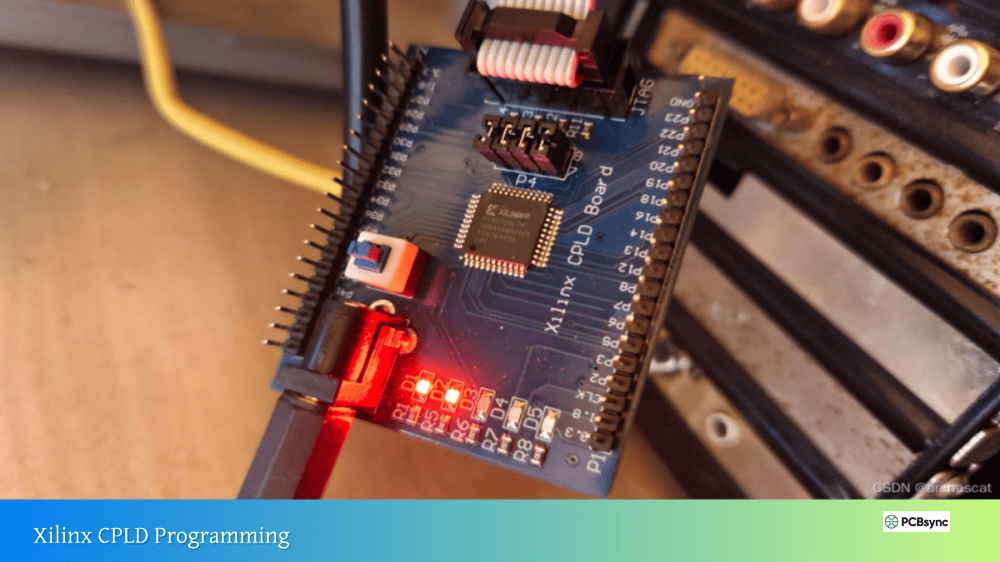
All CoolRunner-II devices support IEEE 1149.1/1532 JTAG programming. The four JTAG pins (TCK, TMS, TDI, TDO) provide in-system programming capability without removing the device from your board.
Development Tools
Xilinx ISE WebPack: The primary development environment, supporting design entry, synthesis, implementation, and programming. While older than Vivado, ISE remains the required tool for CoolRunner-II development.
Programming Hardware Options:
Programmer
Notes
Xilinx Platform Cable USB
Official solution, native ISE support
Digilent HS2/HS3
Reliable alternative
FT2232-based cables
Budget option via SVF playback
UrJTAG
Open-source SVF programmer
Programming Sequence
Create design using Verilog, VHDL, or schematic entry
Programming endurance exceeds 1,000 cycles for CoolRunner-II devices (compared to 10,000 for XC9500XL). For designs requiring frequent reprogramming during development, this limit rarely becomes a concern.
CoolRunner-II vs XC9500XL: Which to Choose?
The choice between CoolRunner-II and XC9500XL depends on your application priorities.
Criteria
CoolRunner-II
XC9500XL
Standby Power
< 100 µA
Several mA
Core Voltage
1.8V
3.3V
5V Tolerance
No
Yes
Supply Complexity
Multiple rails
Single 3.3V
Programming Cycles
1,000+
10,000+
Cost
Slightly higher
Lower
Speed
Moderate
Faster
Choose CoolRunner-II when:
Battery operation or energy harvesting
Multi-voltage system interfaces (1.5V to 3.3V)
Heat dissipation constraints
Portable or wearable applications
Choose XC9500XL when:
5V system compatibility needed
Simple power supply preferred
Maximum speed required
Cost is primary concern
Typical Applications for CoolRunner-II
The ultra-low power characteristics make CoolRunner-II devices ideal for specific application categories.
Portable and Battery-Operated Equipment
Handheld instruments, medical devices, remote sensors, and wearable electronics benefit most from CoolRunner-II power efficiency. The instant-on capability (no configuration time) suits applications requiring immediate response from sleep states.
Voltage Level Translation
With two or four I/O banks operating at independent voltages, CoolRunner-II devices serve as intelligent level shifters. Unlike passive translators, you can add logic functions (filtering, timing adjustment, protocol conversion) to the translation path.
Wireless Interface Controllers
Bluetooth modules, WiFi subsystems, and RF transceivers often require glue logic running from battery power. CoolRunner-II handles control sequencing while minimizing drain on limited energy budgets.
Low-Power State Machines
Industrial sensors, building automation controllers, and environmental monitors spend most of their time idle, waking periodically to collect and transmit data. CoolRunner-II’s near-zero standby consumption suits this duty cycle perfectly.
Useful Resources for CoolRunner-II Development
Documentation Downloads
Document
Description
DS090
CoolRunner-II Family Datasheet
DS310
XC2C32A Device Datasheet
DS311
XC2C64A Device Datasheet
DS093
XC2C128 Device Datasheet
DS094
XC2C256 Device Datasheet
XAPP389
CoolRunner-II Power Calculation
XAPP399
Interfacing to High-Speed SSTL
Development Boards
Board
Device
Features
Digilent CoolRunner-II Starter
XC2C256
Pmod ports, switches, LEDs
Dangerous Prototypes Breakout
XC2C64A
Minimal, low-cost
Seeed Studio CPLD Board
XC2C64A
USB programming, breadboard-friendly
Software Tools
Tool
Purpose
ISE WebPack 14.7
Design entry, synthesis, implementation
iMPACT
Device programming
XPower Analyzer
Power estimation
FAQs About CoolRunner-II CPLDs
What is the main advantage of CoolRunner-II over other CPLDs?
The primary advantage is ultra-low power consumption. CoolRunner-II devices draw as little as 16µA standby current compared to several milliamps for traditional CPLDs like XC9500XL. This makes them suitable for battery-powered applications where other CPLDs would drain batteries too quickly. The Fast Zero Power technology eliminates the residual current that sense-amplifier-based CPLDs always draw.
Can CoolRunner-II interface with 5V logic?
No, CoolRunner-II devices are not 5V tolerant. Maximum input voltage is 3.9V (for LVCMOS33). If you need 5V compatibility, use the XC9500XL family instead, or add external level shifters. The CoolRunner-II multi-voltage I/O banks support 1.5V, 1.8V, 2.5V, and 3.3V interfaces natively.
Which CoolRunner-II device should I start with?
The Xilinx XC2C64A offers an excellent balance of capability and cost for learning and prototyping. It provides 64 macrocells, enough for meaningful projects, while remaining affordable ($2-3 each). Development boards based on this device cost under $20 and include necessary programming support.
Are CoolRunner-II devices still available for new designs?
AMD (which acquired Xilinx) issued an End of Life notice for CoolRunner-II in early 2024, with final orders accepted through mid-2024. While devices remain available through distribution channels, new designs should consider alternative solutions. Existing products can source devices from distributors’ stock for continued production.
How does the power consumption compare at operating frequency?
At 20MHz operating frequency, an XC9500XL might draw approximately 18mA while a similarly-loaded CoolRunner-II stays under 1mA. The difference becomes even more dramatic at standby, where CoolRunner-II draws microamps versus milliamps for competing CPLDs. For battery life calculations, this order-of-magnitude improvement often determines project feasibility.
Conclusion
The CoolRunner-II family carved out a unique niche in programmable logic by prioritizing power efficiency without completely sacrificing performance. From the tiny XC2C32A through the Xilinx XC2C256 and larger devices, these CPLDs enabled battery-powered designs that traditional programmable logic couldn’t support.
While the product family has reached end-of-life status, existing designs can continue sourcing devices from distribution. For new projects requiring similar ultra-low power characteristics, consider modern alternatives like Lattice MachXO3 or evaluate whether your application truly needs the power optimization CoolRunner-II provides.
For legacy designs or projects where CoolRunner-II devices remain available, the combination of instant-on operation, multi-voltage I/O banking, and micro-amp standby current continues to deliver value in power-constrained applications.
Inquire: Call 0086-755-23203480, or reach out via the form below/your sales contact to discuss our design, manufacturing, and assembly capabilities.
Quote: Email your PCB files to Sales@pcbsync.com (Preferred for large files) or submit online. We will contact you promptly. Please ensure your email is correct.
Notes: For PCB fabrication, we require PCB design file in Gerber RS-274X format (most preferred), *.PCB/DDB (Protel, inform your program version) format or *.BRD (Eagle) format. For PCB assembly, we require PCB design file in above mentioned format, drilling file and BOM. Click to download BOM template To avoid file missing, please include all files into one folder and compress it into .zip or .rar format.