Inquire: Call 0086-755-23203480, or reach out via the form below/your sales contact to discuss our design, manufacturing, and assembly capabilities.
Quote: Email your PCB files to Sales@pcbsync.com (Preferred for large files) or submit online. We will contact you promptly. Please ensure your email is correct.
Notes: For PCB fabrication, we require PCB design file in Gerber RS-274X format (most preferred), *.PCB/DDB (Protel, inform your program version) format or *.BRD (Eagle) format. For PCB assembly, we require PCB design file in above mentioned format, drilling file and BOM. Click to download BOM template To avoid file missing, please include all files into one folder and compress it into .zip or .rar format.
Xilinx Spartan-6 FPGA: Still Relevant? Complete 2025 Guide
The Spartan 6 FPGA family has been a workhorse in the embedded industry since its introduction in 2009. After 15+ years in production, many engineers are asking whether the Xilinx Spartan 6 remains a viable choice for new designs or if it’s time to migrate to newer platforms. Having worked with these devices across dozens of commercial projects, I can tell you the answer isn’t straightforward—it depends heavily on your specific requirements and constraints.
This guide covers everything you need to know about the Xilinx Spartan 6 FPGA in 2025: current availability status, technical capabilities, tool support limitations, and when migration to newer devices makes sense.
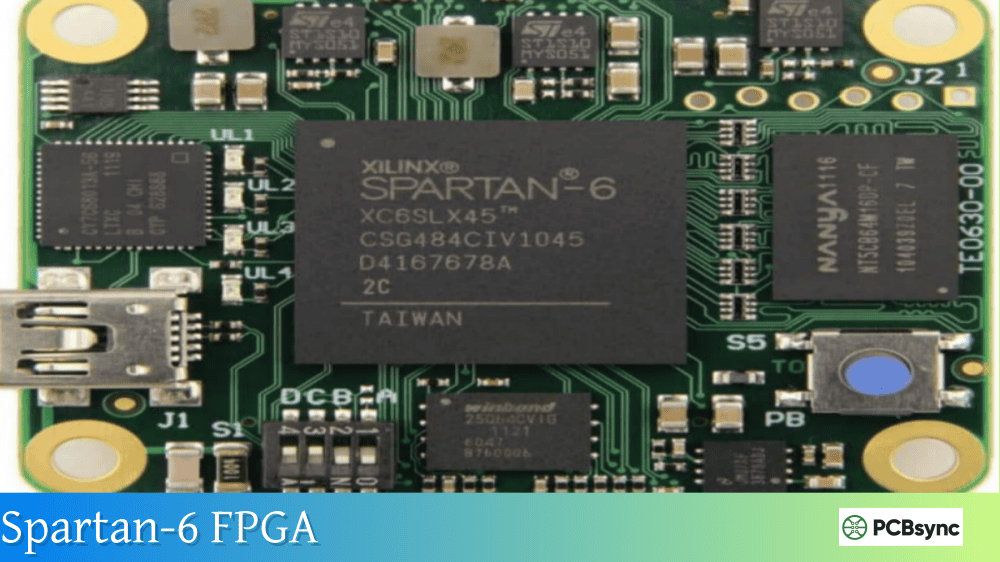
The Xilinx Spartan 6 FPGA family is a cost-optimized programmable logic platform built on 45nm process technology. When AMD/Xilinx launched it, the family represented a significant leap in capability-per-dollar for high-volume applications. The architecture brought features previously reserved for higher-end Virtex devices down to cost-sensitive markets.
The Spartan 6 family consists of two sub-families:
Sub-Family
Focus
GTP Transceivers
PCIe Support
Spartan-6 LX
Logic-optimized
No
No
Spartan-6 LXT
Serial connectivity
Up to 8 (3.2 Gbps)
Yes (x1 Gen1)
This differentiation matters because it directly impacts your migration path—designs using LXT transceivers cannot migrate to Spartan-7, which lacks transceivers entirely.
Spartan-6 FPGA Family Specifications
Device
Logic Cells
Slices
Block RAM (Kb)
DSP48A1 Slices
Max User I/O
XC6SLX4
3,840
600
216
8
132
XC6SLX9
9,152
1,430
576
16
200
XC6SLX16
14,579
2,278
576
32
232
XC6SLX25
24,051
3,758
936
38
266
XC6SLX45
43,661
6,822
2,088
58
358
XC6SLX75
74,637
11,662
3,096
132
408
XC6SLX100
101,261
15,822
4,824
180
480
XC6SLX150
147,443
23,038
4,824
180
576
The Xilinx Spartan 6 family spans 13 devices covering a wide range of applications:
The LXT variants (XC6SLX25T through XC6SLX150T) add GTP transceivers and PCIe endpoint blocks to the corresponding LX devices.
Key Features of the Xilinx Spartan 6 FPGA
Integrated Memory Controllers
One of the standout features of the Spartan 6 family is the hard Memory Controller Block (MCB). These dedicated blocks support:
Memory Type
Max Data Rate
Interface Width
DDR3
800 Mb/s
4, 8, or 16-bit
DDR2
800 Mb/s
4, 8, or 16-bit
DDR
400 Mb/s
4, 8, or 16-bit
LPDDR
400 Mb/s
4, 8, or 16-bit
This hard MCB was a significant advantage over competitors at the time and remains relevant for existing designs. However, it’s worth noting that Spartan-7 uses a soft memory controller, which impacts migration planning.
DSP48A1 Slices
The Xilinx Spartan 6 FPGA includes second-generation DSP slices (DSP48A1) with these capabilities:
18×18 signed multiplier
48-bit accumulator
Pre-adder for filter optimization
Pipelining and cascading support
Up to 250 MHz operation
For signal processing applications, the DSP48A1 slices provide efficient hardware multiplication and accumulation without consuming general-purpose logic.
Clock Management
Each Spartan 6 device includes Clock Management Tiles (CMTs), each containing:
Two Digital Clock Managers (DCM)
One Phase-Locked Loop (PLL)
Frequency synthesis from 400 MHz to 1,080 MHz
Spread-spectrum clock generation
Jitter filtering
Larger devices provide up to 6 CMTs, enabling complex multi-clock domain designs.
GTP Transceivers (LXT Only)
The Spartan-6 LXT sub-family includes GTP transceivers supporting:
Feature
Specification
Data Rate
622 Mb/s to 3.2 Gb/s
Transceivers per Device
2 to 8
Supported Protocols
PCIe, SATA, Gigabit Ethernet, Aurora
Encoding
8B/10B optional
The integrated PCIe endpoint block in LXT devices handles physical, data link, and transaction layers with under 200 LUTs of wrapper logic.
Here’s the reality of Spartan 6 availability in 2025:
Status
Details
Production Status
Active (extended lifecycle)
Lifecycle Commitment
Extended through at least 2030
Supply Situation
Constrained, long lead times
New Design Recommendation
Migration to 7 Series preferred
AMD announced in June 2023 that the Spartan 6 lifecycle has been extended until at least 2030. However, availability remains challenging due to several factors:
45nm fab capacity prioritized for newer devices
Extended lead times (often 12+ months)
Limited distributor stock
Pricing pressure on available inventory
For production designs already using Spartan 6, the devices will continue to be manufactured. But for new designs, AMD recommends migrating to Spartan-7, Artix-7, or other 7 Series devices.
ISE Design Suite: The Tool Situation
The Xilinx Spartan 6 FPGA is exclusively supported by ISE Design Suite—and this is where things get complicated. ISE entered “sustaining mode” in October 2013 and hasn’t received feature updates since then.
ISE Design Suite Status
Aspect
Status
Latest Version
ISE 14.7
Last Update
October 2013
Windows Support
Windows 7 (native), Windows 10 (VM only)
Linux Support
Limited to older distributions
Future Updates
None planned
License Cost
Free (WebPACK)
Running ISE on Modern Systems
Getting ISE to run on current operating systems requires workarounds:
Windows 10/11: AMD provides a virtual machine image with ISE pre-installed. This runs under VirtualBox or VMware and provides a functional development environment.
Linux: ISE 14.7 targets older distributions (RHEL 6, Ubuntu 12.04). Running on modern Linux requires compatibility libraries and sometimes manual intervention with installation scripts.
macOS: Not supported. Use a VM-based approach.
The tool situation alone makes new Spartan 6 designs increasingly difficult to justify—Vivado offers substantial productivity improvements for 7 Series devices.
When Spartan-6 Still Makes Sense
Despite the challenges, some scenarios justify continued Spartan 6 use:
Maintaining Existing Products
If you have a production design running on Xilinx Spartan 6 that works reliably:
The toolchain is stable and known
Your design files and workflows are established
Validation and testing are complete
Customer qualification may be tied to specific parts
In these cases, continuing production makes more sense than redesigning. Just ensure you have sufficient inventory or confirmed supply commitments.
Cost-Sensitive High-Volume Applications
The Spartan 6 family, particularly smaller devices like XC6SLX4 and XC6SLX9, can still be cost-competitive for:
Simple protocol bridges
Basic I/O expansion
Legacy interface support
Applications where 45nm power consumption is acceptable
Designs Requiring TQFP Packages
Here’s something hobbyists appreciate: Spartan 6 is available in TQFP packages (144-pin and 256-pin) that can be hand-soldered. Spartan-7 only comes in BGA packages, making home prototyping without specialized equipment impossible.
Device
TQFP-144
TQFP-256
XC6SLX4
✓
–
XC6SLX9
✓
✓
XC6SLX16
–
✓
XC6SLX25
–
✓
Migration Considerations: Spartan-6 to 7 Series
When the time comes to migrate from Xilinx Spartan 6, several architectural differences require attention:
Architecture Differences
Feature
Spartan-6
Spartan-7
Process Node
45nm
28nm
LUT Inputs
6 (dual 5-input mode)
6 (dual 5-input mode)
Block RAM Size
18 Kb
36 Kb (2×18 Kb)
DSP Slice
DSP48A1
DSP48E1
Memory Controller
Hard MCB
Soft MIG
Transceivers
GTP (LXT only)
None
ADC
None
XADC (dual 12-bit)
Tool Support
ISE
Vivado
Key Migration Challenges
Block RAM: The 36 Kb blocks in Spartan-7 are larger but can operate as dual 18 Kb. Designs heavily optimized for 18 Kb may need adjustment.
Memory Controller: Moving from hard MCB to soft MIG impacts timing closure and resource utilization. The MIG wizard handles this, but it’s not transparent.
Clocking: The Spartan-7 clocking architecture (MMCM + PLL per CMT) differs from Spartan-6 (2×DCM + PLL per CMT). Buffer types like BUFIO2 require manual migration.
No Transceivers: If your Spartan 6 design uses GTP transceivers, Spartan-7 cannot accommodate it. Consider Artix-7 instead.
Constraints: UCF constraint files must be converted to XDC format for Vivado.
For a direct comparison between the old and new cost-optimized families:
Specification
Spartan-6 (XC6SLX75)
Spartan-7 (XC7S50)
Logic Cells
74,637
52,160
Block RAM
3,096 Kb
2,700 Kb
DSP Slices
132
120
Max User I/O
408
250
Transceivers
4 (LXT variant)
0
Process Node
45nm
28nm
Power (relative)
1.0×
~0.5×
Performance
1.0×
~1.3×
XADC
No
Yes
Tool Support
ISE (archived)
Vivado (active)
The Spartan-7 delivers better performance and power efficiency, but with fewer maximum I/Os and no transceivers. Your specific design requirements determine which tradeoffs matter.
Development Boards and Evaluation Kits
For those working with Xilinx Spartan 6 FPGA designs:
Board
FPGA
Status
Notes
SP605
XC6SLX45T
Discontinued
Official Xilinx eval kit
Nexys 3
XC6SLX16
Discontinued
Academic/hobbyist
Mojo V3
XC6SLX9
Limited availability
Popular hobbyist board
EDGE Spartan 6
XC6SLX9
Available
Budget option with peripherals
Finding Spartan 6 development boards has become difficult. Most manufacturers have transitioned to Spartan-7 or Artix-7 based platforms.
Useful Resources and Downloads
Official Documentation
DS160: Spartan-6 Family Overview
DS162: Spartan-6 FPGA Data Sheet (DC and AC Switching Characteristics)
UG380: Spartan-6 FPGA Configuration User Guide
UG381: Spartan-6 FPGA SelectIO Resources
UG382: Spartan-6 FPGA Clocking Resources
UG383: Spartan-6 FPGA Block RAM Resources
UG384: Spartan-6 FPGA Configurable Logic Block
UG385: Spartan-6 FPGA Packaging and Pinouts
UG386: Spartan-6 FPGA GTP Transceivers
UG388: Spartan-6 FPGA Memory Controller
UG389: Spartan-6 FPGA DSP48A1 Slice
Software Downloads
ISE Design Suite 14.7 – AMD/Xilinx Archive Downloads
ISE Virtual Machine for Windows 10 – Pre-configured VM image
Platform Cable USB II Drivers – JTAG programmer support
Migration Resources
UG429: 7 Series FPGAs Migration Methodology Guide
Adam Taylor’s Migration White Paper – Adiuvo Engineering
BLT Spartan-6 Migration Training – Professional training option
Frequently Asked Questions
Is the Xilinx Spartan-6 obsolete?
No, the Xilinx Spartan 6 is not officially obsolete. AMD extended the lifecycle through at least 2030. However, it’s in “mature” status with constrained supply and long lead times. New designs should target 7 Series devices unless there’s a compelling reason to use Spartan-6.
Can I use Vivado with Spartan-6 FPGAs?
No, Vivado does not support Spartan 6 devices. You must use ISE Design Suite 14.7, which is available for free download but hasn’t been updated since 2013. ISE runs natively on Windows 7 or via virtual machine on Windows 10/11.
What should I migrate to from Spartan-6?
For Spartan 6 LX devices (no transceivers), Spartan-7 is the natural successor. For LXT devices using GTP transceivers, Artix-7 is the appropriate target since Spartan-7 lacks transceivers. The Zynq-7000 family is worth considering if you want to add embedded processing capability.
Why are Spartan-6 parts hard to find?
AMD/Xilinx prioritizes fab capacity for newer 28nm and 16nm devices over the 45nm Spartan 6 family. The 2021-2022 semiconductor shortage particularly impacted older process nodes, creating extended backlogs that are still being worked through.
Should I start a new design with Spartan-6?
Generally, no. Unless you have specific requirements that only Xilinx Spartan 6 can meet (like TQFP packages for hand-soldering or exact compatibility with existing hardware), starting new designs on 7 Series devices is strongly recommended. The tool support, supply chain, and long-term availability are all better with Spartan-7 or Artix-7.
Conclusion
The Xilinx Spartan 6 FPGA family served the industry well for over 15 years and remains in production with extended lifecycle support through 2030. For existing designs in production, continuing with Spartan 6 is viable as long as you can secure supply. The devices are proven, the tools are stable (if dated), and there’s no need to re-validate working hardware.
For new designs, the calculus is different. The combination of constrained supply, archived toolchain, and superior alternatives makes Xilinx Spartan 6 a tough sell. Spartan-7 offers better power efficiency, improved performance, modern tool support with Vivado, and reliable availability. The migration effort—while not trivial—pays dividends in long-term maintainability and supply chain security.
If you’re maintaining a legacy Spartan 6 design, plan your migration strategy now rather than waiting for a supply crisis. And if you’re starting fresh, embrace the 7 Series—the transition from ISE to Vivado alone will improve your development experience significantly.
Inquire: Call 0086-755-23203480, or reach out via the form below/your sales contact to discuss our design, manufacturing, and assembly capabilities.
Quote: Email your PCB files to Sales@pcbsync.com (Preferred for large files) or submit online. We will contact you promptly. Please ensure your email is correct.
Notes: For PCB fabrication, we require PCB design file in Gerber RS-274X format (most preferred), *.PCB/DDB (Protel, inform your program version) format or *.BRD (Eagle) format. For PCB assembly, we require PCB design file in above mentioned format, drilling file and BOM. Click to download BOM template To avoid file missing, please include all files into one folder and compress it into .zip or .rar format.