Inquire: Call 0086-755-23203480, or reach out via the form below/your sales contact to discuss our design, manufacturing, and assembly capabilities.
Quote: Email your PCB files to Sales@pcbsync.com (Preferred for large files) or submit online. We will contact you promptly. Please ensure your email is correct.
Notes: For PCB fabrication, we require PCB design file in Gerber RS-274X format (most preferred), *.PCB/DDB (Protel, inform your program version) format or *.BRD (Eagle) format. For PCB assembly, we require PCB design file in above mentioned format, drilling file and BOM. Click to download BOM template To avoid file missing, please include all files into one folder and compress it into .zip or .rar format.
In an era of microscopic surface-mount components and silicon integration, the wire wound resistor might seem like a relic from the age of vacuum tubes. Yet, open up a modern electric vehicle charger, a high-end audio amplifier, or a precision multimeter, and you will find them standing tall.
Why? Because when physics gets tough—when you need to dissipate 100 watts of heat, handle a massive energy pulse, or measure resistance with 0.01% accuracy—thin film and carbon composite resistors simply melt or drift.
As a PCB engineer, I consider the wire wound resistor the “heavy artillery” of the component library. It is not the cheapest or the smallest option, but when reliability is non-negotiable, it is the only choice. This guide delves into the construction, the non-inductive winding techniques, and the specific applications where this ancient technology still reigns supreme.
A wire wound resistor is exactly what it sounds like: a length of resistive wire wrapped around a non-conductive core. It is the oldest type of resistor, dating back to the dawn of electricity, yet it remains the gold standard for high-power and high-precision applications.
Unlike carbon or metal film resistors, which rely on a thin layer of conductive material, wire wound resistors use a solid metal alloy wire. This physical bulk gives them their two greatest superpowers:
Thermal Mass: They can absorb huge energy pulses without vaporizing.
Stability: The metal alloys used are incredibly stable over time and temperature.
Construction: Anatomy of Reliability
To select the right part, you need to understand what is happening inside the ceramic shell. The construction dictates the performance.
1. The Core (Substrate)
The foundation is usually a ceramic rod (alumina), steatite, or fiberglass.
Ceramic: Used for high-power resistors because it conducts heat well and withstands extreme temperatures.
Fiberglass: Used for flexible heating elements or lower-power precision parts.
2. The Resistive Wire
This is the heart of the component. The choice of alloy determines if the resistor is a “Power” resistor or a “Precision” resistor.
Alloy Material
Key Property
Application
Nichrome (Ni-Cr)
High resistance, withstands 1000°C+.
Power Resistors, Heaters.
Constantan (Cu-Ni)
Moderate resistance, low thermal drift.
General purpose.
Manganin (Cu-Mn-Ni)
Ultra-low Temperature Coefficient (TCR).
Precision Shunts, Instruments.
Evanohm (Ni-Cr-Al-Cu)
Extremely stable, high resistance.
Standards Lab Reference.
3. The Coating / Housing
Once wound, the wire must be protected from moisture and physical damage.
Vitreous Enamel: A glass-like coating fired at high temperatures. It provides the best heat dissipation and insulation. You see this on the classic green or brown tubular power resistors.
Silicone Cement: A cheaper, flame-proof coating used on commercial power resistors.
Aluminum Housed: The coil is potted inside an aluminum heatsink case (often gold or metallic colored) for chassis mounting.
Molded Plastic: Used for precision resistors to mechanically protect the delicate fine wire.
The Inductance Problem (and Solution)
If you take a wire and wrap it in a spiral around a core, you have accidentally built an inductor.
For a standard DC circuit (like a heater), this doesn’t matter. But if you use a standard wire wound resistor in a high-speed audio amp or a switching power supply, that inductance will filter out high frequencies and cause phase shifts.
Ayrton-Perry Winding (Non-Inductive)
To solve this, engineers use a technique called Ayrton-Perry winding.
Instead of one wire, two wires are wound in opposite directions (bifilar) and connected in parallel.
Physics: The magnetic field from the clockwise wire cancels out the magnetic field from the counter-clockwise wire.
Result: A “Non-Inductive” wire wound resistor that acts purely resistive up to much higher frequencies.
Trade-off: These are more expensive to manufacture and usually have lower resistance limits due to space constraints.
Types of Wire Wound Resistors
We categorize these resistors not by their size, but by their job.
1. Power Wire Wound Resistors
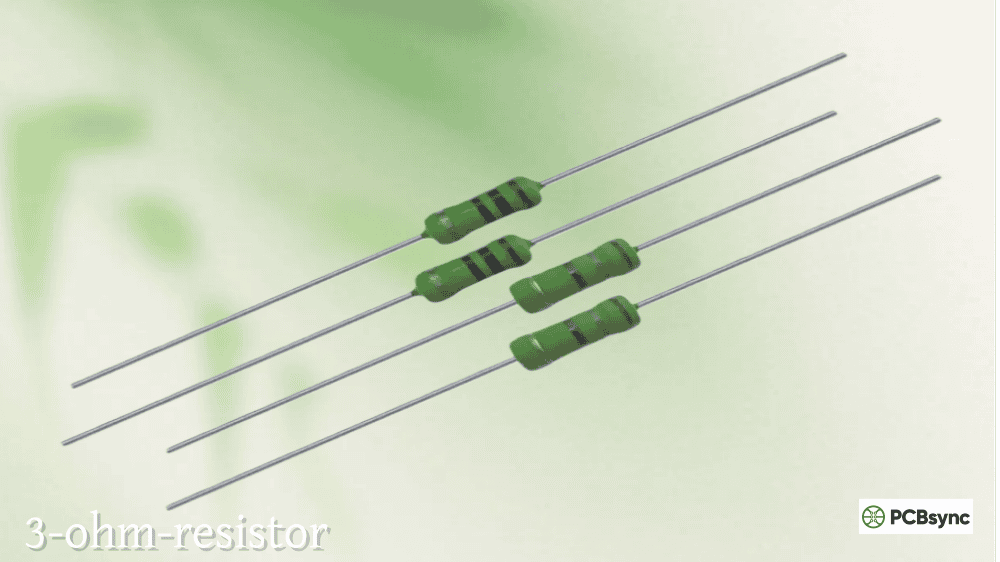
These are the workhorses. Ranging from 5 Watts to 1000 Watts.
Focus: Heat dissipation and robustness.
Tolerance: Loose (5% or 10%).
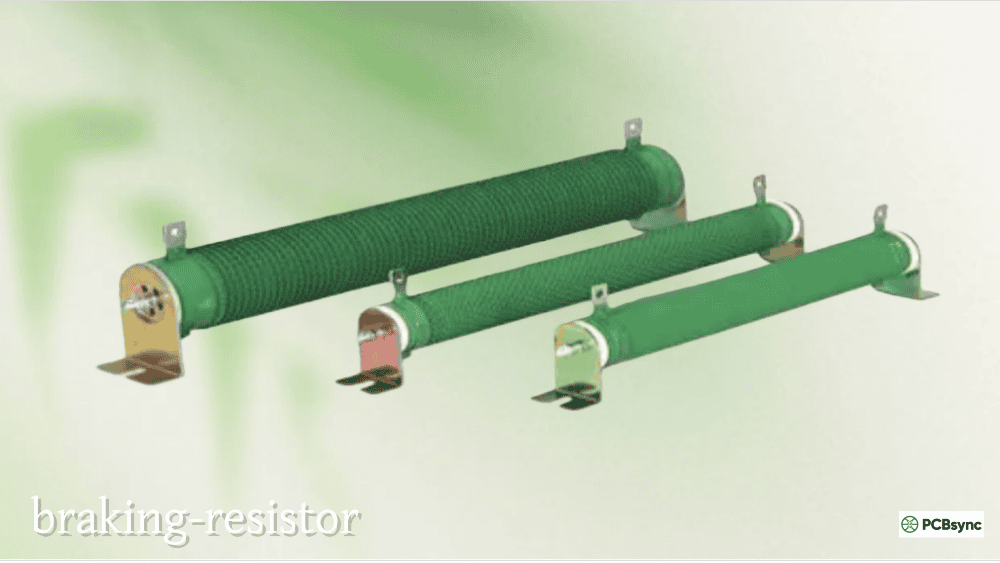
Appearance: Usually large, ceramic-coated tubes or aluminum chassis-mount bricks.
Use Case: Motor braking, load banks, inrush limiting.
2. Precision Wire Wound Resistors
These are the snipers. Used in multimeters and calibration equipment.
Focus: Stability (TCR) and Accuracy.
Tolerance: Tight (0.1% to 0.005%).
TCR: As low as 1 ppm/°C.
Appearance: Small, black, rectangular molded epoxy or axial leads.
Use Case: Measurement bridges, current sensing shunts, feedback networks.
3. Fusible Wire Wound Resistors
A safety device and a resistor in one.
Mechanism: The wire is designed to melt (open circuit) cleanly at a specific current overload.
Use Case: Input protection for power supplies (e.g., inside your phone charger). It limits inrush current during normal use and acts as a fuse if the charger fails.
Key Specifications for Selection
When reading a datasheet for a wire wound resistor, look beyond the resistance value.
Pulse Handling (The Joule Rating)
This is the main reason we choose wire wound over film.
A thin film resistor has a mass of a few milligrams. A wire wound resistor has grams of metal wire.
When a 1000V spike hits:
Film: Heats up instantly and vaporizes (Open Circuit).
Wire: The mass absorbs the heat energy (Joules) without raising the temperature instantly, surviving the pulse.
Datasheet Check: Look for the “Pulse Energy” or “Surge Capability” graph.
This tells you how much the resistance changes as it gets hot.
Formula: $\Delta R = R \times TCR \times \Delta T$
For a Power Resistor, 200ppm/°C is acceptable.
For a Precision Resistor, you want <10ppm/°C.
Stability (Load Life)
If you run a resistor at full power for 1000 hours, its value will shift due to thermal stress (annealing the wire).
Wire Wound: Very stable (typically <1% shift).
Carbon Composition: Very unstable (can shift 5-10%).
Practical Applications
1. Capacitor Discharge (Bleeder Resistor)
High-voltage capacitors in tube amps or power supplies can hold a lethal charge for days. A wire wound resistor is placed across the capacitor to drain it safely when power is off.
Why Wire Wound? It can withstand the high voltage without arcing and handles the continuous power dissipation reliably.
2. Current Sensing (Shunts)
We use low-value precision wire wound resistors (often Manganin alloy) to measure current.
Why Wire Wound? Manganin wire has virtually zero TCR at room temperature, meaning your current reading doesn’t drift as the sensor heats up.
3. Snubber Circuits
In switching power supplies, we use an RC (Resistor-Capacitor) network to dampen voltage spikes across MOSFETs.
Why Wire Wound? The resistor sees high-energy spikes millions of times a second. A non-inductive wire wound resistor is required here to handle the pulse energy without adding inductance to the circuit.
4. Audio Crossovers
In passive speaker crossovers, resistors match the volume of the tweeter to the woofer (L-Pad).
Why Wire Wound? They need to handle the high power of the amplifier without changing resistance (which would change the crossover frequency) as they heat up. Non-inductive types are preferred to preserve high-frequency audio quality.
Wire Wound vs. The Alternatives
Why not just use Metal Film for everything? It’s cheaper.
Feature
Wire Wound
Metal Film
Carbon Composition
Power Density
High
Medium
Low
Pulse Handling
Excellent
Poor
Good
High Frequency
Poor (Inductive)
Excellent
Good
Precision
Excellent
Good
Poor
Noise
Ultra Low
Low
High
Cost
High
Low
Medium
Useful Resources
For engineers sourcing these parts, here are the databases and manufacturers to trust:
Vishay / Dale: The industry giant. Their “RS” and “NS” (Non-Inductive) series are the standard for military and industrial use.
Ohmite: Famous for their power resistors and ceramic rheostats. Check their “Pulse Power” whitepapers.
TE Connectivity: Good source for aluminum-housed chassis mount resistors (HSC Series).
Riedon: Specialists in precision wire wounds. Their technical library has excellent data on temperature coefficients.
Frequently Asked Questions (FAQ)
1. Can I replace a wire wound resistor with a metal oxide resistor?
In DC circuits, often yes. However, if the circuit involves pulses (like a surge protector or soft-start circuit), a metal oxide resistor might fail. Metal oxide film is much thinner than wire and cannot absorb the same energy surge.
2. Why does my wire wound resistor hum?
Because it is a coil! If AC current flows through it, the magnetic field expands and contracts, causing the wire windings to vibrate against the core (magnetostriction). This is common in large power resistors. Using a “potted” or vitreous enamel coated resistor helps dampen this noise.
3. Are all wire wound resistors inductive?
By default, yes. They are coils. However, if you buy a resistor marked “Non-Inductive” (often with an ‘N’ in the part number, like ’50N’), it uses the Ayrton-Perry winding to cancel the inductance. Use these for audio and high-speed switching.
4. How hot can a wire wound resistor get?
Hotter than you think. A standard ceramic power resistor is often rated to operate with a surface temperature of 300°C to 400°C at full load. Always ensure you mount them away from heat-sensitive plastics or capacitors.
5. What is a “Safety Resistor”?
This usually refers to a Fusible Wire Wound resistor. It is designed to fail “safe” (open circuit) without catching fire when overloaded. Standard resistors might overheat and ignite the PCB before they burn open.
Conclusion
The wire wound resistor is a testament to the idea that simple, robust engineering never goes out of style. While it may lack the miniaturization of modern SMD chips, it offers reliability that no film resistor can match.
Whether you are designing a 5kW load bank or a 0.01% reference standard, the coil of wire around a ceramic core remains the engineer’s best friend for managing power and precision. The next time you need a component that can take a beating and keep on working, reach for the wire wound.
Inquire: Call 0086-755-23203480, or reach out via the form below/your sales contact to discuss our design, manufacturing, and assembly capabilities.
Quote: Email your PCB files to Sales@pcbsync.com (Preferred for large files) or submit online. We will contact you promptly. Please ensure your email is correct.
Notes: For PCB fabrication, we require PCB design file in Gerber RS-274X format (most preferred), *.PCB/DDB (Protel, inform your program version) format or *.BRD (Eagle) format. For PCB assembly, we require PCB design file in above mentioned format, drilling file and BOM. Click to download BOM template To avoid file missing, please include all files into one folder and compress it into .zip or .rar format.