Inquire: Call 0086-755-23203480, or reach out via the form below/your sales contact to discuss our design, manufacturing, and assembly capabilities.
Quote: Email your PCB files to Sales@pcbsync.com (Preferred for large files) or submit online. We will contact you promptly. Please ensure your email is correct.
Notes: For PCB fabrication, we require PCB design file in Gerber RS-274X format (most preferred), *.PCB/DDB (Protel, inform your program version) format or *.BRD (Eagle) format. For PCB assembly, we require PCB design file in above mentioned format, drilling file and BOM. Click to download BOM template To avoid file missing, please include all files into one folder and compress it into .zip or .rar format.
Building your own SDR receiver or portable VHF radio is one of the most rewarding electronics projects you can tackle. But there’s always that moment when you realize the antenna is going to be a problem. At 145 MHz, a quarter-wave antenna is about 50 centimeters long. At 169 MHz for smart metering applications, it’s still over 40 centimeters. How exactly do you fit that onto a circuit board that measures 10 centimeters across?
This is the fundamental challenge of VHF PCB antenna design, and it’s one I’ve wrestled with on numerous projects—from compact amateur radio handhelds to IoT devices operating in the 169 MHz band. The physics don’t lie: you’re trying to make an electrically small antenna work at frequencies where wavelengths are measured in meters, not centimeters.
The good news is that with the right techniques, you can build a VHF PCB antenna that actually performs. It won’t match a full-size external antenna, but for portable SDR receivers, handheld radios, and embedded IoT applications, a well-designed PCB antenna can provide surprisingly useful performance. This guide covers everything you need to know to design one that works.
Understanding VHF Frequencies and the Size Challenge
The VHF (Very High Frequency) band spans 30 MHz to 300 MHz. This range covers some of the most interesting frequencies for hobbyists and professionals alike.
Key VHF Frequency Allocations
Frequency
Application
Quarter Wavelength
50-54 MHz
Amateur 6m band
150 cm
88-108 MHz
FM broadcast
85 cm
136-174 MHz
Public safety, business
55-44 cm
144-148 MHz
Amateur 2m band
52-51 cm
156-162 MHz
Marine VHF
48-46 cm
169 MHz
Smart metering (EU)
44 cm
220-225 MHz
Amateur 1.25m band
34-33 cm
Look at those quarter-wavelength dimensions. Even at the high end of VHF (220 MHz), you’re dealing with antennas that should be over 30 centimeters long for optimal performance. Most PCBs for portable devices are 5-15 centimeters in their longest dimension.
This size mismatch is the core challenge of VHF PCB antenna design. You’re creating what antenna engineers call an “electrically small antenna” (ESA)—one where the physical dimensions are significantly smaller than the operating wavelength.
The Efficiency Trade-off
Here’s the uncomfortable truth about VHF PCB antennas: miniaturization costs efficiency. There’s a fundamental physical limit called the Chu-Harrington limit that relates antenna size to achievable bandwidth and efficiency. The smaller you make an antenna relative to its wavelength, the more you sacrifice in these parameters.
A full-size quarter-wave ground plane antenna at 145 MHz might achieve 95% efficiency. A compact VHF PCB antenna of the same frequency, squeezed onto a 10cm board, might achieve 15-40% efficiency depending on the design. That’s a significant loss—but it’s still usable for many applications, especially receive-only SDR projects.
The key is setting realistic expectations and optimizing your design to get the best possible performance within your size constraints.
Types of VHF PCB Antennas
Several antenna topologies work for VHF PCB applications. Each offers different trade-offs between size, efficiency, bandwidth, and design complexity.
Helical PCB Antennas
The helical antenna winds a conductor into a coil, increasing electrical length while reducing physical size. For VHF PCB applications, you can implement this as a trace wound around a cylindrical form factor, or as a planar spiral on the PCB surface.
Advantages:
Significant size reduction (3:1 to 5:1 possible)
Relatively simple to implement
Good for narrow bandwidth applications
Disadvantages:
Lower efficiency than full-size antennas
Narrow bandwidth
May require external matching components
Best for: Compact handheld radios, IoT devices where size is critical
Meander Line Antennas
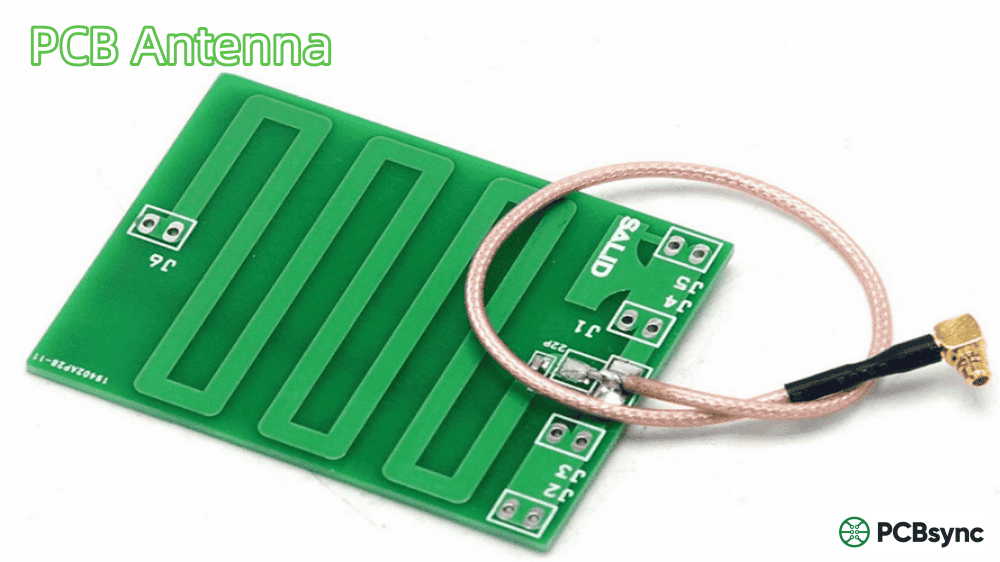
Meander line antennas fold a monopole or dipole element back and forth in a serpentine pattern. This increases the electrical path length while keeping the overall antenna footprint small.
Advantages:
Can be implemented entirely as PCB traces
Moderate size reduction (2:1 to 3:1)
Lower profile than helical designs
Disadvantages:
Adjacent sections can couple, reducing effectiveness
Requires careful optimization of meander geometry
Bandwidth typically narrower than straight elements
Best for: SDR receiver front-ends, embedded applications with flat form factors
Small Loop Antennas
Small loop antennas (also called magnetic loops) are resonant loops much smaller than a wavelength. They’re naturally high-Q, meaning narrow bandwidth but good efficiency for their size.
Advantages:
Excellent noise rejection
Directional pattern useful for direction finding
Can be very compact
Disadvantages:
Very narrow bandwidth (may need variable tuning)
High-Q makes them sensitive to nearby objects
Lower gain than dipole-type antennas
Best for: Receive-only SDR applications, direction finding, noise-sensitive environments
Planar Inverted-F Antenna (PIFA)
The PIFA is widely used in mobile phones and can be adapted for VHF frequencies, though it becomes quite large. It consists of a radiating plate parallel to a ground plane, with a shorting pin and feed point.
Advantages:
Low profile
Can be integrated with ground plane
Reasonable bandwidth
Disadvantages:
Large size at VHF frequencies
Sensitive to ground plane dimensions
Complex impedance behavior
Best for: Applications where height is limited but footprint is less constrained
Inductively Loaded Monopole
Adding lumped inductors to a shortened monopole increases its electrical length. This is one of the simplest miniaturization techniques and can be combined with other methods.
Advantages:
Simple to implement
Allows use of shorter trace lengths
Can be tuned by changing inductor values
Disadvantages:
Inductor losses reduce efficiency
Requires high-Q inductors for best performance
Narrowband
Best for: Quick prototypes, applications where PCB space is very limited
VHF PCB Antenna Type Comparison
Antenna Type
Size Reduction
Efficiency
Bandwidth
Complexity
Helical
3:1 to 5:1
15-35%
Narrow
Medium
Meander Line
2:1 to 3:1
25-45%
Narrow
Medium
Small Loop
5:1 to 10:1
20-40%
Very Narrow
High
PIFA
1.5:1 to 2:1
40-60%
Moderate
Medium
Loaded Monopole
2:1 to 4:1
20-40%
Narrow
Low
Designing Your VHF PCB Antenna: Step by Step
Let me walk through the practical process of designing a VHF PCB antenna for an SDR receiver project targeting the 2-meter amateur band (144-148 MHz).
Step 1: Define Your Requirements
Before any design work, document your constraints:
For a receive-only application, efficiency is less critical than for transmit. Even a 20% efficient antenna can work well for receiving if you have a good low-noise amplifier (LNA) in your signal chain.
Step 2: Calculate Starting Dimensions
At 146 MHz (center frequency):
Wavelength (λ) = 300/146 = 2.05 meters
Quarter wavelength = 513 mm
Available space = 100 mm maximum dimension
We need to fit 513mm of electrical length into roughly 100mm of physical space—a reduction factor of about 5:1. This pushes toward a helical or loaded meander design.
Step 3: Choose Your Topology
For this project, I’ll use a meander line monopole with inductive loading. This combination allows:
PCB trace implementation (no external components for the main element)
Tuning adjustment via a series inductor
Reasonable efficiency for receive applications
Step 4: Design the Meander Element
The meander line geometry requires optimization, but here are starting parameters:
Trace width: 1.5mm (wider traces have lower loss) Meander spacing: 3mm between parallel sections Number of meanders: 8 sections Section length: 12mm each Total trace length: Approximately 200mm
This gives us about 40% of the required electrical length from the meander element alone. The remaining length comes from inductive loading.
Step 5: Add Inductive Loading
To make up the missing electrical length, add a series inductor between the feed point and the meander element.
Required inductance: Approximately 120-150 nH Inductor type: Air-core or high-Q ceramic Placement: At or near the feed point
The exact inductor value will need adjustment during testing. Start with a slightly higher value and trim down.
Step 6: Design the Ground Plane
The ground plane is critical for VHF PCB antenna performance. At these frequencies, the ground plane becomes part of the radiating structure.
Minimum ground plane size: λ/4 in at least one dimension (500mm ideal, but impractical) Practical approach: Make the ground plane as large as your PCB allows Our design: 100mm × 60mm ground plane on the bottom layer
A ground plane this small will affect the antenna’s resonant frequency and radiation pattern. Plan to tune the antenna with the actual ground plane in place.
Step 7: Simulate Before Building
Use electromagnetic simulation software to verify your design before fabrication:
4nec2: Free, excellent for wire antennas
OpenEMS: Free, handles PCB structures
HFSS/CST: Professional tools if available
Simulation will show you the expected resonant frequency, impedance, and radiation pattern. Expect to iterate several times to optimize performance.
Getting the PCB layout right is essential for VHF antenna performance.
Keep the Antenna Clear
Maintain at least 10mm clearance between the antenna element and any other copper (traces, components, ground pours). At VHF frequencies, nearby metal significantly affects antenna behavior.
Antenna Placement
Position the antenna at the edge or corner of the PCB, extending away from other circuitry. This maximizes the effective ground plane and minimizes coupling to noise sources.
Ground Plane Continuity
Use a continuous ground plane on the layer opposite the antenna. Avoid slots or cuts in the ground plane under the antenna area—these create unpredictable resonances.
Feed Line Design
Route the feed line from the antenna to your RF circuitry as a 50Ω transmission line (microstrip or coplanar waveguide). Keep this line as short as possible to minimize losses.
Microstrip width for 50Ω on 1.6mm FR-4: Approximately 3mm
Matching Network Location
If you need a matching network (likely), place the components as close to the antenna feed point as possible. Long traces between the antenna and matching components add loss and parasitic effects.
Matching Your VHF PCB Antenna
Electrically small antennas rarely present a 50Ω impedance. You’ll need a matching network to efficiently transfer power between the antenna and your receiver.
Measuring the Impedance
Use a VNA (Vector Network Analyzer) or antenna analyzer to measure the antenna’s actual impedance. NanoVNA devices are affordable and adequate for VHF work.
Typical results for a miniaturized VHF PCB antenna:
Resistance: 5-25Ω (lower than 50Ω)
Reactance: -j50 to -j200Ω (capacitive)
L-Match Network
The simplest matching approach uses two reactive components in an L-configuration. For the typical case of low resistance with capacitive reactance:
Configuration: Series inductor + shunt capacitor
Example values for 15-j100Ω antenna at 146 MHz:
Series inductor: 82 nH
Shunt capacitor: 22 pF
Component Selection
Use high-Q components for the matching network. Lossy components waste precious efficiency in an already-compromised antenna.
Inductors: Air-core, ceramic, or wire-wound (avoid standard chip inductors below 100 MHz) Capacitors: NP0/C0G ceramic, silver mica, or porcelain
Tuning for Best Match
With the matching components installed, measure S11 (return loss) with your VNA. Adjust component values to minimize S11 at your target frequency.
Target S11: Better than -10 dB (VSWR < 2:1) Achievable S11: -15 to -25 dB with careful tuning
Practical Build Tips for SDR Projects
Here are lessons learned from building VHF PCB antennas for SDR receiver projects.
Use an LNA
For receive applications, add a low-noise amplifier between the antenna and your SDR. This compensates for the reduced antenna efficiency and improves overall sensitivity.
Recommended LNA gain: 15-20 dB Noise figure: < 1 dB Popular devices: SPF5189Z, PSA4-5043, Mini-Circuits PGA-103+
Shield Your SDR
Many SDR receivers (RTL-SDR dongles, etc.) generate significant digital noise that can couple into a nearby PCB antenna. Shield the SDR in a metal enclosure, or locate it away from the antenna.
Consider a Receive-Only Design
For receive-only applications, you can use antenna designs that would be impractical for transmit. Higher-Q designs with narrower bandwidth are fine if you’re only listening.
Build Test Fixtures
Create a simple test fixture that lets you measure the antenna on your VNA without soldering it to your final circuit. Use SMA connectors and edge-mount the antenna board during development.
Iterate Quickly
Expect your first VHF PCB antenna to need adjustment. Order multiple PCB copies so you can modify and retest without long fabrication delays.
VHF PCB Antenna Design Example: 169 MHz Smart Meter Receiver
Let me share a concrete design for a 169 MHz VHF PCB antenna—a frequency commonly used for smart metering in Europe and increasingly for IoT applications.
Design Specifications
Frequency: 169.4-169.475 MHz (Wireless M-Bus)
Bandwidth: 100 kHz (narrow)
PCB size: 50mm × 30mm
Application: Receive-only smart meter monitor
Chosen Topology: Loaded Meander
Given the narrow bandwidth requirement and small size, a loaded meander line offers the best compromise.
Dimensions
Meander trace width: 1.0mm
Meander spacing: 2.5mm
Number of sections: 6
Section length: 8mm
Total meander length: 100mm
Loading inductor: 180 nH (placed at feed)
Ground plane: Full bottom layer, 50mm × 30mm
Performance (Simulated)
Resonant frequency: 169.4 MHz
Impedance at resonance: 18 + j5 Ω
Bandwidth (S11 < -10 dB): 400 kHz
Estimated efficiency: 22%
Matching Network
To match 18Ω to 50Ω:
Series inductor: 68 nH
Shunt capacitor: 33 pF
This design achieves usable receive performance in a very compact package. The 22% efficiency sounds low, but for a receive-only application with an LNA, it works well in practice.
TI SWRA046: Antenna Selection Guide for embedded applications
Radiocrafts AN007: 169 MHz Antenna Tuning
Infineon AN91445: Antenna Design and RF Layout Guidelines
STMicroelectronics AN2866: Antenna matching for various bands
Component Suppliers
Coilcraft: High-Q inductors for matching networks
Murata: Ceramic capacitors and chip inductors
Johanson Technology: RF matching components
Community Resources
ARRL Antenna Book: Comprehensive antenna theory
RTL-SDR Blog: SDR project tutorials and antenna discussions
The Things Network Forum: IoT antenna discussions for LoRa/VHF
Frequently Asked Questions About VHF PCB Antennas
What efficiency can I realistically expect from a VHF PCB antenna?
For a VHF PCB antenna on a typical 10cm × 6cm board operating around 145-170 MHz, expect 15-40% efficiency depending on your design. A larger board (15cm × 10cm) might achieve 30-50%. These numbers assume careful design and proper matching. For comparison, a full-size quarter-wave antenna achieves 90%+ efficiency. The reduced efficiency of PCB antennas is acceptable for many portable and receive-only applications, but you should account for it in your link budget.
How important is the ground plane size for VHF PCB antennas?
The ground plane is critical—arguably as important as the antenna element itself. At VHF frequencies, the ground plane participates in radiation, and its size directly affects resonant frequency, impedance, and efficiency. Ideally, the ground plane should be at least λ/4 in its longest dimension, but this is impractical for most VHF PCB applications. Make the ground plane as large as your design allows, and expect to tune the antenna with your actual ground plane in place. Changing ground plane size will shift the resonant frequency significantly.
Can I use a VHF PCB antenna for transmitting on amateur radio bands?
Technically yes, but with significant limitations. The reduced efficiency means most of your transmit power becomes heat rather than radiated signal. For a 5W transmitter with a 25% efficient antenna, only 1.25W actually radiates. For low-power applications (QRP, under 1W), this can be acceptable. For higher power, the efficiency loss and heating become problematic. Many jurisdictions also have regulations about antenna efficiency for licensed transmitters. For most amateur transmit applications, an external antenna is strongly recommended.
Why is my VHF PCB antenna resonating at the wrong frequency?
Several factors cause frequency shift in VHF PCB antennas. The most common are: (1) Ground plane size—smaller ground planes shift resonance upward; (2) Nearby objects—metal enclosures, batteries, or LCD displays detune the antenna; (3) Component tolerances—inductor values can vary ±10-20%; (4) PCB dielectric constant—FR-4 εr varies from 4.2 to 4.8. Always tune your antenna with all components installed and the enclosure in place. Leave room in your design for trimming (slightly long traces) or component substitution.
Should I use FR-4 or a special RF substrate for my VHF PCB antenna?
For most VHF PCB antenna applications, standard FR-4 is adequate. Unlike microwave frequencies where FR-4 losses become significant, VHF frequencies are low enough that substrate losses are minor compared to other efficiency losses. The dielectric constant variation of FR-4 (4.2-4.8) does affect resonant frequency, so you may need to tune your design. For production applications where consistency matters, consider tighter-tolerance FR-4 or a material like Rogers RO4003C. For hobby projects and prototypes, standard FR-4 works fine and costs much less.
Conclusion
Designing a VHF PCB antenna is an exercise in managing trade-offs. You’re fighting against physics—trying to make an antenna work at frequencies where the wavelength dwarfs your available board space. Perfect performance isn’t possible, but useful performance absolutely is.
The keys to success are setting realistic expectations, choosing the right antenna topology for your constraints, and paying careful attention to the ground plane and matching network. For SDR receiver projects, the reduced efficiency of a compact VHF PCB antenna can be compensated with an LNA. For transmit applications, think carefully about whether a PCB antenna makes sense, or whether an external antenna is a better choice.
Start with the simpler designs—a loaded meander or basic helical—before attempting more complex topologies. Simulate before you build, and plan for iteration. Even experienced antenna designers rarely get VHF PCB antennas right on the first try.
The satisfaction of receiving signals on an antenna you designed yourself makes the effort worthwhile. When you pick up that distant repeater or decode those smart meter transmissions on your homebrew SDR receiver with its integrated VHF PCB antenna, you’ll understand why antenna design remains one of the most rewarding aspects of radio engineering.
Inquire: Call 0086-755-23203480, or reach out via the form below/your sales contact to discuss our design, manufacturing, and assembly capabilities.
Quote: Email your PCB files to Sales@pcbsync.com (Preferred for large files) or submit online. We will contact you promptly. Please ensure your email is correct.
Notes: For PCB fabrication, we require PCB design file in Gerber RS-274X format (most preferred), *.PCB/DDB (Protel, inform your program version) format or *.BRD (Eagle) format. For PCB assembly, we require PCB design file in above mentioned format, drilling file and BOM. Click to download BOM template To avoid file missing, please include all files into one folder and compress it into .zip or .rar format.