Inquire: Call 0086-755-23203480, or reach out via the form below/your sales contact to discuss our design, manufacturing, and assembly capabilities.
Quote: Email your PCB files to Sales@pcbsync.com (Preferred for large files) or submit online. We will contact you promptly. Please ensure your email is correct.
Notes: For PCB fabrication, we require PCB design file in Gerber RS-274X format (most preferred), *.PCB/DDB (Protel, inform your program version) format or *.BRD (Eagle) format. For PCB assembly, we require PCB design file in above mentioned format, drilling file and BOM. Click to download BOM template To avoid file missing, please include all files into one folder and compress it into .zip or .rar format.
Ultra-wideband technology has moved from military radar systems to the smartphone in your pocket. When Apple introduced the U1 chip and Samsung followed with their UWB implementations, suddenly everyone wanted to know how to design antennas that work across several gigahertz of bandwidth. Having worked on UWB PCB antenna designs for asset tracking and secure access systems, I can tell you the challenges are real—but so are the solutions.
The UWB PCB antenna sits at the heart of any positioning or ranging system. Get it wrong, and your 10cm accuracy promise becomes 2 meters of uncertainty. Get it right, and you unlock centimeter-level precision that GPS simply cannot match indoors. This guide walks through the complete design process, from understanding what makes UWB antennas unique to laying out a working design on your PCB.
Whether you’re building an asset tracking tag, a smart lock with spatial awareness, or an indoor navigation system, the antenna principles remain the same. Let’s dig into what actually works.
Traditional narrowband antenna design focuses on a single frequency with maybe 5-10% bandwidth. UWB PCB antenna design throws that playbook out the window. The FCC allocated 3.1 to 10.6 GHz for unlicensed UWB use—that’s 7.5 GHz of bandwidth, or roughly a 109% fractional bandwidth relative to the center frequency.
This massive bandwidth creates unique challenges that don’t exist in WiFi or Bluetooth antenna design.
The Bandwidth Challenge
A typical 2.4 GHz Bluetooth antenna needs to cover about 80 MHz. A UWB PCB antenna targeting channels 5-9 (the most commonly used for indoor positioning) must maintain performance from 6.24 GHz to 7.99 GHz—nearly 1.75 GHz of usable bandwidth. Some applications require covering the full 3.1-10.6 GHz range.
Achieving this bandwidth while maintaining stable impedance, consistent radiation patterns, and acceptable group delay requires fundamentally different antenna structures than narrowband designs.
Why Group Delay Matters for Ranging
Here’s something that catches many engineers off guard: for positioning and ranging applications, group delay matters as much as return loss. UWB systems determine distance by measuring time-of-flight of very short pulses (typically 1-2 nanoseconds). If your antenna introduces variable delay across the frequency band, those pulses get distorted, and your ranging accuracy suffers.
A good UWB PCB antenna should maintain group delay variation below 0.5 ns across the operating band. Achieving this requires smooth impedance transitions and careful attention to resonant structures that can introduce phase distortion.
UWB Frequency Bands and Channel Selection
Before designing anything, you need to know exactly which frequencies your UWB PCB antenna must cover. The IEEE 802.15.4z standard defines specific channels, and regional regulations limit which channels you can use.
UWB Channel Allocations
Channel
Center Frequency
Bandwidth
Common Use
1
3.494 GHz
499.2 MHz
Legacy, limited regional support
2
3.993 GHz
499.2 MHz
Legacy, limited regional support
3
4.493 GHz
499.2 MHz
Europe (some regions)
4
3.993 GHz
1331.2 MHz
Wide channel, less common
5
6.489 GHz
499.2 MHz
Primary global channel
6
6.988 GHz
499.2 MHz
Global support
7
6.489 GHz
1081.6 MHz
Wide channel
8
7.488 GHz
499.2 MHz
Global support
9
7.987 GHz
499.2 MHz
Primary global channel
Regional Considerations
Region
Permitted Bands
Notes
USA (FCC)
3.1-10.6 GHz
Full band, -41.3 dBm/MHz limit
Europe (ETSI)
6.0-8.5 GHz
Channels 5-9 preferred
China
6.0-9.0 GHz
Similar to Europe
Japan
7.25-10.25 GHz
Higher frequency focus
Design Recommendation: For global products, target channels 5 and 9 (6.5 GHz and 8.0 GHz). Design your UWB PCB antenna to cover 6.0-9.0 GHz with good margin, and you’ll satisfy most regulatory requirements worldwide.
Types of UWB PCB Antennas
Selecting the right antenna topology is critical. Each type offers different trade-offs between bandwidth, size, gain, and design complexity.
Planar Monopole Antennas
The planar monopole is the workhorse of UWB PCB antenna design. It consists of a shaped radiating element over a partial ground plane, fed by a microstrip or CPW line.
Common Shapes:
Circular disc monopole
Elliptical monopole
Rectangular with beveled corners
Diamond/rhombus shape
Characteristics:
Bandwidth: Easily covers 3:1 frequency ratio
Size: Moderate (typically 25-40mm for 6-9 GHz)
Gain: 2-4 dBi, relatively omnidirectional
Complexity: Low to medium
The circular disc monopole is particularly popular because its smooth geometry provides consistent impedance across wide bandwidths. The radius primarily determines the lower cutoff frequency.
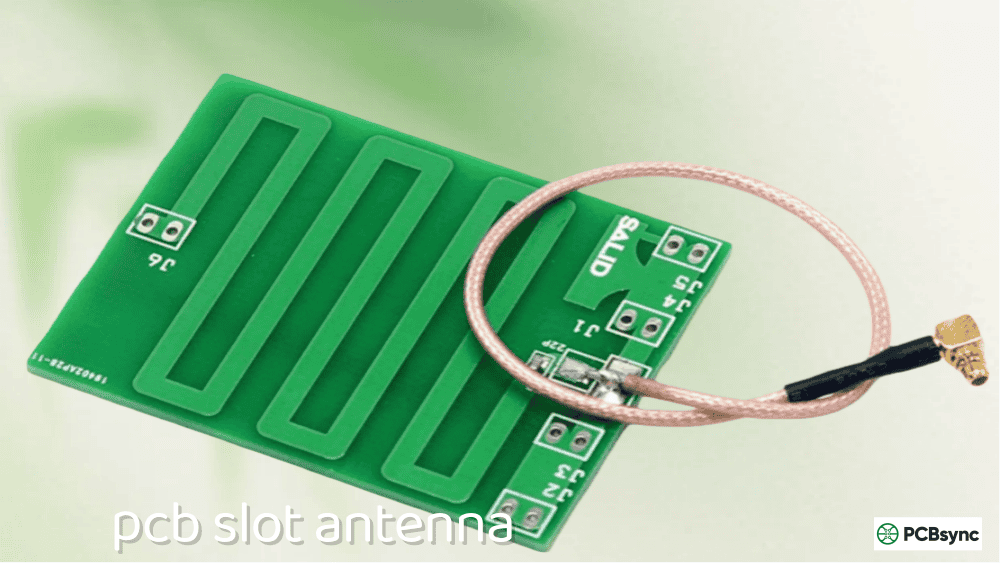
CPW-Fed Slot Antennas
Coplanar waveguide (CPW) fed slot antennas offer excellent wideband performance and easy integration with CPW-based UWB transceivers.
Characteristics:
Bandwidth: 3:1 to 5:1 achievable
Size: Compact, fits within ground plane
Gain: 2-3 dBi
Complexity: Medium
The slot acts as a magnetic dipole, and by shaping the slot (rectangular, elliptical, or tapered), you can control the bandwidth and impedance characteristics.
Vivaldi/Tapered Slot Antennas
For applications requiring directional radiation and higher gain, the Vivaldi antenna (also called tapered slot antenna or TSA) is an excellent choice.
Characteristics:
Bandwidth: Extremely wide (10:1 possible)
Size: Larger (length scales with lowest frequency)
Gain: 4-10 dBi, directional
Complexity: Medium to high
Vivaldi antennas are common in UWB radar and imaging systems but less common in compact positioning tags due to their size.
Fractal and Modified Monopole Antennas
Fractal geometries (Sierpinski, Koch, Minkowski) allow size reduction while maintaining bandwidth. These work by creating multiple resonant paths within a compact structure.
Characteristics:
Bandwidth: Good (2:1 to 3:1)
Size: 20-40% smaller than standard monopoles
Gain: 1-3 dBi
Complexity: High (precise geometry required)
UWB PCB Antenna Type Comparison
Antenna Type
Typical Size (6-9 GHz)
Gain
Bandwidth Ratio
Best Application
Circular Monopole
30 × 35 mm
3 dBi
3:1
Tags, general purpose
Elliptical Monopole
25 × 30 mm
2.5 dBi
3.5:1
Compact tags
CPW Slot
25 × 25 mm
2 dBi
3:1
Integrated designs
Vivaldi
50 × 80 mm
6-8 dBi
10:1
Anchors, readers
Fractal Monopole
20 × 25 mm
2 dBi
2.5:1
Size-constrained tags
UWB PCB Antenna Design Process: Step by Step
Here’s the systematic approach I use for every UWB PCB antenna project. Following these steps avoids the costly iteration cycles that plague wideband antenna development.
Radiation pattern (omnidirectional vs. directional)
Group delay variation limit (< 0.5 ns for ranging)
Efficiency target (> 70% for battery-powered devices)
Step 2: Select Antenna Topology
Based on your requirements, choose the antenna type:
Choose Planar Monopole if:
You need omnidirectional coverage
Size constraints are moderate
Design simplicity is valued
Choose CPW Slot if:
Your transceiver uses CPW interface
You want the antenna within the ground plane area
Bidirectional radiation is acceptable
Choose Vivaldi if:
You need directional gain (anchors/readers)
Size is not severely constrained
You’re building fixed infrastructure
Step 3: Calculate Initial Dimensions
For a circular disc monopole (most common starting point), the key relationship is:
Lower cutoff frequency ≈ c / (4 × r × √εeff)
Where:
r = disc radius
c = speed of light
εeff = effective dielectric constant
For FR-4 (εr ≈ 4.4) targeting 6 GHz lower cutoff:
εeff ≈ 2.9 (typical for microstrip geometry)
r ≈ 7.3 mm
This gives a disc diameter of approximately 15mm. Add the ground plane gap and feed structure, and you’re looking at roughly 25 × 30 mm total antenna area.
Step 4: Design the Feed Transition
The feed transition from your 50Ω line to the radiating element is critical for wideband performance. Poor transitions cause reflections that narrow bandwidth and distort pulses.
Key Techniques:
Tapered Microstrip Feed: Gradually widen the microstrip as it approaches the radiating element. This provides impedance transformation and smoother bandwidth.
CPW Feed with Ground Taper: For CPW-fed antennas, taper the ground plane edges near the feed point. This reduces discontinuity and improves high-frequency performance.
Stepped Impedance Matching: Use quarter-wave sections at different impedances to achieve broadband matching. Typically requires 2-3 sections for UWB.
Step 5: Optimize Ground Plane Geometry
The ground plane is not just a reference—it’s part of the antenna. For UWB monopoles:
Ground Plane Size: Minimum 0.25λ at lowest frequency from the antenna edge. For 6 GHz, that’s about 12mm clearance.
Partial Ground: Most UWB monopoles use a partial ground plane (ground doesn’t extend under the radiating element). The gap between ground and radiator strongly affects impedance matching.
Ground Plane Shaping: Rounded corners, notches, or slots in the ground plane edge can improve bandwidth by introducing additional resonances that merge with the main antenna response.
Step 6: Simulate and Iterate
Run full-wave electromagnetic simulations before fabrication. Key parameters to monitor:
S11 (Return Loss):
Target: < -10 dB across operating band
Better: < -15 dB for robust performance
Radiation Pattern:
Check at low, mid, and high frequencies
Verify pattern stability across band
Group Delay:
Calculate from S21 phase (antenna pair simulation)
Target: < 0.5 ns variation across band
Gain and Efficiency:
Verify gain meets requirements
Check efficiency isn’t degraded by substrate losses
Step 7: Prototype and Measure
Simulation gets you close; measurement confirms reality.
Essential Measurements:
S11 with calibrated VNA
Radiation pattern (anechoic chamber preferred)
Time-domain response (pulse fidelity)
Practical Tips:
Use SMA edge-launch connectors for repeatable measurements
Measure with and without enclosure
Test in intended mounting configuration
PCB Material Selection for UWB Antennas
Material choice significantly impacts UWB PCB antenna performance, especially at the higher frequencies where losses increase.
Recommendation: For production UWB PCB antennas operating in the 6-9 GHz band, Rogers RO4003C or RO4350B provide an excellent balance of performance and cost. FR-4 can work for prototyping but will show measurable efficiency loss at 8+ GHz.
Let me walk through a practical design example—a circular disc monopole for channels 5-9 (6.0-9.0 GHz) indoor positioning applications.
Design Specifications
Frequency: 6.0-9.0 GHz (channels 5-9)
S11: < -10 dB across band
Size: < 35 × 40 mm
Substrate: Rogers RO4003C, 0.8mm thickness
Feed: 50Ω microstrip
Calculated Dimensions
Disc Radius: 7.5mm (15mm diameter)
Feed Line Width: For 50Ω microstrip on 0.8mm RO4003C:
Width ≈ 1.8mm
Ground Gap: 0.3mm between disc edge and ground plane
Ground Plane: 35mm wide, extending 15mm below the disc
Taper Section: 5mm length, widening from 1.8mm to 3mm at disc connection
Expected Performance
S11: < -12 dB from 5.8-9.5 GHz
Gain: 2.5-4 dBi across band
Efficiency: > 85%
Group delay variation: < 0.3 ns
Layout Considerations
Feed Point Position: Center-feed for circular disc provides symmetric pattern. Off-center feed can introduce pattern tilt if needed.
Ground Plane Edge: Keep ground edge straight beneath the disc. Curved or notched ground edges can improve bandwidth but require simulation to optimize.
Via Stitching: Place ground vias along the ground plane edge, spaced < λ/10 at highest frequency (< 3mm at 10 GHz).
Common UWB PCB Antenna Design Mistakes
After reviewing dozens of failed UWB antenna designs, these mistakes appear repeatedly.
FR-4’s loss tangent of 0.02 causes significant efficiency degradation above 6 GHz. A design that simulates 90% efficiency might measure 60% on standard FR-4.
Solution: Use low-loss substrates for production, or account for losses in your link budget.
Mistake 2: Inadequate Ground Clearance
Placing components or traces too close to the antenna element causes detuning and efficiency loss.
Solution: Maintain minimum λ/4 clearance at lowest frequency from antenna to any metal. For 6 GHz, that’s 12mm minimum.
Mistake 3: Neglecting Feed Transition Design
An abrupt transition from 50Ω feed to radiating element creates reflections that narrow bandwidth and increase group delay variation.
Solution: Use tapered feeds, stepped impedance transformers, or shaped ground planes to create smooth transitions.
Mistake 4: Testing in Ideal Conditions Only
The antenna works perfectly in simulation and on the bench. It fails in the plastic enclosure.
Solution: Always simulate and test with enclosure materials. Include plastic covers, nearby batteries, and LCD displays in your models.
Mistake 5: Forgetting Group Delay
Return loss looks great, but ranging accuracy is poor because group delay varies 2 ns across the band.
Solution: Monitor group delay throughout the design process. Avoid resonant structures that introduce sharp phase transitions.
UWB PCB Antenna Resources and Tools
Simulation Software
Ansys HFSS: Industry standard for antenna simulation
CST Studio Suite: Excellent time-domain solver for UWB
MATLAB Antenna Toolbox: Quick parametric studies, includes UWB examples
OpenEMS: Free open-source option
Reference Designs and Application Notes
Qorvo DW1000/DW3000 Reference Designs: Complete antenna layouts for their UWB transceivers
NXP SR040/SR150 Application Notes: UWB antenna guidelines for their chips
PCB Antenna Design Tool: Various online parametric calculators
Academic Resources
IEEE Xplore: Search “UWB antenna design” for peer-reviewed papers
ResearchGate: Many open-access UWB antenna papers with simulation files
Google Scholar: Academic citations for design verification
Frequently Asked Questions About UWB PCB Antenna Design
Can I use a chip antenna instead of a PCB antenna for UWB?
Yes, chip antennas are available for UWB applications and offer easier integration. Companies like Taoglas, Kyocera AVX, and Johanson Technology offer UWB chip antennas covering channels 5-9. However, chip antennas typically have lower efficiency (50-70%) compared to well-designed PCB antennas (80-90%). For battery-powered tags where every dB matters, a PCB antenna often provides better range. Chip antennas excel when board space is extremely limited or when you need predictable performance without RF expertise.
What’s the minimum ground plane size for a UWB PCB antenna?
For monopole-type UWB antennas, the ground plane should extend at least λ/4 at the lowest operating frequency beyond the antenna edges. For a 6 GHz design, that means approximately 12mm of ground plane beyond the radiating element on each side. Smaller ground planes will still work but may shift the resonant frequency upward and reduce low-frequency gain. The ground plane length (in the direction of current flow) affects radiation pattern and impedance more than width.
How do I add band-notch functionality to reject WiFi interference?
Band-notch features are created by adding resonant structures (slots, stubs, or parasitic elements) that create high impedance at the notch frequency. Common techniques include etching a U-shaped slot in the radiating element tuned to 5.5 GHz, adding a parasitic strip near the feed line, or incorporating split-ring resonators (SRRs). The notch bandwidth and depth are controlled by the Q-factor of the resonant structure. Be careful that band-notch structures don’t introduce excessive group delay variation in adjacent frequencies.
What return loss should I target for UWB ranging applications?
Target S11 < -10 dB as the minimum acceptable threshold across your operating band. This corresponds to VSWR < 2:1 and ensures more than 90% of power reaches the antenna. For ranging applications, -15 dB or better is preferred because it provides margin for manufacturing variation and environmental detuning. More importantly for ranging, monitor group delay variation—even with excellent return loss, high group delay variation will degrade ranging accuracy.
How does the enclosure affect UWB PCB antenna performance?
Plastic enclosures typically shift the antenna’s resonant frequency downward by 5-15% due to the higher dielectric constant of plastic compared to air. The effect is most pronounced when the plastic is within λ/10 of the antenna (about 5mm at 6 GHz). Metal enclosures are even more problematic—they can completely detune the antenna if too close. Always simulate with enclosure materials included, and leave tuning capability (adjustable matching network or trimmable antenna elements) for production calibration. Use low-permittivity plastics (ABS, polycarbonate) rather than high-permittivity materials when possible.
Conclusion
UWB PCB antenna design for indoor positioning combines the challenges of wideband antenna engineering with the precision requirements of ranging systems. The fundamentals are straightforward—create a radiating structure that maintains consistent impedance and radiation characteristics across 2+ GHz of bandwidth—but the execution requires careful attention to feed transitions, ground plane geometry, substrate selection, and environmental effects.
The most successful UWB PCB antenna designs I’ve seen share common traits: they start with proven topologies (circular monopole, CPW slot), use appropriate low-loss substrates, include smooth feed transitions, and undergo thorough testing in realistic conditions. The failures typically stem from cutting corners on substrate quality, ignoring group delay, or testing only in ideal bench conditions.
Start with a circular disc monopole if you’re new to UWB antenna design—it’s forgiving and well-documented. Use simulation tools extensively but trust measurement results. Account for your enclosure from day one. And always remember that for ranging applications, time-domain performance matters as much as frequency-domain specifications.
The resources linked in this guide will help you dive deeper into specific topics. Qorvo’s application notes are particularly valuable for practical UWB antenna implementation. With careful design and proper validation, your UWB PCB antenna can achieve the centimeter-level accuracy that makes indoor positioning truly useful.
Inquire: Call 0086-755-23203480, or reach out via the form below/your sales contact to discuss our design, manufacturing, and assembly capabilities.
Quote: Email your PCB files to Sales@pcbsync.com (Preferred for large files) or submit online. We will contact you promptly. Please ensure your email is correct.
Notes: For PCB fabrication, we require PCB design file in Gerber RS-274X format (most preferred), *.PCB/DDB (Protel, inform your program version) format or *.BRD (Eagle) format. For PCB assembly, we require PCB design file in above mentioned format, drilling file and BOM. Click to download BOM template To avoid file missing, please include all files into one folder and compress it into .zip or .rar format.