Inquire: Call 0086-755-23203480, or reach out via the form below/your sales contact to discuss our design, manufacturing, and assembly capabilities.
Quote: Email your PCB files to Sales@pcbsync.com (Preferred for large files) or submit online. We will contact you promptly. Please ensure your email is correct.
Notes: For PCB fabrication, we require PCB design file in Gerber RS-274X format (most preferred), *.PCB/DDB (Protel, inform your program version) format or *.BRD (Eagle) format. For PCB assembly, we require PCB design file in above mentioned format, drilling file and BOM. Click to download BOM template To avoid file missing, please include all files into one folder and compress it into .zip or .rar format.
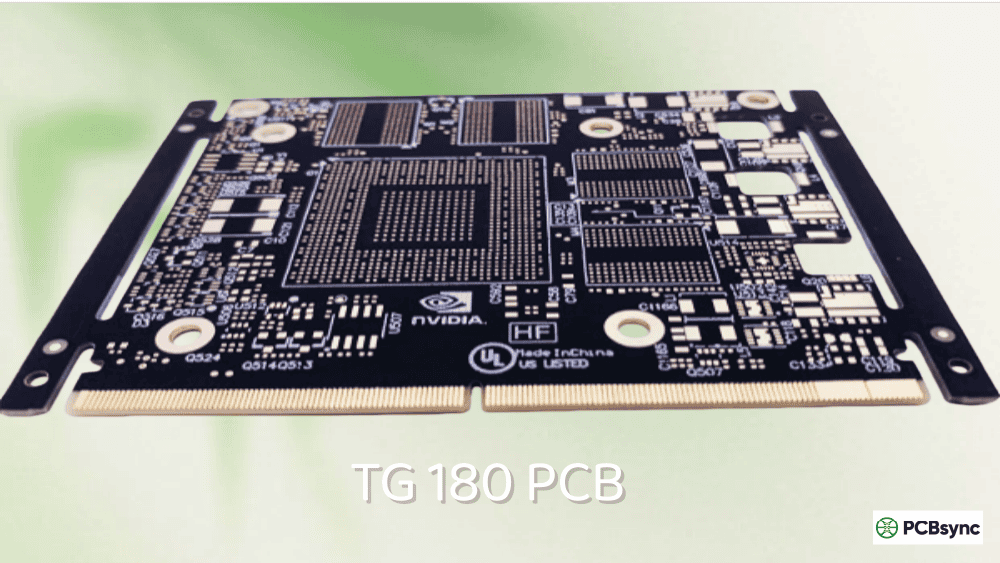
When standard high-Tg material isn’t enough, engineers turn to Tg 180 PCB — the premium tier of FR4 laminates designed for the most demanding thermal environments. While Tg 170 handles most high-temperature applications, certain designs push beyond its capabilities. Aerospace avionics, military radar systems, automotive powertrain electronics, and high-layer-count boards with sequential lamination all benefit from the extra thermal margin that Tg 180 provides.
After working on projects ranging from commercial industrial controls to defense-grade systems, I’ve learned that choosing between Tg 170 and Tg 180 isn’t always straightforward. This guide explains when Tg 180 PCB material is genuinely necessary, when it’s overkill, and how to make the right material selection for your specific application.
What is Tg 180 PCB? Understanding the Premium High-Tg Tier
The Tg 180 PCB designation refers to FR4 laminate materials with a glass transition temperature of 180°C or higher. At this temperature, the epoxy resin matrix begins transitioning from a rigid, glass-like state to a softer, more pliable condition. Materials in this category represent the upper performance tier of standard FR4 technology.
To put this in context, here’s how Tg 180 fits within the FR4 hierarchy:
Classification
Tg Range
Industry Position
Typical Applications
Standard Tg
130-140°C
Entry level
Consumer electronics
Medium Tg
150-165°C
Mid-range
Industrial, automotive interior
High Tg
170-175°C
High performance
Under-hood, telecom, multilayer
Premium High Tg
180-185°C
Maximum FR4 performance
Aerospace, military, extreme thermal
Ultra-High Tg
200°C+
Specialty
Specialized applications
The jump from 170°C to 180°C might seem incremental, but it represents a significant upgrade in resin chemistry. Tg 180 materials use advanced multifunctional epoxy systems with denser molecular cross-linking, resulting in measurably better thermal stability, lower Z-axis expansion, and superior performance during repeated high-temperature exposures.
Why 180°C Matters: The Engineering Significance
The 180°C threshold isn’t arbitrary. It provides meaningful engineering benefits:
Increased Operating Temperature Margin: With the 25-30°C safety guideline below Tg, Tg 180 PCB supports continuous operation at 150-155°C — approximately 10°C higher than Tg 170 material.
Superior Lead-Free Reflow Survival: During lead-free soldering at 240-260°C peak temperatures, Tg 180 materials experience less resin degradation and weight loss than Tg 170 alternatives.
Sequential Lamination Capability: High layer count boards (20+ layers) requiring multiple lamination cycles benefit from Tg 180’s ability to withstand repeated thermal processing without degradation.
Extended Time-to-Delamination: T260 and T288 values are significantly higher for Tg 180 materials, providing better assembly process margin.
Tg 180 PCB vs Tg 170 PCB: Critical Differences
This comparison is essential for material selection decisions. Both are “high-Tg” materials, but they serve different requirements.
Head-to-Head Specification Comparison
Property
Tg 170 PCB
Tg 180 PCB
Advantage
Glass Transition (Tg)
170-175°C
180-185°C
Tg 180: +10°C margin
Decomposition Temp (Td)
340-345°C
350-360°C
Tg 180: Better reflow survival
Max Operating Temp
~145°C
~155°C
Tg 180: Higher ceiling
Z-axis CTE (below Tg)
45-55 ppm/°C
40-50 ppm/°C
Tg 180: Lower expansion
Z-axis CTE (above Tg)
160-180 ppm/°C
140-165 ppm/°C
Tg 180: Better stability
Total Z-axis Expansion
2.8-3.2%
2.0-2.5%
Tg 180: Significantly lower
T260 (minutes)
>60
>90
Tg 180: More process margin
T288 (minutes)
>30
>45
Tg 180: Better reflow capability
Material Cost
Baseline
+15-25% premium
Tg 170: More economical
Drilling Difficulty
Moderate
Higher
Tg 170: Easier processing
When Tg 170 is Sufficient
For most high-temperature applications, Tg 170 provides adequate performance:
Operating temperatures below 130°C sustained
Standard lead-free assembly (1-2 reflow cycles)
Layer counts up to 16-18 layers
Commercial and industrial reliability requirements
Applications where cost optimization matters
When Tg 180 PCB is Necessary
Choose Tg 180 PCB when your application exceeds Tg 170’s comfortable operating range:
Operating temperatures consistently above 140°C
Multiple reflow cycles or extensive rework requirements
Layer counts exceeding 18-20 layers with sequential lamination
Aerospace, military, or defense applications (MIL-PRF-31032)
Mission-critical systems with zero tolerance for thermal failures
Products with 15+ year service life in harsh environments
FR4 Tg 180 Technical Specifications
Understanding the complete specification profile helps you evaluate whether Tg 180 PCB meets your design requirements.
Thermal Properties
Property
Typical Value
Test Method
Engineering Significance
Glass Transition (Tg)
180-185°C
DSC (IPC-TM-650 2.4.25)
Operating temperature ceiling
Decomposition Temp (Td)
350-360°C
TGA (5% weight loss)
Lead-free assembly margin
CTE X/Y (below Tg)
12-14 ppm/°C
IPC-TM-650 2.4.41
In-plane dimensional stability
CTE Z (below Tg)
40-50 ppm/°C
IPC-TM-650 2.4.41
Via reliability
CTE Z (above Tg)
140-165 ppm/°C
IPC-TM-650 2.4.41
Reflow stress on vias
Total Z-expansion
2.0-2.5%
IPC-TM-650 2.4.41
Multilayer reliability
Thermal Conductivity
0.35-0.45 W/m·K
—
Heat spreading capability
T260
>90 minutes
IPC-TM-650 2.4.24.1
Process window at 260°C
T288
>45 minutes
IPC-TM-650 2.4.24.1
High-temp reflow margin
Electrical Properties
Property
Typical Value
Test Method
Dielectric Constant (Dk) @ 1MHz
4.2-4.5
IPC-TM-650 2.5.5.9
Dielectric Constant (Dk) @ 1GHz
4.0-4.3
IPC-TM-650 2.5.5.9
Dissipation Factor (Df) @ 1MHz
0.015-0.020
IPC-TM-650 2.5.5.9
Dissipation Factor (Df) @ 1GHz
0.018-0.022
IPC-TM-650 2.5.5.9
Volume Resistivity
10⁸-10¹⁰ MΩ·cm
IPC-TM-650 2.5.17.1
Surface Resistivity
10⁷-10⁹ MΩ
IPC-TM-650 2.5.17.1
Dielectric Breakdown
50-60 kV/mm
IPC-TM-650 2.5.6
CTI (Comparative Tracking Index)
≥175V
IEC 60112
Mechanical Properties
Property
Typical Value
Test Method
Notes
Tensile Strength
450-520 MPa
IPC-TM-650 2.4.18
Higher than Tg 170
Flexural Strength (25°C)
550-620 MPa
IPC-TM-650 2.4.4
Excellent rigidity
Flexural Strength (150°C)
380-450 MPa
IPC-TM-650 2.4.4
Maintains strength at temp
Peel Strength (1oz Cu)
1.0-1.4 N/mm
IPC-TM-650 2.4.8
Good copper adhesion
Moisture Absorption
≤0.08%
IPC-TM-650 2.6.2.1
Lower than Tg 170
Flammability
UL94 V-0
UL 94
Self-extinguishing
Extreme Thermal Applications for Tg 180 PCB
The Tg 180 PCB excels in environments where thermal stress pushes standard high-Tg materials to their limits.
Aerospace and Defense Electronics
Aerospace applications demand the highest reliability under extreme conditions:
Avionics Systems: Flight control computers, navigation systems, and cockpit displays experience rapid temperature cycling from -55°C at cruise altitude to 85°C+ on the ground. Tg 180 provides stability through these transitions.
Radar and Electronic Warfare: High-power RF systems generate significant localized heat. Tg 180 material handles the thermal load without degradation over decades of service.
Satellite Electronics: Space applications require materials that survive launch vibration, thermal vacuum cycling, and radiation exposure. Tg 180’s superior dimensional stability is essential.
Military Communication: Field-deployed communication equipment operates in desert heat (60°C+ ambient) and must survive rough handling. Tg 180 provides the reliability margin military applications require.
Aerospace/Defense Application
Operating Environment
Why Tg 180
Flight control computers
-55°C to +85°C cycling
Dimensional stability
Radar power amplifiers
High-power RF heat
Thermal margin
Missile guidance
Extreme shock/vibration
Mechanical strength
Satellite systems
Thermal vacuum cycling
Long-term stability
Electronic warfare
Continuous high-temp operation
Extended Td margin
Automotive Powertrain Electronics
Modern vehicles contain extensive electronics in thermally challenging locations:
Engine Control Units (ECUs): Mounted on or near engines, these systems experience ambient temperatures of 125-150°C with thermal spikes even higher.
Transmission Controllers: Operating in the transmission housing exposes PCBs to sustained elevated temperatures and transmission fluid vapor.
Electric Vehicle Power Electronics: EV inverters and DC-DC converters generate substantial heat during high-power operation. Tg 180 material supports the thermal cycling these systems experience.
Battery Management Systems: BMS boards in high-performance EVs must operate reliably despite proximity to battery packs that can reach elevated temperatures during fast charging.
High-Power Industrial Systems
Industrial applications often push thermal boundaries:
Power inverters and motor drives: Continuous high-current operation generates substantial heat
Welding equipment controllers: Extreme thermal cycling during operation
Furnace and oven controls: Elevated ambient temperatures near industrial heating equipment
Oil and gas electronics: Downhole equipment operating at 150°C+ ambient
High-Layer-Count Multilayer PCBs
Complex multilayer designs benefit significantly from Tg 180 material:
Layer Count
Lamination Cycles
Recommended Tg
Notes
8-14 layers
1-2 cycles
Tg 170 sufficient
Standard multilayer
16-20 layers
2-3 cycles
Tg 170 or Tg 180
Consider Tg 180
20-28 layers
3-4 cycles
Tg 180 recommended
Sequential lamination
28+ layers
4+ cycles
Tg 180 required
Multiple sequential
Each lamination cycle exposes the material to 180-200°C for extended periods. Tg 180 materials maintain dimensional stability through these repeated thermal exposures, ensuring proper layer registration and via reliability.
What is the maximum operating temperature for Tg 180 PCB?
Following the industry guideline of operating 25-30°C below Tg, Tg 180 PCB supports continuous operation at approximately 150-155°C. This is roughly 10°C higher than Tg 170 material. Brief temperature excursions during soldering (240-260°C) are acceptable since they’re transient. For applications requiring sustained operation above 155°C, consider polyimide or ceramic substrates rather than FR4.
Is Tg 180 PCB necessary for all lead-free assembly?
No, Tg 180 is not required for standard lead-free assembly. Tg 170 material handles typical lead-free reflow profiles (240-260°C peak) adequately for most commercial applications. However, Tg 180 becomes beneficial when your process involves multiple reflow cycles, extensive rework, or particularly aggressive thermal profiles. The higher Td value (~350°C vs ~340°C) provides additional margin against resin degradation.
How many layers can Tg 180 material support in multilayer PCBs?
Tg 180 PCB material reliably supports layer counts exceeding 28 layers with sequential lamination. The enhanced dimensional stability through repeated thermal cycles makes it the preferred choice for designs requiring 3-4 or more lamination sequences. For standard 2-cycle sequential lamination (16-20 layers), Tg 170 may suffice, but Tg 180 provides additional process margin.
What’s the cost difference between Tg 180 and Tg 170 PCB?
Tg 180 PCB typically costs 15-25% more than Tg 170 for raw material, with total board cost premiums of 10-20% depending on design complexity. Additional costs arise from longer lamination cycles, increased drill bit consumption, and potentially longer lead times. However, for high-reliability applications, the cost premium often delivers net savings through reduced field failures and warranty claims.
When should I choose polyimide instead of Tg 180 FR4?
Consider polyimide (Tg 250°C+) instead of Tg 180 FR4 when: operating temperatures consistently exceed 150°C, the application requires flexibility (flex or rigid-flex designs), extreme thermal cycling causes FR4 reliability concerns, or weight reduction is critical (polyimide is lighter). Polyimide costs 2-3x more than Tg 180 FR4, so use it only when FR4’s limitations genuinely constrain your design.
Conclusion: Making the Right Tg 180 PCB Decision
Tg 180 PCB represents the premium tier of FR4 laminate materials, delivering the thermal performance, dimensional stability, and long-term reliability that extreme applications demand. It’s the right choice when operating temperatures exceed 140°C, when designs require 20+ layers with sequential lamination, or when failure simply isn’t an option.
Applications demand aerospace, military, or Class 3 reliability
Multiple reflow cycles or extensive rework is expected
Product service life exceeds 15 years in harsh environments
Customer or regulatory requirements mandate premium materials
Tg 170 remains appropriate when:
Operating temperatures stay below 130°C sustained
Layer counts don’t exceed 18 layers
Standard commercial or industrial reliability suffices
Cost optimization is a primary design driver
Lead-free assembly involves only 1-2 reflow cycles
The 25-40% cost premium for Tg 180 material is insurance against thermal failures in demanding applications. When reliability matters and operating conditions push boundaries, that premium investment typically pays for itself through reduced field failures, longer product life, and satisfied customers.
Work closely with your PCB fabricator and laminate supplier to select the right Tg 180 material for your specific application. They can provide guidance based on your operating conditions, layer count requirements, and reliability expectations. The right material choice at the design stage prevents expensive problems throughout the product lifecycle.
This guide reflects practical engineering experience with premium high-Tg PCB material selection. Specific material properties vary by manufacturer — always verify values against current datasheets for production decisions.
Inquire: Call 0086-755-23203480, or reach out via the form below/your sales contact to discuss our design, manufacturing, and assembly capabilities.
Quote: Email your PCB files to Sales@pcbsync.com (Preferred for large files) or submit online. We will contact you promptly. Please ensure your email is correct.
Notes: For PCB fabrication, we require PCB design file in Gerber RS-274X format (most preferred), *.PCB/DDB (Protel, inform your program version) format or *.BRD (Eagle) format. For PCB assembly, we require PCB design file in above mentioned format, drilling file and BOM. Click to download BOM template To avoid file missing, please include all files into one folder and compress it into .zip or .rar format.