Inquire: Call 0086-755-23203480, or reach out via the form below/your sales contact to discuss our design, manufacturing, and assembly capabilities.
Quote: Email your PCB files to Sales@pcbsync.com (Preferred for large files) or submit online. We will contact you promptly. Please ensure your email is correct.
Notes: For PCB fabrication, we require PCB design file in Gerber RS-274X format (most preferred), *.PCB/DDB (Protel, inform your program version) format or *.BRD (Eagle) format. For PCB assembly, we require PCB design file in above mentioned format, drilling file and BOM. Click to download BOM template To avoid file missing, please include all files into one folder and compress it into .zip or .rar format.
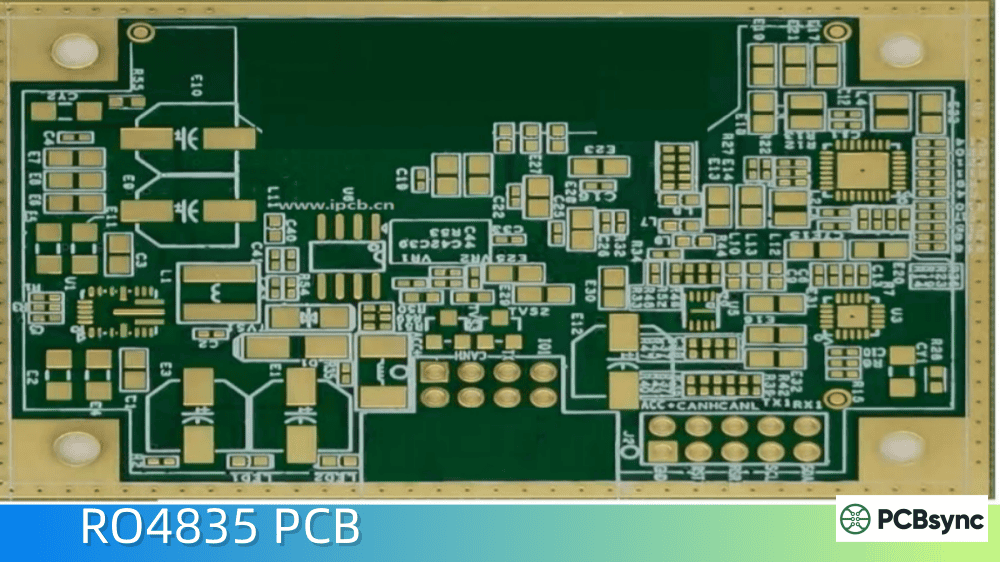
If you’ve been working with high-frequency circuits long enough, you’ve probably hit the point where FR-4 just doesn’t cut it anymore. Signal losses creep up, your impedance starts drifting with temperature changes, and suddenly that 24 GHz radar design you’ve been working on performs nothing like the simulation predicted. That’s exactly where RO4835 PCB material comes into play.
As a PCB engineer who has spent years working with various Rogers PCB materials, I can tell you that RO4835 represents a sweet spot in the Rogers RO4000 series. It gives you the high-frequency performance you need without the manufacturing headaches that come with PTFE-based materials. In this guide, I’ll walk you through everything you need to know about RO4835 PCB, from its core properties to practical design considerations.
RO4835 is a hydrocarbon ceramic laminate developed by Rogers Corporation as part of the RO4000 series. It’s specifically engineered for applications that demand stability at elevated temperatures and superior oxidation resistance compared to standard RF thermoset materials.
Here’s what makes RO4835 stand out: Rogers essentially took the proven RO4350B formula and added antioxidant fillers to create a material that’s significantly more resistant to oxidation over time. This might sound like a minor tweak, but it makes a huge difference in applications where long-term reliability matters, such as automotive radar systems that need to perform consistently for years under the hood of a vehicle.
The material consists of hydrocarbon resins combined with ceramic fillers, giving it that unique combination of excellent electrical properties and mechanical robustness. Unlike PTFE-based materials, RO4835 doesn’t require specialized via preparation processes like sodium etching. You can process it using standard FR-4 fabrication techniques, which keeps manufacturing costs down and lead times reasonable.
Key Characteristics of RO4835
What really sets RO4835 apart from other high-frequency materials is its balance of performance and manufacturability. The material offers tight dielectric constant tolerance, which is crucial for controlled impedance transmission lines. It’s also compatible with lead-free soldering processes and meets UL 94 V-0 flammability standards, making it suitable for safety-critical applications.
The RO4835 material conforms to IPC-4103 requirements (slash sheet /11), which means it meets industry standards for high-speed and high-frequency applications. It’s available with Rogers’ proprietary LoPro reverse treated copper foil, which is ideal when you need to minimize insertion loss in your RF circuits.
RO4835 PCB Material Properties and Specifications
Understanding the detailed specifications of RO4835 is essential for accurate circuit design. Here’s a comprehensive breakdown of the key material properties you’ll need for your calculations:
Electrical Properties
Property
Value
Test Condition
Dielectric Constant (Dk)
3.48 ± 0.05
10 GHz / 23°C
Design Dk
3.66
Process
Dissipation Factor (Df)
0.0037
10 GHz / 23°C
Thermal Coefficient of Dk
+50 ppm/°C
-50°C to +150°C
Volume Resistivity
1.2 × 10¹⁰ MΩ·cm
—
Thermal Properties
Property
Value
Notes
Glass Transition Temperature (Tg)
>280°C
TMA Method
Thermal Conductivity
0.69 W/m/K
—
CTE (X-axis)
10 ppm/°C
Below Tg
CTE (Y-axis)
12 ppm/°C
Below Tg
CTE (Z-axis)
31 ppm/°C
Below Tg
Decomposition Temperature (Td)
390°C
5% weight loss
Mechanical Properties
Property
Value
Test Method
Peel Strength
6 lb/in (1oz Cu)
After solder float
Flexural Strength
276 MPa (40,200 psi)
—
Moisture Absorption
0.05%
24 hours immersion
Flame Rating
UL 94 V-0
—
Density
1.87 g/cm³
—
Available Thickness Options
RO4835 laminates come in several standard thicknesses to suit different design requirements:
Thickness (mils)
Thickness (mm)
6.6
0.168
10
0.254
20
0.508
30
0.762
60
1.524
The material is typically available with 0.5 oz (18 μm), 1 oz (35 μm), and 2 oz (70 μm) copper cladding options.
RO4835 vs RO4350B: Understanding the Difference
One of the most common questions I get is about the difference between RO4835 and RO4350B. On paper, they look almost identical, and that’s intentional. Rogers designed RO4835 to provide nearly identical electrical and mechanical properties to RO4350B, which has been a workhorse material in the industry for years.
The critical difference lies in oxidation resistance. RO4835 includes antioxidant fillers that make it approximately 10 times more resistant to oxidation than traditional thermoset materials, including RO4350B. This matters because oxidation affects all thermoset laminates over time and temperature. In the long run, oxidation leads to small increases in dielectric constant and dissipation factor.
Comparison Table: RO4835 vs RO4350B
Property
RO4835
RO4350B
Dielectric Constant (Dk)
3.48 ± 0.05
3.48 ± 0.05
Dissipation Factor (Df)
0.0037
0.0037
Oxidation Resistance
10× better than standard
Standard
Automotive Certification
Yes (safety tested)
Limited
Moisture Absorption
0.05%
0.06%
Tg
>280°C
>280°C
Price
Slightly higher
Baseline
When to Choose RO4835 Over RO4350B
Choose RO4835 when your application involves high ambient temperatures over extended periods, automotive environments where under-hood temperatures can be extreme, or long product lifecycles where oxidation-related drift could affect performance. The automotive radar market, particularly 24 GHz and 77 GHz collision avoidance systems, has largely standardized on RO4835 for exactly these reasons.
If your application is more benign, such as indoor telecom equipment with controlled environments and shorter product lifecycles, RO4350B might be the more economical choice while still delivering excellent RF performance.
RO4835 PCB material finds its home in applications where high-frequency performance meets demanding environmental requirements. Here’s where you’ll typically see this material deployed:
Automotive Radar and Sensors
This is probably the largest application area for RO4835. Automotive radar systems operating at 24 GHz and 76-81 GHz frequencies rely heavily on this material. The combination of low loss at millimeter-wave frequencies, excellent oxidation resistance, and the ability to withstand automotive temperature cycling (-40°C to +125°C) makes RO4835 ideal for ADAS (Advanced Driver Assistance Systems) applications, including adaptive cruise control radar, blind spot detection systems, collision avoidance radar, and parking assist sensors.
5G Telecommunications
RO4835 PCB serves critical roles in 5G infrastructure, particularly in antenna arrays and RF front-end modules. The material’s low loss characteristics help maintain signal integrity in sub-6 GHz and mmWave frequency bands. Base station antennas, small cells, and customer premise equipment all benefit from RO4835’s stable dielectric properties.
Point-to-Point Microwave Systems
Microwave backhaul links that connect cell towers and other infrastructure often use RO4835. These systems operate at frequencies from 6 GHz up to 80 GHz, where the material’s low dissipation factor helps maximize link budget and system gain.
Power Amplifiers
High-power RF amplifiers generate significant heat, making thermal stability crucial. RO4835’s thermal conductivity of 0.69 W/m/K helps dissipate heat away from active devices, while its stable Dk ensures consistent impedance matching even as temperatures rise.
Phased Array Antennas
Modern phased array systems require tight control over element-to-element phase matching. RO4835’s tight Dk tolerance (±0.05) ensures that antenna elements perform consistently, critical for beam steering accuracy.
Aerospace and Defense
Military and aerospace applications demand proven reliability under extreme conditions. RO4835 finds use in avionics, satellite communications, guidance systems, and other defense electronics where failure is not an option.
RO4835 PCB Design Guidelines
Getting the most out of RO4835 requires attention to design practices that leverage its strengths while accounting for its characteristics.
Impedance Control and Trace Width Calculations
RO4835’s tight Dk tolerance of ±0.05 makes it excellent for controlled impedance designs. When calculating trace widths for 50Ω microstrip lines, use the design Dk value of 3.66 rather than the lower test Dk of 3.48. The design Dk accounts for the full copper-to-dielectric interaction in actual circuits.
For a 10 mil (0.254 mm) thick RO4835 substrate with 1 oz copper, a 50Ω microstrip line typically requires a trace width of approximately 23 mils. Always verify with your PCB fabricator’s impedance calculator, as actual values depend on copper thickness, etch factor, and specific material lot.
Stackup Recommendations
For multilayer RO4835 PCB designs, consider these stackup approaches:
2-Layer Design: Simple RF circuits can use a straightforward top signal, bottom ground configuration with RO4835 as the dielectric. This works well for filters, couplers, and simple antenna feeds.
4-Layer Hybrid Design: Combine RO4835 for the RF signal layers with FR-4 or high-performance FR-4 (like Isola 370HR) for power and digital layers. This optimizes cost while maintaining RF performance where it matters. A typical stack might be: RO4835 (RF layer), FR-4 prepreg, FR-4 core (power/ground), FR-4 prepreg, RO4835 (RF layer).
6+ Layer Designs: For complex RF systems, multiple RO4835 layers can be combined with FR-4 layers. Pay attention to CTE matching, RO4835’s low Z-axis CTE of 31 ppm/°C is close to copper, which helps maintain via reliability. Use symmetrical stackups to prevent warpage.
Via Design for RO4835 PCB
One of RO4835’s advantages is that it doesn’t require the plasma desmear or sodium etch processes needed for PTFE materials. Standard drilling and plating processes work well. However, keep these points in mind:
Via Sizing: Minimum recommended via diameter is typically 8-10 mils (0.2-0.25 mm) for mechanical drilling. Smaller vias require laser drilling.
Aspect Ratio: Keep drill aspect ratio (board thickness to via diameter) below 10:1 for reliable plating. For a 62 mil thick board, minimum via diameter should be around 6.2 mils.
Via Stubs: At high frequencies, via stubs create resonances that degrade signal integrity. Use back-drilling to remove stubs on critical RF transitions, or design with buried vias to eliminate stubs entirely.
Ground Plane Considerations
Solid ground planes under RF traces are essential for controlled impedance and minimizing radiation. Avoid ground plane cuts or slots that cross signal paths. Where power and ground plane splits are necessary, ensure RF signals don’t cross the splits.
For microstrip designs, the ground plane should extend at least 3× the substrate thickness beyond the signal traces on each side to prevent fringing field issues.
Manufacturing and Fabrication Considerations
Working with RO4835 is significantly easier than PTFE-based materials, but it still requires attention to detail for best results.
Drilling Parameters
RO4835 can be drilled using standard carbide tools. Rogers recommends entry material, backup material, and surface speeds below 500 SFM to maximize tool life. Chip loads of 0.002″ to 0.003″ per revolution work well for most hole sizes.
The ceramic filler in RO4835 does cause accelerated drill wear compared to FR-4, but hole wall quality remains consistent throughout the drill’s life. Hole wall roughness typically ranges from 8 to 25 μm.
Lamination Process
For multilayer constructions, use precisely controlled temperature and pressure profiles. The goal is void-free bonding without excessive resin flow that could alter dielectric thickness. RO4835 is compatible with standard multilayer bonding processes and Rogers’ RO4450F or RO4450T prepregs.
When building hybrid stackups with FR-4, sequential lamination may be necessary to manage CTE mismatches. Pre-bake both materials before lamination to remove moisture.
Etching and Surface Preparation
RO4835 PCB material is compatible with standard DES (develop, etch, strip) processes used for FR-4. Both liquid and dry film photoresists work well. For inner layers, standard oxide or oxide alternative treatments prepare the copper for multilayer bonding.
Surface finish options include ENIG (Electroless Nickel Immersion Gold), immersion silver, OSP, and HASL. For RF applications requiring wire bonding, ENIG is often preferred for its stable surface.
How to Source RO4835 Laminates
Rogers Corporation distributes RO4835 through authorized distributors worldwide. Major distributors include Richardson RFPD and Digi-Key for smaller quantities. For production volumes, work directly with Rogers’ regional sales offices or their authorized distribution network.
Lead times for RO4835 typically run 4-8 weeks for standard thicknesses, though popular configurations like 10 mil and 20 mil may have shorter lead times from distributor stock. For custom thicknesses or large volumes, plan for longer lead times and engage with Rogers early in your design cycle.
When specifying RO4835, include the dielectric thickness, copper weight, whether you need LoPro copper, and any special requirements like TCR resistor foil options.
Useful Resources for RO4835 PCB Design
Here are the essential resources you’ll need when working with RO4835:
Rogers Technology Support Hub – Technical papers on dielectric properties, thermal management, and application notes
Design Tools
Rogers MWI Calculator – Online impedance calculator for Rogers materials
Rogers Laminate Properties Tool – Interactive material comparison database
Industry Standards
IPC-4103 – Specification for High Speed/High Frequency Materials
IPC-6012 – Qualification and Performance Specification for Rigid Printed Boards
Frequently Asked Questions About RO4835 PCB
What is the dielectric constant of RO4835?
RO4835 has a dielectric constant (Dk) of 3.48 ± 0.05 when measured at 10 GHz and 23°C using the IPC clamped stripline method. For design purposes, Rogers recommends using a “design Dk” of 3.66, which accounts for the copper-dielectric interaction in actual circuit configurations. The Dk remains stable across temperature with a thermal coefficient of +50 ppm/°C from -50°C to +150°C.
Can RO4835 be processed using standard FR-4 equipment?
Yes, one of the major advantages of RO4835 is its compatibility with standard FR-4 processing equipment and techniques. Unlike PTFE-based high-frequency materials that require specialized sodium etch or plasma desmear processes for via preparation, RO4835 can be drilled, etched, and plated using conventional PCB fabrication processes. This compatibility significantly reduces manufacturing costs and allows more fabrication shops to work with the material.
What is the maximum operating frequency for RO4835 PCB?
RO4835 PCB material performs well up to millimeter-wave frequencies, with documented use in automotive radar applications at 77 GHz and higher. The low dissipation factor of 0.0037 at 10 GHz helps minimize signal loss even at these elevated frequencies. For optimal performance at the highest frequencies, consider using Rogers’ LoPro copper foil option, which features a smoother surface that reduces conductor loss.
How does RO4835 compare to PTFE-based materials?
RO4835 offers several advantages over PTFE materials: easier manufacturing without specialized via treatments, better dimensional stability, stronger copper adhesion, and more consistent mechanical handling during fabrication. PTFE materials like Rogers RT/duroid series have lower Df values (around 0.001-0.002) compared to RO4835’s 0.0037, so they may be preferred for the most loss-critical applications. However, for most RF designs up to 77 GHz, RO4835 provides an excellent balance of performance and manufacturability.
Is RO4835 suitable for automotive applications?
RO4835 is exceptionally well-suited for automotive applications. The material has passed automotive safety regulations and is specifically designed to handle the demanding thermal cycling (-40°C to +125°C), vibration, and long-term reliability requirements of automotive environments. Its superior oxidation resistance compared to RO4350B makes it particularly appropriate for under-hood applications where elevated temperatures accelerate material degradation. Automotive radar at 24 GHz and 77 GHz represents one of the largest application areas for RO4835 PCB.
Inquire: Call 0086-755-23203480, or reach out via the form below/your sales contact to discuss our design, manufacturing, and assembly capabilities.
Quote: Email your PCB files to Sales@pcbsync.com (Preferred for large files) or submit online. We will contact you promptly. Please ensure your email is correct.
Notes: For PCB fabrication, we require PCB design file in Gerber RS-274X format (most preferred), *.PCB/DDB (Protel, inform your program version) format or *.BRD (Eagle) format. For PCB assembly, we require PCB design file in above mentioned format, drilling file and BOM. Click to download BOM template To avoid file missing, please include all files into one folder and compress it into .zip or .rar format.