Inquire: Call 0086-755-23203480, or reach out via the form below/your sales contact to discuss our design, manufacturing, and assembly capabilities.
Quote: Email your PCB files to Sales@pcbsync.com (Preferred for large files) or submit online. We will contact you promptly. Please ensure your email is correct.
Notes: For PCB fabrication, we require PCB design file in Gerber RS-274X format (most preferred), *.PCB/DDB (Protel, inform your program version) format or *.BRD (Eagle) format. For PCB assembly, we require PCB design file in above mentioned format, drilling file and BOM. Click to download BOM template To avoid file missing, please include all files into one folder and compress it into .zip or .rar format.
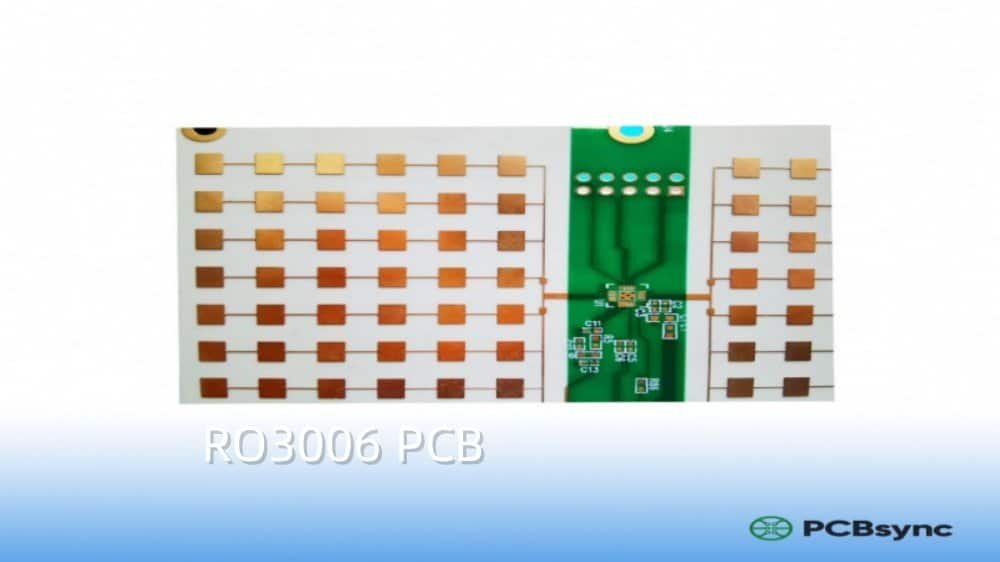
If you’ve been designing RF circuits or working on microwave applications, you’ve probably come across Rogers materials. Among them, RO3006 PCB stands out as a go-to choice for engineers who need reliable high-frequency performance without breaking the bank. After working with various high-frequency laminates over the years, I’ve found RO3006 to be one of the most versatile options in the RO3000 series — and I’ll explain exactly why in this guide.
This article covers everything you need to know about Rogers RO3006: its properties, specifications, applications, design considerations, and how it stacks up against other popular materials like RO4350B and standard FR-4.
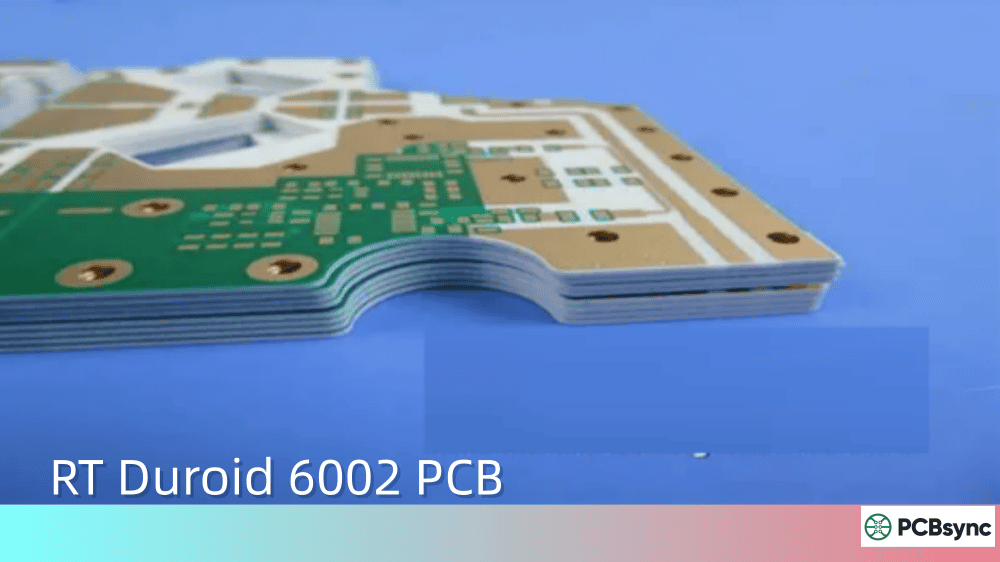
Rogers RO3006 is a ceramic-filled PTFE (polytetrafluoroethylene) composite laminate specifically engineered for commercial microwave and RF applications. Developed by Rogers Corporation, this material belongs to the RO3000 series — a family of high-frequency circuit materials designed to deliver exceptional electrical and mechanical stability at competitive prices.
What makes RO3006 particularly interesting is its dielectric constant of 6.15. This higher Dk value (compared to RO3003’s 3.0) allows for more compact circuit designs — a crucial advantage when you’re working on size-constrained applications like GPS antennas or automotive radar modules.
The ceramic filler in the PTFE matrix isn’t just there for show. It provides dimensional stability that pure PTFE materials can’t match, while maintaining the excellent electrical properties that make PTFE so valuable for high-frequency work.
RO3006 PCB Technical Specifications
Before diving into applications, let’s look at the numbers. Here’s what you’re working with when you spec RO3006 for your next project:
Electrical Properties
Property
Value
Test Condition
Dielectric Constant (Dk)
6.15 ± 0.15
10 GHz / 23°C
Dissipation Factor (Df)
0.0020
10 GHz
Thermal Coefficient of Dk
-3 ppm/°C
-50°C to +150°C (Z-direction)
Volume Resistivity
10⁷ MΩ·cm
C-96/35/90
Surface Resistivity
10⁷ MΩ
C-96/35/90
Mechanical & Thermal Properties
Property
Value
Notes
CTE (X-axis)
17 ppm/°C
Matched to copper
CTE (Y-axis)
17 ppm/°C
Matched to copper
CTE (Z-axis)
24 ppm/°C
Excellent PTH reliability
Thermal Conductivity
0.79 W/m·K
—
Moisture Absorption
0.02%
48 hours immersion
Density
2.6 g/cm³
—
Peel Strength
8.9 lb/in (1.56 N/mm)
1 oz ED copper
Available Thicknesses
Thickness (inches)
Thickness (mm)
Tolerance
0.005″
0.13 mm
±0.0005″
0.010″
0.25 mm
±0.0007″
0.025″
0.64 mm
±0.0010″
0.050″
1.28 mm
±0.0020″
Standard panel sizes include 12″ × 18″ (305 × 457mm) and 24″ × 18″ (610 × 457mm), with copper cladding options of ½ oz, 1 oz, and 2 oz electrodeposited copper foil.
Key Benefits of RO3006 PCB Material
After working with this material on multiple projects, here’s what I’ve found makes RO3006 worth considering:
Stable Dielectric Constant Across Temperature
One of the biggest headaches in RF design is Dk drift with temperature. Standard PTFE/glass materials exhibit a step change in dielectric constant near room temperature — which can throw off your impedance calculations when the board heats up during operation.
RO3006 eliminates this problem. The thermal coefficient of Dk reaches just -3 ppm/°C across the -50°C to +150°C range. For practical purposes, your circuit’s electrical characteristics stay consistent whether you’re testing in a cold lab or deploying in a hot outdoor enclosure.
Low Dielectric Loss
With a dissipation factor of 0.0020 at 10 GHz, RO3006 keeps signal loss to a minimum. This translates directly to better performance in power amplifiers (higher gain), receive chains (better sensitivity), and any application where you can’t afford to waste signal energy as heat in the substrate.
CTE Matched to Copper
The 17 ppm/°C thermal expansion in X and Y directions matches copper almost perfectly. Why does this matter? It means your etched traces maintain their dimensions through thermal cycles, and your surface mount assemblies don’t develop stress cracks from CTE mismatch.
The Z-axis CTE of 24 ppm/°C also contributes to exceptional plated through-hole reliability — even in applications with severe thermal cycling requirements.
Uniform Mechanical Properties
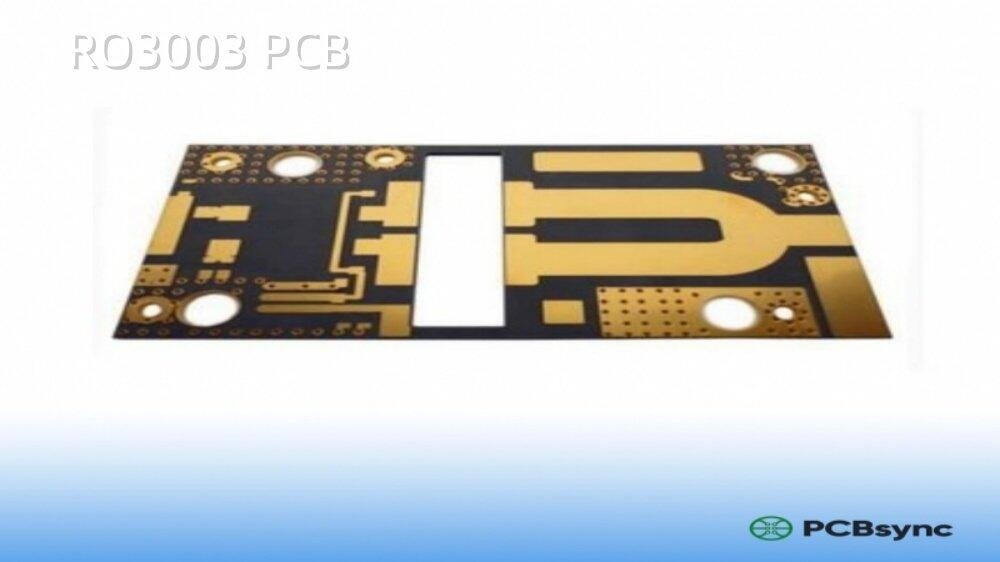
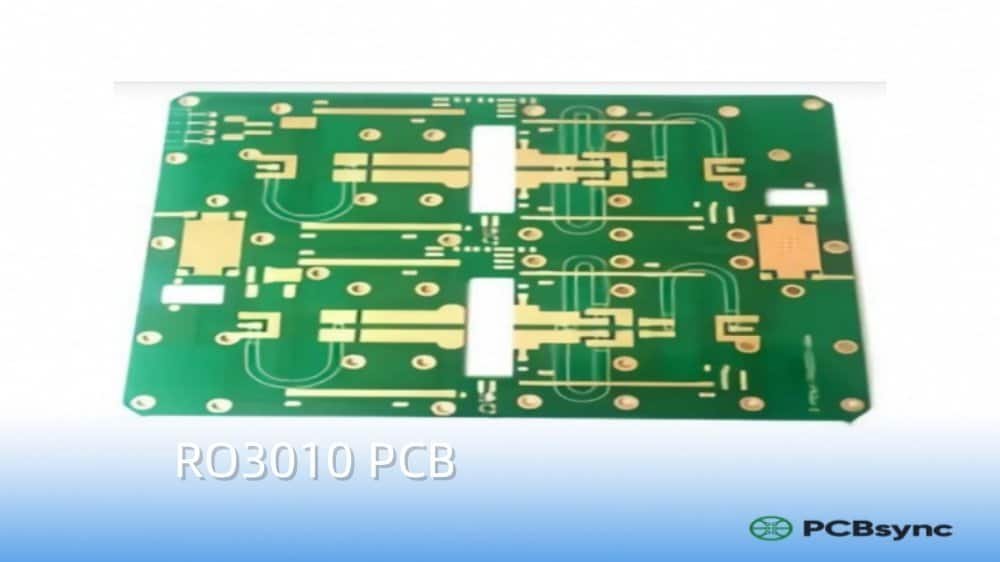
Here’s something that saves time in multilayer designs: RO3006 shares the same mechanical properties with other RO3000 series materials (RO3003, RO3010, RO3035). You can combine different Dk values in a multilayer stackup without worrying about warpage or layer-to-layer reliability issues.
Cost-Effective Volume Manufacturing
Unlike some exotic microwave materials, RO3006 can be processed using standard PTFE PCB fabrication techniques. This means shorter lead times, lower fabrication costs, and fewer headaches when you’re ready to scale from prototype to production.
Choosing the right laminate depends on your specific requirements. Here’s how RO3006 compares to materials you might be considering:
RO3006 vs RO3003 vs RO3010 Comparison
Property
RO3003
RO3006
RO3010
Dielectric Constant
3.00
6.15
10.2
Dissipation Factor
0.0013
0.0020
0.0023
Best For
Low-loss applications, wide traces
Compact designs, power amplifiers
Maximum miniaturization
Typical Applications
Millimeter-wave, stripline
GPS, radar, cellular
Automotive radar, filters
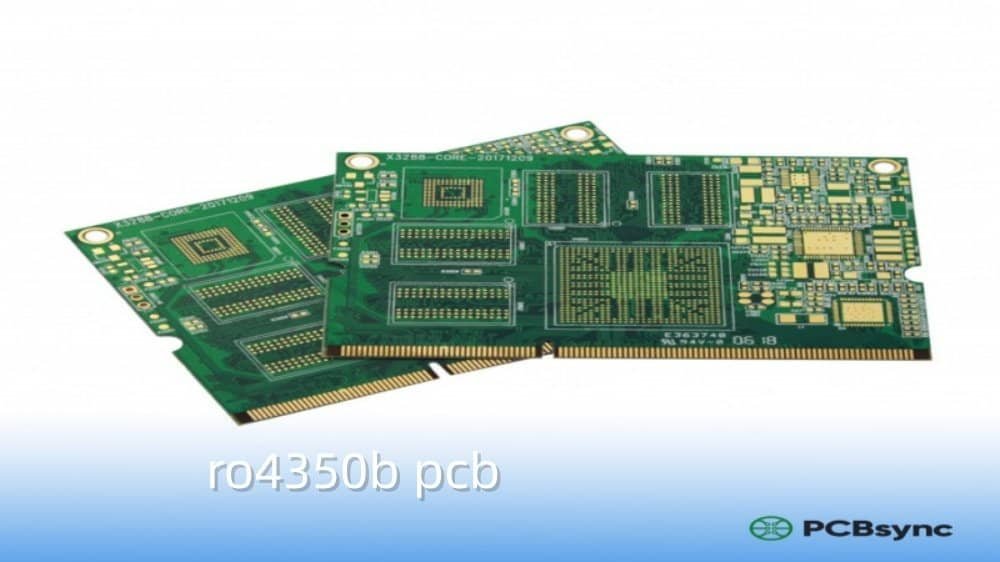
RO3006 vs RO4350B
Aspect
RO3006
RO4350B
Material Type
Ceramic-filled PTFE
Hydrocarbon ceramic
Dielectric Constant
6.15
3.48
Processing
PTFE techniques
FR-4-like processing
Relative Cost
Moderate
Lower
Circuit Size
Smaller (higher Dk)
Larger
Dissipation Factor
0.0020
0.0037
When to choose RO3006: You need a higher Dk for circuit miniaturization, or your design demands lower dielectric loss than RO4350B can provide.
When to choose RO4350B: You want easier processing (similar to FR-4) and the lower Dk works for your design. RO4350B also offers better flame rating (UL 94 V-0).
RO3006 vs Standard FR-4
Property
RO3006
FR-4
Dk @ 10 GHz
6.15
~4.5 (variable)
Df @ 10 GHz
0.0020
0.020+
Dk Stability
Excellent
Poor at high frequency
Max Frequency
77 GHz+
~1-2 GHz
Relative Cost
5-10× higher
Baseline
The bottom line: FR-4 works fine for low-frequency digital circuits, but it’s simply not viable for serious RF work above a few GHz. The dielectric loss alone would kill your signal integrity.
Common Applications for RO3006 PCB
Based on its properties, RO3006 finds its way into several demanding applications:
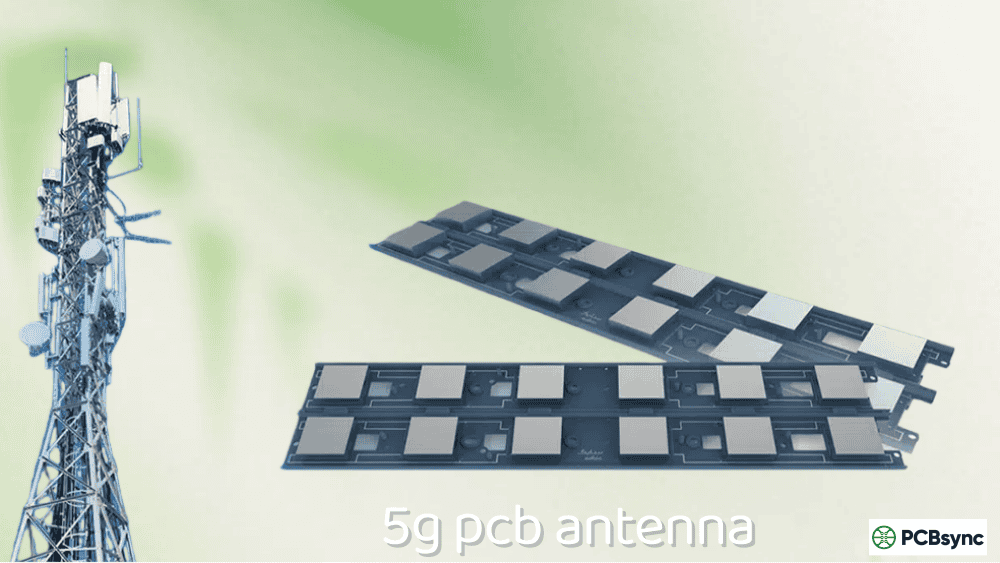
5G Base Station Antennas
The combination of low loss and stable Dk makes RO3006 ideal for cellular infrastructure. Base station antenna arrays need consistent performance across temperature ranges that outdoor installations experience.
Automotive Radar Systems
With ADAS (Advanced Driver Assistance Systems) becoming standard, automotive radar at 77 GHz requires materials that can handle the frequency while surviving automotive temperature extremes. RO3006’s thermal stability and low moisture absorption fit this environment well.
GPS and Satellite Antennas
Global positioning systems demand precise phase relationships — which means you can’t tolerate Dk drift. RO3006’s stable dielectric properties make it a natural choice for GPS patch antennas and satellite communication systems.
Power Amplifiers
The low dissipation factor means less energy lost as heat in the substrate. For power amplifier designs, this translates to higher efficiency and easier thermal management.
Patch Antennas for Wireless Communications
The higher Dk value (6.15) allows for smaller patch antenna designs compared to lower-Dk materials. When board space is limited, this can be the deciding factor.
Additional Application Areas
Direct broadcast satellites (DBS)
Remote meter reading systems
Datalink on cable systems
Power backplanes
Phased array radar systems
Electronic warfare systems
RO3006 PCB Design Considerations
Getting good results with RO3006 requires attention to a few design details:
Impedance Control
The higher dielectric constant affects your transmission line dimensions. For 50Ω microstrip, you’ll need narrower traces compared to lower-Dk materials. Run your impedance calculations with the actual Dk value (6.15), and work with your fabricator to account for manufacturing tolerances.
Trace Width Guidelines
For 50Ω microstrip on various RO3006 thicknesses:
Substrate Thickness
Approximate Trace Width
10 mil (0.25mm)
~6 mil
25 mil (0.64mm)
~15 mil
50 mil (1.28mm)
~30 mil
Note: These are rough estimates. Always verify with your own impedance calculations using actual stack-up parameters.
Stackup Design for Multilayer Boards
RO3006 works well in hybrid constructions with FR-4. A typical approach:
Use RO3006 for RF signal layers
Use FR-4 for power distribution and low-frequency digital signals
Bond with RO3000 series bondply or compatible prepreg
The matching mechanical properties within the RO3000 series simplify mixed-dielectric stackups when you need different Dk values in different layers.
Thermal Management
While RO3006’s thermal conductivity (0.79 W/m·K) is better than standard FR-4 (~0.3 W/m·K), high-power applications still need proper thermal design. Consider:
Thermal vias under high-dissipation components
Metal backing for antenna applications
Adequate copper pours for heat spreading
Via Design
The 24 ppm/°C Z-axis CTE provides good plated through-hole reliability, but follow standard high-frequency practices:
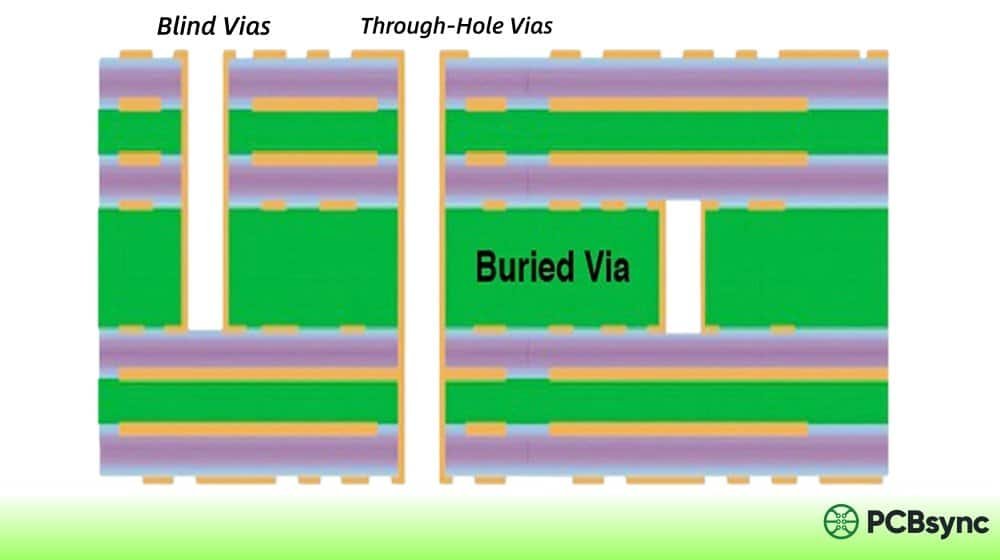
Minimize via stubs (use back-drilling if needed)
Consider via fencing for isolation
Keep vias short to reduce inductance
RO3006 PCB Fabrication Guidelines
Working with RO3006 follows standard PTFE processing, with a few points to keep in mind:
Drilling
Use sharp, high-quality carbide drills
Drill speeds and feeds similar to other PTFE materials
Entry/backup materials help prevent burrs
Plating
Standard electroless copper and electrolytic plating processes work well
The ceramic filler improves surface roughness compared to pure PTFE
Plasma treatment or sodium etch may be needed for optimal copper adhesion
Typical etch shrinkage is less than 0.5 mils per inch (thanks to copper-matched CTE)
Maintain tight etch compensation for impedance-controlled designs
Lamination
For multilayer boards, use RO3000 series bondply
Follow Rogers’ recommended lamination temperatures and pressures
Hybrid stackups with FR-4 require attention to Tg and CTE differences
Most experienced high-frequency PCB fabricators have established processes for RO3000 series materials. When getting quotes, confirm that your vendor has documented experience with PTFE-based laminates.
Useful Resources and Downloads
Here are official resources for RO3006 design and specification:
Official Rogers Corporation Resources
RO3000 Series Datasheet (PDF): Contains complete electrical, mechanical, and thermal specifications
IPC-4101: Specification for Base Materials for Rigid and Multilayer Printed Boards
IPC-6012: Qualification and Performance Specification for Rigid Printed Boards
Frequently Asked Questions About RO3006 PCB
What frequency range can RO3006 support?
RO3006 laminates can be used in applications up to 77 GHz and beyond. The stable dielectric constant and low loss characteristics make it suitable for millimeter-wave frequencies, though most commercial applications using RO3006 operate in the 1-40 GHz range.
Can RO3006 be used in multilayer PCB designs?
Yes. RO3006 shares uniform mechanical properties with other RO3000 series materials, making it ideal for multilayer constructions. You can combine RO3006 with RO3003, RO3010, or RO3035 in different layers to achieve specific electrical characteristics without warpage or reliability issues. Hybrid constructions with FR-4 are also common.
How does RO3006 compare to FR-4 for high-frequency applications?
RO3006 offers dramatically better performance above 1 GHz. The dissipation factor is roughly 10× lower (0.002 vs 0.02+), and the dielectric constant remains stable across temperature and frequency. FR-4’s Dk varies significantly at high frequencies, making impedance control unreliable. For any serious RF or microwave work, RO3006 or similar high-frequency laminates are necessary.
Is RO3006 PCB expensive compared to other Rogers materials?
RO3006 falls in the mid-range for Rogers high-frequency materials. It’s more expensive than standard FR-4 (typically 5-10× the raw material cost) but offers a good balance between performance and price within the Rogers lineup. The RO3000 series was specifically designed to provide exceptional electrical and mechanical stability at competitive prices compared to traditional PTFE microwave laminates.
What surface finishes work with RO3006?
Standard surface finishes are compatible with RO3006, including:
Immersion Gold (ENIG)
Immersion Silver
Immersion Tin
HASL (lead-free)
OSP (Organic Solderability Preservative)
For high-frequency applications, ENIG or immersion silver are typically preferred due to their flat surfaces and consistent RF performance.
How to Choose Between RO3006 and Other RO3000 Series Materials
Selecting the right material from the RO3000 family depends on your specific application requirements. Here’s a practical decision framework:
Choose RO3003 (Dk = 3.0) When:
You need the lowest possible dielectric loss
Your design can accommodate wider traces
You’re working with millimeter-wave frequencies where every dB matters
Stripline or precision transmission line applications
Choose RO3006 (Dk = 6.15) When:
Circuit miniaturization is important
You need compact antenna designs
Working with power amplifiers where moderate Dk helps efficiency
Balance between size, cost, and performance is the goal
Choose RO3010 (Dk = 10.2) When:
Maximum miniaturization is required
Space constraints are severe (e.g., automotive radar in tight enclosures)
High capacitance density is beneficial for filter designs
Working with patch antennas where smaller size outweighs other factors
Choose RO3035 (Dk = 3.5) When:
You need a middle-ground Dk between RO3003 and RO3006
Specific impedance requirements fall between what RO3003 and RO3006 offer easily
Drop-in replacement for designs originally done on similar-Dk materials
Cost Considerations for RO3006 PCB Projects
Let’s talk about the practical side: budget. RO3006 costs more than FR-4, but understanding where those costs come from helps you make informed decisions.
Material Cost Factors
The raw laminate cost for RO3006 typically runs 5-10× higher than equivalent FR-4 panels. However, material cost is often a smaller portion of total PCB cost than people assume. Fabrication complexity, layer count, and surface finish can dominate the final price.
Ways to Optimize Cost
Right-size your material selection: Don’t use RO3006 everywhere if only the RF layers need it. Hybrid stackups with FR-4 for non-critical layers reduce material consumption.
Panel utilization: Work with your fabricator on panelization. Better utilization of standard panel sizes reduces waste and cost per board.
Prototype vs. production quantities: High-frequency fabricators often have minimum charges. Combining prototype runs or moving to production quantities can dramatically improve per-unit economics.
Design for manufacturability: Tight tolerances, complex stackups, and unusual features add cost. Relaxing specifications where performance allows saves money.
Total Cost of Ownership
Remember that choosing cheaper materials that don’t perform can cost more in the long run. Failed prototypes, redesigns, and field failures have real costs. For RF applications, the incremental cost of RO3006 over marginal alternatives often pays for itself in first-spin success.
RO3006 PCB Quality Control and Testing
When you receive RO3006 boards from your fabricator, what should you check?
Incoming Inspection Points
Check
Method
Acceptance Criteria
Visual inspection
Magnification
No delamination, scratches, or contamination
Dimensional accuracy
CMM or optical
Within drawing tolerances
Copper thickness
Cross-section or XRF
Per specification (typically ±10%)
Dielectric thickness
Cross-section
Within laminate tolerance
Surface finish quality
Visual + adhesion test
Complete coverage, good adhesion
Electrical Testing
Impedance verification: Time Domain Reflectometry (TDR) or Vector Network Analyzer (VNA) measurements
Insertion loss: Important for transmission lines and filters
Return loss: Indicates impedance match quality
Isolation: Critical for multichannel or adjacent trace situations
Reliability Testing for Critical Applications
For aerospace, automotive, or other demanding applications:
Thermal cycling: Verify no delamination or cracking
Humidity exposure: Confirm moisture absorption stays within spec
Solder float test: Ensure PTH reliability at reflow temperatures
Real-World Design Tips From Experience
After working with RO3006 on numerous projects, here are some lessons learned that might save you time:
Simulation vs. Reality
Electromagnetic simulation tools like HFSS, CST, or ADS are essential, but real-world results often differ slightly from simulation. Build in margin for:
Manufacturing tolerances on Dk (±0.15 for RO3006)
Copper surface roughness effects at higher frequencies
Connector and transition parasitics
A 5-10% margin on critical parameters like bandwidth often prevents costly re-spins.
Working With Your Fabricator
Not all PCB shops have equal experience with high-frequency materials. Ask potential vendors:
How many RO3000 series jobs have they run?
What’s their typical impedance tolerance on PTFE materials?
Do they have documented processes for PTFE preparation and plating?
Can they provide test coupons with your order?
Common Mistakes to Avoid
Ignoring via transitions: At frequencies above 10 GHz, via stubs create resonances. Use back-drilling or blind vias.
Insufficient ground stitching: RF signals need solid ground references. Space ground vias appropriately to prevent parallel plate modes.
Wrong assumptions about soldermask: Soldermask has its own Dk that affects covered traces. Model it or keep critical RF traces exposed.
Underestimating connector effects: Edge-launch SMA connectors, for example, need proper footprints. Generic footprints often add significant mismatch.
Conclusion
Rogers RO3006 PCB material occupies a valuable middle ground in the high-frequency laminate landscape. Its Dk of 6.15 enables compact circuit designs, while the ceramic-filled PTFE construction delivers the thermal stability and low loss that microwave applications demand.
Whether you’re working on 5G antenna arrays, automotive radar systems, or satellite communication equipment, RO3006 provides a proven foundation for reliable RF performance. The material’s compatibility with standard PTFE processing and its uniform mechanical properties (shared across the RO3000 series) simplify both prototyping and volume manufacturing.
For your next high-frequency project, consider whether RO3006’s combination of higher dielectric constant, excellent thermal stability, and cost-effective processing might be the right fit. And as always, work closely with an experienced RF PCB fabricator to ensure your design translates successfully from simulation to hardware.
Inquire: Call 0086-755-23203480, or reach out via the form below/your sales contact to discuss our design, manufacturing, and assembly capabilities.
Quote: Email your PCB files to Sales@pcbsync.com (Preferred for large files) or submit online. We will contact you promptly. Please ensure your email is correct.
Notes: For PCB fabrication, we require PCB design file in Gerber RS-274X format (most preferred), *.PCB/DDB (Protel, inform your program version) format or *.BRD (Eagle) format. For PCB assembly, we require PCB design file in above mentioned format, drilling file and BOM. Click to download BOM template To avoid file missing, please include all files into one folder and compress it into .zip or .rar format.