Inquire: Call 0086-755-23203480, or reach out via the form below/your sales contact to discuss our design, manufacturing, and assembly capabilities.
Quote: Email your PCB files to Sales@pcbsync.com (Preferred for large files) or submit online. We will contact you promptly. Please ensure your email is correct.
Notes: For PCB fabrication, we require PCB design file in Gerber RS-274X format (most preferred), *.PCB/DDB (Protel, inform your program version) format or *.BRD (Eagle) format. For PCB assembly, we require PCB design file in above mentioned format, drilling file and BOM. Click to download BOM template To avoid file missing, please include all files into one folder and compress it into .zip or .rar format.
Resistors in Series: Formula, Calculator & Circuit Examples
Resistors in series form the backbone of countless circuit designs. From simple voltage dividers to precision reference circuits, understanding how series resistors behave has been essential to every PCB project I’ve worked on over the past fifteen years. Whether you’re designing LED current limiters, sensor interface circuits, or transistor biasing networks, series resistor calculations come up constantly.
This guide covers everything you need to know about resistors in series: the formulas, practical calculations, voltage divider applications, and real circuit examples. I’ve included tables, worked problems, and resources to help you master series resistance calculations confidently.
Resistors in series are resistors connected end-to-end in a single path, forming a chain where current must flow through each resistor sequentially. Unlike parallel connections where current has multiple paths, a series circuit provides only one route for electron flow.
The defining characteristics of resistors in series include:
Property
Behavior in Series Circuit
Current
Same through all resistors
Voltage
Divides among resistors
Total Resistance
Sum of all individual resistances
Power
Distributed proportionally to resistance
Think of resistors in series like toll booths on a single-lane highway. Every car (electron) must pass through each booth (resistor), experiencing resistance at each point. The total trip resistance equals the sum of all individual booth delays.
The Series Resistor Formula
Calculating resistors in series couldn’t be simpler. You just add them up.
Basic Formula for Total Resistance
R_total = R₁ + R₂ + R₃ + … + Rₙ
That’s it. No reciprocals, no complex math. The total resistance of resistors in series equals the arithmetic sum of each individual resistance value.
Why Series Resistance Adds Directly
The formula makes intuitive sense when you consider what’s happening physically. Current must push through every resistor in the chain. Each resistor presents its own opposition to current flow. The total opposition equals all individual oppositions combined, just as walking through three doors requires pushing open all three, not just one.
Mathematically, this derives from Ohm’s Law and Kirchhoff’s Voltage Law. Since current is constant through series resistors, and voltage drops across each resistor sum to the total applied voltage:
V_total = V₁ + V₂ + V₃
Using Ohm’s Law (V = IR) for each resistor:
I × R_total = I × R₁ + I × R₂ + I × R₃
The current I cancels, leaving:
R_total = R₁ + R₂ + R₃
Step-by-Step Series Resistance Calculations
Let me walk through increasingly complex examples to solidify your understanding of resistors in series.
Example 1: Three Basic Resistors in Series
Problem: Calculate the total resistance of 1kΩ, 2.2kΩ, and 4.7kΩ resistors connected in series.
Solution:
R_total = 1kΩ + 2.2kΩ + 4.7kΩ R_total = 7.9kΩ
Simple addition gives us 7.9kΩ total resistance.
Example 2: Finding Current in a Series Circuit
Problem: A 9V battery connects to three resistors in series: 100Ω, 200Ω, and 300Ω. Calculate the circuit current and voltage across each resistor.
The nearest standard value would be 1.8kΩ (giving 15.1kΩ total) or 1.5kΩ (giving 14.8kΩ total).
Quick Reference: Common Series Combinations
This table shows total resistance for common series resistor combinations using standard E12 values:
R₁
R₂
R₃
Series Total
1kΩ
1kΩ
–
2kΩ
1kΩ
2.2kΩ
–
3.2kΩ
1kΩ
4.7kΩ
–
5.7kΩ
10kΩ
10kΩ
10kΩ
30kΩ
10kΩ
22kΩ
–
32kΩ
47kΩ
100kΩ
–
147kΩ
100kΩ
100kΩ
100kΩ
300kΩ
1MΩ
1MΩ
–
2MΩ
Keep this table nearby when you need to quickly combine available resistors to hit a target value.
The Voltage Divider Rule for Resistors in Series
One of the most powerful applications of resistors in series is the voltage divider circuit. This fundamental configuration appears everywhere in electronics, from sensor interfaces to reference voltage generation.
Voltage Divider Formula
When two resistors connect in series across a voltage source, the voltage at their junction equals:
V_out = V_in × (R₂ / (R₁ + R₂))
Where R₂ is the “bottom” resistor (between the output and ground) and R₁ is the “top” resistor (between input and output).
Voltage Divider Design Example
Problem: Design a voltage divider to reduce 5V to 3.3V for interfacing a 5V Arduino output with a 3.3V ESP32 input.
Solution:
The required ratio is: 3.3V / 5V = 0.66
Using the voltage divider formula: 0.66 = R₂ / (R₁ + R₂)
Close enough for most digital logic level shifting applications.
General Voltage Division Rule
For any resistor in a series chain, the voltage across that resistor equals:
V_Rn = V_total × (Rn / R_total)
The voltage drop across any resistor is proportional to its resistance relative to the total resistance. Larger resistors develop larger voltage drops; smaller resistors develop smaller drops.
Understanding power distribution in series circuits prevents component damage and ensures reliable designs.
Power Calculation for Series Resistors
Since current is identical through all resistors in series, power dissipation depends on each resistor’s value:
P = I² × R
Higher resistance values dissipate more power in series circuits. This contrasts with parallel circuits, where lower resistance values handle more power.
Power Distribution Example
Problem: Three resistors (1kΩ, 2kΩ, 3kΩ) connect in series across 12V. Calculate power dissipation for each.
The 3kΩ resistor dissipates the most power (12mW) because it has the highest resistance. All standard 1/8W (125mW) resistors can easily handle these power levels.
Practical Applications of Resistors in Series
Series resistor configurations solve many common design challenges.
LED Current Limiting
LEDs require current limiting to prevent destruction. A resistor in series with the LED limits current to safe levels.
Formula: R = (V_supply – V_LED) / I_LED
For a red LED (V_LED ≈ 2V) running at 20mA from 5V: R = (5V – 2V) / 20mA = 150Ω
Voltage Level Shifting
When interfacing circuits operating at different voltages, series resistor dividers step voltage levels down safely. The 5V to 3.3V example above demonstrates this common application.
Reference Voltage Generation
Precision voltage references often use resistor dividers from a stable supply. For critical applications, use 1% or better tolerance resistors to minimize output voltage variation.
Sensor Signal Conditioning
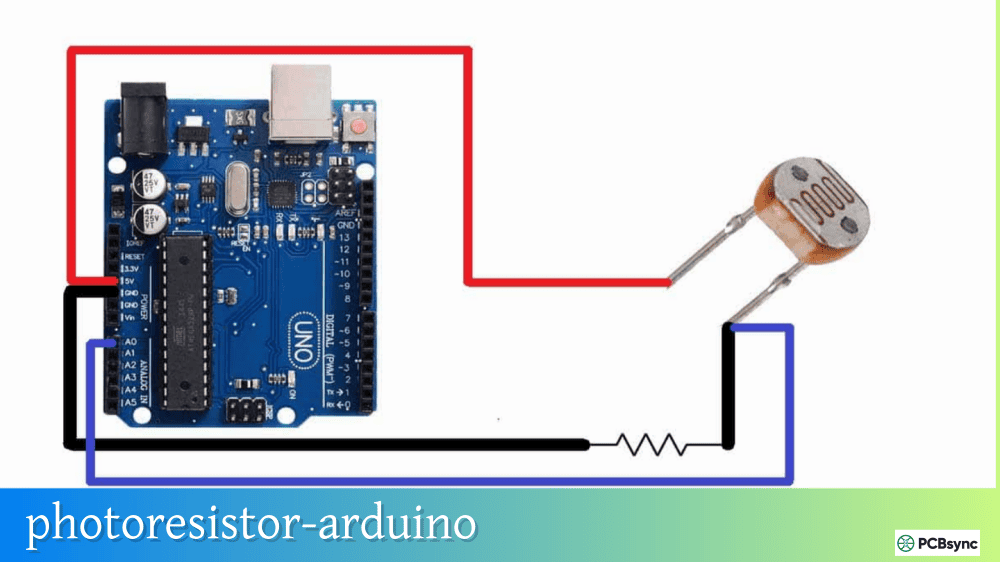
Resistive sensors like thermistors and photoresistors typically connect in voltage divider configurations. The changing sensor resistance produces a proportional voltage change that microcontrollers can measure.
Transistor Biasing
Bipolar transistor base bias networks frequently employ series resistors to establish proper operating points. The resistor values set the base current and consequently the collector current.
Series vs Parallel Resistors: Key Differences
Knowing when to use each configuration is essential for effective circuit design.
Characteristic
Series
Parallel
Total Resistance
Increases (sum)
Decreases (reciprocal sum)
Current
Same through all
Divides among branches
Voltage
Divides among resistors
Same across all
Failure Mode
One open = circuit breaks
One open = others still work
Power Distribution
Higher R = more power
Lower R = more power
Main Application
Voltage division
Current division
When to Use Series Resistors
Choose series connections when you need to:
Divide voltage into proportional parts
Increase total resistance
Create a specific resistance value from smaller values
Ensure identical current through multiple components
When to Use Parallel Resistors
Choose parallel connections when you need to:
Divide current into multiple paths
Decrease total resistance
Create a specific resistance value from larger values
Increase power handling capability
Common Mistakes with Resistors in Series
After reviewing many student and junior engineer designs, these errors appear most frequently:
Mixing these up leads to wildly incorrect results.
Mistake 2: Forgetting voltage divider loading effects
An unloaded voltage divider produces the calculated output voltage. But connecting a load draws current and changes the effective “bottom” resistance, reducing output voltage. Always verify that load impedance is at least 10× the divider output impedance for minimal loading error.
Mistake 3: Ignoring power ratings
In series circuits, the largest resistor dissipates the most power. Verify that your highest-value resistor can handle its power load, not just the total circuit power.
Mistake 4: Neglecting tolerance effects
If you cascade multiple resistors in series, their tolerances compound. Three ±5% resistors in series could produce a total resistance anywhere within approximately ±5% of the calculated value, since the errors can either add or partially cancel.
Mistake 5: Using wrong values in voltage divider calculations
Remember: R₂ goes in the numerator of the voltage divider formula. R₂ is the resistor between the output node and ground, not between input and output.
Online Calculators and Resources
These tools simplify resistors in series calculations:
Series Resistance Calculators:
Omni Calculator Series Resistor Tool (omnicalculator.com)
All About Circuits Textbook (allaboutcircuits.com)
SparkFun Learn Tutorials (learn.sparkfun.com)
Frequently Asked Questions About Resistors in Series
What happens to total resistance when you add more resistors in series?
Total resistance increases with every resistor added. Since series resistance equals the sum of individual resistances, adding any positive resistance value increases the total. This contrasts with parallel circuits, where adding resistors decreases total resistance. If you have 10kΩ total and add another 5kΩ in series, you get 15kΩ total.
Why is current the same through all resistors in a series circuit?
Current has only one path through a series circuit. Every electron that enters must exit through the same route, passing through each resistor sequentially. There’s nowhere else for current to go, no branches or alternative paths. This is analogous to water flowing through a single pipe; the flow rate must be identical at every point along the pipe.
How do I choose resistor values for a voltage divider?
Start by determining your required output voltage and acceptable current draw. The ratio R₂/(R₁+R₂) sets the output voltage fraction. Lower total resistance means higher current draw but better load regulation. Higher total resistance saves power but is more susceptible to loading effects. For most applications, total divider resistance between 1kΩ and 100kΩ works well. Ensure load impedance exceeds 10× the divider’s Thevenin equivalent resistance.
Can I mix different wattage resistors in a series circuit?
Yes, but with caution. Each resistor must individually handle the power it dissipates. In series circuits, higher resistance values dissipate more power (P = I²R). Calculate the power for each resistor and ensure its wattage rating exceeds the calculated dissipation with adequate margin. A 1/4W and 1/8W resistor can work together in series as long as neither exceeds its individual rating.
What’s the maximum number of resistors I can connect in series?
Theoretically, there’s no limit. Practically, several factors constrain series chains: total resistance may become impractically high, accumulated tolerance errors increase uncertainty, physical space and PCB area become issues, and parasitic effects (lead inductance, stray capacitance) may affect high-frequency behavior. For most applications, two to four resistors in series handle typical design requirements without complications.
Wrapping Up
Resistors in series represent one of the most fundamental circuit configurations you’ll encounter. The simple addition formula makes calculations straightforward, while the voltage divider application extends the utility of series resistors into countless practical designs.
The key principles to remember: current stays constant through all series resistors, voltage divides proportionally to resistance values, and total resistance equals the sum of all individual resistances. These rules, combined with Ohm’s Law, let you analyze and design virtually any series resistor network.
Whether you’re building a simple LED circuit or designing precision measurement systems, mastering resistors in series gives you essential tools for effective circuit design. The formulas are simple, the applications are endless, and the concepts form the foundation for understanding more complex resistive networks.
Inquire: Call 0086-755-23203480, or reach out via the form below/your sales contact to discuss our design, manufacturing, and assembly capabilities.
Quote: Email your PCB files to Sales@pcbsync.com (Preferred for large files) or submit online. We will contact you promptly. Please ensure your email is correct.
Notes: For PCB fabrication, we require PCB design file in Gerber RS-274X format (most preferred), *.PCB/DDB (Protel, inform your program version) format or *.BRD (Eagle) format. For PCB assembly, we require PCB design file in above mentioned format, drilling file and BOM. Click to download BOM template To avoid file missing, please include all files into one folder and compress it into .zip or .rar format.