Inquire: Call 0086-755-23203480, or reach out via the form below/your sales contact to discuss our design, manufacturing, and assembly capabilities.
Quote: Email your PCB files to Sales@pcbsync.com (Preferred for large files) or submit online. We will contact you promptly. Please ensure your email is correct.
Notes: For PCB fabrication, we require PCB design file in Gerber RS-274X format (most preferred), *.PCB/DDB (Protel, inform your program version) format or *.BRD (Eagle) format. For PCB assembly, we require PCB design file in above mentioned format, drilling file and BOM. Click to download BOM template To avoid file missing, please include all files into one folder and compress it into .zip or .rar format.
Complete Resistor Guide: Types, Values, Color Codes & Applications
Every electronic circuit contains resistors. These passive components regulate current flow, divide voltages, bias transistors, terminate transmission lines, and perform countless other functions that make electronics work. Whether you’re debugging a power supply, designing an LED driver, or troubleshooting a microcontroller circuit, understanding resistors is fundamental to the job.
This guide covers everything you need to know about resistors: how they work, the different types available, how to read color codes, SMD marking systems, standard values, power ratings, and practical selection criteria. By the end, you’ll have a solid reference for all your resistor-related decisions.
A resistor is an electrical component that opposes the flow of current. The relationship between voltage, current, and resistance follows Ohm’s Law: V = I × R, where V is voltage in volts, I is current in amperes, and R is resistance in ohms (Ω).
Resistors work by converting electrical energy into heat. The resistive element—whether carbon, metal film, or wire—has a specific resistance determined by its material properties, length, and cross-sectional area. When current flows through, electrons collide with atoms in the resistive material, generating heat proportional to I²R (power dissipation).
The symbol for resistance is the Greek letter omega (Ω). Common prefixes include kilo-ohm (kΩ = 1,000Ω) and mega-ohm (MΩ = 1,000,000Ω). For very low values, milli-ohm (mΩ = 0.001Ω) is used in current-sensing applications.
Types of Resistors: Choosing the Right Construction
Different resistor constructions serve different purposes. The material and manufacturing method determine accuracy, stability, noise performance, temperature coefficient, frequency response, and pulse handling capability.
Carbon Composition Resistors
Carbon composition resistors were the workhorses of electronics from the 1920s through the 1970s. They’re made by mixing carbon powder with a ceramic binder, compressing the mixture into a cylindrical shape, and attaching leads.
Carbon composition resistors have largely been replaced by film types for general use, but they still have applications where pulse handling matters—like ESD protection circuits and surge suppression. Their ability to absorb transients without damage makes them valuable in specific situations.
Carbon Film Resistors
Carbon film resistors improved on composition types by depositing a thin carbon layer onto a ceramic rod, then cutting a spiral groove to achieve the desired resistance value. This construction provides better tolerance and stability than carbon composition.
Characteristics:
Tolerance: ±2% to ±5%
Temperature coefficient: ~200-500 ppm/°C
Noise: Moderate
Power ratings: 1/8W to 2W typical
Frequency response: Good to ~1 MHz
Carbon film resistors offer a good balance of cost and performance for general-purpose applications. They’re often marked with a “CF” prefix (e.g., CF100kΩ). While metal film has largely superseded them for precision work, carbon film remains popular for non-critical applications where cost matters.
Metal Film Resistors
Metal film resistors represent the current standard for precision through-hole applications. A thin nickel-chromium (NiCr) or tantalum nitride layer is deposited onto a ceramic substrate, then laser-trimmed to achieve tight tolerances.
Characteristics:
Tolerance: ±0.1% to ±2%
Temperature coefficient: 15-100 ppm/°C
Noise: Very low
Stability: Excellent (15-50 ppm/year drift)
Frequency response: Good to ~100 MHz
Metal film resistors are marked with “MFR” prefix and are the go-to choice for analog circuits, instrumentation, audio equipment, and any application requiring precision. Their low noise makes them essential for sensitive measurement circuits. The primary limitation is pulse handling—the thin film can be damaged by high-energy transients.
Metal Oxide Film Resistors
Metal oxide resistors use a tin oxide film and offer higher temperature capability than standard metal film. They’re particularly useful for high-voltage applications.
Characteristics:
Tolerance: ±1% to ±5%
Temperature range: Up to 300°C operating
Voltage capability: Higher than metal film
Surge handling: Better than metal film
Metal oxide resistors bridge the gap between precision metal film and rugged carbon composition. They’re common in power supplies and industrial applications where temperature extremes and voltage transients are concerns.
Wirewound Resistors
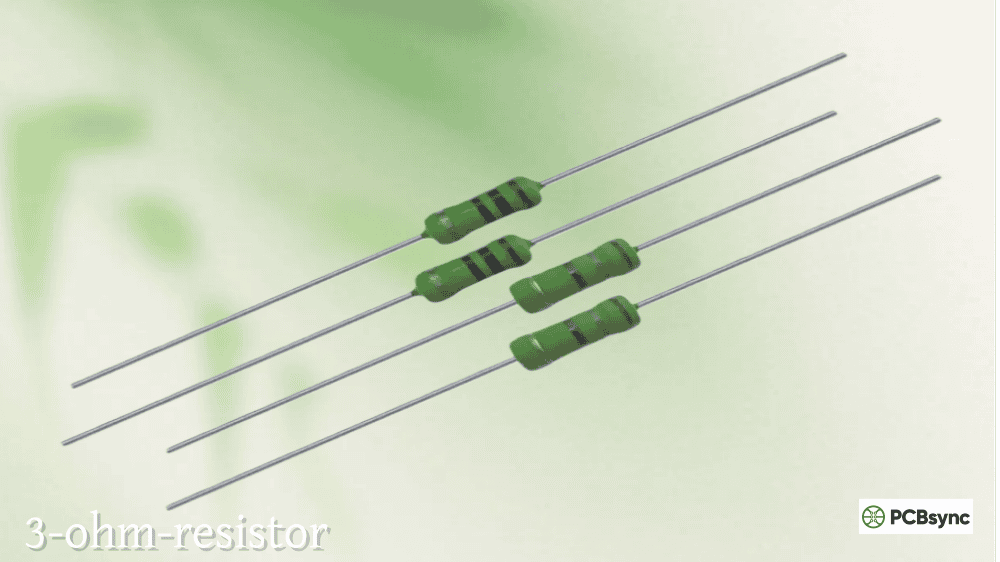
Wirewound resistors are made by winding resistance wire (typically nichrome) around a ceramic or fiberglass core. They’re the oldest resistor technology still in production and remain essential for high-power applications.
Characteristics:
Tolerance: ±0.005% to ±5% (precision types)
Temperature coefficient: <10 ppm/°C (precision types)
Stability: Best available (15-50 ppm/year)
Power ratings: 1W to hundreds of watts
Inductance: High (limits high-frequency use)
Types of wirewound resistors:
Type
Application
Temperature Range
Notes
Precision wirewound
Measurement, calibration
-55°C to +125°C
Tolerances to 0.005%
Power wirewound
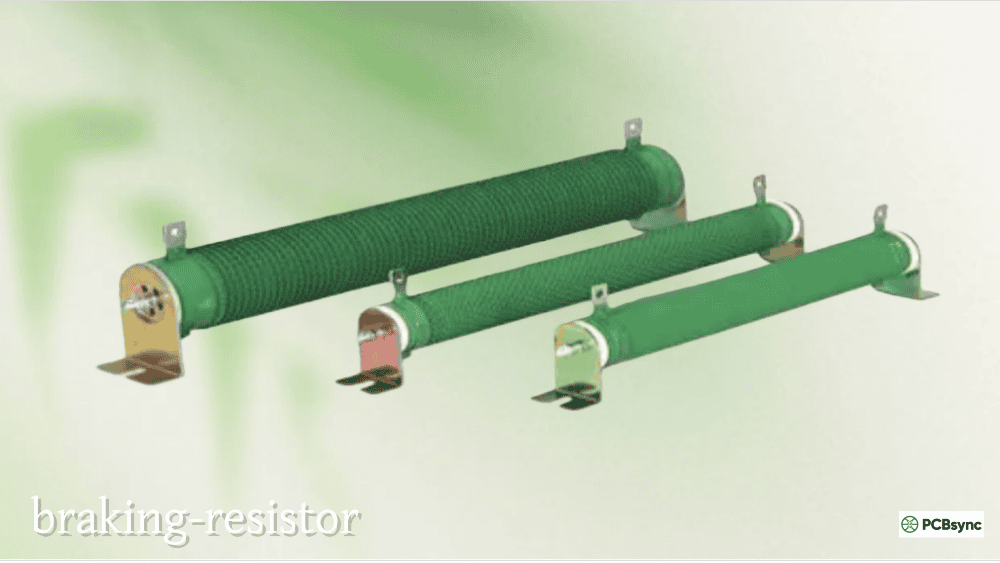
Braking, heating, power supplies
Up to 300°C
Available in chassis-mount versions
Non-inductive wirewound
RF applications
Standard
Bifilar winding cancels inductance
The main limitation of wirewound resistors is inductance. The coiled wire creates significant self-inductance, making these unsuitable for frequencies above 50 kHz without special non-inductive winding techniques.
Thick Film Resistors (SMD)
Thick film resistors dominate surface-mount applications. A ruthenium oxide paste is screen-printed onto a ceramic substrate, fired at high temperature, and laser-trimmed to value.
Characteristics:
Tolerance: ±0.1% to ±5%
Temperature coefficient: 50-200 ppm/°C
Size: 0201 to 2512 packages
Cost: Very low in volume
Noise: Moderate
Most SMD resistors you encounter are thick film. They’re adequate for 90% of applications and extremely cost-effective in production quantities.
Thin Film Resistors (SMD)
Thin film resistors use a sputtered metal layer (typically NiCr or tantalum nitride) rather than a printed paste. This provides superior performance at higher cost.
Characteristics:
Tolerance: ±0.01% to ±1%
Temperature coefficient: 5-50 ppm/°C
Stability: Much better than thick film
Noise: Very low
Thin film resistors are essential for precision analog circuits, ADC/DAC reference networks, and any application where long-term stability and low noise matter.
Resistor Comparison Table
Type
Tolerance
TCR (ppm/°C)
Noise
Pulse Handling
Cost
Best For
Carbon Composition
±5-20%
~1000
High
Excellent
Low
ESD/surge protection
Carbon Film
±2-5%
200-500
Moderate
Good
Low
General purpose
Metal Film
±0.1-2%
15-100
Very low
Poor
Medium
Precision analog
Metal Oxide
±1-5%
100-300
Low
Good
Medium
High voltage/temp
Wirewound Precision
±0.005-1%
<10
Very low
Good
High
Measurement
Wirewound Power
±1-5%
20-50
Low
Excellent
Medium
High power
Thick Film SMD
±0.1-5%
50-200
Moderate
Moderate
Very low
General SMD
Thin Film SMD
±0.01-1%
5-50
Very low
Moderate
High
Precision SMD
Standard Resistor Values: The E-Series System
Resistors aren’t manufactured in every possible value. Instead, the industry uses standardized “preferred values” organized into E-series. The E-number indicates how many values exist per decade (1-10, 10-100, etc.), with spacing designed so adjacent values overlap within their tolerance range.
E-Series and Tolerance Relationship
E-Series
Values per Decade
Typical Tolerance
Common Use
E3
3
±50%
Obsolete, electrolytic capacitors
E6
6
±20%
Non-critical applications
E12
12
±10%
General purpose
E24
24
±5%
Most common series
E48
48
±2%
Precision work
E96
96
±1%
High precision
E192
192
±0.5% or better
Ultra-precision
E24 Standard Values (Most Common)
The E24 series covers most resistor needs. These values repeat in every decade:
Example: If you need approximately 4,500Ω, the nearest E24 values are 4.3kΩ and 4.7kΩ. For a ±5% tolerance resistor, either value provides adequate coverage.
E12 Standard Values
The E12 series is a subset of E24, commonly used for less critical applications:
Design tip: When tolerance isn’t critical (pull-up resistors, LED current limiters), stick to E12 or even E6 values. This simplifies your BOM and reduces inventory costs.
How to Read Resistor Color Codes
Through-hole resistors use colored bands to indicate their value, tolerance, and sometimes temperature coefficient. The coding system, defined by IEC 60062, has been standard since the 1920s.
Color Code Reference Table
Color
Digit
Multiplier
Tolerance
Temp Coefficient
Black
0
×1
—
250 ppm/°C
Brown
1
×10
±1%
100 ppm/°C
Red
2
×100
±2%
50 ppm/°C
Orange
3
×1,000
—
15 ppm/°C
Yellow
4
×10,000
—
25 ppm/°C
Green
5
×100,000
±0.5%
20 ppm/°C
Blue
6
×1,000,000
±0.25%
10 ppm/°C
Violet
7
×10,000,000
±0.1%
5 ppm/°C
Gray
8
×100,000,000
±0.05%
1 ppm/°C
White
9
×1,000,000,000
—
—
Gold
—
×0.1
±5%
—
Silver
—
×0.01
±10%
—
None
—
—
±20%
—
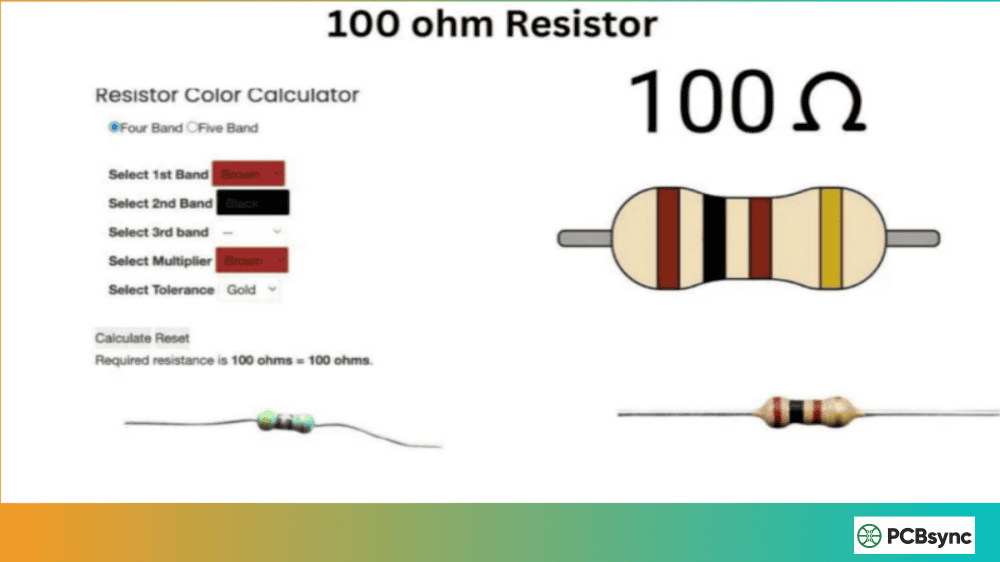
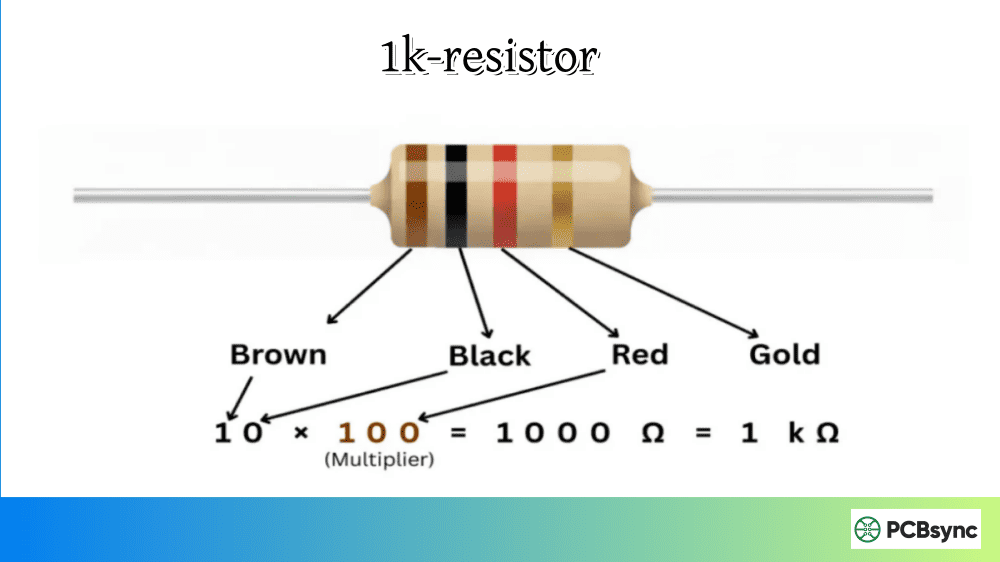
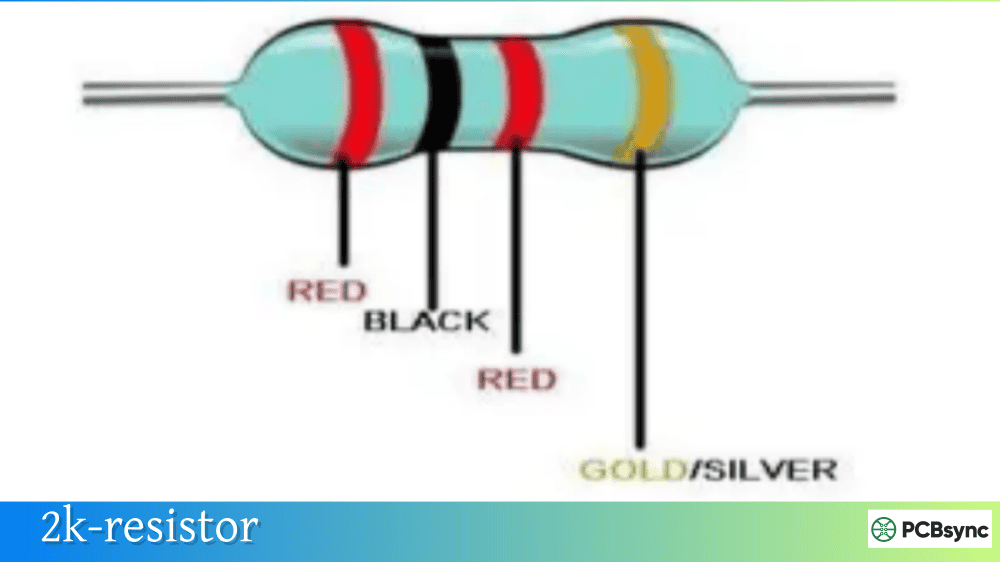
4-Band Resistor Color Code
The most common resistor marking uses four bands: two digits, a multiplier, and tolerance.
Reading direction: The tolerance band (gold or silver) is always at one end. Start reading from the opposite end.
Example: Green-Blue-Red-Gold
Green (5) + Blue (6) = 56
Red multiplier = ×100
Gold tolerance = ±5%
Result: 5,600Ω (5.6kΩ) ±5%
5-Band Resistor Color Code
Precision resistors use five bands: three significant digits, multiplier, and tolerance.
Example: Brown-Black-Black-Brown-Brown
Brown (1) + Black (0) + Black (0) = 100
Brown multiplier = ×10
Brown tolerance = ±1%
Result: 1,000Ω (1kΩ) ±1%
6-Band Resistor Color Code
High-precision resistors add a sixth band for temperature coefficient.
Example: Orange-Red-Brown-Brown-Green-Red
Orange (3) + Red (2) + Brown (1) = 321
Brown multiplier = ×10
Green tolerance = ±0.5%
Red temp coefficient = 50 ppm/°C
Result: 3,210Ω (3.21kΩ) ±0.5%, 50 ppm/°C
Color Code Memory Aid
The classic mnemonic “Bad Beer Rots Our Young Guts But Vodka Goes Well” helps remember the color sequence: Black, Brown, Red, Orange, Yellow, Green, Blue, Violet, Gray, White.
Special Cases
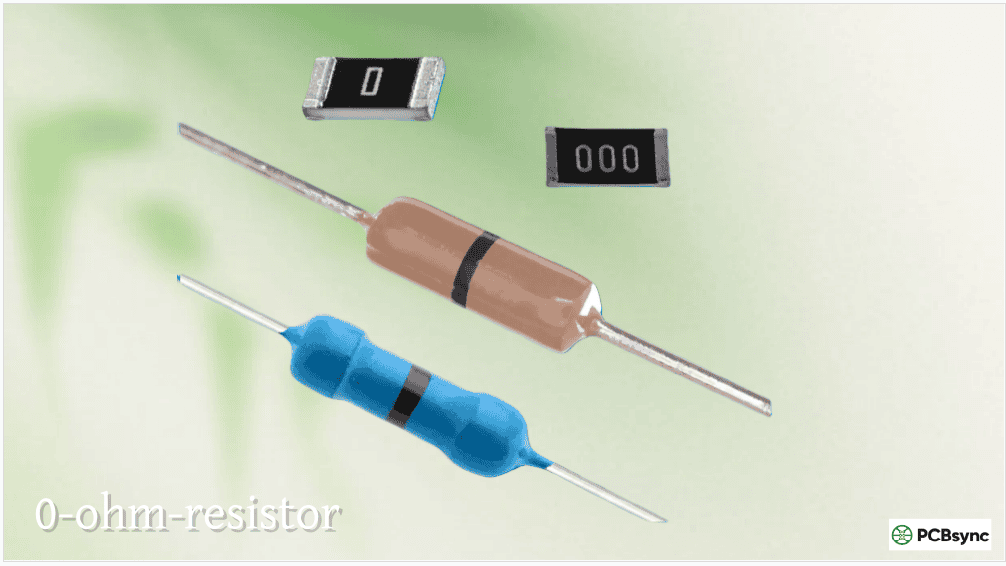
Zero-ohm resistors: A single black band indicates a zero-ohm jumper—essentially a wire link packaged as a resistor for automated assembly.
High-voltage resistors: Gold and silver bands may be replaced with yellow and gray to prevent metal particles in the coating.
Surface-mount resistors use numerical codes rather than color bands. The marking system depends on the resistor size and tolerance.
3-Digit Code (Standard)
Most SMD resistors use a three-digit code where the first two digits are significant figures and the third is the multiplier (number of zeros to add).
Marking
Calculation
Value
100
10 × 10⁰
10Ω
101
10 × 10¹
100Ω
102
10 × 10²
1kΩ
103
10 × 10³
10kΩ
104
10 × 10⁴
100kΩ
472
47 × 10²
4.7kΩ
220
22 × 10⁰
22Ω
4-Digit Code (Precision)
Precision SMD resistors (1% or better) use four digits: three significant figures plus multiplier.
Marking
Calculation
Value
1001
100 × 10¹
1kΩ
1002
100 × 10²
10kΩ
4701
470 × 10¹
4.7kΩ
2200
220 × 10⁰
220Ω
R Notation (Sub-Ohm Values)
For values below 10Ω, the letter “R” indicates the decimal point position.
Marking
Value
R10
0.10Ω
R47
0.47Ω
1R0
1.0Ω
4R7
4.7Ω
47R
47Ω
EIA-96 Code (1% Resistors)
Some precision resistors use the EIA-96 alphanumeric code: two digits plus a letter. The digits reference a lookup table value, and the letter indicates the multiplier.
Letter
Multiplier
Z
×0.001
Y/R
×0.01
X/S
×0.1
A
×1
B/H
×10
C
×100
D
×1,000
E
×10,000
F
×100,000
Example: “01C” = 100Ω (code 01 = 100 from table, C = ×100… wait, that’s 10,000Ω. Let me correct: code 01 represents 1.00 in the EIA-96 table, so 01C = 1.00 × 100 = 100Ω)
SMD Resistor Package Sizes
SMD resistor packages are designated by a four-digit code representing dimensions in hundredths of an inch.
Package
Imperial (inches)
Metric (mm)
Power Rating
Typical Use
0201
0.02 × 0.01
0.6 × 0.3
0.05W
Wearables, hearing aids
0402
0.04 × 0.02
1.0 × 0.5
0.063W
Smartphones, tablets
0603
0.06 × 0.03
1.6 × 0.8
0.1W
Consumer electronics
0805
0.08 × 0.05
2.0 × 1.25
0.125W
General purpose
1206
0.12 × 0.06
3.2 × 1.6
0.25W
Industrial, automotive
2010
0.20 × 0.10
5.0 × 2.5
0.5-0.75W
Higher power
2512
0.25 × 0.12
6.35 × 3.2
1W
Power applications
Selection guidelines:
0805 and 1206 are easiest for hand soldering
0402 and smaller require microscope and precision tools
Match power rating to actual dissipation with 20-30% margin
Consider assembly capabilities when choosing package size
Understanding Resistor Specifications
Beyond basic resistance value, several specifications determine whether a resistor is suitable for a particular application. Professional circuit design requires attention to these parameters.
Tolerance
Tolerance indicates how much the actual resistance can deviate from the marked value. A 10kΩ resistor with ±5% tolerance can measure anywhere from 9,500Ω to 10,500Ω and still be within specification.
Tolerance
Typical Application
±20%
Obsolete, rarely used
±10%
Non-critical, very cost-sensitive
±5%
General purpose digital circuits
±2%
Improved precision at moderate cost
±1%
Standard for modern designs
±0.5%
Precision analog
±0.1%
High-precision measurement
±0.01%
Calibration standards
Design tip: Modern 1% resistors cost nearly the same as 5% parts in most packages. Unless you have a compelling cost reason, default to 1% tolerance for new designs.
Temperature Coefficient of Resistance (TCR)
TCR specifies how much resistance changes with temperature, expressed in parts per million per degree Celsius (ppm/°C). A 100 ppm/°C resistor will change 0.01% for every degree temperature change.
Example calculation: A 10kΩ resistor with 100 ppm/°C TCR operating at 75°C (25°C above the 25°C reference temperature) will drift by:
The actual resistance could be 10,025Ω or 9,975Ω depending on TCR polarity.
TCR Value
Resistor Type
Application
1000+ ppm/°C
Carbon composition
Where stability doesn’t matter
200-500 ppm/°C
Carbon film
General purpose
50-100 ppm/°C
Metal film, thick film SMD
Standard precision
15-50 ppm/°C
Precision thin film
Instrumentation
5-15 ppm/°C
Precision wirewound
Measurement standards
<5 ppm/°C
Ultra-precision
Calibration equipment
For precision voltage dividers and measurement circuits, matched TCR between resistors matters more than absolute TCR value. Resistor networks with tracking TCR are available for this purpose.
Voltage Rating and Voltage Coefficient
Every resistor has a maximum working voltage determined by its physical size and construction. Exceeding this rating can cause arcing, breakdown, or catastrophic failure.
Package
Typical Max Voltage
0402 SMD
50V
0603 SMD
75V
0805 SMD
150V
1206 SMD
200V
1/4W axial
250V
1/2W axial
350V
High voltage special
1kV+
Voltage coefficient describes how resistance changes with applied voltage. For most applications this is negligible, but high-voltage circuits and precision applications require attention to this specification.
Long-Term Stability
Resistance drift over time matters for calibrated instruments and precision applications. Stability is expressed in ppm per year or ppm per 1000 hours.
Type
Typical Stability
Carbon composition
1000+ ppm/year
Carbon film
500-1000 ppm/year
Thick film SMD
200-500 ppm/year
Metal film
50-200 ppm/year
Thin film SMD
25-100 ppm/year
Precision wirewound
15-50 ppm/year
Noise
Resistors generate two types of noise: thermal noise (fundamental physics) and excess noise (construction-dependent).
Thermal noise is unavoidable and depends only on resistance value and temperature: Vn = √(4kTRΔf), where k is Boltzmann’s constant, T is temperature in Kelvin, R is resistance, and Δf is bandwidth.
Excess noise varies dramatically by resistor type. It’s specified as a noise index in dB or µV/V. Carbon composition resistors can have 10-100 times more excess noise than metal film types.
For low-noise applications:
Use metal film or thin film resistors
Keep resistance values as low as practical
Avoid carbon composition and thick film when possible
Consider wire-wound for ultra-low-noise requirements
Resistor Power Ratings
Every resistor has a maximum power rating—exceed it and the component will overheat, drift in value, or fail. Power dissipation follows P = V²/R or P = I²R.
Through-Hole Power Ratings
Physical Size
Typical Rating
1/8W (0.125W)
Small signal
1/4W (0.25W)
Most common
1/2W (0.5W)
Moderate power
1W
Power circuits
2W+
High power
Derating Considerations
Power ratings are typically specified at 70°C ambient temperature. At higher temperatures, you must derate:
Above 70°C: Reduce allowable power linearly
At 125°C: Many resistors allow zero power
Rule of thumb: Design for 50% of rated power for long life
Example: A 1/4W resistor dissipating 125mW (half rating) will run cooler and last longer than one running at full rated power.
Resistor Applications in Circuit Design
Resistors serve numerous functions in electronic circuits. Understanding these applications helps you select the right type and value.
Current Limiting
The most basic application: controlling current flow. LED circuits are the classic example.
LED current calculation: R = (Vsupply – Vforward) / Idesired
For a red LED (Vf = 2V) running at 20mA from 5V: R = (5 – 2) / 0.020 = 150Ω
Power dissipation: P = I × V = 0.020 × 3 = 60mW
A 1/8W (125mW) resistor provides adequate margin. For multiple LEDs or higher currents, recalculate power requirements.
Voltage Division
Two resistors in series create a voltage divider:
Vout = Vin × (R2 / (R1 + R2))
Common applications:
ADC input scaling (reducing voltage to safe levels)
Reference voltage generation
Sensor interfaces
Feedback networks in power supplies
Design consideration: The divider draws continuous current, which matters in battery-powered applications. Higher resistance values reduce quiescent current but increase noise susceptibility.
Pull-Up and Pull-Down Resistors
Digital circuits use resistors to establish default logic states:
Pull-up: Connects input to Vcc through a resistor (typically 4.7kΩ to 10kΩ)
Pull-down: Connects input to ground through a resistor
I²C pull-up calculation: The pull-up resistance depends on bus capacitance and speed. For standard 100kHz I²C with 100pF bus capacitance, 4.7kΩ is typical. Faster buses or higher capacitance require lower resistance values.
Biasing Networks
Transistor and op-amp circuits require resistors to establish DC operating points. The resistor values set gain, input impedance, and bias current.
Op-amp gain setting: For an inverting amplifier, gain = -Rf/Rin. A 100kΩ feedback resistor with 10kΩ input resistor gives gain of -10.
Termination
Transmission lines (high-speed digital, RF) require termination resistors matching the characteristic impedance to prevent reflections.
Common schemes:
Series termination: Resistor at driver end, value = Z0 – driver impedance
Parallel termination: Resistor at receiver end, value = Z0
Thevenin termination: Two resistors to Vcc and ground
Current Sensing
Low-value resistors (typically 0.01Ω to 1Ω) in the power path allow current measurement via the voltage drop. Precision, low-TCR types are essential for accurate sensing.
Example: A 0.1Ω sense resistor carrying 1A develops 100mV across it, easily measured by an ADC or comparator. Power dissipation is P = I²R = 1² × 0.1 = 0.1W.
Timing Circuits
RC time constants (τ = R × C) determine delays in timer circuits, oscillator frequencies, and filter cutoff points.
555 timer example: For an astable 555 circuit, frequency ≈ 1.44 / ((R1 + 2×R2) × C). Adjusting resistor values changes frequency while keeping the same capacitor.
Filter Networks
Resistors combined with capacitors create RC filters for signal conditioning:
Low-pass filter cutoff: fc = 1 / (2π × R × C)
High-pass filter cutoff: fc = 1 / (2π × R × C)
Active filters using op-amps rely on precision resistors for accurate frequency response.
Selecting the Right Resistor: Practical Guidelines
When choosing resistors for a design, consider these factors systematically to avoid specification errors that cause circuit failures or unnecessary cost.
Selection Checklist
Resistance value: Calculate required value, find nearest E-series standard
Tolerance: Match to circuit sensitivity requirements
Power rating: Calculate dissipation, add 50% margin minimum
Package/size: Match to assembly method and board space
Temperature coefficient: Critical for precision applications
Voltage rating: Verify adequate for maximum circuit voltage
Operating temperature: Check specifications cover your range
Cost and availability: Verify parts are in stock and affordable
By Application Type
Application
Recommended Type
Key Specifications
Digital pull-up/down
Thick film SMD
E12 values, 1-10kΩ
LED current limit
Carbon/thick film
E24 values, match power
Precision voltage divider
Thin film, metal film
±0.1-1%, low TCR
Audio circuits
Metal film
Low noise, ±1%
Current sensing
Precision, low-ohm
±0.1-1%, <50ppm TCR
High voltage
Metal oxide, wirewound
Voltage rating
Surge/ESD protection
Carbon composition
Pulse rating
High frequency
Metal film, thin film
Low inductance
Common Design Mistakes
Ignoring power dissipation: Calculate actual power and add margin
Wrong tolerance: Using 5% resistors in precision dividers
Ignoring temperature coefficient: Critical for measurement circuits
Package size mismatch: Choosing packages too small for hand assembly
Not checking availability: Specifying values that aren’t in stock
Useful Resources
Online Calculators
DigiKey Resistor Color Code Calculator: digikey.com/en/resources/conversion-calculators/conversion-calculator-resistor-color-code
All About Circuits Resistor Calculator: allaboutcircuits.com/tools/resistor-color-code-calculator/
What is the difference between 4-band and 5-band resistors?
Four-band resistors have two significant digits plus a multiplier and tolerance band, giving values like 47kΩ or 100Ω. Five-band resistors add a third significant digit for more precise values like 47.5kΩ or 102Ω. The extra digit allows tighter tolerances (typically 1% or better versus 5% for most 4-band parts). Five-band resistors are standard for precision applications, while 4-band parts are fine for non-critical circuits like pull-up resistors or LED current limiters.
How do I know which direction to read color bands?
The tolerance band (gold, silver, or precision colors like brown for 1%) is always at one end of the resistor. Read the color bands starting from the opposite end. If uncertain, look for a larger gap between the multiplier band and tolerance band—that gap indicates where to stop reading digits. When in doubt, measure with a multimeter; color bands can fade or be misread, especially on old or overheated components.
What SMD resistor size should I use for hand soldering?
For manual assembly, 0805 and 1206 packages are most practical. These sizes are large enough to see clearly and manipulate with tweezers, while still providing adequate power handling (0.125W and 0.25W respectively). Anything smaller than 0603 becomes frustrating without specialized equipment. If you’re prototyping or doing rework, 1206 is the safest choice—the extra board space is usually worth the assembly convenience.
Can I use resistors in series or parallel to get non-standard values?
Yes, and this is common practice. Resistors in series add directly (Rtotal = R1 + R2), while parallel combinations follow 1/Rtotal = 1/R1 + 1/R2. For precision applications, use resistors from the same batch to ensure matched temperature coefficients. Two equal resistors in parallel give half the resistance of one—useful for getting lower values or higher power handling. Series combinations are simpler for precise values since the math is straightforward.
Why do some resistors make noise, and how do I minimize it?
All resistors generate thermal noise (Johnson-Nyquist noise), which is unavoidable physics. However, some types generate excess noise beyond thermal levels. Carbon composition and thick film resistors produce the most excess noise due to granular current paths in the resistive material. Metal film and thin film resistors have much lower excess noise because current flows through a continuous metal layer. For low-noise applications (audio preamplifiers, precision instrumentation, sensor interfaces), always specify metal film or thin film types and keep resistance values as low as practical while meeting other design requirements.
Conclusion
Resistors are fundamental building blocks that appear in every electronic circuit. Understanding the different types—carbon film, metal film, wirewound, and SMD variants—allows you to select the right component for each application. The color code system, while dating back nearly a century, remains the standard for marking through-hole parts, while SMD resistors use numeric codes that become intuitive with practice.
Key takeaways for practical design work:
Match resistor type to application requirements (precision, power, frequency, cost)
Use E-series standard values to simplify procurement
Always verify power dissipation stays within ratings
Consider temperature coefficient for precision circuits
Keep a reference chart handy for color code and SMD marking lookup
With this foundation, you can confidently specify resistors for any project, from simple LED circuits to precision instrumentation. The principles don’t change whether you’re working with through-hole prototypes or high-density SMD production boards—only the package sizes and marking systems vary.
Inquire: Call 0086-755-23203480, or reach out via the form below/your sales contact to discuss our design, manufacturing, and assembly capabilities.
Quote: Email your PCB files to Sales@pcbsync.com (Preferred for large files) or submit online. We will contact you promptly. Please ensure your email is correct.
Notes: For PCB fabrication, we require PCB design file in Gerber RS-274X format (most preferred), *.PCB/DDB (Protel, inform your program version) format or *.BRD (Eagle) format. For PCB assembly, we require PCB design file in above mentioned format, drilling file and BOM. Click to download BOM template To avoid file missing, please include all files into one folder and compress it into .zip or .rar format.