Inquire: Call 0086-755-23203480, or reach out via the form below/your sales contact to discuss our design, manufacturing, and assembly capabilities.
Quote: Email your PCB files to Sales@pcbsync.com (Preferred for large files) or submit online. We will contact you promptly. Please ensure your email is correct.
Notes: For PCB fabrication, we require PCB design file in Gerber RS-274X format (most preferred), *.PCB/DDB (Protel, inform your program version) format or *.BRD (Eagle) format. For PCB assembly, we require PCB design file in above mentioned format, drilling file and BOM. Click to download BOM template To avoid file missing, please include all files into one folder and compress it into .zip or .rar format.
Raspberry Pi Compute Module 4: The Complete Guide for Developers
When the Raspberry Pi Compute Module 4 landed on my workbench in late 2020, it represented everything I’d wanted from an embedded Linux platform for commercial product development. The previous compute modules were capable, but the CM4 brought a fundamentally new architecture that finally addressed the limitations holding back serious industrial applications. After designing multiple carrier boards and deploying dozens of raspberry pi cm4 units across various projects, I can share practical insights that go beyond the marketing specifications.
This comprehensive guide covers everything developers need to know about the Raspberry Pi Compute Module 4, from hardware specifications and carrier board design to programming the eMMC and selecting the right variant for your application. Whether you’re prototyping on the official IO board or designing a custom carrier for production, this resource will accelerate your development process.
The Raspberry Pi Compute Module 4 is a system-on-module (SoM) that packages the core functionality of the Raspberry Pi 4 Model B into a compact form factor designed for integration into custom hardware. Unlike the consumer-oriented Pi 4B with its fixed ports and connectors, the CM4 exposes all interfaces through two high-density 100-pin mezzanine connectors, giving hardware designers complete freedom in implementing only the features their application requires.
Released in October 2020, the raspberry pi compute module 4 marked a significant departure from previous compute modules. Earlier generations (CM1, CM3, CM3+) used the DDR2 SODIMM form factor familiar from laptop memory modules. The CM4 abandoned this approach for a more compact design measuring just 55mm × 40mm, while simultaneously adding capabilities impossible in the previous form factor.
The module is specifically designed for industrial and commercial applications including digital signage, thin clients, network appliances, robotics, and process automation. Raspberry Pi commits to keeping the CM4 in production until at least January 2031, providing the long-term availability that commercial products require.
CM4 Hardware Specifications
Understanding the complete hardware capabilities helps you evaluate whether the raspberry pi cm4 meets your project requirements.
Processor and Memory
Component
Specification
SoC
Broadcom BCM2711
CPU
Quad-core Cortex-A72 (ARM v8) 64-bit @ 1.5GHz
GPU
VideoCore VI @ 500MHz
RAM Options
1GB, 2GB, 4GB, or 8GB LPDDR4-3200
RAM Bandwidth
4266MT/s (32-bit bus)
The BCM2711 delivers approximately twice the performance of the BCM2837B0 used in the CM3+, thanks to the more capable Cortex-A72 cores. This isn’t just a clock speed bump; the A72 architecture includes larger caches, improved branch prediction, and better memory handling that translate to real-world performance gains in compute-intensive applications.
Storage Options
Variant
eMMC Capacity
Boot Options
CM4Lite
None
microSD, USB, Network
CM4 8GB
8GB eMMC
eMMC, USB, Network
CM4 16GB
16GB eMMC
eMMC, USB, Network
CM4 32GB
32GB eMMC
eMMC, USB, Network
The CM4Lite variants omit on-board storage entirely, requiring a carrier board with microSD slot or alternative boot mechanism. The eMMC versions include industrial-grade flash storage soldered directly to the module, eliminating the reliability concerns associated with SD cards in demanding environments.
Connectivity and Interfaces
Interface
Specification
Gigabit Ethernet
Native PHY with IEEE 1588 support
WiFi
2.4GHz/5.0GHz 802.11 b/g/n/ac (optional)
Bluetooth
5.0, BLE (optional)
USB
1× USB 2.0 port
PCIe
Gen 2.0 x1 lane
HDMI
2× HDMI 2.0 (up to 4Kp60)
Camera/Display
2× MIPI CSI-2, 2× MIPI DSI
GPIO
28 user GPIO pins
I2C
Multiple buses available
SPI
Multiple buses available
UART
Multiple UARTs available
PWM
Available on GPIO
Physical Specifications
Parameter
Value
Dimensions
55mm × 40mm
Module Height
4.7mm (flat), 5.078mm/6.578mm with standoffs
Connectors
2× 100-pin Hirose DF40C-100DS-0.4V
Weight
Approximately 14g
Operating Temperature
0°C to +80°C (standard), -20°C to +85°C (industrial)
CM4 Variants and Pricing
With 32 distinct SKUs available, selecting the right raspberry pi compute module 4 variant requires understanding your project’s actual needs. The combinations span RAM capacity (1/2/4/8 GB), storage capacity (none/8/16/32 GB eMMC), and wireless connectivity (with or without WiFi/Bluetooth).
Complete Variant Matrix
RAM
No Wireless + No eMMC
No Wireless + 8GB
No Wireless + 16GB
No Wireless + 32GB
1GB
$25
$30
$35
$40
2GB
$35
$40
$45
$50
4GB
$45
$50
$55
$60
8GB
$65
$70
$75
$80
RAM
Wireless + No eMMC
Wireless + 8GB
Wireless + 16GB
Wireless + 32GB
1GB
$30
$35
$40
$45
2GB
$40
$45
$50
$55
4GB
$50
$55
$60
$65
8GB
$70
$75
$80
$85
Prices shown are MSRP in USD. The wireless module adds $5 to any configuration. Each storage tier adds $5 to the base price.
Choosing the Right Variant
For prototyping and development: Start with a 4GB RAM, 32GB eMMC, wireless-enabled module. This provides flexibility during development when requirements may change.
For headless servers and network appliances: Consider 2GB or 4GB RAM with no wireless (use Gigabit Ethernet instead) and 8GB or 16GB eMMC. The $40-55 range offers excellent value.
For digital signage and media players: Choose 2GB or 4GB RAM with storage sized for your content. Wireless is optional depending on deployment location.
For edge AI and compute-intensive applications: The 8GB RAM variant becomes essential when running TensorFlow, OpenCV, or similar frameworks. Pair with NVMe storage via PCIe for maximum performance.
For cost-sensitive production: The $25 base model (1GB RAM, no eMMC, no wireless) makes sense only for extremely constrained applications. Most projects benefit from at least 2GB RAM.
The CM4 IO Board
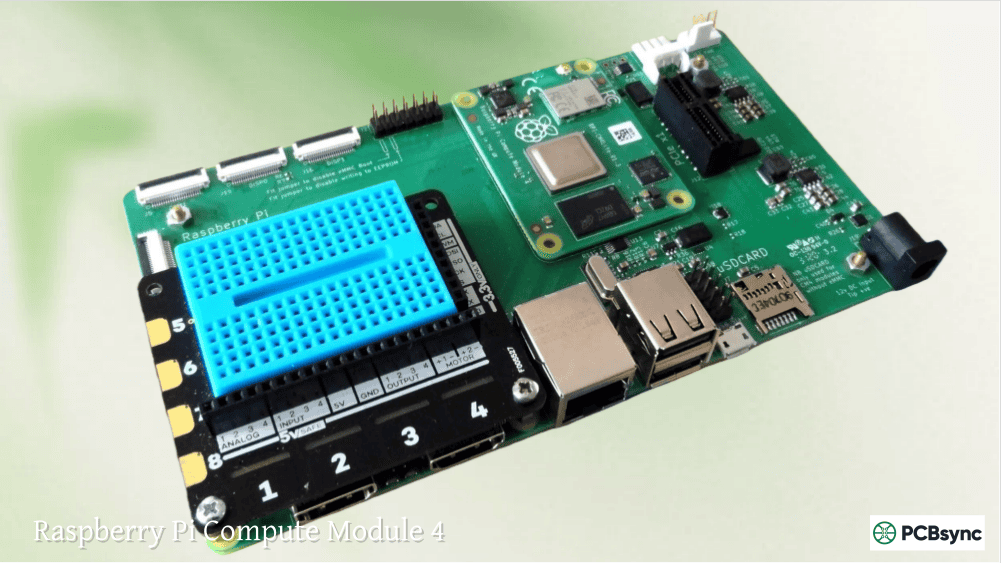
The official Raspberry Pi Compute Module 4 IO Board provides access to all CM4 interfaces through standard connectors, serving as both a development platform and reference design for custom carrier boards.
IO Board Features
Feature
Implementation
Power Input
7.5V-28V barrel jack, supports industrial 12V/24V systems
HDMI
2× full-size HDMI 2.0 ports
USB
2× USB 2.0 Type-A ports (via hub)
Ethernet
Gigabit RJ45 jack
microSD
Slot for CM4Lite variants
PCIe
x1 slot for expansion cards
Camera
2× 22-pin FFC connectors (15-pin camera adapter included)
Display
2× 22-pin FFC connectors
GPIO
40-pin header (Pi 4 compatible)
RTC
Battery backup connector
PoE
Header for PoE HAT
Fan
PWM-controlled fan header
The IO board’s PCIe slot deserves special attention. While the Pi 4B routes its single PCIe lane to the VL805 USB 3.0 controller chip, the CM4 exposes this lane directly. This enables connecting NVMe SSDs, network interface cards, SATA controllers, or specialized hardware like the Google Coral TPU. Performance tops out around 400MB/s due to the Gen 2.0 x1 specification, but this still dramatically outperforms USB-attached storage.
Using the IO Board for Development
For most developers, the IO board provides everything needed to evaluate the CM4 and develop software before committing to custom hardware. The board’s comprehensive breakout of all signals also makes it invaluable for debugging custom carrier board designs.
One important consideration: the IO board’s size (160mm × 90mm) and connector selection prioritize development convenience over production suitability. Custom carrier boards typically reduce dimensions by 50-80% by including only necessary interfaces.
Flashing the CM4 eMMC Storage
Programming the embedded flash storage requires a different workflow than the familiar microSD card approach. The process involves booting the CM4 into a special USB mass storage mode that exposes the eMMC as an external drive.
Hardware Setup for eMMC Flashing
Before connecting power, configure the carrier board for programming mode:
Install a jumper on the J2 header (labeled “Fit jumper to disable eMMC Boot” on the IO board)
Connect a USB cable from your computer to the “USB Slave” micro USB port on the IO board
Connect power to the IO board
The CM4 will power on (D1 LED illuminates) but will not boot from eMMC due to the jumper. Instead, it waits for the host computer to initiate the boot process.
Installing rpiboot
The rpiboot utility communicates with the CM4’s boot ROM to expose the eMMC as a mass storage device.
On Windows: Download and run the pre-built installer from the usbboot repository’s win32 directory. The installer configures necessary drivers automatically.
Flashing Process
After running rpiboot, the eMMC appears as a standard USB storage device. You can then use Raspberry Pi Imager, balenaEtcher, or dd to write your chosen operating system image.
After flashing completes, disconnect power, remove the programming jumper from J2, and reconnect power. The CM4 will boot from its freshly programmed eMMC.
Enabling USB Ports
An important post-installation step often catches newcomers: the CM4 ships with USB disabled by default to save power in embedded applications. To enable USB ports, add the following line to /boot/config.txt:
dtoverlay=dwc2,dr_mode=host
Alternatively, for the IO board specifically:
dtoverlay=cm4-io-board
Designing Custom Carrier Boards
Creating a custom carrier board transforms the raspberry pi cm4 from a development platform into a production-ready solution tailored to your application’s exact requirements.
Essential Design Resources
Raspberry Pi provides comprehensive design files to accelerate carrier board development:
Resource
Description
CM4 Datasheet
Complete electrical specifications and interface details
CM4IO KiCad Files
Schematic and PCB files for the official IO board
CM4 Product Brief
Overview document with key specifications
Hardware Design Guide
Carrier board design recommendations
The official IO board KiCad files deserve special attention. They include verified footprints for the Hirose connectors, tested routing for high-speed signals, and working reference designs for every interface. Starting from these files rather than creating components from scratch saves weeks of development time.
Connector Considerations
The dual 100-pin Hirose DF40C connectors (or compatible alternatives from Panasonic, JAE, or Amphenol) require careful PCB design:
Parameter
Recommendation
Connector Part Number
Hirose DF40C-100DS-0.4V(51)
Mating Height
Available in multiple stacking heights (1.5mm, 2.0mm, 3.0mm)
PCB Layer Count
Minimum 4 layers recommended
High-Speed Routing
100Ω differential impedance for HDMI, PCIe, USB
Power Delivery
Wide traces for 5V input (minimum 1A capacity per connector)
Minimal Carrier Board Design
A bare-minimum carrier board requires surprisingly few components:
Two 100-pin connectors
5V power input with appropriate filtering
Power indicator LED
Activity indicator LED
This configuration supports CM4 variants with onboard eMMC and WiFi, providing a functional system in the smallest possible footprint. The CM4 handles all power regulation internally, requiring only a clean 5V supply.
The PCIe interface enables significantly faster storage than eMMC or SD cards provide. Implementing an M.2 slot requires:
Signal
Notes
PCIe_TX+/-
Transmit differential pair, 100Ω impedance
PCIe_RX+/-
Receive differential pair, 100Ω impedance
PCIe_CLK_REQ#
Clock request from device
PCIe_RESET#
Reset signal
REFCLK+/-
100MHz reference clock (some designs omit, using device internal clock)
3.3V Power
M.2 specification requires 3.3V supply
The CM4 includes AC coupling capacitors on the transmit pair, so your carrier board needs capacitors only on signals originating from the M.2 device. Most successful designs place these as close to the mezzanine connector as possible.
Power Considerations
The CM4 simplifies carrier board power design compared to previous compute modules:
Power Rail
CM4 Consumption
Notes
5V Input
1.4A typical (idle ~400mA)
Single supply, CM4 generates internal rails
3.3V Output
Up to 600mA available
For carrier board peripherals
1.8V Output
Up to 600mA available
For carrier board peripherals
The 5V input must be clean and stable. Include appropriate bulk capacitance (100-470µF) near the connectors and high-frequency decoupling (100nF ceramic) distributed across the power plane.
Third-Party Carrier Boards
The CM4 ecosystem includes numerous carrier boards from third parties, each targeting specific use cases.
Popular Carrier Board Comparison
Board
Key Features
Best For
Official IO Board
Full feature breakout, PCIe slot
Development, prototyping
Waveshare CM4-IO-BASE-A
Compact, dual cameras, M.2 2242
Space-constrained projects
TOFU by Oratek
9cm square, M.2 B-key, industrial focus
Industrial applications
Piunora
Arduino form factor, M.2, Qwiic
Maker projects, prototyping
Compute Blade
Rack-mount, PoE+, NVMe
Server clusters, home labs
Gumstix Development Board
Full IO, AI accelerator support
Edge AI development
Seeed reTerminal
Integrated display, touch, GPIO
HMI applications
When selecting a third-party carrier board, verify that it exposes the specific interfaces your application requires. Many compact boards omit features like the second HDMI, camera interfaces, or full GPIO header to achieve smaller dimensions.
CM4 vs Previous Compute Modules
Understanding how the raspberry pi cm4 compares to earlier generations helps evaluate upgrade paths for existing products.
Generation Comparison
Feature
CM1
CM3/CM3+
CM4
CPU
BCM2835
BCM2837B0
BCM2711
Cores
1× ARM1176
4× Cortex-A53
4× Cortex-A72
Clock
700MHz
1.2GHz
1.5GHz
RAM
512MB
1GB
1-8GB
eMMC
4GB
0-32GB
0-32GB
Form Factor
DDR2 SODIMM
DDR2 SODIMM
Dual 100-pin
Gigabit Ethernet
No
No
Yes (native)
WiFi/BT
No
No
Optional
PCIe
No
No
Yes (x1 Gen 2)
USB 2.0
1
1
1
HDMI
1
1
2
The shift away from the DDR2 SODIMM form factor means CM4 carrier boards are incompatible with earlier compute modules. However, Raspberry Pi released the CM4S specifically for applications requiring backward compatibility, offering CM4 performance in the legacy SODIMM form factor (without WiFi/Bluetooth support).
Industrial Applications of the CM4
The raspberry pi compute module 4 excels in commercial and industrial deployments where the consumer Pi 4B falls short.
Digital Signage
The dual 4K HDMI outputs support video walls and high-resolution displays. The eMMC storage eliminates SD card failures that plague 24/7 signage deployments. Network boot capability allows centralized content management across large installations.
Network Appliances
Native Gigabit Ethernet with IEEE 1588 precision timing support enables network monitoring, firewall, and router applications. The PCIe slot can accommodate additional network interfaces, NVMe caching, or hardware acceleration cards.
Edge Computing and AI
The 8GB RAM variant combined with the Google Coral TPU (connected via PCIe or USB) creates a capable edge AI platform. Applications include real-time video analytics, anomaly detection, and sensor data processing.
Robotics and Automation
The extensive GPIO, multiple I2C/SPI buses, and camera interfaces support complex robotic systems. The compact form factor fits within space-constrained enclosures, while the processing power handles computer vision and path planning algorithms.
Medical and Scientific Instruments
The -20°C to +85°C extended temperature range (on industrial variants) meets requirements for laboratory and field equipment. Long-term availability commitments satisfy medical device certification requirements.
Software and Operating System Support
The CM4 runs the same software ecosystem as the Pi 4B, with some hardware-specific considerations.
Supported Operating Systems
OS
Status
Notes
Raspberry Pi OS (32-bit)
Full support
Official, Debian-based
Raspberry Pi OS (64-bit)
Full support
Recommended for 8GB RAM
Ubuntu Server
Full support
20.04 LTS, 22.04 LTS, 24.04 LTS
Ubuntu Desktop
Full support
Requires adequate RAM
Fedora
Community support
ARM SIG builds
Buildroot
Full support
Custom minimal systems
Yocto
Full support
Production embedded Linux
Boot Configuration
The CM4’s boot process differs slightly from the Pi 4B due to the eMMC option and industrial use cases:
Boot Source
Configuration
eMMC (default)
No configuration needed on eMMC variants
microSD
CM4Lite only, automatic fallback
USB
Enable in EEPROM bootloader configuration
Network (PXE)
Enable in EEPROM bootloader configuration
NVMe
Enable in EEPROM, requires bootloader update
To modify boot order or enable NVMe boot, use the rpi-eeprom-config utility to update the bootloader configuration stored in the CM4’s EEPROM.
Raspberry Pi OS: raspberrypi.com/software/operating-systems/
Ubuntu for Raspberry Pi: ubuntu.com/download/raspberry-pi
Buildroot: buildroot.org
Frequently Asked Questions
What is the difference between CM4 and CM4Lite?
The CM4Lite variants omit the onboard eMMC flash storage, reducing cost by $5-25 depending on what storage capacity you would have otherwise selected. CM4Lite requires booting from an external source such as a microSD card on your carrier board, USB storage, or network boot. Choose CM4Lite for applications where you need easily swappable storage or when cost optimization is critical. Choose standard CM4 with eMMC for reliability-focused applications where the soldered storage eliminates mechanical failure points.
Can the CM4 boot from NVMe SSD?
Yes, but it requires updating the EEPROM bootloader configuration. By default, the CM4 boot order doesn’t include NVMe. Use the rpi-eeprom-config utility to modify the BOOT_ORDER parameter, adding 6 (NVMe) to the sequence. Performance from NVMe significantly exceeds eMMC, with random I/O showing 3x improvements in typical benchmarks. Note that NVMe requires a carrier board with PCIe-to-M.2 routing, which the official IO board provides via its x1 slot (adapter required) or various third-party carrier boards provide directly.
Is the CM4 compatible with Raspberry Pi HATs?
The CM4 itself is not directly compatible with HATs, but carrier boards can provide compatibility. The official CM4 IO board includes a standard 40-pin GPIO header that accepts most HATs designed for the Pi 4B. However, HATs that require specific mechanical clearances or use the USB/Ethernet ports in their design may have compatibility issues. When designing custom carrier boards, you can include a 40-pin header to maintain HAT compatibility, or implement the required functionality directly on the carrier board.
How do I choose between CM4 and Pi 4 Model B?
Choose the Pi 4 Model B for standalone projects, education, and applications where you need standard ports immediately available. Choose the raspberry pi cm4 when: you’re developing a commercial product requiring custom form factor; you need industrial reliability with eMMC storage; you want to expose PCIe for NVMe or expansion cards; you require multiple camera or display interfaces simultaneously; or you need the extended temperature rating for harsh environments. The CM4 plus carrier board approach costs more than a bare Pi 4B but enables possibilities impossible with the standard board.
What thermal management does the CM4 require?
The CM4 requires active or passive cooling depending on workload. Under light loads (web server, file sharing), a small heatsink with natural convection suffices. Under sustained heavy loads (video encoding, AI inference), active cooling becomes necessary. The BCM2711 throttles at 80°C, reducing performance to prevent damage. The official IO board includes a PWM-controlled fan header with temperature-based control available through the standard Raspberry Pi cooling daemon. For custom designs, ensure adequate thermal mass and/or airflow for your worst-case workload. Industrial variants rated for higher ambient temperatures may require more aggressive cooling solutions.
Final Thoughts
The Raspberry Pi Compute Module 4 represents the culmination of Raspberry Pi’s evolution from educational tool to legitimate industrial computing platform. The combination of modern ARM64 performance, flexible configuration options, exposed PCIe, and the new compact form factor opens applications that previous compute modules couldn’t address.
For hardware developers, the CM4 offers a rare combination: enough processing power for demanding applications, comprehensive interface options, excellent documentation, a vibrant ecosystem of carrier boards and accessories, and pricing that enables experimentation without excessive risk. The ten-year production commitment provides the supply chain confidence that commercial products require.
Whether you’re building your first embedded Linux product or optimizing an existing design, the raspberry pi cm4 deserves serious consideration. Start with the official IO board to validate your software architecture, then design a custom carrier board optimized for your specific requirements. The extensive reference designs and community support mean you won’t be working in isolation.
The embedded computing landscape continues evolving rapidly, but the CM4 has established itself as a capable, well-supported platform that will remain relevant for years to come. That’s exactly what production hardware development requires.
Inquire: Call 0086-755-23203480, or reach out via the form below/your sales contact to discuss our design, manufacturing, and assembly capabilities.
Quote: Email your PCB files to Sales@pcbsync.com (Preferred for large files) or submit online. We will contact you promptly. Please ensure your email is correct.
Notes: For PCB fabrication, we require PCB design file in Gerber RS-274X format (most preferred), *.PCB/DDB (Protel, inform your program version) format or *.BRD (Eagle) format. For PCB assembly, we require PCB design file in above mentioned format, drilling file and BOM. Click to download BOM template To avoid file missing, please include all files into one folder and compress it into .zip or .rar format.