Inquire: Call 0086-755-23203480, or reach out via the form below/your sales contact to discuss our design, manufacturing, and assembly capabilities.
Quote: Email your PCB files to Sales@pcbsync.com (Preferred for large files) or submit online. We will contact you promptly. Please ensure your email is correct.
Notes: For PCB fabrication, we require PCB design file in Gerber RS-274X format (most preferred), *.PCB/DDB (Protel, inform your program version) format or *.BRD (Eagle) format. For PCB assembly, we require PCB design file in above mentioned format, drilling file and BOM. Click to download BOM template To avoid file missing, please include all files into one folder and compress it into .zip or .rar format.
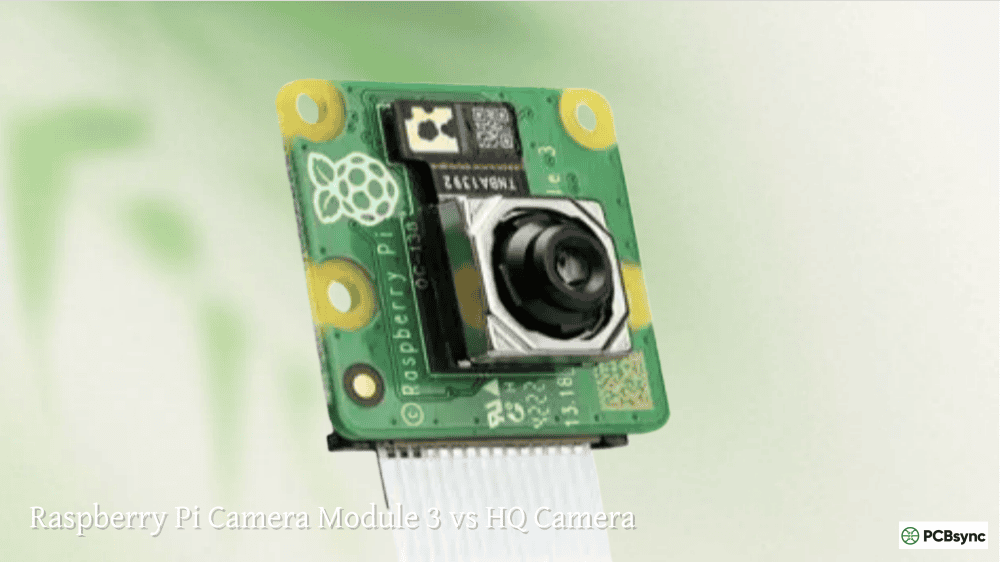
Raspberry Pi Camera Module 3 vs HQ Camera: Which Should You Buy?
Choosing between the Camera Module 3 and the Raspberry Pi HQ Camera trips up a lot of makers, and I understand why. Both offer 12-megapixel resolution, both produce excellent images, and both connect through the same CSI interface. Yet they serve fundamentally different purposes, and picking the wrong one can leave you frustrated or overpaying for capabilities you’ll never use.
After integrating both cameras into various embedded imaging projects and consulting with other hardware engineers in the maker community, I’ve developed strong opinions about when each camera makes sense. This comparison cuts through the marketing specifications to help you make the right choice for your specific application.
Before diving into specifications, let’s establish what separates these two cameras philosophically. The Camera Module 3 represents the “smartphone camera” approach: a fixed lens with autofocus, optimized for convenience and general-purpose use. The Raspberry Pi HQ Camera follows the “mirrorless camera” philosophy: a large sensor with interchangeable lenses, optimized for maximum image quality and flexibility.
This distinction matters more than any individual specification. If you want a camera that works immediately out of the box with minimal fuss, the Camera Module 3 wins. If you need to swap lenses for different focal lengths or require the absolute best image quality in challenging conditions, the HQ Camera delivers.
Technical Specifications Head-to-Head
Let’s examine the hardware differences that drive real-world performance.
Complete Specifications Comparison
Specification
Camera Module 3
Raspberry Pi HQ Camera
Sensor
Sony IMX708
Sony IMX477
Resolution
11.9MP (4608×2592)
12.3MP (4056×3040)
Sensor Size
6.4mm diagonal
7.9mm diagonal
Pixel Size
1.4µm
1.55µm
Aspect Ratio
16:9
4:3
Focus System
Phase Detection Autofocus
Manual (lens-dependent)
Lens Mount
Fixed
C/CS Mount
Field of View
66° or 102° (wide)
Varies by lens
HDR Mode
Yes (3MP max)
No
Price
$25 (standard) / $35 (wide)
$50 (body only)
The IMX708 Sensor Advantage
The Camera Module 3 uses Sony’s IMX708 sensor, a back-illuminated stacked CMOS design that represents current smartphone imaging technology. This sensor brings several innovations to the Raspberry Pi ecosystem that weren’t available in previous modules.
Phase Detection Autofocus (PDAF) is the headline feature. Unlike contrast-detection systems that hunt back and forth to find focus, PDAF calculates the correct focus distance almost instantly by analyzing phase differences in the light reaching the sensor. In practical terms, this means focus acquisition in roughly 200-300ms versus the multiple seconds that contrast detection can require.
The IMX708 also supports HDR capture through multi-frame processing. The camera captures multiple exposures and combines them into a single image with extended dynamic range. There’s a tradeoff: HDR mode limits resolution to approximately 3 megapixels. For scenes with extreme brightness differences (like windows on sunny days), this mode produces dramatically better results than single exposures.
The IMX477 Sensor Advantage
The Raspberry Pi HQ Camera uses Sony’s IMX477R, a larger sensor designed for industrial and professional imaging applications. The key advantage is physical: at 7.9mm diagonal versus 6.4mm, the HQ Camera’s sensor captures approximately 52% more light-gathering area.
Larger sensors provide two practical benefits. First, each pixel is physically larger (1.55µm versus 1.4µm), collecting more photons during exposure. This translates to cleaner images with less noise, particularly in low-light conditions. Second, the larger sensor enables shallower depth of field with appropriate lenses, useful for portrait photography and artistic effects.
The 4:3 aspect ratio also matters for certain applications. Still photography has traditionally used 4:3 or 3:2 ratios, while 16:9 is optimized for video. If you’re shooting stills for printing or detailed documentation, the HQ Camera’s aspect ratio wastes fewer pixels.
Real-World Image Quality Comparison
Specifications only tell part of the story. How do these cameras actually perform in typical shooting conditions?
Sharpness and Lens Quality
In my testing, the Camera Module 3’s fixed lens consistently outperforms budget lenses on the HQ Camera. The image remains sharp across the entire frame with minimal barrel distortion. The 6mm wide-angle lens commonly bundled with the HQ Camera shows pronounced softness toward frame edges and significant barrel distortion even when stopped down.
This surprised me initially, but it makes sense economically. Raspberry Pi invested significant engineering effort into the Module 3’s fixed optic, optimizing it for the specific sensor. Generic C-mount lenses are designed for a range of sensors and compromises in the process.
To match the Module 3’s edge-to-edge sharpness with the HQ Camera, you’ll need to invest in higher-quality lenses—typically $50-100+ for decent C-mount glass. Budget lenses work, but expect center-weighted sharpness.
Low-Light Performance
The HQ Camera wins decisively in low-light conditions. The larger sensor collects more light, and the interchangeable lens system allows using faster apertures (f/1.2 or wider) that aren’t available with the Module 3’s fixed f/1.8 lens.
In my basement workshop with modest artificial lighting, the HQ Camera with a fast lens produces cleaner images at ISO 800 than the Module 3 produces at ISO 400. This advantage compounds in truly dark environments like outdoor night photography.
The Module 3’s back-illuminated sensor design does help narrow the gap somewhat. Modern BSI sensors position the photodiode above the wiring layer, improving light collection efficiency. Still, physics wins: more area captures more photons.
Dynamic Range
Here the comparison gets interesting. The Module 3’s HDR mode can exceed the HQ Camera’s single-exposure dynamic range, but at the cost of resolution and processing artifacts. For static scenes where you can enable HDR mode, the Module 3 captures more tonal range from shadows to highlights.
For video and situations requiring full resolution, the HQ Camera’s larger pixels provide better native dynamic range. The 1.55µm pixels simply have more headroom before clipping highlights or losing shadow detail to noise.
When to Choose the Camera Module 3
The Module 3 makes sense for the majority of Raspberry Pi camera projects. Here’s when it’s clearly the right choice:
Security and Surveillance
Home security systems benefit enormously from the Module 3’s autofocus and wide-angle variant. The 120-degree field of view captures entire rooms without blind spots, and autofocus maintains sharpness as people move through the scene at varying distances.
The Module 3 NoIR variant enables 24/7 operation when paired with infrared illuminators. This combination provides color footage during daylight and clear IR imagery at night without manual intervention.
Video Conferencing and Streaming
For webcam applications, the Module 3’s autofocus eliminates the fixed-focus frustration of previous Pi cameras. Move closer to your desk, lean back in your chair—the camera adapts. The 16:9 aspect ratio also matches video platforms natively without cropping.
3D Printer Monitoring
OctoPrint users appreciate the Module 3’s autofocus for print monitoring. As layer heights change and the print head moves, the camera maintains focus on the action. Fixed-focus cameras require careful positioning that may not work for all print volumes.
Rapid Prototyping
When you need imaging capability quickly for proof-of-concept projects, the Module 3’s plug-and-play simplicity saves hours. No lens selection, no focus adjustment, no adapter hunting—just connect and capture.
When to Choose the Raspberry Pi HQ Camera
The HQ Camera justifies its higher cost and complexity for specific applications where its capabilities matter:
Photography Projects
Building a digital camera, time-lapse system, or photo booth? The HQ Camera’s interchangeable lenses let you optimize for your specific use case. Wide-angle for landscapes, telephoto for wildlife, macro for product photography—one camera body handles all scenarios.
Machine Vision with Specific Optics
Industrial inspection systems often require precise focal lengths and specialized lenses. The C/CS mount system accepts thousands of available lenses, including telecentric optics for dimensional measurement and low-distortion lenses for metrology.
Low-Light Applications
Astrophotography, wildlife cameras, and other low-light applications benefit from the HQ Camera’s larger sensor and fast lens options. The ability to use f/1.2 or faster lenses provides 2+ stops of additional light gathering compared to the Module 3’s f/1.8 fixed lens.
Optical Zoom Requirements
The Module 3 offers only digital zoom (cropping), which degrades image quality. The HQ Camera with telephoto lenses provides true optical zoom, maintaining full resolution at any focal length within your lens collection.
For makers who want capabilities beyond official modules, the Arducam 64MP camera deserves consideration. This third-party module offers smartphone-class resolution (9152×6944 pixels) with autofocus in the same form factor as official Pi cameras.
Arducam 64MP Specifications
Feature
Arducam 64MP
Resolution
64MP (9152×6944)
Sensor Size
1/1.7″ diagonal
Pixel Size
0.8µm (1.6µm binned)
Aperture
f/1.8
Focus
Motorized Autofocus
Digital Zoom
Up to 10×
Video
1080p @ 30fps
Price
~$45-60
The Arducam 64MP excels at high-resolution stills for document scanning, detailed inspection, and situations where you need to crop significantly while retaining detail. The 10× digital zoom with autofocus enables pseudo-telephoto capability without lens changes.
However, there are tradeoffs. The tiny 0.8µm pixels struggle in low light compared to larger-pixel sensors. Software support requires Arducam’s custom drivers rather than native libcamera, adding setup complexity. Some users report image softness at full resolution due to lens diffraction limitations.
For maximum resolution when lighting is adequate, the Arducam 64MP offers excellent value. For general-purpose use, the official modules provide better software integration and more consistent results.
Software and Compatibility Considerations
Both official cameras work seamlessly with libcamera and Picamera2, the current standard software stack for Raspberry Pi imaging. The Camera Module 3 requires Raspberry Pi OS Bullseye or later—legacy raspistill/raspivid commands won’t work.
The HQ Camera maintains broader compatibility, working with both legacy and current software stacks. This matters if you’re maintaining existing projects or using specialized software that hasn’t been updated for libcamera.
Both cameras support the Raspberry Pi 5, though you’ll need the appropriate FPC adapter cable for the Pi 5’s different CSI connector location.
Useful Resources and Documentation
Official Documentation
Resource
Description
Raspberry Pi Camera Documentation
Complete hardware and software reference
libcamera Documentation
Camera control library reference
Picamera2 Library
Python programming interface
Camera Tuning Guide
Advanced ISP configuration
Third-Party Resources
Resource
Description
Jeff Geerling’s Camera Reviews
Detailed hands-on testing and comparisons
Arducam Documentation
Third-party camera setup guides
Raspberry Pi Forums
Community troubleshooting and projects
Random Nerd Tutorials
Project-based camera implementation guides
Frequently Asked Questions
Can I use HQ Camera lenses on the Camera Module 3?
No. The Camera Module 3 has a fixed, non-removable lens integrated with the sensor assembly. The HQ Camera’s C/CS mount system is physically incompatible with the Module 3’s design. If you need interchangeable lenses, choose the HQ Camera.
Is the Camera Module 3 good enough for professional photography?
For web and social media use, absolutely. The Module 3 produces images comparable to mid-range smartphones. For print publication, gallery display, or situations requiring maximum dynamic range and resolution, the HQ Camera with quality lenses produces noticeably superior results.
Does the HQ Camera support autofocus?
Not natively. The HQ Camera relies on manual focus through the lens mechanism. Some motorized C-mount lenses offer electronic focus control, but this requires additional hardware and software beyond the standard Pi camera stack. The Camera Module 3’s built-in PDAF is currently unique among official Pi cameras.
Which camera is better for machine learning projects?
For most ML applications, the Camera Module 3 provides the best balance of convenience and capability. ML models typically require images of 224×224 to 640×640 pixels after preprocessing—both cameras far exceed these requirements. The Module 3’s autofocus helps maintain consistent input quality without manual adjustment.
How much do HQ Camera lenses cost?
The official 6mm wide-angle lens costs approximately $25, and the 16mm telephoto lens costs around $50. Quality third-party C-mount lenses range from $30 for basic options to $200+ for professional-grade glass. Budget $75-100 total (camera plus lens) for a capable HQ Camera setup, versus $25-35 all-inclusive for the Module 3.
Final Verdict: Making Your Decision
Choose the Camera Module 3 if you want imaging capability that works immediately with minimal configuration. The IMX708 sensor combined with phase-detection autofocus creates the most versatile official Pi camera yet. At $25-35, it’s hard to justify the HQ Camera’s added cost and complexity unless you specifically need its advantages.
Choose the Raspberry Pi HQ Camera if you need interchangeable lenses, maximum low-light performance, or specific optical characteristics for professional applications. The larger sensor and lens flexibility enable results impossible with fixed-lens cameras, but you’re paying for capabilities you may not need.
Consider the Arducam 64MP if ultra-high resolution stills matter more than video quality or low-light performance. It’s a specialized tool that excels in its niche but isn’t a general-purpose replacement for official modules.
For most makers starting their first Pi camera project, the Camera Module 3 represents the best combination of capability, convenience, and cost. Upgrade to the HQ Camera when you hit its limitations—and you’ll know exactly what you need when that happens.
Inquire: Call 0086-755-23203480, or reach out via the form below/your sales contact to discuss our design, manufacturing, and assembly capabilities.
Quote: Email your PCB files to Sales@pcbsync.com (Preferred for large files) or submit online. We will contact you promptly. Please ensure your email is correct.
Notes: For PCB fabrication, we require PCB design file in Gerber RS-274X format (most preferred), *.PCB/DDB (Protel, inform your program version) format or *.BRD (Eagle) format. For PCB assembly, we require PCB design file in above mentioned format, drilling file and BOM. Click to download BOM template To avoid file missing, please include all files into one folder and compress it into .zip or .rar format.