Inquire: Call 0086-755-23203480, or reach out via the form below/your sales contact to discuss our design, manufacturing, and assembly capabilities.
Quote: Email your PCB files to Sales@pcbsync.com (Preferred for large files) or submit online. We will contact you promptly. Please ensure your email is correct.
Notes: For PCB fabrication, we require PCB design file in Gerber RS-274X format (most preferred), *.PCB/DDB (Protel, inform your program version) format or *.BRD (Eagle) format. For PCB assembly, we require PCB design file in above mentioned format, drilling file and BOM. Click to download BOM template To avoid file missing, please include all files into one folder and compress it into .zip or .rar format.
This comprehensive guide covers the QuickLogic FPGA ecosystem from a practical engineering perspective: what makes their technology different from competitors, when to use their discrete devices versus licensing their eFPGA IP, and how their open-source toolchain fundamentally changes the development experience. Whether you are building always-on voice interfaces, wearable sensors, industrial IoT systems, or aerospace applications, understanding these options can significantly impact your power budget and time-to-market.
QuickLogic Corporation (NASDAQ: QUIK) has carved out a unique position in the FPGA market by focusing relentlessly on ultra-low power consumption and embedded applications. Unlike the major FPGA vendors such as AMD/Xilinx, Intel/Altera, and Lattice who compete primarily on logic density and raw performance, QuickLogic FPGA solutions target applications where power efficiency is the primary design constraint. This strategic focus has made them the go-to solution for battery-powered and always-on sensing applications.
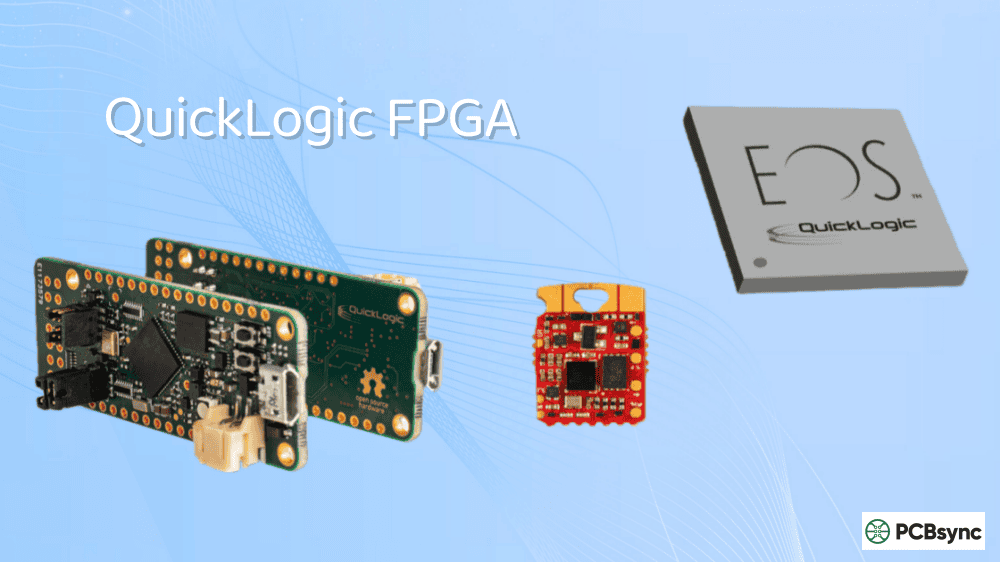
The company offers two distinct product lines that serve different engineering needs. First, they provide complete SoC devices like the EOS S3, which integrate an ARM Cortex-M4F processor with embedded FPGA fabric on a single chip. Second, they license their eFPGA IP (ArcticPro and Australis) to SoC designers who want to add programmable logic to their custom ASICs. This dual approach means you can either buy a ready-made QuickLogic FPGA device for rapid prototyping and production, or integrate their silicon-proven eFPGA technology into your own custom chip design.
What truly sets QuickLogic apart from every other FPGA vendor is their commitment to open-source development tools. In 2020, they became the first programmable logic vendor to fully embrace open-source FPGA tooling through their QORC (QuickLogic Open Reconfigurable Computing) initiative. This is not simply a marketing gimmick – you can actually synthesize, place, route, and generate bitstreams using completely open-source software like F4PGA (formerly SymbiFlow), with full technical support from QuickLogic engineering.
EOS S3: The QuickLogic FPGA MCU Platform
The EOS S3 is QuickLogic flagship device – a multi-core sensor processing SoC that combines an ARM Cortex-M4F processor with embedded FPGA fabric on a single die. This heterogeneous architecture makes it ideal for applications that need both software flexibility and hardware acceleration, including always-on voice detection, multi-sensor fusion, and edge AI inference at microwatt power levels.
EOS S3 Technical Specifications
Processor: ARM Cortex-M4F running up to 80 MHz with hardware floating-point unit and DSP extensions for efficient signal processing
Memory: 512 KB SRAM for program execution and data storage, eliminating external memory for many applications
eFPGA Fabric: Approximately 2,400 effective logic cells with 64 KB dedicated block RAM for custom hardware acceleration
Flexible Fusion Engine (FFE): Dedicated 10 MHz DSP-like processor for always-on sensor computational processing at one-quarter the power of the main CPU
Voice Processing: Hardcoded Low Power Sound Detector (LPSD) with hardware PDM to PCM conversion for minimal audio processing power
Sensor Manager: Autonomous hardware block that manages and controls all sensors independently of the main processor
Interfaces: I2C (100/400 kHz), SPI, UART, GPIO, I2S for audio, and PDM microphone interface
Low Voltage Option: 0.85V VDD mode reduces power consumption by 33% compared to standard operation
The multi-core architecture enables sophisticated power management strategies that are impossible with single-processor solutions. The Sensor Manager can autonomously handle sensor polling while the main processor remains in deep sleep, and the FFE can run sensor fusion algorithms continuously at minimal power. When voice activity is detected by the hardware LPSD, the system progressively wakes higher-power processing elements only as needed – all without requiring external components or complex power management ICs.
QuickLogic FPGA IP: Embedded FPGA for Custom SoC Designs
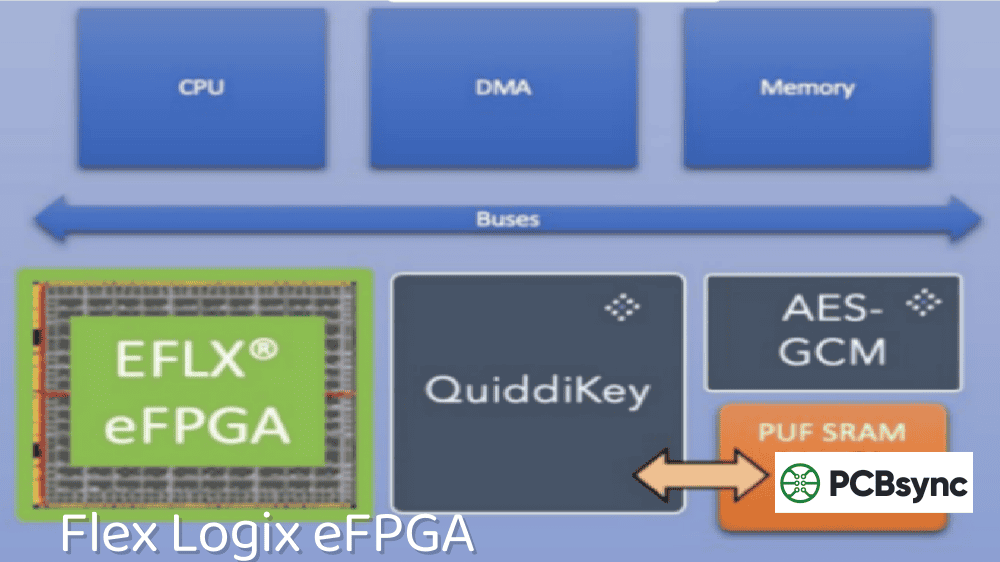
For SoC designers who want programmable logic integrated directly into their custom chips, QuickLogic offers eFPGA IP licensing. This is fundamentally different from buying discrete FPGA devices – you are integrating silicon-proven FPGA fabric into your own SoC, giving your customers the flexibility to customize device functionality after manufacturing without the BOM cost of a separate FPGA chip.
Australis eFPGA IP Generator
The Australis eFPGA IP Generator is QuickLogic proprietary tool for creating custom eFPGA IP cores tailored to specific customer requirements. Built on the OpenFPGA open-source framework but significantly enhanced with QuickLogic three decades of commercial FPGA expertise, Australis can generate customer-specific eFPGA blocks optimized for particular power, performance, and area (PPA) targets. In April 2025, QuickLogic delivered the first eFPGA Hard IP for Intel 18A technology – marking the first time eFPGA has been implemented on a sub-5nm process node.
Australis key capabilities include:
Custom-parameterized eFPGA IP generation in days to weeks for established process nodes
Support for multiple foundries: GlobalFoundries, Intel Foundry, Samsung, TSMC, and others
Process nodes ranging from 65nm legacy processes down to Intel 18A (sub-5nm)
Common architecture based on 6-input LUTs, configurable BlockRAM, and DSP multiply-accumulate resources
Complete toolchain support with Aurora FPGA User Tools in both open-source and commercial configurations
ArcticPro eFPGA Technology
ArcticPro is QuickLogic silicon-proven eFPGA technology that has been shipping in volume production for years. Originally available on GlobalFoundries 65nm and 40nm bulk CMOS processes, ArcticPro is now also qualified on the 22FDX FD-SOI process for applications requiring even lower power consumption. Companies like Nations Technologies in China have selected ArcticPro for their IoT SoC products specifically because of its ultra-low power characteristics, ease of integration, and the post-manufacturing flexibility it provides to their customers.
QuickLogic FPGA Product Comparison Table
Choosing between QuickLogic discrete devices and eFPGA IP licensing depends on your production volume, customization requirements, and time-to-market constraints. The following table summarizes how the options compare across key decision factors:
One of the most significant developments in the QuickLogic FPGA ecosystem is the availability of completely open-source development tools. Through the QORC initiative and active participation in the CHIPS Alliance, QuickLogic has made it possible to complete the entire design flow from Verilog RTL to device bitstream using entirely open-source software – a first in the commercial FPGA industry.
F4PGA: The Open-Source FPGA Toolchain
F4PGA (FOSS Flows For FPGA) is an ambitious open-source project under the CHIPS Alliance that provides a complete HDL-to-bitstream flow for multiple FPGA architectures. Think of it as the GCC of FPGAs – a vendor-neutral, community-supported toolchain that liberates designers from proprietary tool lock-in. The toolchain integrates Yosys for Verilog synthesis, VPR (Verilog to Routing) for technology mapping and place-and-route, and device-specific backends for bitstream generation. QuickLogic EOS S3 is one of the fully supported target devices.
Aurora FPGA User Tools
For eFPGA IP customers who need production-grade tooling, QuickLogic provides Aurora FPGA User Tools in two configurations. The first version is built entirely on open-source components derived from F4PGA, giving designers complete transparency and the ability to inspect every step of the synthesis and implementation flow. The second version integrates with Synopsys commercial EDA tools for customers whose design flows already depend on those products. Both versions target the same eFPGA architectures and produce functionally identical results.
Renode: SoC Emulation for Early Development
Renode is an open-source development framework created by Antmicro that enables complete SoC system emulation, including full support for the EOS S3 platform. This powerful capability enables firmware and application software development months before physical hardware becomes available – you can write, debug, and validate code entirely in simulation. The framework includes native integration with Zephyr RTOS and FreeRTOS, making it straightforward to port existing embedded software to QuickLogic FPGA platforms without waiting for silicon.
QuickLogic FPGA for Aerospace and Defense Applications
While QuickLogic is widely known for IoT and consumer applications, their eFPGA technology has gained significant traction in aerospace and defense markets. The company has accumulated over 30 years of experience delivering programmable logic solutions optimized for SWaP-C (Size, Weight, Power, and Cost) requirements in the most extreme operating environments, from low-earth orbit satellites to high-altitude aircraft.
Radiation-Tolerant eFPGA Solutions
QuickLogic has partnered with Zero-Error Systems to deliver radiation-tolerant eFPGA IP specifically designed for commercial space applications. The Australis eFPGA IP Generator can create custom eFPGA blocks optimized for aerospace, satellite, and defense applications, with silicon-proven reliability and EAR99 export compliance for international programs. This capability enables satellite and spacecraft designers to integrate reprogrammable logic directly into their radiation-hardened SoCs, extending mission lifetimes through in-orbit updates and reducing costly hardware redesigns.
Key aerospace and defense capabilities:
Custom eFPGA IP cores delivered in 4-6 months for new fabrication process nodes
Ruggedized discrete FPGA devices for strategic systems and critical infrastructure
Post-Quantum Cryptographic (PQC) core-ready solutions through partnership with Xiphera
Industry-first UCIe-compatible FPGA chiplet ecosystem for modular heterogeneous designs
Long-term supply assurance and configuration management for mission-critical programs spanning decades
QuickLogic offers several affordable development kits that make it easy to evaluate their technology and begin prototyping designs. The low-cost hardware combined with completely free open-source tools means you can start experimenting with QuickLogic FPGA designs without significant upfront investment or complex license negotiations.
Development Kit
Key Features
Best Applications
QuickFeather
EOS S3 SoC, breadboard headers, 100% open hardware/software
Low-power ML prototyping, open-source development, education
SparkFun Thing Plus
EOS S3, Feather form factor, LiPo charging, 6-axis IMU, PDM microphone
Complete SiP module, pre-certified for rapid product integration
Production designs requiring reduced certification effort
All development kits support both FreeRTOS and Zephyr RTOS, and can be programmed using either the open-source F4PGA toolchain or commercial EDA tools depending on your workflow preferences.
QuickLogic FPGA for Edge AI and Machine Learning
Edge AI represents one of the primary use cases driving adoption of QuickLogic FPGA technology. The combination of an always-on sensor processor, embedded FPGA fabric for hardware acceleration, and integrated SensiML tooling creates a complete platform for deploying machine learning models on battery-powered devices that must operate for months or years without recharging.
SensiML Analytics Toolkit Integration
QuickLogic acquired SensiML Corporation to provide a complete end-to-end solution for edge AI development. The SensiML Analytics Toolkit enables engineers to collect sensor data, train optimized ML models, and generate highly efficient code that runs on the EOS S3 eFPGA with minimal power consumption. The toolkit supports TensorFlow Lite model import and includes AutoML capabilities for developers who may not have deep machine learning expertise but need to deploy intelligent sensing applications.
Typical edge AI applications enabled by QuickLogic FPGA include:
Always-on voice wake word detection consuming less than 1mW average power
Gesture recognition for wearables and smart home control interfaces
Predictive maintenance using vibration, acoustic, and thermal sensors
Human activity recognition for fitness trackers and elderly care monitors
Anomaly detection for industrial IoT equipment monitoring
Essential Resources for QuickLogic FPGA Development
Here are the key resources every engineer needs for getting started with QuickLogic FPGA designs:
Official Documentation and Downloads
QuickLogic Official Website: www.quicklogic.com – Product datasheets and technical documentation
EOS S3 Product Page: quicklogic.com/devices/fpga/fpga-mcu/ – Complete SoC specifications
QORC SDK Repository: github.com/QuickLogic-Corp/qorc-sdk – Open-source SDK with examples
1. How does QuickLogic FPGA power consumption compare to Xilinx, Intel, or Lattice devices?
QuickLogic FPGA devices are specifically architected and optimized for ultra-low power applications from the ground up. The EOS S3, for example, can run always-on voice detection at microwatt-level power consumption, which is typically 5-10x lower than comparable solutions from larger FPGA vendors. The architecture includes multiple independently-controllable power domains that enable fine-grained power management strategies that are simply not possible with general-purpose FPGAs designed primarily for performance.
2. Can I use proprietary commercial FPGA tools with QuickLogic devices?
Yes, while QuickLogic strongly supports and recommends open-source tooling through F4PGA and Aurora, they also provide commercial tool integration for customers who prefer or require traditional vendor workflows. The eFPGA IP licensing specifically supports both completely open-source and Synopsys-based tool flows, giving you flexibility to match your existing design infrastructure and team expertise.
3. What is the fundamental difference between eFPGA IP and a discrete FPGA device?
A discrete FPGA is a standalone integrated circuit that you purchase from distribution and integrate onto your PCB alongside other components. eFPGA IP is programmable logic fabric that gets integrated directly into your custom SoC during the chip design phase – it becomes part of your silicon. The eFPGA approach eliminates the need for a separate FPGA package, reduces BOM cost at high volumes, enables better power optimization through tighter integration, and allows direct connection to other on-chip resources without going through package pins. The trade-off is the significant upfront NRE cost and 12-24 month development time required for custom SoC design.
4. Is QuickLogic FPGA suitable for volume production or only prototyping?
QuickLogic FPGA devices are absolutely suitable for and actively used in production applications by numerous customers worldwide. The EOS S3 is available in production-qualified packages including CSP, BGA, and pre-certified SiP modules that can dramatically reduce your time to market. For very high-volume applications exceeding 100K units annually, the eFPGA IP licensing model has been successfully deployed in production SoCs by companies like Nations Technologies. The key consideration is whether the power profile and logic density of QuickLogic devices match your specific application requirements.
5. How do I evaluate if QuickLogic FPGA is the right choice for my IoT project?
Start with the QuickFeather or SparkFun Thing Plus development kit – both are available for under $100 and provide everything needed to evaluate the platform including sensors and programming hardware. The completely open-source toolchain means zero license fees during evaluation. If your application requires always-on sensing with minimal power consumption, hardware acceleration for ML inference at the edge, or flexible I/O expansion that cannot be achieved with a standard microcontroller, QuickLogic FPGA technology deserves serious consideration. The SensiML toolkit integration can help you rapidly prototype edge AI applications without requiring deep machine learning expertise.
Conclusion: When to Choose QuickLogic FPGA
After working with QuickLogic FPGA technology across multiple production projects and prototypes, here is my practical guidance for making the right device selection decision:
Choose EOS S3 when you need an integrated all-in-one solution combining ARM MCU, eFPGA fabric, and specialized sensor processing capabilities on a single chip. It is ideal for always-on voice interfaces, wearable devices, and IoT edge nodes where power consumption is the critical design constraint and you want fast time-to-market with production-ready off-the-shelf silicon.
Choose eFPGA IP licensing when you are designing a custom SoC and need programmable logic integrated directly into your chip for maximum power efficiency and minimum BOM cost. This approach makes compelling economic sense at production volumes above 100K units per year, or when you need specific power/performance/area characteristics that simply cannot be achieved with any discrete device.
Choose QuickLogic for aerospace and defense when you need radiation-tolerant, reprogrammable logic with guaranteed long-term supply assurance and full export compliance. Their Australis generator can create custom eFPGA IP precisely matched to your specific mission requirements and operating environment.
The open-source tooling support genuinely differentiates QuickLogic FPGA from every competitor in the market. Being able to inspect, modify, debug, and extend the entire toolchain from Verilog source through bitstream generation provides a level of transparency and engineering control that proprietary tools fundamentally cannot match. For educational institutions, hobbyist projects, startups, or any application where vendor lock-in is a strategic concern, this openness provides invaluable freedom.
QuickLogic may not have the marketing budget or brand recognition of the major FPGA vendors, but their technology solves real engineering problems in the ultra-low power domain that others simply do not address. If your next project requires programmable logic operating at milliwatt or microwatt power levels, QuickLogic FPGA absolutely deserves a prominent place on your evaluation list.
Inquire: Call 0086-755-23203480, or reach out via the form below/your sales contact to discuss our design, manufacturing, and assembly capabilities.
Quote: Email your PCB files to Sales@pcbsync.com (Preferred for large files) or submit online. We will contact you promptly. Please ensure your email is correct.
Notes: For PCB fabrication, we require PCB design file in Gerber RS-274X format (most preferred), *.PCB/DDB (Protel, inform your program version) format or *.BRD (Eagle) format. For PCB assembly, we require PCB design file in above mentioned format, drilling file and BOM. Click to download BOM template To avoid file missing, please include all files into one folder and compress it into .zip or .rar format.