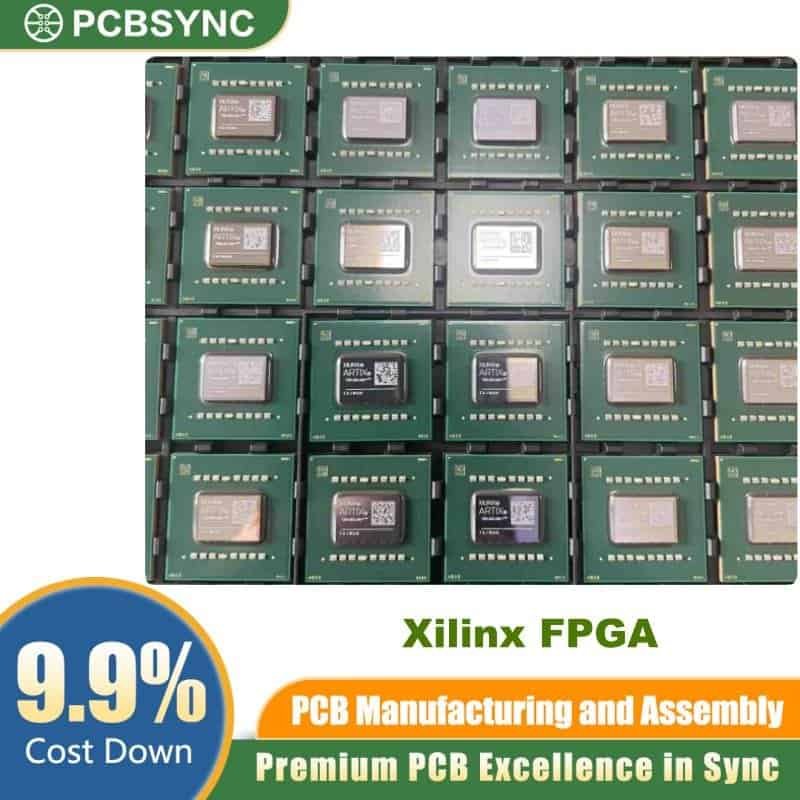
Overview of the AMD Xilinx XCV50E-7FG256C FPGA
The XCV50E-7FG256C is a powerful Field Programmable Gate Array (FPGA) from AMD’s (formerly Xilinx) renowned Virtex-E family. This advanced programmable logic device delivers exceptional performance for demanding applications in telecommunications, video processing, embedded systems, and high-speed networking. Manufactured using cutting-edge 0.18µm CMOS process technology with six metal layers, the XCV50E-7FG256C represents a significant evolution in programmable logic design.
Key Specifications and Technical Features
Core Architecture and Performance
| Specification |
Details |
| Product Family |
Virtex-E |
| Manufacturer |
AMD (Xilinx) |
| Part Number |
XCV50E-7FG256C |
| System Gates |
65,536 (64K) |
| Logic Cells |
1,728 |
| Maximum Frequency |
400MHz |
| Process Technology |
0.18µm CMOS |
| Operating Voltage |
1.8V Core |
| Speed Grade |
-7 (High Performance) |
Package and Pin Configuration
| Feature |
Specification |
| Package Type |
256-Pin FBGA (Fine-Pitch Ball Grid Array) |
| User I/O Pins |
176 |
| Package Code |
FG256 |
| Mounting Type |
Surface Mount |
| Packaging |
Tray |
Memory and Logic Resources
The XCV50E-7FG256C incorporates robust memory and logic resources that enable complex digital design implementations:
- Block RAM: 32 dedicated 18-Kbit block RAMs providing flexible on-chip memory
- Look-Up Tables (LUTs): 256 slices with two 6-input LUTs per slice
- DSP Slices: 8 dedicated DSP slices for high-performance signal processing
- Distributed RAM: Additional distributed RAM capabilities within CLBs
Advanced Features and Capabilities
High-Speed Performance Architecture
The XCV50E-7FG256C leverages the Virtex-E architecture optimized for maximum performance and routing efficiency. The -7 speed grade designation indicates this device is engineered for applications requiring superior clock frequencies and minimal propagation delays, making it ideal for time-critical applications operating at 400MHz and beyond.
Flexible I/O Configuration
With 176 user-configurable I/O pins, the XCV50E-7FG256C offers exceptional interface flexibility:
- Support for multiple I/O standards including LVTTL, LVCMOS, LVDS, and more
- Programmable drive strength and slew rate control
- Hot-socketing capability for live insertion
- Up to 48 dedicated differential I/O pairs for high-speed serial communications
Programmable Logic Density
The 1,728 logic cells and 65,536 system gates provide ample resources for implementing complex digital designs including:
- Custom processor architectures
- Protocol converters and bridges
- Video/image processing pipelines
- High-speed data acquisition systems
- Network packet processors
Applications and Use Cases
Telecommunications and Networking
The XCV50E-7FG256C excels in telecommunications infrastructure where high bandwidth and low latency are critical. Common applications include:
- Protocol conversion and bridging
- Network traffic management
- SDH/SONET framers
- Wireless base station processing
- Packet classification engines
Video and Image Processing
With dedicated DSP slices and substantial block RAM, this Xilinx FPGA is well-suited for real-time video applications:
- Video format conversion (HD, SD, 4K)
- Real-time image filtering and enhancement
- Video compression/decompression acceleration
- Broadcast equipment signal processing
- Machine vision systems
Industrial and Embedded Systems
The device’s reliability and performance make it an excellent choice for industrial automation:
- Motor control systems
- Industrial protocol converters
- Real-time control systems
- Data acquisition and logging
- Sensor interface processing
High-Performance Computing
For compute-intensive applications, the XCV50E-7FG256C provides:
- Custom arithmetic accelerators
- Cryptographic processing engines
- FFT and signal processing implementations
- Neural network inference acceleration
- Scientific computation offload
Design Tools and Development Support
Xilinx ISE Design Suite Compatibility
The XCV50E-7FG256C is fully supported by Xilinx ISE (Integrated Software Environment) Design Suite, providing comprehensive tools for:
- HDL synthesis (VHDL, Verilog)
- Place and route optimization
- Timing analysis and constraint management
- In-system debugging with ChipScope
- Bitstream generation and configuration
IP Core Integration
Designers can leverage Xilinx’s extensive IP core library to accelerate development:
- Communication controllers (Ethernet, USB, PCI)
- Memory controllers (DDR, SDRAM)
- DSP functions (FIR filters, FFTs, equalizers)
- Math functions (CORDIC, dividers, multipliers)
- Video/image processing cores
Technical Specifications Summary
Electrical Characteristics
| Parameter |
Specification |
| Core Voltage (VCCINT) |
1.8V ± 5% |
| I/O Voltage (VCCO) |
1.5V to 3.3V (bank dependent) |
| Power Consumption |
Varies with design utilization |
| Junction Temperature |
-40°C to +100°C (Commercial) |
Reliability and Compliance
| Feature |
Status |
| RoHS Compliance |
Non-Compliant (Legacy Product) |
| Product Status |
Obsolete (Available through distribution) |
| Quality Grade |
Commercial/Industrial |
| MTBF |
High reliability for mission-critical applications |
Comparison with Related Virtex-E Family Devices
| Part Number |
Logic Cells |
System Gates |
User I/O |
Package |
| XCV50E-7FG256C |
1,728 |
65,536 |
176 |
256-FBGA |
| XCV100E |
2,400 |
100,000 |
Up to 404 |
Various |
| XCV200E |
4,704 |
200,000 |
Up to 516 |
Various |
| XCV300E |
6,912 |
300,000 |
Up to 644 |
Various |
Ordering and Availability Information
Part Number Breakdown
XCV50E-7FG256C decodes as follows:
- XC = Xilinx Commercial
- V = Virtex family
- 50E = 50K equivalent gates, Extended features
- -7 = Speed grade (highest performance)
- FG256 = Fine-pitch BGA, 256 pins
- C = Commercial temperature range
Distribution Channels
While the XCV50E-7FG256C is listed as obsolete by the manufacturer, it remains available through:
- Authorized distributors with existing inventory
- Electronic component brokers
- Surplus and excess inventory suppliers
- Secondary market sources
Migration and Replacement Options
Modern FPGA Alternatives
For new designs, consider these contemporary AMD Xilinx FPGA families:
- Artix-7 Series: Cost-optimized with improved power efficiency
- Spartan-7 Series: Entry-level with modern features
- Kintex-7 Series: Mid-range performance and capabilities
- Virtex-7 Series: High-performance applications
Pin-Compatible Alternatives
When seeking direct replacements, evaluate:
- Other speed grades within the Virtex-E family (e.g., -6, -8)
- Functionally equivalent devices with similar gate counts
- Pin-compatible devices from the same package family
Design Considerations and Best Practices
Power Supply Design
Ensure robust power delivery for optimal performance:
- Provide clean, well-regulated 1.8V core supply
- Use adequate decoupling capacitors (0.1µF and 10µF)
- Implement proper power sequencing
- Monitor current consumption during design verification
Thermal Management
Proper thermal design ensures reliable operation:
- Calculate junction temperature based on power dissipation
- Provide adequate heatsinking for high-utilization designs
- Ensure proper airflow in enclosed systems
- Monitor thermal performance during testing
Configuration and Programming
The XCV50E-7FG256C supports multiple configuration modes:
- Master Serial: FPGA controls external PROM
- Slave Serial: External controller drives configuration
- JTAG Boundary Scan: In-system programming and debugging
- SelectMAP: High-speed parallel configuration
Conclusion
The XCV50E-7FG256C represents a proven FPGA solution that has powered countless digital designs across telecommunications, video processing, industrial automation, and embedded systems. While classified as an obsolete product, its robust architecture, 400MHz performance capability, and comprehensive feature set continue to make it valuable for maintenance, repair, and legacy system support.
For designers working with existing XCV50E-7FG256C implementations, the device offers reliable performance backed by mature development tools and extensive documentation. Those embarking on new projects should explore modern Xilinx FPGA families that deliver enhanced performance, lower power consumption, and contemporary features while maintaining the programmable logic flexibility that makes FPGAs indispensable in modern electronic design.
Whether sourcing this component for production continuation, repair services, or legacy system maintenance, understanding the XCV50E-7FG256C’s capabilities and specifications ensures successful implementation in your critical applications.