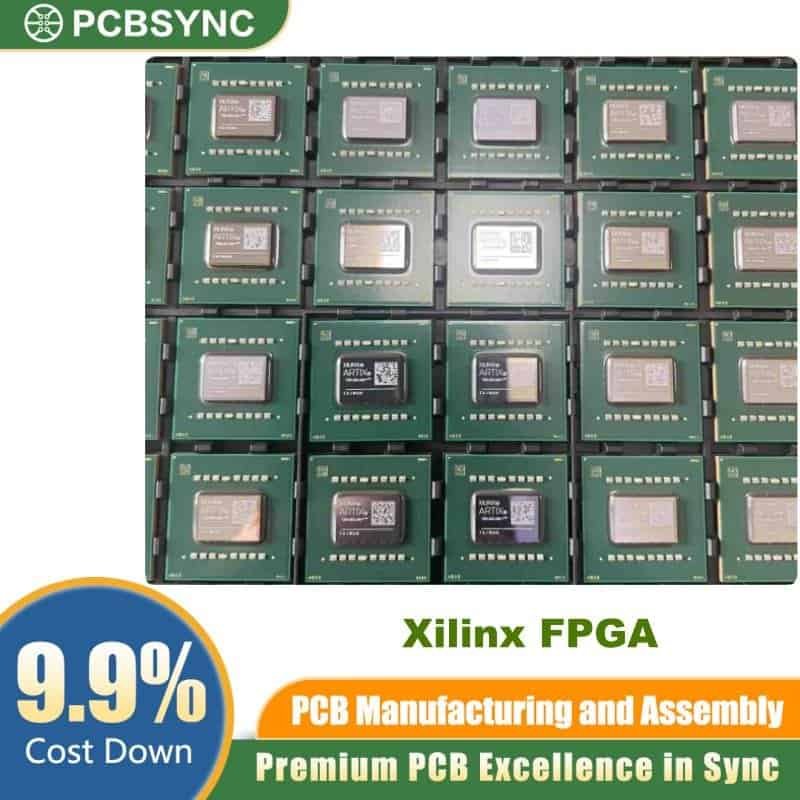
Overview of the XCV50E-6PQ240I Field Programmable Gate Array
The XCV50E-6PQ240I is a professional-grade Field Programmable Gate Array (FPGA) from AMD (formerly Xilinx), designed to deliver exceptional performance in complex digital logic applications. This advanced integrated circuit belongs to the renowned Virtex-E series, offering engineers and designers a powerful, flexible solution for telecommunications, industrial automation, embedded systems, and signal processing applications.
As part of AMD’s legacy Xilinx FPGA portfolio, the XCV50E-6PQ240I represents a proven technology platform that continues to serve critical roles in modern electronic designs where reliability, performance, and programmability are paramount.
Key Features and Specifications
Core Architecture Specifications
The XCV50E-6PQ240I FPGA delivers robust processing capabilities through its well-engineered architecture:
| Specification |
Value |
| Logic Elements/Cells |
1,728 |
| User I/O Pins |
158 |
| Total Terminations |
240 |
| RAM Bits |
65,536 |
| Package Type |
240-Pin PQFP (Plastic Quad Flat Pack) |
| Mounting Type |
Surface Mount |
| Operating Temperature Range |
Industrial (-40°C to +100°C) |
Electrical Characteristics
| Parameter |
Specification |
| Supply Voltage (Nominal) |
1.8V |
| Voltage Range |
1.71V to 1.89V |
| Speed Grade |
-6 (Industrial) |
| Operating Frequency |
Up to 250 MHz |
| Power Consumption |
Optimized for low-power operation |
Package and Physical Specifications
| Characteristic |
Details |
| Package Code |
PQ240 |
| Package Style |
PQFP (Plastic Quad Flat Pack) |
| Pin Count |
240 pins |
| Mounting Technology |
Surface Mount Device (SMD) |
| Temperature Grade |
Industrial (I suffix) |
| Packaging |
Tray |
Technical Capabilities and Performance
Logic Element Architecture
The XCV50E-6PQ240I incorporates 1,728 configurable logic elements that provide the building blocks for implementing complex digital circuits. Each logic element can be configured to perform various logical functions, register operations, and arithmetic computations, making this FPGA ideal for applications requiring flexible digital processing.
Memory Resources
With 65,536 RAM bits integrated on-chip, the XCV50E-6PQ240I offers substantial embedded memory for data buffering, lookup tables, and temporary storage operations. This distributed memory architecture enables efficient data management without requiring external memory components in many applications.
I/O Capabilities
Featuring 158 user-configurable I/O pins, this FPGA provides extensive connectivity options for interfacing with various peripherals, sensors, communication protocols, and other system components. The flexible I/O architecture supports multiple voltage standards and can be configured for different signaling requirements.
Primary Applications and Use Cases
Telecommunications Infrastructure
The XCV50E-6PQ240I excels in telecommunications applications where reliable signal processing and protocol handling are essential:
- Digital signal processing (DSP) functions
- Protocol conversion and bridging
- Data packet processing
- Communication interface controllers
- Telecom switching systems
Industrial Automation and Control
In industrial environments, this FPGA serves critical control and monitoring functions:
- Programmable logic controllers (PLC) enhancement
- Motor control systems
- Sensor data acquisition and processing
- Real-time control algorithms
- Industrial protocol implementation (Profibus, Modbus, EtherCAT)
Embedded Systems Development
The device provides an ideal platform for embedded system applications:
- Custom processing accelerators
- Hardware encryption/decryption
- Image and video processing
- Audio signal processing
- Embedded control systems
Signal Processing Applications
Engineers leverage the XCV50E-6PQ240I for various signal processing tasks:
- Digital filtering operations
- Fast Fourier Transform (FFT) implementation
- Data compression algorithms
- Signal conditioning circuits
- Waveform generation
Design and Development Advantages
Programmability and Flexibility
Unlike fixed-function ASICs, the XCV50E-6PQ240I offers complete reconfigurability, allowing designers to:
- Modify functionality without hardware changes
- Implement iterative design improvements
- Adapt to changing requirements
- Prototype complex systems rapidly
- Reduce time-to-market
Integration Benefits
The FPGA’s comprehensive feature set enables system consolidation:
- Reduces component count on PCBs
- Lowers overall system cost
- Simplifies board layout and routing
- Decreases power consumption
- Improves system reliability
Development Tool Support
AMD provides comprehensive development tools for the XCV50E-6PQ240I:
- Vivado Design Suite compatibility
- ISE Design Suite support (legacy)
- IP core libraries
- Simulation and verification tools
- Hardware debugging capabilities
Temperature and Environmental Specifications
Industrial Temperature Rating
The “I” suffix designation indicates this device is qualified for industrial temperature operation from -40°C to +100°C junction temperature. This extended temperature range makes the XCV50E-6PQ240I suitable for:
- Harsh industrial environments
- Outdoor installations
- Automotive applications
- Military and aerospace systems (with appropriate screening)
- Extreme climate deployments
Reliability and Quality
The Virtex-E family maintains high reliability standards:
- Proven silicon technology
- Extensive qualification testing
- Long-term availability commitment
- RoHS compliant (depending on ordering code)
- Quality manufacturing processes
Package Information and PCB Design Considerations
PQFP Package Advantages
The 240-pin Plastic Quad Flat Pack offers several benefits:
- Cost-effective packaging solution
- Proven reliability in high-volume production
- Easier visual inspection compared to BGA
- Suitable for rework and repair operations
- Lower-cost PCB manufacturing requirements
PCB Design Guidelines
When designing with the XCV50E-6PQ240I, consider:
- Adequate power supply decoupling (multiple ceramic capacitors near device)
- Controlled impedance routing for high-speed signals
- Proper grounding and power plane design
- Thermal management (heatsink may be required in high-utilization applications)
- Configuration pin pull-up/pull-down requirements
- JTAG programming interface accessibility
Speed Grade and Performance Characteristics
Understanding the -6 Speed Grade
The “-6” speed grade designation indicates:
- Moderate performance tier within the Virtex-E family
- Balanced power consumption vs. performance
- Suitable for applications requiring up to 250 MHz operation
- Cost-effective solution for mainstream applications
- Lower power dissipation compared to faster speed grades
Performance Optimization
To maximize performance with the XCV50E-6PQ240I:
- Implement proper clock domain crossing techniques
- Utilize pipelining in high-speed data paths
- Optimize critical path timing during synthesis
- Leverage dedicated hardware resources efficiently
- Apply appropriate timing constraints
Comparison with Related Devices
XCV50E Family Variants
| Part Number |
Package |
I/O Count |
Temp Grade |
Speed Grade |
| XCV50E-6PQ240I |
240-PQFP |
158 |
Industrial |
-6 |
| XCV50E-7PQ240I |
240-PQFP |
158 |
Industrial |
-7 |
| XCV50E-8PQ240I |
240-PQFP |
158 |
Industrial |
-8 |
| XCV50E-6FG256I |
256-FBGA |
176 |
Industrial |
-6 |
| XCV50E-6CS144I |
144-CSBGA |
94 |
Industrial |
-6 |
Procurement and Supply Chain Considerations
Availability and Sourcing
The XCV50E-6PQ240I is available through:
- Authorized distributors (DigiKey, Mouser, Arrow)
- AMD direct sales channels
- Certified component brokers
- Franchised electronics distributors
Lead Time and Inventory
As a mature product:
- Generally available from distributor stock
- Production lead times may vary
- Recommended to check current availability
- Consider long-term availability for new designs
- Alternative packages available if needed
Quality Assurance
When purchasing XCV50E-6PQ240I devices:
- Verify authorized distributor status
- Check for proper AMD/Xilinx marking
- Confirm anti-static packaging
- Verify date codes and lot traceability
- Request certificates of conformance when needed
Programming and Configuration
Configuration Methods
The XCV50E-6PQ240I supports multiple configuration modes:
- JTAG boundary scan programming
- Master Serial mode
- Slave Serial mode
- SelectMAP parallel configuration
- Configuration from external PROM
Configuration Memory Requirements
Typical configuration file sizes require:
- Approximately 559 Kbits for full device programming
- Compatible with standard configuration PROMs
- Support for bitstream compression
- Readback capability for verification
- Configuration encryption support (with appropriate tools)
Power Supply Design Requirements
Power Distribution Network
Proper power supply design is critical:
Core Power (VCCINT):
- 1.8V nominal (1.71V to 1.89V range)
- Multiple decoupling capacitors required
- Low-ESR ceramic capacitors recommended
- Power plane with adequate copper thickness
I/O Power (VCCO):
- Voltage depends on I/O standard used
- Separate supplies for different I/O banks
- Independent filtering and decoupling
Auxiliary Power (VCCAUX):
- 2.5V or 3.3V depending on configuration
- Required for certain internal functions
- Proper sequencing may be necessary
Frequently Asked Questions
What is the maximum operating frequency of the XCV50E-6PQ240I?
The device can operate at frequencies up to 250 MHz, depending on the specific design implementation and routing efficiency. Critical paths and resource utilization will impact achievable clock rates.
Can I use this FPGA for new designs in 2026?
While the XCV50E-6PQ240I is a mature product, it remains suitable for many applications. However, for new designs, consider evaluating newer FPGA families that may offer improved performance, lower power consumption, and enhanced features. Check with AMD regarding long-term product availability.
What development tools are required?
The XCV50E-6PQ240I can be programmed using AMD’s ISE Design Suite (legacy) or may have limited support in newer Vivado versions. Check AMD’s website for current tool compatibility and download options.
What is the difference between the -6, -7, and -8 speed grades?
Speed grades indicate maximum performance levels, with higher numbers representing faster devices. The -6 grade offers moderate performance, the -7 grade provides higher speed capability, and the -8 grade delivers the fastest performance within the XCV50E family. Faster speed grades typically consume more power.
Is the XCV50E-6PQ240I RoHS compliant?
RoHS compliance depends on the specific ordering code suffix. Devices with lead-free packaging designations meet RoHS requirements. Verify the complete part number and consult the datasheet for environmental compliance information.
Conclusion: Why Choose the XCV50E-6PQ240I
The XCV50E-6PQ240I represents a proven, reliable FPGA solution for diverse digital logic applications. With 1,728 logic elements, 158 I/O pins, industrial temperature rating, and membership in the respected Virtex-E family, this device offers:
✓ Proven reliability in demanding applications
✓ Flexible architecture for diverse design requirements
✓ Industrial temperature range for harsh environments
✓ Comprehensive I/O capabilities for extensive system connectivity
✓ Cost-effective solution for moderate-complexity designs
✓ Established supply chain with multiple sourcing options
Whether you’re developing telecommunications equipment, industrial control systems, embedded processors, or signal processing platforms, the XCV50E-6PQ240I delivers the performance, flexibility, and reliability needed for successful product deployment.
For technical specifications, datasheets, and development resources, consult the official AMD documentation or contact authorized distributors. When designing with FPGAs, leverage the extensive library of IP cores and reference designs available through AMD’s ecosystem to accelerate your development process.