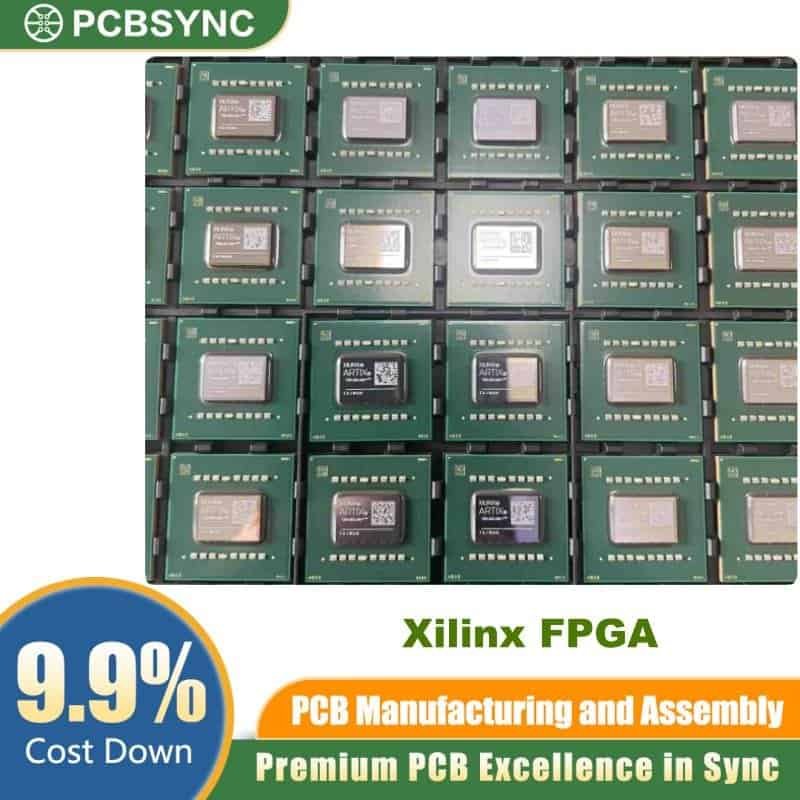
Complete Guide to AMD Xilinx XCV50E-6FGG256C Field Programmable Gate Array
The XCV50E-6FGG256C represents a powerful solution in AMD Xilinx’s acclaimed Virtex-E family of Field Programmable Gate Arrays (FPGAs). This advanced programmable logic device delivers exceptional performance for complex digital signal processing, embedded systems, and industrial control applications. Whether you’re maintaining legacy systems or developing custom logic circuits, this FPGA offers the reliability and flexibility modern engineers demand.
Product Overview: XCV50E-6FGG256C Specifications
The XCV50E-6FGG256C combines high-speed processing capabilities with programmable flexibility, making it an ideal choice for demanding applications across telecommunications, aerospace, medical imaging, and industrial automation sectors.
Key Technical Specifications
| Parameter |
Specification |
| Part Number |
XCV50E-6FGG256C |
| Manufacturer |
AMD (formerly Xilinx) |
| Product Family |
Virtex-E 1.8V FPGAs |
| System Gates |
71,693 gates |
| Logic Cells |
1,728 cells |
| CLB Array |
16 x 24 configuration |
| Maximum Frequency |
357 MHz |
| Core Voltage |
1.8V |
| Process Technology |
0.18 μm CMOS |
| Package Type |
256-Pin FBGA (Fine-Pitch Ball Grid Array) |
| Operating Temperature |
Commercial (0°C to +85°C) |
| Speed Grade |
-6 (high performance) |
Architecture and Performance Features
Advanced FPGA Architecture
The XCV50E-6FGG256C leverages Xilinx’s optimized Virtex-E architecture, featuring:
- 20,736K equivalent logic gates for complex digital designs
- Six-layer metal interconnect utilizing advanced 0.18 μm CMOS process
- Configurable Logic Blocks (CLBs) arranged in efficient 16×24 array
- Embedded RAM blocks for high-speed data buffering
- Dedicated routing resources optimized for place-and-route efficiency
High-Speed Digital Signal Processing
| Feature |
Capability |
| Clock Frequency |
Up to 357 MHz maximum |
| I/O Standards |
LVDS, BLVDS, LVPECL support |
| Data Processing |
Real-time signal filtering and encoding |
| Reconfiguration |
Dynamic partial reconfiguration support |
| Communication Protocols |
Software-defined radio (SDR) compatible |
Application Areas and Use Cases
Industrial and Commercial Applications
The Xilinx FPGA XCV50E-6FGG256C excels in numerous demanding environments:
- Telecommunications Infrastructure
- Base station signal processing
- Protocol conversion and routing
- Software-defined radio (SDR) systems
- High-speed data filtering and encoding
- Medical Imaging Systems
- MRI and CT scan image processing
- Real-time algorithm execution
- High-speed data acquisition
- Diagnostic equipment control
- Aerospace and Defense
- Navigation system controllers
- Satellite communication modules
- Radar signal processing
- Mission-critical embedded systems
- Industrial Automation
- Motion control systems
- Process monitoring and control
- Machine vision applications
- Programmable logic controllers (PLC)
Programming and Development
Design Tools and Software
| Tool Category |
Recommended Software |
| Development Environment |
Xilinx ISE Foundation Series™ |
| Alternative IDE |
Xilinx Alliance Series™ |
| HDL Support |
VHDL, Verilog |
| Simulation |
ModelSim, ISim |
| Programming |
iMPACT, Chipscope Pro |
Development Workflow
- Design Entry: Create schematics or write HDL code (VHDL/Verilog)
- Functional Simulation: Verify logic behavior before synthesis
- Synthesis: Convert HDL to gate-level netlist
- Implementation: Place-and-route optimization
- Timing Analysis: Validate performance against specifications
- Configuration: Program FPGA via JTAG or SelectMAP interface
Package and Pin Configuration
256-Pin FBGA Package Details
| Package Feature |
Description |
| Pin Count |
256 pins total |
| Package Type |
Fine-pitch Ball Grid Array (FBGA) |
| Body Size |
Compact footprint design |
| Thermal Performance |
Optimized heat dissipation |
| User I/O Pins |
176 configurable I/O pins |
| Power Pins |
Dedicated VCC and GND pins |
Electrical Characteristics
Power and Performance
| Specification |
Value |
| Core Voltage (VCCINT) |
1.8V ± 5% |
| I/O Voltage (VCCO) |
1.5V to 3.3V (bank dependent) |
| Maximum Power |
Varies by configuration |
| Static Power |
Low standby consumption |
| Dynamic Power |
Configuration-dependent |
I/O Standards Compatibility
The XCV50E-6FGG256C supports multiple industry-standard I/O interfaces:
- LVDS (Low Voltage Differential Signaling)
- BLVDS (Bus LVDS)
- LVPECL (Low Voltage Positive Emitter-Coupled Logic)
- SSTL (Stub Series Terminated Logic)
- GTL/GTL+ (Gunning Transceiver Logic)
- LVCMOS (Low Voltage CMOS)
- LVTTL (Low Voltage TTL)
Legacy System Support and Availability
Replacement and Maintenance Solutions
While the XCV50E-6FGG256C is classified as “not recommended for new designs,” it remains valuable for:
- Legacy system maintenance and repairs
- Direct replacement in existing Virtex-E designs
- System upgrades without hardware redesign
- Spare parts inventory for critical applications
Alternative and Compatible Models
| Model Number |
Key Difference |
| XCV50E-6FG256I |
Industrial temperature range (-40°C to +100°C) |
| XCV50E-7FGG256C |
Speed grade -7 (faster performance) |
| XCV50E-6CS144C |
144-pin CSBGA package variant |
| XCV50E-6PQ240C |
240-pin PQFP package option |
Quality and Reliability
Manufacturing Standards
- Original AMD Xilinx manufacture: Authentic silicon from authorized facilities
- Quality assurance: Comprehensive testing and validation
- Traceability: Full component tracking and documentation
- RoHS compliance: Environmentally friendly manufacturing
- Anti-static packaging: ESD-safe shipping and storage
Testing and Validation
Each XCV50E-6FGG256C undergoes rigorous quality control:
- Functional testing at specified operating conditions
- Timing verification across commercial temperature range
- Power consumption validation
- I/O standards compliance testing
- Package integrity inspection
Procurement and Availability
Ordering Information
Full Part Number: XCV50E-6FGG256C
Package Marking:
- Manufacturer: AMD/Xilinx logo
- Part number: XCV50E-6FGG256C
- Date code: Manufacturing week/year
- Lot traceability code
Stock and Lead Time
The XCV50E-6FGG256C is available through authorized distributors and specialty FPGA suppliers. Typical availability includes:
- New original stock: Factory-sealed components
- Lead time: 2-12 weeks depending on quantity
- Minimum order: Varies by distributor
- Volume pricing: Available for bulk orders
Technical Support and Resources
Documentation and Design Files
| Resource Type |
Description |
| Datasheet |
Complete electrical and timing specifications |
| User Guide |
Virtex-E family architecture manual |
| Application Notes |
Design best practices and examples |
| PCB Layout Guidelines |
FBGA footprint and routing recommendations |
| Programming Guide |
Configuration and debugging procedures |
Design Assistance
Technical support available for:
- Pin assignment and I/O planning
- Power supply design and decoupling
- Clock distribution and management
- Signal integrity considerations
- Thermal management solutions
Frequently Asked Questions
What is the difference between XCV50E-6FGG256C and XCV50E-6FG256I?
The primary distinction is temperature range: the “C” suffix denotes commercial temperature operation (0°C to +85°C), while the “I” suffix indicates industrial temperature range (-40°C to +100°C). Both share identical logic resources and electrical specifications.
Can I use modern Vivado tools with XCV50E-6FGG256C?
No, Virtex-E FPGAs require Xilinx ISE Design Suite for development. Vivado supports only 7-series and newer FPGA families. ISE 14.7 is the final version supporting legacy Virtex-E devices.
What configuration modes does XCV50E-6FGG256C support?
The device supports multiple configuration modes including:
- Master Serial mode
- Slave Serial mode
- Master SelectMAP (parallel)
- Slave SelectMAP (parallel)
- JTAG boundary-scan
Is the XCV50E-6FGG256C suitable for new product designs?
AMD Xilinx has designated this device as “not recommended for new designs.” For new projects, consider modern FPGA families like Artix-7, Spartan-7, or Zynq-7000 series that offer superior performance, lower power consumption, and ongoing manufacturer support.
What is the typical power consumption?
Power consumption varies significantly based on design utilization, clock frequency, and I/O activity. Static power is minimal (typically <100mW), while dynamic power can range from hundreds of milliwatts to several watts depending on application complexity and switching activity.
Competitive Advantages
Why Choose XCV50E-6FGG256C?
- Proven reliability: Decades of field deployment in critical systems
- Cost-effective: Competitive pricing for legacy replacements
- Wide availability: Multiple distribution channels
- Extensive ecosystem: Mature design tools and IP cores
- Drop-in compatibility: Direct replacement for existing Virtex-E designs
- Technical heritage: Based on industry-proven FPGA architecture
Conclusion: Reliable FPGA Solution for Critical Applications
The XCV50E-6FGG256C continues to serve as a reliable programmable logic solution for maintaining and upgrading existing systems. While newer FPGA families offer enhanced features and performance, this Virtex-E device provides the stability and compatibility essential for legacy system support.
With 1,728 logic cells, 357 MHz maximum frequency, and comprehensive I/O standard support, the XCV50E-6FGG256C delivers the performance needed for telecommunications, industrial automation, medical equipment, and aerospace applications. Its fine-pitch ball grid array package ensures compact PCB footprint while maintaining robust electrical performance.
For engineers requiring authentic AMD Xilinx components with guaranteed quality and traceability, the XCV50E-6FGG256C remains available through authorized distributors specializing in legacy FPGA devices. Whether for system maintenance, spare parts inventory, or specialized applications requiring Virtex-E architecture, this FPGA provides a dependable programmable logic solution.