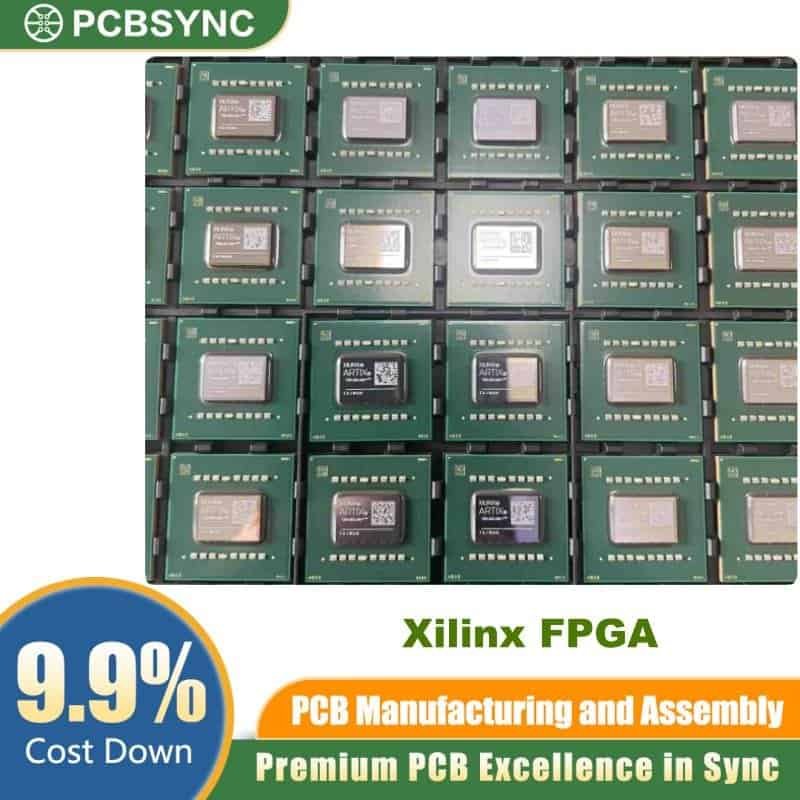
Overview of the XCV50E-6FG256I Field Programmable Gate Array
The XCV50E-6FG256I is a sophisticated Field Programmable Gate Array (FPGA) from AMD’s (formerly Xilinx) renowned Virtex-E family, engineered to deliver exceptional performance for complex digital design applications. This advanced programmable logic device combines high-density integration with flexible I/O capabilities, making it an ideal solution for telecommunications, industrial automation, signal processing, and embedded systems development.
Built on an aggressive 0.18µm CMOS process technology with six metal layers, the XCV50E-6FG256I offers designers a powerful platform that balances performance, capacity, and power efficiency. Whether you’re developing prototypes or deploying production systems, this Xilinx FPGA provides the versatility needed for today’s demanding applications.
Key Technical Specifications
Core Architecture Features
| Specification |
Value |
Description |
| Logic Elements |
1,728 Cells |
Configurable logic blocks for custom digital circuits |
| System Gates |
71,693 Gates |
Equivalent gate count for design complexity |
| CLBs |
384 CLBs |
Configurable Logic Blocks for flexible design |
| Total RAM |
65,536 bits |
On-chip memory for data storage and buffering |
| Maximum Frequency |
357 MHz |
High-speed operation capability |
| I/O Pins |
176 I/O |
Extensive connectivity options |
Electrical Characteristics
| Parameter |
Specification |
Notes |
| Supply Voltage |
1.71V – 1.89V |
Core voltage range |
| Operating Temperature |
-40°C to +100°C (TJ) |
Industrial temperature range |
| Process Technology |
0.18µm CMOS |
Six-layer metal process |
| Power Consumption |
Optimized |
Low-power design architecture |
Package Information
| Attribute |
Details |
| Package Type |
256-FBGA (Fine-Pitch Ball Grid Array) |
| Package Dimensions |
17mm x 17mm |
| Mounting Type |
Surface Mount Technology (SMT) |
| Pin Count |
256 pins |
| Packaging |
Tray |
XCV50E-6FG256I Performance Advantages
High-Speed Processing Capabilities
The XCV50E-6FG256I FPGA operates at frequencies up to 357 MHz, enabling rapid data processing and real-time system responses. This high-performance capability makes it suitable for applications requiring:
- Fast signal processing algorithms
- High-bandwidth data transmission
- Real-time control systems
- Complex computational tasks
- Parallel processing architectures
Flexible Logic Resources
With 1,728 logic cells organized in 384 Configurable Logic Blocks (CLBs), the XCV50E-6FG256I provides designers with substantial resources for implementing custom logic functions. The architecture supports multiple design paradigms including:
- Combinational logic circuits
- Sequential state machines
- Arithmetic operations
- Data path implementations
- Custom IP cores
Robust I/O Infrastructure
The 176 user I/O pins offer extensive connectivity options, supporting various I/O standards and voltage levels. This flexibility enables seamless integration with different system components and interfaces.
Virtex-E Family Architecture Benefits
Advanced Routing Resources
The Virtex-E architecture features a rich hierarchy of interconnect resources optimized for efficient place-and-route operations. This sophisticated routing network minimizes signal delays and maximizes design performance.
Memory Integration
The integrated 65,536 bits of on-chip RAM provides distributed memory resources that can be configured as:
- Dual-port RAM
- Single-port RAM
- Shift registers
- FIFO buffers
- Look-up tables (LUTs)
Process Technology Excellence
The six-layer metal 0.18µm CMOS process delivers superior silicon efficiency, enabling higher gate densities and improved performance compared to previous generations.
Primary Applications for XCV50E-6FG256I
Telecommunications Systems
The XCV50E-6FG256I excels in telecommunications applications requiring high-speed data processing and protocol implementation:
- Digital signal processing (DSP)
- Protocol conversion and bridging
- Channel coding/decoding
- Baseband processing
- Network packet processing
Industrial Automation
Industrial control systems benefit from the FPGA’s reliability and flexibility:
- Motor control systems
- Machine vision processing
- Sensor data acquisition
- Real-time monitoring systems
- Programmable logic controllers (PLC)
Embedded Systems Development
The device serves as an excellent platform for embedded system prototyping and deployment:
- Custom peripheral interfaces
- Hardware acceleration modules
- System-on-Chip (SoC) components
- Rapid prototyping platforms
- Hardware/software co-design
Medical Equipment
Medical device manufacturers utilize the XCV50E-6FG256I for:
- Diagnostic equipment
- Medical imaging systems
- Patient monitoring devices
- Laboratory instrumentation
- Therapeutic equipment
Design and Development Considerations
Development Tools Compatibility
The XCV50E-6FG256I is supported by AMD Xilinx development tools, including:
- ISE Design Suite
- Vivado Design Suite (with legacy support)
- Chipscope for debugging
- EDK (Embedded Development Kit)
- IP Core libraries
Thermal Management
With an operating temperature range of -40°C to +100°C (junction temperature), the device requires appropriate thermal design considerations:
- Adequate heat sinking for high-utilization designs
- Proper PCB thermal vias
- Airflow management in enclosed systems
- Thermal simulation during design phase
Power Supply Design
The 1.71V to 1.89V core voltage requires a stable, low-noise power supply. Design recommendations include:
- Decoupling capacitors at multiple locations
- Separate power planes for core and I/O
- Power sequencing circuits
- Current monitoring capabilities
Comparison with Similar FPGAs
XCV50E-6FG256I vs XCV50E-7FG256I
| Feature |
XCV50E-6FG256I |
XCV50E-7FG256I |
| Speed Grade |
-6 (Faster) |
-7 (Standard) |
| Maximum Frequency |
357 MHz |
Lower frequency |
| Power Consumption |
Slightly higher |
Lower |
| Cost |
Premium |
Standard |
| Applications |
High-performance systems |
Cost-sensitive designs |
The speed grade “-6” designation indicates enhanced performance characteristics compared to standard “-7” grade devices, making the XCV50E-6FG256I ideal for timing-critical applications.
Quality and Reliability Features
Industrial-Grade Performance
The industrial temperature range (-40°C to +100°C) ensures reliable operation in harsh environmental conditions commonly found in:
- Outdoor installations
- Manufacturing facilities
- Automotive systems
- Aerospace applications
- Military equipment
Built-In Testing Capabilities
The Virtex-E architecture includes boundary scan (JTAG) support for:
- Board-level testing
- In-system programming
- Design debugging
- Production testing
- Field updates
Procurement and Availability
Product Status
Note: The XCV50E-6FG256I is classified as obsolete by the manufacturer. While inventory may still be available through authorized distributors and surplus component suppliers, designers should consider migration to current-generation FPGA families for new designs.
Recommended Alternatives
For new design projects, consider these modern alternatives:
- Artix-7 family for cost-sensitive applications
- Kintex-7 family for mid-range performance
- Virtex-7 family for high-performance requirements
- Spartan-7 family for low-power designs
Technical Support Resources
Documentation Access
Comprehensive technical documentation includes:
- Detailed datasheet with electrical specifications
- User guide with design guidelines
- Application notes for specific use cases
- Reference designs and example code
- Errata sheets and known issues
Design Assistance
Technical support resources available:
- Online community forums
- Application engineers
- Training webinars and workshops
- Design consulting services
- Migration guides for legacy designs
Environmental and Compliance Information
RoHS Status
The XCV50E-6FG256I is designated as RoHS non-compliant. Designers requiring RoHS-compliant components should verify specific part number suffixes or consider alternative devices from current product families.
Industry Certifications
The device meets various industry standards for:
- Electrostatic discharge (ESD) protection
- Electromagnetic compatibility (EMC)
- Environmental testing requirements
- Quality management systems
- Reliability standards
Best Practices for XCV50E-6FG256I Implementation
PCB Layout Recommendations
Optimal PCB design practices include:
- Power Distribution: Use dedicated power planes with multiple entry points
- Signal Integrity: Control impedance for high-speed signals
- Grounding: Implement solid ground planes with minimal discontinuities
- Decoupling: Place capacitors close to power pins (0.1µF and 10µF values)
- Thermal Vias: Include thermal relief under the package
Configuration Methods
The XCV50E-6FG256I supports multiple configuration modes:
- Master Serial mode
- Slave Serial mode
- Boundary Scan (JTAG) mode
- SelectMAP mode (parallel configuration)
Clock Distribution Strategy
For optimal performance:
- Use dedicated clock input pins
- Implement clock buffers (BUFG) for global distribution
- Minimize clock skew through careful routing
- Consider phase-locked loops (PLLs) or delay-locked loops (DLLs)
Frequently Asked Questions
What is the difference between FG256I and FGG256I packages?
The “FG256” designation refers to the Fine-pitch Ball Grid Array with 256 balls, while “FGG256” indicates a similar package with minor variations in ball pitch or substrate materials. Both are functionally equivalent for most applications.
Can I replace a -7 speed grade with a -6 speed grade?
Yes, the -6 speed grade is faster and can generally replace a -7 grade device. However, power consumption may be slightly higher, and cost will typically increase.
What programming interface does the XCV50E-6FG256I use?
The device uses JTAG (IEEE 1149.1) boundary scan for programming and debugging, accessible through standard JTAG programmers compatible with Xilinx devices.
Is this FPGA suitable for new product designs?
As an obsolete component, the XCV50E-6FG256I is not recommended for new designs. Consider migrating to current AMD Xilinx FPGA families like Artix-7, Kintex-7, or Spartan-7 for better long-term support and availability.
Conclusion: Leveraging the XCV50E-6FG256I Capabilities
The XCV50E-6FG256I represents a proven FPGA solution with robust performance characteristics and extensive logic resources. Its 357 MHz operation, 176 I/O pins, and 71,693 system gates provide substantial capability for complex digital designs across telecommunications, industrial, and embedded applications.
While classified as obsolete, existing inventory continues to support legacy system maintenance and upgrades. For designers working with established products incorporating this device, the XCV50E-6FG256I remains a reliable component with well-documented characteristics and proven field performance.
New design projects should evaluate current Xilinx FPGA families to take advantage of enhanced features, improved power efficiency, better development tools, and guaranteed long-term availability. The architectural principles and design methodologies developed for the Virtex-E family transfer readily to modern FPGA platforms, ensuring smooth migration paths for future development.
For technical specifications, purchasing information, or design support, consult authorized AMD Xilinx distributors and technical resources to ensure proper component selection and implementation strategies aligned with your specific application requirements.