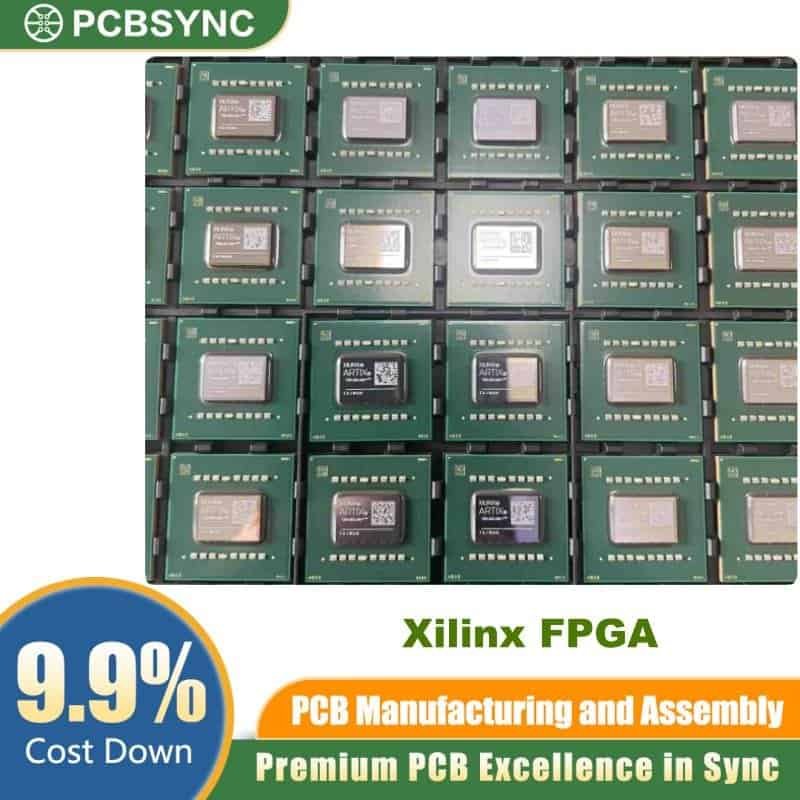
The XCV300E-7PQG240I is a high-performance field-programmable gate array (FPGA) from Xilinx’s Virtex-E family, now under the AMD portfolio. Designed for demanding industrial and embedded applications, this device offers 300,000 system gates, a 240-pin PQFP package, and an industrial temperature rating — making it a trusted choice for engineers who need reliable reconfigurable logic in harsh environments. Whether you are designing signal processing systems, custom controllers, or high-speed data paths, the XCV300E-7PQG240I delivers the density, speed, and flexibility required.
For a broader selection of reconfigurable logic devices, explore our full range of Xilinx FPGA products.
What Is the XCV300E-7PQG240I?
The XCV300E-7PQG240I belongs to Xilinx’s Virtex-E architecture, which was engineered as an enhanced version of the original Virtex family. The “E” designation indicates the use of an improved 0.18 µm CMOS process technology, enabling lower power consumption and higher logic density compared to the original Virtex series. The Virtex-E family was specifically designed to address the needs of communications, networking, and high-speed data processing.
Part Number Breakdown
Understanding the part number helps engineers quickly identify the correct device for their application:
| Segment |
Value |
Meaning |
| XCV |
XCV |
Xilinx Virtex Family |
| Density |
300 |
300,000 system gates |
| Generation |
E |
Enhanced (Virtex-E) |
| Speed Grade |
-7 |
Speed grade 7 (commercial timing) |
| Package Type |
PQ |
Plastic Quad Flat Pack (PQFP) |
| Pin Count |
G240 |
240 pins |
| Temperature |
I |
Industrial temperature range |
XCV300E-7PQG240I Key Specifications
The table below summarizes the most critical electrical and physical parameters for the XCV300E-7PQG240I:
| Parameter |
Value |
| Manufacturer |
AMD (formerly Xilinx) |
| Part Number |
XCV300E-7PQG240I |
| Family |
Virtex-E |
| Number of System Gates |
300,000 |
| Number of Logic Cells |
6,912 |
| CLB Array (Rows × Columns) |
48 × 36 |
| CLB Flip-Flops |
13,824 |
| Total RAM Bits |
589,824 |
| Distributed RAM Bits |
108,000 |
| Block RAM Bits |
466,560 |
| Maximum User I/O Pins |
166 |
| Package |
240-Pin PQFP (PQG240) |
| Core Supply Voltage (VCC) |
1.8V |
| I/O Supply Voltage (VCCO) |
1.5V – 3.3V |
| Speed Grade |
-7 |
| Operating Temperature |
–40°C to +100°C (Industrial) |
| Process Technology |
0.18 µm CMOS |
| Configuration Width |
SelectMAP (8-bit) / Serial / Boundary Scan |
XCV300E-7PQG240I Architecture Overview
## Configurable Logic Blocks (CLBs)
The heart of any Xilinx Virtex-E FPGA is its Configurable Logic Block structure. The XCV300E-7PQG240I contains 6,912 logic cells arranged in a 48-row by 36-column matrix. Each CLB contains four slices, and each slice includes two 4-input Look-Up Tables (LUTs), two flip-flops, and fast carry logic. This architecture supports both sequential and combinatorial logic implementation with high efficiency.
## Embedded Block RAM (BRAM)
One of the key advantages of the XCV300E-7PQG240I is its on-chip memory. The device integrates 12 dedicated Block RAM units, each configurable as 4K × 4 bits or 2K × 8 bits. These BRAMs can be cascaded to create larger memories and support both synchronous single-port and dual-port configurations — ideal for FIFO buffers, lookup tables, and local data storage in embedded designs.
| Memory Type |
Capacity |
| Total RAM Bits |
589,824 bits |
| Distributed RAM (from LUTs) |
108,000 bits |
| Block RAM (dedicated) |
466,560 bits |
| Block RAM Units |
12 |
## Digital Clock Managers (DCMs)
The XCV300E-7PQG240I includes four Digital Clock Managers (DCMs), each capable of:
- Clock deskewing and phase alignment
- Frequency synthesis (multiply and divide)
- Clock duty-cycle correction
- Phase shifting in fine increments
DCMs eliminate clock distribution skew and enable designs to run system-wide synchronous interfaces with minimal jitter — critical in communications and data acquisition applications.
## I/O Architecture and Standards Support
The XCV300E-7PQG240I provides 166 user-configurable I/O pins through its 240-pin PQFP package. The flexible I/O supports a wide range of single-ended and differential signaling standards:
| I/O Standard |
Type |
| LVCMOS 3.3V / 2.5V / 1.8V |
Single-ended |
| LVTTL |
Single-ended |
| PCI / PCI-X (3.3V) |
Single-ended |
| GTL / GTL+ |
Single-ended (open drain) |
| HSTL Class I / II / III / IV |
Single-ended |
| SSTL2 Class I / II |
Single-ended |
| LVDS |
Differential |
| LVPECL |
Differential |
| BLVDS |
Differential |
Each I/O bank can be configured with its own VCCO supply voltage, providing exceptional flexibility when interfacing with mixed-voltage systems.
## Package and Mechanical Information
The XCV300E-7PQG240I uses the industry-standard 240-pin Plastic Quad Flat Package (PQFP), a surface-mount package suitable for standard PCB assembly processes. The “G” suffix in the part number designates a green/RoHS-compliant packaging variant shipped in tray format.
| Package Parameter |
Detail |
| Package Type |
PQFP (Plastic Quad Flat Pack) |
| Pin Count |
240 |
| Package Code |
PQG240 |
| Mounting Style |
Surface Mount Technology (SMT) |
| RoHS Compliance |
Yes (G suffix = Green/RoHS) |
| Shipping Format |
Tray |
| Pitch |
0.5 mm |
## Speed Grade and Timing Performance
The -7 speed grade of the XCV300E-7PQG240I represents a standard performance tier within the Virtex-E family (with lower numbers indicating faster performance). Key timing parameters for the -7 grade include:
| Timing Parameter |
Typical Value |
| Maximum Internal Clock Frequency |
~175 MHz |
| CLB-to-CLB Delay |
~0.9 ns |
| Setup Time (Flip-Flop) |
~0.3 ns |
| I/O Input Delay |
~1.2 ns |
| Minimum Clock-to-Output (Tco) |
~2.5 ns |
Note: Always consult the official Xilinx Virtex-E datasheet (DS022) for definitive timing values, as they vary by design, operating voltage, and temperature.
## Industrial Temperature Rating: What It Means
The “I” suffix on the XCV300E-7PQG240I indicates an Industrial temperature rating, meaning the device is guaranteed to operate correctly across the full range of –40°C to +100°C. This is in contrast to the commercial-grade equivalent (XCV300E-7PQ240C), which is only rated from 0°C to +85°C.
| Temperature Grade |
Suffix |
Range |
| Commercial |
C |
0°C to +85°C |
| Industrial |
I |
–40°C to +100°C |
Industrial-grade devices are essential for applications deployed in outdoor environments, factory automation, automotive-adjacent systems, and any design where ambient temperatures cannot be tightly controlled.
## Configuration Modes
The XCV300E-7PQG240I supports multiple configuration methods, providing design flexibility for different system architectures:
| Configuration Mode |
Description |
| Master Serial |
FPGA drives configuration clock; reads from serial PROM |
| Slave Serial |
External host drives configuration; daisy-chainable |
| SelectMAP (Slave Parallel) |
8-bit parallel interface for fast configuration by a processor |
| JTAG / Boundary Scan |
IEEE 1149.1 compliant; supports in-system programming |
The JTAG interface also supports in-system debugging, allowing engineers to probe internal signals using Xilinx’s ChipScope Pro logic analyzer tool — invaluable during hardware bring-up and verification.
## Target Applications
The XCV300E-7PQG240I is well-suited for a broad range of industrial and professional-grade applications:
| Application Area |
Use Case Examples |
| Industrial Control |
Motor controllers, PLC co-processors, real-time state machines |
| Communications |
Protocol converters, line cards, packet processing engines |
| Test & Measurement |
Data acquisition systems, waveform generators, signal analyzers |
| Embedded Computing |
Custom CPU implementations, hardware accelerators |
| Networking |
Switching fabric, MAC layer processing, traffic shaping |
| Aerospace & Defense |
Signal intelligence, radar processing (where extended temp is needed) |
| Medical Devices |
Image processing, patient monitoring back-end logic |
## Comparison: XCV300E vs Similar Devices
Designers evaluating the XCV300E-7PQG240I often compare it against adjacent devices in the Virtex-E family or competing architectures:
| Parameter |
XCV100E |
XCV300E |
XCV600E |
XCV1000E |
| System Gates |
100,000 |
300,000 |
600,000 |
1,000,000 |
| Logic Cells |
2,352 |
6,912 |
14,112 |
24,192 |
| Block RAM Bits |
196,608 |
466,560 |
720,896 |
786,432 |
| DCMs |
2 |
4 |
4 |
4 |
| Max User I/O |
— |
166 (PQG240) |
— |
— |
For designs that have outgrown the XCV300E-7PQG240I or require more modern process nodes, Xilinx’s Spartan-6 and Kintex-7 families offer pin-efficient alternatives with improved logic-per-mW ratios.
## Design Tools and Software Support
The XCV300E-7PQG240I is supported by Xilinx’s ISE Design Suite (particularly ISE 14.7, the final release). Key tools include:
- XST (Xilinx Synthesis Technology) — RTL synthesis from VHDL or Verilog
- PAR (Place and Route) — Automatic placement and routing with timing-driven algorithms
- TRCE (Timing Report and Circuit Evaluation) — Static timing analysis
- iMPACT — Device configuration and boundary-scan programming
- ChipScope Pro — In-system logic analysis via JTAG
While ISE is a legacy tool no longer under active development, it remains fully functional and is widely used to maintain and extend existing Virtex-E designs in production systems.
## Ordering Information
| Part Number |
Package |
Speed Grade |
Temperature |
Shipping Format |
| XCV300E-7PQ240C |
240-pin PQFP |
-7 |
Commercial (0°C to +85°C) |
Tray |
| XCV300E-7PQG240I |
240-pin PQFP |
-7 |
Industrial (–40°C to +100°C) |
Tray (RoHS) |
| XCV300E-6PQG240I |
240-pin PQFP |
-6 (faster) |
Industrial (–40°C to +100°C) |
Tray (RoHS) |
| XCV300E-8PQG240I |
240-pin PQFP |
-8 (slower) |
Industrial (–40°C to +100°C) |
Tray (RoHS) |
Note: Lower speed grade numbers indicate faster (higher performance) devices in Xilinx nomenclature.
## Frequently Asked Questions
Q: What is the difference between XCV300E-7PQ240I and XCV300E-7PQG240I? The “G” suffix indicates RoHS-compliant, green packaging. Electrically and functionally, the two parts are identical. The G variant ships in tray format and is the standard procurement option for new designs.
Q: Is the XCV300E-7PQG240I still in production? The Virtex-E family has reached end-of-life with AMD/Xilinx. However, the XCV300E-7PQG240I remains available through authorized distributors and specialty component suppliers. For new designs, migration to a more current FPGA family is recommended.
Q: What programming voltage does the XCV300E-7PQG240I require? The core logic operates at 1.8V VCC, while the I/O banks accept VCCO voltages from 1.5V to 3.3V depending on the selected I/O standard. Ensure your power supply can deliver stable 1.8V at the device’s rated current.
Q: Can I use Vivado to design for the XCV300E-7PQG240I? No. Vivado does not support legacy Virtex-E devices. You must use Xilinx ISE Design Suite (version 14.7 or earlier) for synthesis, implementation, and programming of this device.
Q: What is the maximum user I/O count in the 240-pin package? In the PQG240 package, the XCV300E-7PQG240I provides up to 166 user-configurable I/O pins. The remaining pins are dedicated to power, ground, and configuration signals.
## Summary
The XCV300E-7PQG240I is a proven, high-density Xilinx Virtex-E FPGA that continues to serve critical roles in legacy industrial, communications, and embedded systems. With 300,000 system gates, 466 Kbits of block RAM, four DCMs, 166 user I/O pins in a compact 240-pin PQFP, and a full industrial temperature rating, it provides an excellent balance of logic capacity, memory, and clocking resources. Its support for multiple I/O standards and JTAG configuration makes it highly versatile for both new development and long-term production maintenance.
Engineers maintaining existing designs or sourcing replacements for field-deployed hardware will find the XCV300E-7PQG240I to be a reliable, specification-matched solution backed by a mature ecosystem of ISE-based tools and third-party IP cores.