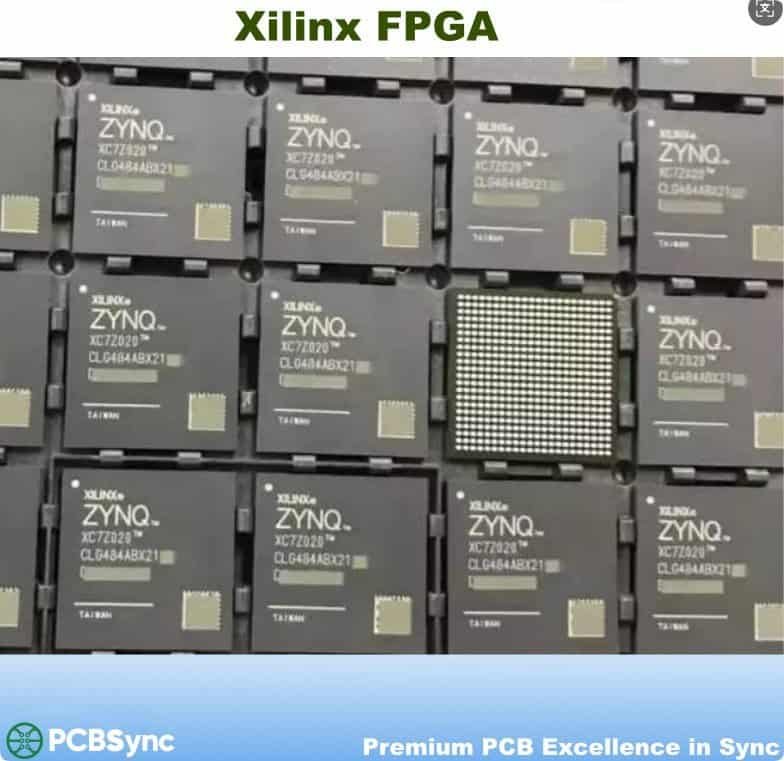
The XCV300E-6FG456I represents a powerful solution in programmable logic technology, delivering exceptional performance for complex digital system applications. This <a href=”https://pcbsync.com/xilinx-fpga/”>Xilinx FPGA</a> combines high gate density with advanced architectural features to meet demanding design requirements across industrial, telecommunications, and embedded system applications.
Overview of XCV300E-6FG456I FPGA Specifications
The XCV300E-6FG456I is a member of the Virtex-E family, engineered with 0.18μm CMOS technology to provide superior performance and capacity. This field-programmable gate array delivers robust functionality for applications requiring high-speed data processing and complex logic implementation.
Key Technical Specifications
| Specification |
Value |
| Part Number |
XCV300E-6FG456I |
| Manufacturer |
AMD (formerly Xilinx) |
| Product Family |
Virtex-E |
| Gate Count |
82,944 gates (equivalent) |
| Logic Cells |
6,912 cells |
| Configurable Logic Blocks (CLBs) |
1,536 CLBs |
| Maximum Operating Frequency |
357 MHz |
| I/O Pins |
312 user I/O |
| Package Type |
456-pin FBGA (Fine-Pitch Ball Grid Array) |
| Operating Voltage |
1.8V core, 3.3V I/O |
| Speed Grade |
-6 (industrial grade) |
| Process Technology |
0.18 μm, 6-layer metal CMOS |
| Operating Temperature Range |
Industrial (-40°C to +100°C) |
Architecture and Performance Features
Advanced FPGA Core Architecture
The XCV300E-6FG456I utilizes an optimized architecture specifically designed for high-performance applications. The device incorporates 1,536 configurable logic blocks that provide flexibility in implementing complex digital functions while maintaining excellent routing efficiency.
Each configurable logic block contains multiple lookup tables (LUTs), flip-flops, and multiplexers, enabling designers to implement both combinational and sequential logic with exceptional density and speed.
High-Speed Performance Capabilities
With a maximum operating frequency of 357 MHz, this FPGA excels in time-critical applications. The -6 speed grade indicates industrial-grade timing performance, making it suitable for applications requiring reliable operation under varying environmental conditions.
Memory and Storage Resources
| Memory Resource |
Capacity |
| Total RAM Bits |
Distributed RAM throughout CLBs |
| Block SelectRAM |
Embedded memory blocks |
| Configuration Memory |
Internal SRAM-based configuration |
Package and Physical Characteristics
456-FBGA Package Details
The XCV300E-6FG456I comes in a 456-pin Fine-Pitch Ball Grid Array package, offering several advantages:
- Compact Footprint: Enables high-density PCB designs
- Excellent Thermal Performance: Superior heat dissipation compared to traditional packages
- High Pin Count: Supports 312 user I/O pins for complex interfacing
- Reliable Connections: Ball grid technology provides robust mechanical and electrical connections
Pin Configuration Overview
| Pin Type |
Quantity |
| Total Pins |
456 |
| User I/O |
312 |
| Power Pins |
Multiple VCCINT, VCCIO pins |
| Ground Pins |
Multiple GND pins |
| Configuration Pins |
Dedicated configuration interface |
Applications and Use Cases
Telecommunications Infrastructure
The XCV300E-6FG456I excels in telecommunications applications requiring high-speed signal processing, including:
- Digital signal processing (DSP) implementations
- Protocol conversion and bridging
- Network packet processing
- Wireless base station equipment
Industrial Control Systems
This FPGA is well-suited for industrial automation applications:
- Motor control and drive systems
- Industrial networking protocols
- Real-time process monitoring
- Machine vision processing
Embedded System Development
Engineers leverage the XCV300E-6FG456I for sophisticated embedded designs:
- Custom peripheral interfaces
- Hardware acceleration engines
- System-on-chip (SoC) prototyping
- High-speed data acquisition systems
Consumer Electronics
The device supports various consumer applications:
- High-definition video processing
- Audio digital signal processing
- Gaming console hardware
- Broadcast equipment
Power Specifications and Thermal Management
Power Supply Requirements
| Power Rail |
Voltage |
Purpose |
| VCCINT |
1.8V |
Core logic power |
| VCCIO |
3.3V / 2.5V / 1.8V |
I/O bank power (selectable) |
| VCCO |
Varies by I/O standard |
Output driver power |
Thermal Considerations
Proper thermal management ensures reliable operation:
- Junction Temperature Range: -40°C to +100°C (industrial)
- Package Thermal Resistance: Dependent on PCB design and airflow
- Power Dissipation: Varies with utilization and clock frequency
Design Tools and Development Support
Compatible Design Software
Developers can program the XCV300E-6FG456I using:
- ISE Design Suite: Xilinx’s comprehensive FPGA development environment
- Synthesis Tools: Support for third-party synthesis tools
- Simulation: Integration with major HDL simulators
- Debugging: ChipScope Pro for in-system analysis
Configuration Options
| Configuration Method |
Description |
| JTAG |
Standard boundary-scan configuration |
| Master Serial |
Configuration from serial PROM |
| Slave Serial |
External processor-controlled configuration |
| SelectMAP |
Parallel configuration interface |
Comparison with Related Virtex-E Family Members
Speed Grade Variants
| Part Number |
Speed Grade |
Maximum Frequency |
| XCV300E-4FG456I |
-4 |
Lower than -6 |
| XCV300E-6FG456I |
-6 |
357 MHz |
| XCV300E-7FG456I |
-7 |
Higher than -6 |
| XCV300E-8FG456I |
-8 |
Highest performance |
Package Alternatives
The XCV300 series is available in multiple package options:
- FG456: 456-pin Fine-Pitch BGA (this variant)
- BG432: 432-pin Ball Grid Array
- BG352: 352-pin Ball Grid Array
- PQ240: 240-pin Plastic Quad Flat Pack
Quality and Reliability Standards
Manufacturing Quality
The XCV300E-6FG456I is manufactured to stringent quality standards:
- Industrial Temperature Rating: -40°C to +100°C operation
- Quality Assurance: Comprehensive testing protocols
- RoHS Compliance: Lead-free and environmentally compliant
- Traceability: Full manufacturing lot traceability
Reliability Metrics
| Reliability Parameter |
Specification |
| MTBF |
High mean time between failures |
| ESD Protection |
Human Body Model (HBM) compliant |
| Latch-up Immunity |
JEDEC standard compliant |
Ordering Information and Availability
Part Number Nomenclature
Understanding the part number structure:
- XCV300E: Virtex-E family, 300K gate equivalent
- -6: Speed grade (industrial)
- FG456: Package type (456-pin FBGA)
- I: Industrial temperature range
Lifecycle Status
Note: The XCV300E-6FG456I is currently listed as an obsolete product by the manufacturer. While existing stock may be available through distributors, designers working on new projects should consider newer FPGA families such as Spartan, Artix, or Kintex for long-term availability.
Alternative Sources
When sourcing the XCV300E-6FG456I, consider:
- Authorized distributors with verified stock
- Quality-certified surplus component suppliers
- Last-time-buy opportunities for legacy support
Design Considerations and Best Practices
PCB Layout Recommendations
For optimal performance when designing with the XCV300E-6FG456I:
Power Distribution
- Implement proper power plane design with low impedance
- Use adequate decoupling capacitors near power pins
- Separate analog and digital ground planes where applicable
Signal Integrity
- Match impedances for high-speed signals
- Minimize stub lengths on critical nets
- Implement proper termination schemes
Thermal Management
- Ensure adequate copper pour for heat dissipation
- Consider thermal vias beneath the package
- Plan for forced air cooling in high-power applications
Clock Distribution Strategy
Effective clock network design is crucial:
- Utilize dedicated clock inputs (GCLK pins)
- Implement proper clock tree synthesis
- Minimize clock skew across the device
- Consider using Digital Clock Managers (DCMs) for clock manipulation
Technical Support and Resources
Documentation Available
Engineers can access comprehensive technical documentation:
- Complete datasheet with electrical characteristics
- User guide detailing architecture and features
- Application notes for specific use cases
- Reference designs and example projects
Development Resources
| Resource Type |
Description |
| Development Boards |
Third-party evaluation platforms available |
| IP Cores |
Library of pre-verified design blocks |
| Technical Forums |
Community support and knowledge base |
| Training Materials |
Tutorials and design methodology guides |
Frequently Asked Questions
What is the difference between commercial and industrial grade?
The “I” suffix indicates industrial temperature range (-40°C to +100°C), compared to commercial grade (0°C to +85°C). Industrial parts are tested for extended temperature operation.
Can I use 5V logic with this FPGA?
The XCV300E-6FG456I I/O banks support various voltage standards, but direct 5V connection requires voltage translation circuitry. The device supports 3.3V, 2.5V, and 1.8V I/O standards natively.
What programming languages are supported?
The FPGA can be programmed using standard hardware description languages including VHDL, Verilog, and SystemVerilog. High-level synthesis tools also support C/C++ for algorithm implementation.
Is this device suitable for new designs?
As an obsolete part, the XCV300E-6FG456I is primarily suitable for legacy support and existing design maintenance. New projects should evaluate current FPGA families for better performance, lower power, and long-term availability.
Conclusion
The XCV300E-6FG456I represents a capable FPGA solution with 82,944 gates, 312 I/O pins, and 357 MHz maximum operating frequency in a compact 456-pin FBGA package. While newer FPGA architectures have superseded the Virtex-E family, this device continues to serve in legacy applications requiring proven reliability and industrial-grade performance. Engineers should carefully consider long-term availability when selecting components, though the XCV300E-6FG456I remains a viable option for existing design support and specific applications where its characteristics align with project requirements.