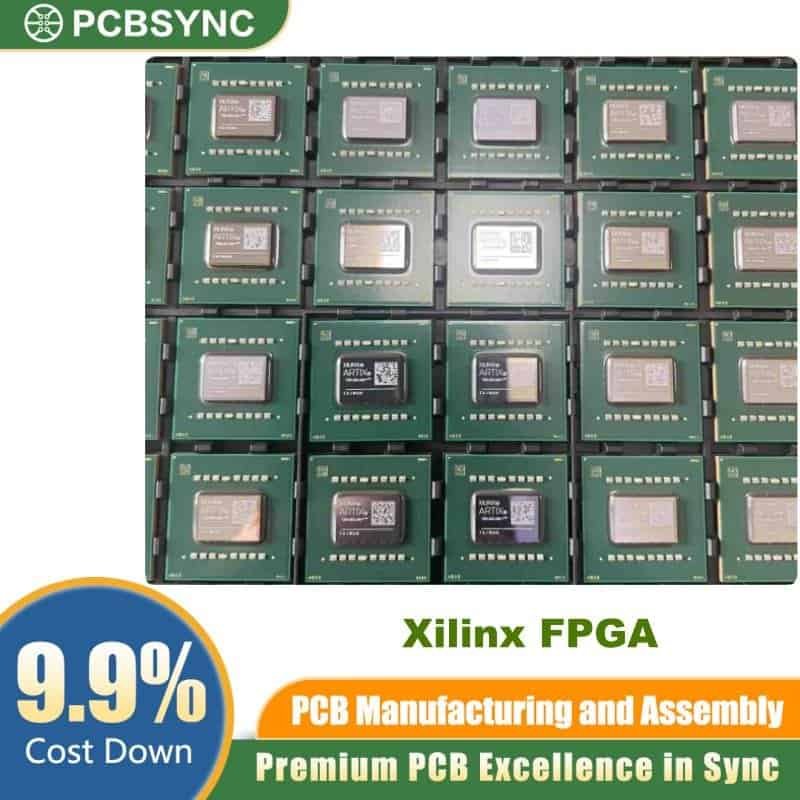
Overview of the XCV300E-6FG456I FPGA
The XCV300E-6FG456I is a high-performance Field Programmable Gate Array (FPGA) from the renowned Virtex-E family, manufactured by Xilinx (now AMD). This versatile programmable logic device delivers exceptional processing capabilities with 82,944 equivalent gates and 6,912 logic cells, making it an ideal solution for complex digital design applications requiring high-speed performance and flexibility.
Originally designed using advanced 0.18μm CMOS technology, this FPGA operates at impressive clock frequencies up to 357 MHz, providing the computational power needed for demanding applications in telecommunications, industrial automation, medical devices, and aerospace systems.
Key Technical Specifications
Core Performance Parameters
| Specification |
Value |
| Device Family |
Virtex-E |
| Logic Cells |
6,912 cells |
| Equivalent Gates |
82,944 gates |
| Configurable Logic Blocks (CLBs) |
1,536 CLBs |
| Maximum Clock Frequency |
357 MHz |
| Technology Node |
0.18μm CMOS |
| Supply Voltage |
1.8V (Core), 3.3V (I/O) |
Package and Pin Configuration
| Feature |
Specification |
| Package Type |
FBGA (Fine-Pitch Ball Grid Array) |
| Total Pin Count |
456 pins |
| User I/O Pins |
312 |
| Package Dimensions |
23mm x 23mm (Square) |
| Package Code |
FG456 |
| Moisture Sensitivity Level |
Level 3 |
Electrical Characteristics
| Parameter |
Value |
| Core Voltage (VCCINT) |
1.8V ±5% |
| I/O Voltage (VCCIO) |
1.2V to 3.6V |
| Power Supply Combinations |
1.2V/3.6V, 1.8V |
| Operating Temperature Range |
Industrial (-40°C to +100°C) |
| Combinatorial Delay (CLB) |
470 ps (max) |
Advanced Features and Capabilities
Programmable Logic Architecture
The XCV300E-6FG456I incorporates Xilinx’s proven Virtex-E architecture, which represents an evolutionary advancement in programmable logic design. The device features:
- Rich Interconnect Hierarchy: Fast and flexible routing resources optimized for place-and-route efficiency
- Advanced 6-Layer Metal Process: Enhanced signal integrity and reduced propagation delays
- High Silicon Efficiency: Optimized architecture delivering superior logic density
- Embedded Memory Blocks: Distributed RAM and dedicated block RAM for data storage
System-Level Features
This Xilinx FPGA offers comprehensive system integration capabilities including:
- Multiple I/O standards support (LVTTL, LVCMOS, PCI, GTL+)
- Dedicated carry logic for high-speed arithmetic operations
- Digital clock management with phase-locked loops (PLLs)
- IEEE 1149.1 (JTAG) boundary-scan support
- SelectRAM memory resources for flexible data buffering
Application Areas
Primary Applications
The XCV300E-6FG456I excels in diverse application domains:
Communications and Networking
- Wireless infrastructure equipment
- Network routers and switches
- Protocol conversion systems
- Signal processing modules
Industrial Automation
- Process control systems
- Motion control applications
- Industrial vision systems
- PLCs and industrial computers
Consumer Electronics
- Digital video processing
- Audio signal processing
- Display controllers
- Set-top boxes
Automotive and Aerospace
- Body electronics and lighting control
- Advanced driver assistance systems (ADAS)
- Avionics systems
- In-vehicle infotainment
Medical Equipment
- Medical imaging devices
- Patient monitoring systems
- Diagnostic equipment
- Laboratory instruments
Design Resources and Development Tools
Software Development Environment
Designers working with the XCV300E-6FG456I can leverage Xilinx’s comprehensive development toolchain:
ISE Design Suite: The legacy integrated development environment supporting Virtex-E devices, providing synthesis, implementation, and simulation capabilities.
Key Tool Features:
- HDL synthesis (VHDL, Verilog)
- Logic simulation and timing analysis
- Place and route optimization
- Bitstream generation
- ChipScope Pro for embedded logic analysis
Development Boards and Evaluation Kits
While the XCV300E-6FG456I is an obsolete/legacy component, compatible development platforms include:
- Custom evaluation boards from third-party vendors
- General-purpose FPGA prototyping boards
- Application-specific reference designs
Pin Configuration and Interface Options
I/O Standards Supported
| I/O Standard |
Voltage Level |
Typical Use Case |
| LVTTL |
3.3V |
General purpose I/O |
| LVCMOS |
1.8V – 3.3V |
Low-voltage applications |
| PCI |
3.3V/5V |
PCI bus interface |
| GTL+ |
1.5V |
High-speed backplane |
| SSTL-2 |
2.5V |
Memory interfaces |
| HSTL |
1.5V |
High-speed telecommunications |
Thermal Management Considerations
| Thermal Parameter |
Value |
| Junction Temperature (TJ Max) |
125°C |
| Thermal Resistance (θJA) |
Dependent on package and airflow |
| Recommended Operating Temp |
-40°C to +100°C |
| Power Dissipation |
Application dependent |
Ordering Information and Availability
Part Number Breakdown
XCV300E-6FG456I
- XC: Xilinx Commercial Product
- V300E: Virtex-E 300K gates
- -6: Speed grade (6 = 357 MHz max)
- FG456: Package type (456-pin Fine BGA)
- I: Industrial temperature range
Lifecycle Status
Important Note: The XCV300E-6FG456I is classified as an obsolete/legacy product by AMD/Xilinx. While still available through authorized distributors and surplus component suppliers, designers should consider:
- Long-term availability constraints
- Transition to current-generation FPGA families (7-Series, UltraScale, Versal)
- Last-time buy opportunities from distributors
- Alternative pin-compatible or functional equivalent devices
Quality and Compliance
| Certification |
Status |
| RoHS Compliance |
Yes (Lead-free) |
| REACH Compliant |
Yes |
| Conflict Minerals |
Compliant |
| JESD-609 Code |
e1 (Green, RoHS compliant) |
Performance Optimization Guidelines
Design Best Practices
To maximize performance from the XCV300E-6FG456I:
- Clock Domain Management: Properly constrain clock domains and minimize clock domain crossings
- Pipelining: Insert pipeline registers in high-speed data paths to meet timing
- Resource Utilization: Balance CLB and routing resource usage for optimal performance
- Power Distribution: Implement robust power delivery with adequate decoupling capacitors
- Thermal Design: Ensure adequate cooling to maintain junction temperature within specifications
Timing Closure Strategies
- Utilize timing-driven place and route algorithms
- Apply appropriate timing constraints (period, offset, path)
- Analyze critical paths using static timing analysis
- Implement clock management using dedicated DCM resources
- Consider physical placement constraints for timing-critical logic
Migration and Upgrade Path
Recommended Alternatives
For new designs or product upgrades, consider these modern FPGA families:
Current AMD/Xilinx Families:
- Artix-7: Cost-optimized, lower power consumption
- Spartan-7: Budget-friendly with enhanced features
- Kintex-7: Mid-range performance and capability
- Zynq-7000: SoC with ARM processor and FPGA fabric
Technical Support and Documentation
Available Resources
- Product datasheet with detailed electrical specifications
- User guides for Virtex-E architecture
- Application notes for specific design scenarios
- PCB layout guidelines and reference designs
- IBIS models for signal integrity simulation
- BSDL files for boundary-scan testing
Community and Support
- Xilinx Community Forums (legacy product support)
- Application engineering support from AMD/Xilinx
- Third-party FPGA design service providers
- Online design resources and tutorials
Packaging and Handling
ESD Precautions
The XCV300E-6FG456I is sensitive to electrostatic discharge. Observe proper ESD handling procedures:
- Use grounded ESD wrist straps during handling
- Store devices in ESD-protective packaging
- Work on ESD-safe workstations
- Follow ANSI/ESD S20.20 standards
Storage Recommendations
- Store in moisture barrier bags with desiccant
- Maintain storage temperature: -40°C to +125°C
- Relative humidity: ≤90% non-condensing
- Avoid exposure to corrosive atmospheres
- Bake devices if MSL level is exceeded
Competitive Analysis
Comparison with Contemporary FPGAs
| Feature |
XCV300E-6FG456I |
Altera APEX 20KE |
Actel ProASIC Plus |
| Logic Cells |
6,912 |
~6,400 |
~7,000 |
| Maximum Frequency |
357 MHz |
310 MHz |
350 MHz |
| Process Technology |
0.18μm |
0.22μm |
0.22μm |
| Core Voltage |
1.8V |
1.8V |
1.5V |
Frequently Asked Questions
Is the XCV300E-6FG456I still available for purchase?
While classified as obsolete, the device remains available through authorized distributors and surplus component suppliers, though availability may be limited.
What development tools support this FPGA?
The Xilinx ISE Design Suite (versions up to 14.7) provides complete design support for Virtex-E devices.
Can this FPGA be used in new designs?
It’s not recommended for new designs due to obsolescence status. Consider current-generation alternatives like Artix-7 or Spartan-7 families.
What is the difference between XCV300E-6FG456I and XCV300E-6FG456C?
The suffix indicates temperature range: ‘I’ = Industrial (-40°C to +100°C), ‘C’ = Commercial (0°C to +85°C).
What PCB design considerations are important?
Critical factors include proper power distribution, decoupling capacitor placement, controlled impedance routing for high-speed signals, and thermal management through vias and copper planes.
Conclusion
The XCV300E-6FG456I represents a proven FPGA solution from Xilinx’s legacy Virtex-E family, offering robust performance for established designs requiring 82K gate equivalents and 357 MHz operation. While newer FPGA architectures provide enhanced capabilities and lower power consumption, this device continues to serve in mature applications where reliability and proven performance are paramount.
For ongoing production support, system maintenance, or legacy design upgrades, the XCV300E-6FG456I remains a viable option through authorized distribution channels. However, forward-looking designs should evaluate contemporary FPGA families that offer superior performance-per-watt, enhanced features, and guaranteed long-term availability.