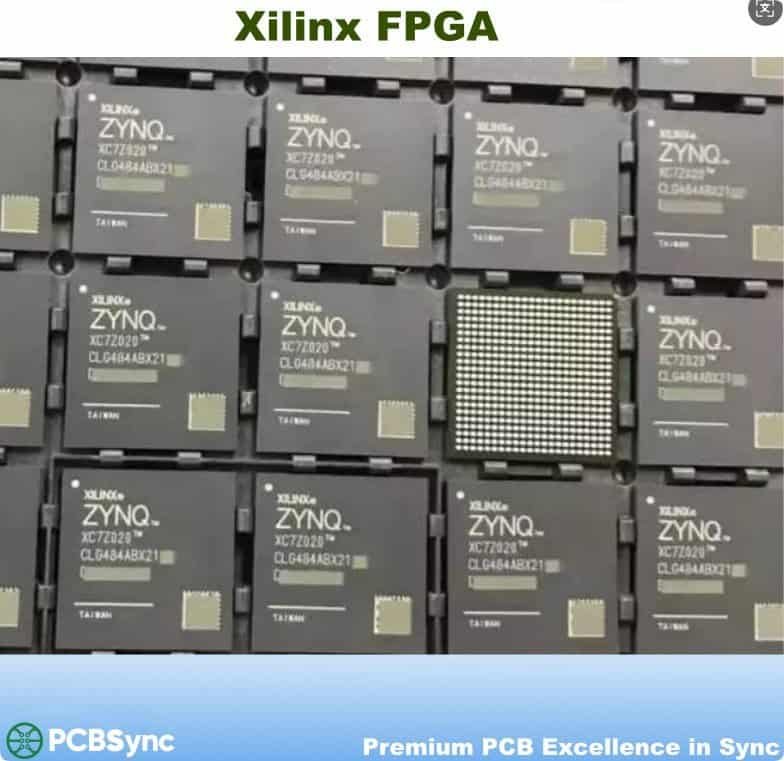
Product Overview: XCV200E-7PQ240I FPGA Solution
The XCV200E-7PQ240I represents a powerful field-programmable gate array (FPGA) from the renowned Virtex-E family, manufactured by Xilinx (now AMD). This industrial-grade programmable logic device delivers exceptional performance for complex digital designs, offering engineers a reliable solution for high-speed data processing, embedded system development, and custom logic implementation.
As part of the Virtex-E series, the XCV200E-7PQ240I combines advanced 0.18μm CMOS technology with 1.8V core voltage operation, making it an energy-efficient choice for industrial applications requiring robust performance in challenging temperature conditions.
Technical Specifications
Core Features and Parameters
| Specification |
Details |
| Part Number |
XCV200E-7PQ240I |
| Manufacturer |
Xilinx Inc. (AMD) |
| Product Family |
Virtex-E FPGAs |
| Package Type |
PQ240 (240-Pin Plastic Quad Flat Pack) |
| Temperature Grade |
Industrial (-40°C to +100°C) |
| Speed Grade |
-7 (High Performance) |
| Core Voltage |
1.8V |
| Logic Cells |
Approximately 4,704 cells |
| I/O Count |
176 User I/Os |
| System Gates |
200,000 gates |
Package and Pin Configuration
| Parameter |
Specification |
| Package Style |
PQFP (Plastic Quad Flat Pack) |
| Total Pins |
240 pins |
| Mounting Type |
Surface Mount |
| Pin Pitch |
0.5mm |
| Package Dimensions |
32mm x 32mm (nominal) |
| Body Thickness |
Standard JEDEC compliant |
Memory and Logic Resources
| Resource Type |
Capacity |
| CLB Slices |
2,352 |
| Block RAM |
56 Kbits |
| Distributed RAM |
Available in CLBs |
| DLLs (Digital Delay Lock Loops) |
4 |
| Maximum User I/O |
176 |
| Differential I/O Pairs |
Up to 88 pairs |
Key Features and Benefits
Advanced FPGA Architecture
The XCV200E-7PQ240I leverages the proven Virtex-E architecture, delivering superior place-and-route efficiency through optimized silicon design. This Xilinx FPGA incorporates a rich hierarchy of interconnect resources, enabling high-speed signal routing and minimal propagation delays across complex designs.
Architecture Highlights:
- Five-layer metal CMOS process for enhanced signal integrity
- Dedicated carry chains for high-speed arithmetic operations
- Flexible logic block configuration supporting multiple design topologies
- Advanced clock management with integrated DLL technology
Industrial Temperature Range Performance
The “I” designation in the XCV200E-7PQ240I part number signifies industrial temperature grade certification, ensuring reliable operation across extended temperature ranges from -40°C to +100°C. This makes the device ideal for:
- Automotive electronics systems
- Industrial control and automation
- Outdoor telecommunications equipment
- Military and aerospace applications
- Medical instrumentation
Speed Grade -7 Performance
The speed grade -7 designation indicates high-performance timing characteristics, providing:
- Fast propagation delays for time-critical paths
- High maximum operating frequencies
- Reduced setup and hold times
- Enhanced throughput for data-intensive applications
Application Areas
Industrial Automation and Control
The XCV200E-7PQ240I excels in industrial environments where programmable logic provides flexibility for:
- Motor control systems
- PLC (Programmable Logic Controller) implementations
- Factory automation interfaces
- Real-time monitoring systems
- Process control applications
Communications Infrastructure
This FPGA solution supports various communication protocols and standards:
- Digital signal processing (DSP) functions
- Protocol conversion and bridging
- Network packet processing
- Telecommunications base stations
- Data acquisition systems
Embedded System Development
Engineers leverage the XCV200E-7PQ240I for custom embedded solutions:
- Custom processor cores
- Co-processor acceleration
- Peripheral interface controllers
- System-on-chip (SoC) prototyping
- Embedded vision processing
Performance Specifications
Electrical Characteristics
| Parameter |
Min |
Typ |
Max |
Unit |
| Core Voltage (VCCINT) |
1.71 |
1.8 |
1.89 |
V |
| I/O Voltage (VCCO) |
1.4 |
Various |
3.6 |
V |
| Static Power (Typ) |
– |
300 |
– |
mW |
| Junction Temperature |
-40 |
– |
+125 |
°C |
Timing Performance
The -7 speed grade delivers competitive timing performance:
- Internal clock frequencies exceeding 200 MHz for many designs
- Low input-to-output delays
- Minimal clock-to-output times
- Fast configuration times for rapid system initialization
Design and Development Support
Compatible Development Tools
The XCV200E-7PQ240I integrates seamlessly with Xilinx development environments:
Software Support:
- Xilinx ISE Design Suite (legacy support)
- Xilinx Vivado (for migration planning)
- Third-party synthesis tools
- VHDL and Verilog HDL support
- Schematic capture interfaces
Programming Options:
- JTAG boundary scan programming
- Master Serial configuration mode
- Slave Serial configuration mode
- SelectMAP parallel configuration
- Configuration PROM support
IP Core Compatibility
Designers can leverage extensive IP core libraries:
- Memory controllers (SDRAM, DDR)
- Communication interfaces (UART, SPI, I2C)
- DSP functions and filters
- PCI bus interfaces
- Custom IP integration
Package Information: PQ240
PQ240 Package Advantages
The 240-pin Plastic Quad Flat Pack offers several benefits:
Space Efficiency:
- Compact 32mm x 32mm footprint
- Suitable for dense PCB layouts
- Four-sided pin arrangement maximizing I/O density
Manufacturing Benefits:
- Standard SMT assembly processes
- Industry-standard package dimensions
- Proven thermal characteristics
- Cost-effective production scaling
Design Flexibility:
- Adequate pin count for medium-complexity designs
- Manageable routing complexity
- Standard 0.5mm pin pitch
- Compatible with automated optical inspection (AOI)
Quality and Reliability
Manufacturing Standards
The XCV200E-7PQ240I adheres to stringent quality standards:
- ISO 9001 certified manufacturing
- JEDEC standard compliance
- Automotive-grade quality processes (where applicable)
- RoHS compliant versions available
- Full traceability and quality documentation
Reliability Metrics
Xilinx FPGAs undergo extensive reliability testing:
- HTOL (High Temperature Operating Life) testing
- Temperature cycling qualification
- Moisture sensitivity level (MSL) classification
- ESD protection testing
- Latch-up immunity verification
Comparison with Related Devices
Virtex-E Family Comparison
| Device |
System Gates |
CLB Slices |
Block RAM |
Max I/Os |
| XCV50E |
50,000 |
384 |
32 Kbits |
176 |
| XCV100E |
100,000 |
1,200 |
40 Kbits |
176 |
| XCV200E |
200,000 |
2,352 |
56 Kbits |
176 |
| XCV300E |
300,000 |
3,456 |
72 Kbits |
316 |
| XCV400E |
400,000 |
4,704 |
96 Kbits |
404 |
Package Variants
The XCV200E is available in multiple package options:
| Package |
Pins |
I/Os |
Form Factor |
| CS144 |
144 |
97 |
Chip Scale |
| PQ240 |
240 |
176 |
Plastic Quad Flat Pack |
| FG256 |
256 |
176 |
Fine-Pitch BGA |
| BG352 |
352 |
260 |
Ball Grid Array |
| FG456 |
456 |
284 |
Fine-Pitch BGA |
Power Management Considerations
Power Supply Requirements
Proper power delivery ensures optimal XCV200E-7PQ240I performance:
Voltage Domains:
- VCCINT (Core): 1.8V ±5% for logic operation
- VCCO (I/O Banks): 1.4V to 3.6V depending on I/O standard
- VCCAUX: 2.5V for DLL and auxiliary functions
Decoupling Recommendations:
- Multiple ceramic capacitors per power domain
- Bulk capacitance for transient response
- Low-ESR capacitors near BGA vias
- Proper power plane design
Thermal Management
The industrial temperature grade requires appropriate thermal design:
Thermal Characteristics:
- Junction-to-ambient thermal resistance varies by airflow
- Heat sink recommendations for high-utilization designs
- Thermal simulation recommended for dense applications
- Temperature monitoring capabilities available
Design Best Practices
PCB Layout Guidelines
Optimizing PCB design for the XCV200E-7PQ240I:
Signal Integrity:
- Controlled impedance routing for high-speed signals
- Differential pair matching for LVDS interfaces
- Ground plane continuity
- Proper via placement and routing
Power Distribution:
- Dedicated power planes for each voltage domain
- Adequate trace widths for current capacity
- Strategic decoupling capacitor placement
- Low-inductance power delivery paths
Configuration Strategy
Several configuration methods support different system requirements:
Master Mode:
- FPGA controls configuration process
- Reads bitstream from external memory
- Suitable for standalone operation
Slave Mode:
- External controller provides bitstream
- Lower component cost
- Simplified board design
JTAG Configuration:
- Development and debugging
- In-system reprogramming
- Boundary scan testing
Migration and Obsolescence Planning
Product Lifecycle Status
The Virtex-E family has reached end-of-life status. For new designs, consider:
Migration Paths:
- Spartan-6 family for cost-optimized designs
- Artix-7 family for enhanced performance
- Kintex-7 for higher logic density
- Zynq SoC for processor integration
Legacy Support:
- Continued availability from distribution channels
- Design tools remain accessible
- Technical documentation preserved
- Third-party support ecosystem
Frequently Asked Questions
What makes the XCV200E-7PQ240I suitable for industrial applications?
The industrial temperature grade (-40°C to +100°C) and robust design make this FPGA ideal for harsh environments where commercial-grade components would fail. The extended temperature range ensures reliable operation in automotive, industrial control, and outdoor telecommunications applications.
How does speed grade -7 compare to other options?
Speed grade -7 represents high-performance timing specifications within the Virtex-E family. It offers faster propagation delays and higher maximum frequencies compared to -4, -5, and -6 speed grades, while -8 provides the absolute highest performance for the most demanding applications.
What development tools are required?
The XCV200E-7PQ240I requires Xilinx ISE Design Suite for legacy support, though migration to Vivado is recommended for long-term projects. Standard HDL languages (VHDL, Verilog) are supported along with schematic capture tools.
Is the XCV200E-7PQ240I RoHS compliant?
RoHS compliance varies by specific date code and manufacturing lot. Consult with your distributor for RoHS-compliant versions or refer to Xilinx documentation for environmental compliance information specific to your procurement requirements.
What configuration memory is recommended?
For Master Serial mode, Xilinx configuration PROMs (XCF series) are recommended. The XCV200E requires approximately 2.5 Megabits of configuration data, making the XCF04S or XCF08P suitable options depending on future design expansion needs.
Ordering Information and Availability
Part Number Nomenclature
Understanding the XCV200E-7PQ240I designation:
- XCV = Virtex-E family identifier
- 200 = 200K system gate equivalent
- E = Enhanced features (DLLs, block RAM)
- -7 = Speed grade (performance level)
- PQ240 = Package type and pin count
- I = Industrial temperature range
Where to Buy
The XCV200E-7PQ240I is available through:
- Authorized Xilinx distributors
- Electronic component retailers
- Specialized FPGA suppliers
- Surplus and obsolete part specialists
For comprehensive Xilinx FPGA solutions and technical support, visit Xilinx FPGA resources.
Conclusion
The XCV200E-7PQ240I delivers proven FPGA performance for industrial applications requiring reliable programmable logic in challenging environments. With its 200,000 system gates, 176 I/Os, and industrial temperature qualification, this device continues to serve legacy designs while offering a foundation for understanding modern FPGA architecture principles.
Whether you’re maintaining existing systems or evaluating migration strategies, the XCV200E-7PQ240I represents a robust solution backed by extensive documentation, proven reliability, and comprehensive development tool support from the Xilinx ecosystem.