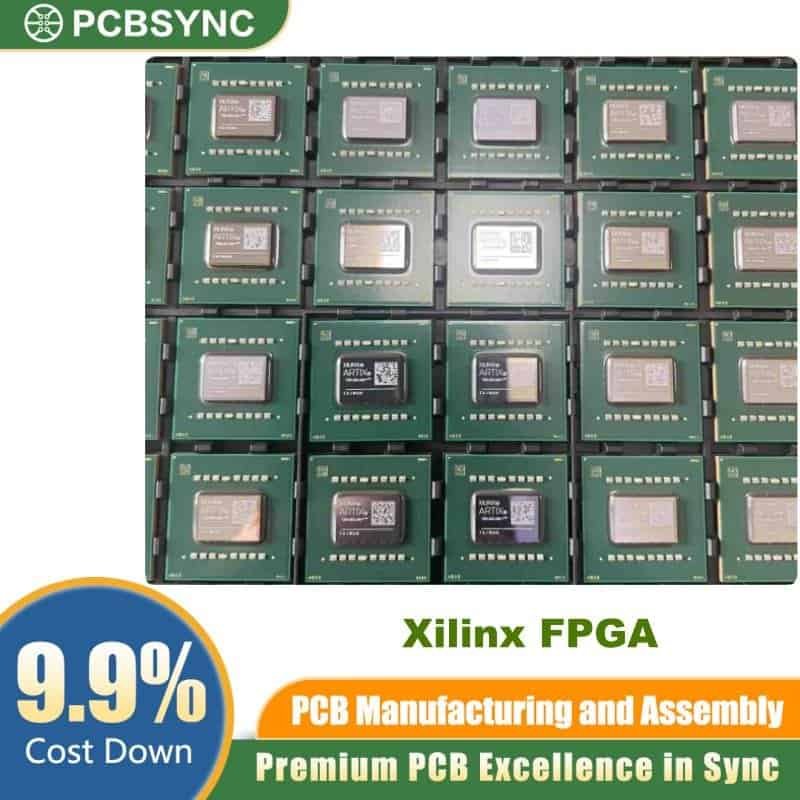
The XCV200E-7FG456C is a high-performance Field-Programmable Gate Array (FPGA) from Xilinx’s Virtex-E family, designed for engineers and system architects who demand speed, flexibility, and silicon efficiency. Built on a 0.18 µm CMOS process with a 456-pin Fine-Pitch Ball Grid Array (FBGA) package, this device delivers 63,504 equivalent system gates and operates at up to 400 MHz — making it a proven solution for demanding digital design applications.
Whether you are working on telecom infrastructure, embedded processing, digital signal processing (DSP), or high-speed data acquisition, the XCV200E-7FG456C provides the programmable logic capacity and I/O bandwidth your design requires.
What Is the XCV200E-7FG456C?
The XCV200E-7FG456C is a member of the Xilinx Virtex-E 1.8V FPGA family — an evolutionary advancement over the original Virtex architecture. Combining a rich hierarchy of fast, flexible interconnect resources with advanced 6-layer metal process technology, the Virtex-E family was designed as a high-density, high-speed alternative to mask-programmed gate arrays, dramatically reducing time-to-market without sacrificing performance.
The part number encodes the device’s key attributes:
| Segment |
Meaning |
| XCV200E |
Virtex-E family, 200K logic capacity |
| -7 |
Speed grade 7 (fastest in the Virtex-E lineup) |
| FG456 |
456-pin Fine-Pitch Ball Grid Array (FBGA) package |
| C |
Commercial temperature range (0°C to +85°C TJ) |
XCV200E-7FG456C Key Technical Specifications
The table below summarizes the core electrical and physical parameters of the XCV200E-7FG456C:
| Parameter |
Value |
| Manufacturer |
Xilinx (now AMD) |
| Series / Family |
Virtex-E |
| Part Number |
XCV200E-7FG456C |
| Logic Gates (Equivalent) |
63,504 |
| Logic Cells |
5,292 |
| CLBs (Configurable Logic Blocks) |
1,176 |
| I/O Pins |
284 |
| Maximum Operating Frequency |
400 MHz |
| Core Supply Voltage (VCCINT) |
1.8V (1.71V – 1.89V) |
| Process Technology |
0.18 µm 6-layer metal CMOS |
| Package |
456-Pin FBGA (FG456) |
| Mounting Type |
Surface Mount |
| On-chip SRAM (Block RAM) |
114,688 bits (≈ 14 kB) |
| Commercial Temp Range |
0°C to +85°C TJ |
| RoHS Compliance |
No (legacy part) |
| Life Cycle Status |
Obsolete (legacy/last-time-buy) |
XCV200E-7FG456C Package & Pinout Overview
The XCV200E-7FG456C uses a 456-pin Fine-Pitch Ball Grid Array (FBGA) package — also referred to as BBGA or FBGA-456. This compact, surface-mount package offers high pin density and excellent electrical performance, making it suitable for high-speed PCB designs.
Package Details
| Attribute |
Detail |
| Package Code |
FG456 / FBGA-456 |
| Total Pin Count |
456 |
| User I/O Count |
284 |
| Mounting |
Surface Mount (SMD) |
| Packaging / Shipping |
Tray |
The 284 user-configurable I/O pins support multiple single-ended and differential I/O standards, giving designers maximum flexibility in interfacing with external devices, memory, and communication buses.
Virtex-E Architecture: What Makes It Powerful
The Virtex-E family architecture is built around a modular array of Configurable Logic Blocks (CLBs), Block RAM, dedicated multipliers, and a hierarchy of routing resources. The XCV200E-7FG456C benefits from all these architectural features.
Configurable Logic Blocks (CLBs)
Each CLB in the Virtex-E family contains two slices, and each slice includes two 4-input Look-Up Tables (LUTs), storage elements (flip-flops), and carry logic for fast arithmetic. With 1,176 CLBs and 5,292 logic cells, the XCV200E-7FG456C provides ample resources for moderate to complex logic designs.
Block RAM (BRAM)
On-chip Block RAM in the XCV200E-7FG456C totals 114,688 bits (~14 kB), configurable as single-port or true dual-port memory. This enables fast, synchronous storage of lookup tables, FIFOs, accumulators, and data buffers without consuming CLB resources.
Interconnect Hierarchy
The Virtex-E routing architecture features a multi-tiered interconnect system including local, long-line, and global routing resources. This results in highly predictable, repeatable timing closure — an essential attribute for high-frequency digital designs.
Dedicated DLL and Global Clock Networks
The device includes Delay-Locked Loops (DLLs) for clock deskewing, phase shifting, and frequency synthesis, along with dedicated global clock buffers to distribute low-skew clocks across the entire device.
Speed Grade -7: Performance Characteristics
The -7 speed grade is the highest-performance variant in the Virtex-E family. Key performance benefits include:
| Performance Metric |
Specification |
| Max System Clock |
400 MHz |
| Speed Grade |
-7 (fastest) |
| Register-to-Register Delay |
Optimized for -7 grade |
| Logic Propagation |
Minimized via architecture |
| I/O Setup/Hold |
Tight constraints for -7 grade |
Designers using the -7 speed grade can achieve the highest logic frequencies among XCV200E variants, making this part ideal for applications requiring maximum throughput.
XCV200E-7FG456C vs. Other XCV200E Variants
The XCV200E is available in multiple speed grades and package combinations. Understanding the differences helps ensure you select the right variant for your system requirements.
| Part Number |
Speed Grade |
Package |
Temp Range |
I/O Pins |
| XCV200E-6FG456C |
-6 (moderate) |
456 FBGA |
Commercial |
284 |
| XCV200E-7FG456C (this part) |
-7 (fastest) |
456 FBGA |
Commercial |
284 |
| XCV200E-7FG456I |
-7 (fastest) |
456 FBGA |
Industrial |
284 |
| XCV200E-8FG256C |
-8 |
256 FBGA |
Commercial |
Lower |
| XCV200E-7PQ240C |
-7 |
240 PQFP |
Commercial |
Lower |
The FG456 package provides the highest I/O count (284 pins) in the XCV200E family, while the C suffix confirms commercial temperature operation (0°C – 85°C TJ). For industrial applications requiring operation down to -40°C, the XCV200E-7FG456I should be selected instead.
Supported I/O Standards
The XCV200E-7FG456C supports a wide variety of I/O signaling standards, enabling seamless integration with diverse system components:
| I/O Standard Category |
Examples |
| Single-Ended CMOS |
LVCMOS 3.3V, 2.5V, 1.8V |
| Single-Ended TTL |
LVTTL |
| Low-Voltage Differential |
LVDS, LVPECL, GTL, GTL+ |
| Bus Standards |
PCI (3.3V), AGP, HSTL |
| High-Speed I/O |
SSTL2, SSTL3 |
This extensive I/O standard support allows the XCV200E-7FG456C to interface with DDR memory, high-speed buses, and mixed-voltage systems without external level-shifting circuitry.
Typical Applications for the XCV200E-7FG456C
As a versatile Xilinx FPGA, the XCV200E-7FG456C has been deployed across a broad range of industries and system types, including:
| Application Area |
Use Case Examples |
| Telecommunications |
Line cards, framing/mapping, signal routing |
| Data Centers & Enterprise |
Network switching, high-speed data buffering |
| Automotive (ADAS) |
Sensor data fusion, image processing pipelines |
| Defense & Aerospace |
Signal processing, radar front-ends |
| Industrial Automation |
Real-time control, machine vision interfaces |
| Consumer Electronics |
Home theater processing, display controllers |
| Embedded Systems |
Custom soft-core processor implementations |
| Test & Measurement |
Pattern generation, data capture, logic analysis |
Design Tools and Software Support
The XCV200E-7FG456C is supported by Xilinx’s legacy ISE Design Suite (not Vivado, which targets newer 7-Series and UltraScale devices). Key software tools for this device include:
- Xilinx ISE – Synthesis, implementation, and bitstream generation
- XST (Xilinx Synthesis Technology) – HDL synthesis engine within ISE
- ChipScope Pro – On-chip logic analysis and debugging
- CORE Generator – IP core generation for common logic functions
- iMPACT – JTAG-based device programming and boundary scan
Since the XCV200E-7FG456C is an obsolete part, Xilinx/AMD no longer provides active software updates for it. Engineers should use the last supported ISE version (14.7) for new or legacy design maintenance.
Ordering Information & Supply Chain Notes
| Attribute |
Detail |
| Manufacturer |
Xilinx, Inc. (now AMD) |
| Full Part Number |
XCV200E-7FG456C |
| ECCN Code |
3A991.D |
| RoHS |
Non-compliant (legacy) |
| Life Cycle |
Obsolete |
| Recommended Alternatives |
Xilinx Spartan-6, Artix-7, or Kintex-7 families |
Because the XCV200E-7FG456C is an obsolete component, it is no longer manufactured in production quantities. Stock is primarily available through independent distributors, franchise distributors managing end-of-life inventory, and authorized excess stock channels. When sourcing this component, buyers should verify:
- Authenticity and traceability (request COC / test reports)
- Date codes and original reel/tray packaging
- ESD-compliant handling and shipping
- Supplier certifications (ISO, AS9120 for defense/aerospace)
XCV200E-7FG456C Absolute Maximum Ratings
Operating the XCV200E-7FG456C beyond its absolute maximum ratings can cause permanent damage. The following are the critical limits to observe:
| Parameter |
Rating |
| Supply Voltage (VCCINT) |
–0.5V to +2.5V |
| Supply Voltage (VCCO) |
–0.5V to +4.0V |
| Input Voltage (VI) |
–0.5V to VCCO + 0.5V |
| Storage Temperature |
–65°C to +150°C |
| Junction Temperature (TJ) – Commercial |
0°C to +85°C |
| ESD Protection |
Per JEDEC/JESD22 |
Always operate within recommended conditions — not at absolute maximum ratings — to ensure full functionality, timing compliance, and long-term device reliability.
Frequently Asked Questions (FAQ)
What is the XCV200E-7FG456C used for?
The XCV200E-7FG456C is a Xilinx Virtex-E FPGA used in high-speed digital design applications such as telecommunications, embedded systems, industrial automation, automotive ADAS, and data center equipment. Its 400 MHz operating frequency and 284 I/O pins make it suitable for bandwidth-intensive designs.
What does the “-7” speed grade mean in XCV200E-7FG456C?
The “-7” indicates the fastest speed grade available in the XCV200E family. A higher speed grade number correlates with faster internal propagation delays and allows the device to operate at higher clock frequencies — up to 400 MHz in this case.
Is the XCV200E-7FG456C still in production?
No. The XCV200E-7FG456C is classified as Obsolete by Xilinx/AMD. It is no longer in active production. Availability is limited to existing inventory held by distributors, and designers starting new projects should evaluate pin-compatible or functionally equivalent replacements from the Xilinx Spartan-6 or Artix-7 families.
What package does the XCV200E-7FG456C use?
It uses a 456-pin Fine-Pitch Ball Grid Array (FBGA-456) package, also denoted FG456. This is a surface-mount package with a total of 456 solder balls, of which 284 are user-accessible I/O pins.
What is the core voltage for the XCV200E-7FG456C?
The core supply voltage (VCCINT) is 1.8V, with a recommended operating range of 1.71V to 1.89V. I/O voltages (VCCO) vary depending on the selected I/O standard, ranging from 1.5V to 3.3V.
What software tools are used to program the XCV200E-7FG456C?
The XCV200E-7FG456C is supported by the Xilinx ISE Design Suite (version 14.7 is the final release). Vivado does not support Virtex-E devices. Programming is performed via JTAG using iMPACT, and on-chip debugging can be done with ChipScope Pro.
Summary
The XCV200E-7FG456C remains a powerful and capable FPGA for engineers maintaining legacy systems or working with architectures originally designed around the Virtex-E family. Its combination of 63,504 equivalent gates, 284 I/O pins, 400 MHz performance, and 1.8V core voltage in a compact 456-pin FBGA package made it a benchmark device in its era — and continues to serve engineers in maintenance, repair, and legacy production scenarios.
For new designs, exploring modern Xilinx/AMD FPGA families will offer improved density, lower power consumption, and better toolchain support, while the XCV200E-7FG456C will continue to serve its role in sustaining existing deployed systems.