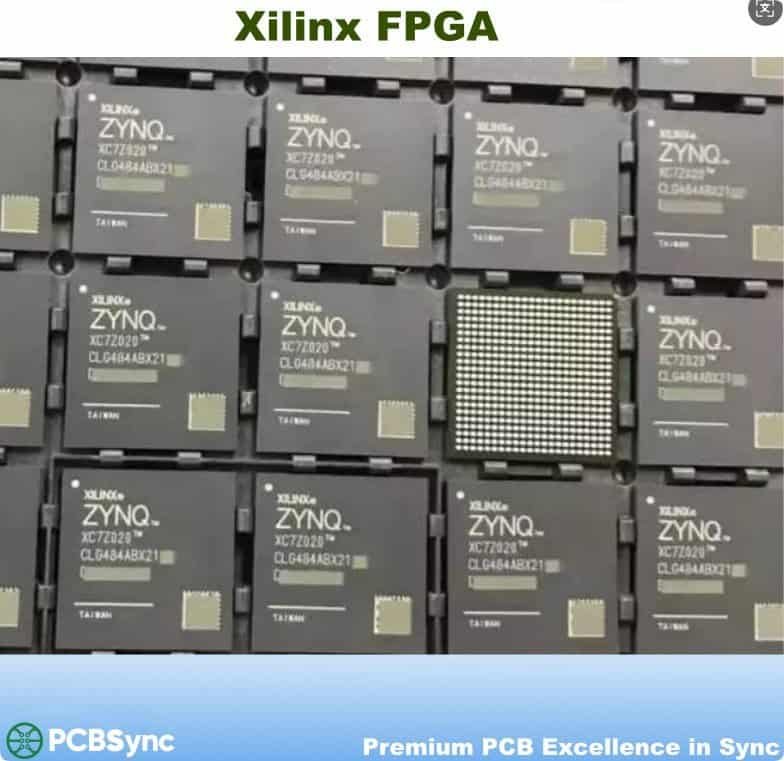
The XCV200E-6FGG256C is a high-performance field programmable gate array (FPGA) from AMD Xilinx’s Virtex-E family, delivering exceptional programmable logic capabilities for demanding industrial applications. This 1.8V FPGA combines advanced 0.18μm CMOS technology with extensive I/O resources, making it the ideal solution for embedded computing, industrial automation, and digital signal processing applications.
Overview of XCV200E-6FGG256C FPGA
The XCV200E-6FGG256C represents a significant advancement in programmable logic design, offering engineers a powerful platform for implementing complex digital systems. Built on Xilinx’s proven Xilinx FPGA architecture, this device delivers superior performance while maintaining low power consumption.
Key Features and Specifications
| Feature |
Specification |
| Logic Cells |
4,096 (5,292 cells) |
| System Gates |
63,504 gates |
| CLBs (Configurable Logic Blocks) |
1,176 |
| Maximum Clock Frequency |
250-357 MHz |
| Technology Node |
0.18μm CMOS process |
| Operating Voltage |
1.8V |
| Package Type |
256-pin Fine-pitch BGA (FBGA) |
| Total I/O Pins |
176 I/O |
| Speed Grade |
-6 (Commercial) |
Technical Architecture and Performance
Advanced FPGA Architecture
The XCV200E-6FGG256C features a sophisticated 6-input lookup table (LUT) architecture optimized for place-and-route efficiency. This advanced design enables:
- High-density logic implementation with 4,096 logic cells
- Up to 8,192 RAM blocks for embedded memory applications
- 256-bit wide data path for high-throughput data processing
- Six-layer metal interconnect architecture for superior routing flexibility
Memory and Processing Capabilities
| Memory Type |
Capacity |
| Total Logic Cells |
4,096 |
| RAM Blocks |
Up to 8,192 |
| Distributed RAM |
Configurable within CLBs |
| Block RAM |
Dedicated memory blocks |
| Data Path Width |
256-bit |
Package and Pin Configuration
256-FBGA Package Details
The XCV200E-6FGG256C utilizes a compact 256-pin Fine-pitch Ball Grid Array (FBGA) package, offering:
- Total Package Pins: 256
- Available User I/O: 176
- Package Footprint: Space-efficient design for high-density PCB layouts
- Ball Pitch: Fine-pitch for maximum signal integrity
- Thermal Performance: Enhanced heat dissipation capabilities
I/O Standards and Compatibility
The device supports multiple I/O standards for maximum design flexibility:
| I/O Standard |
Description |
Application |
| LVDS |
Low-Voltage Differential Signaling |
High-speed serial communication |
| LVCMOS |
Low-Voltage CMOS |
General-purpose digital I/O |
| Single-Ended I/O |
Standard digital signals |
Legacy interface compatibility |
Performance Specifications
Speed and Timing Characteristics
The -6 speed grade delivers robust performance for commercial applications:
- Maximum Operating Frequency: 250-357 MHz (depending on design complexity)
- Propagation Delay: Optimized for high-speed operations
- Setup and Hold Times: Industry-leading timing margins
- Clock-to-Output Delay: Minimal latency for real-time applications
Power Consumption Profile
| Parameter |
Typical Value |
Notes |
| Core Voltage |
1.8V |
Main logic supply |
| I/O Voltage |
Varies by standard |
1.8V to 3.3V range |
| Static Power |
Low |
Advanced power management |
| Dynamic Power |
Application-dependent |
Optimized routing reduces consumption |
Primary Applications and Use Cases
Industrial Automation and Control
The XCV200E-6FGG256C excels in industrial automation applications:
- Motor control systems with precise PWM generation
- PLC (Programmable Logic Controller) implementations
- Process monitoring and data acquisition
- Real-time control loop processing
- Industrial communication protocol handling
Digital Signal Processing (DSP)
Ideal for computationally intensive DSP applications:
- FIR and IIR filter implementations
- FFT/IFFT signal analysis
- Image and video processing pipelines
- Software-defined radio (SDR) platforms
- Audio processing and synthesis
Embedded Computing Solutions
Perfect for embedded system development:
- Custom processor interfaces
- Memory controller implementations
- Peripheral interface bridging
- Protocol conversion engines
- System-on-Chip (SoC) prototyping
Design Tools and Development Support
Xilinx ISE Design Suite
The XCV200E-6FGG256C is supported by comprehensive development tools:
- Synthesis Tools: Optimized for Virtex-E architecture
- Place and Route: Advanced algorithms for maximum performance
- Timing Analysis: Detailed timing closure support
- Simulation: Behavioral and timing simulation capabilities
- Programming Tools: JTAG and configuration memory support
Getting Started Resources
| Resource Type |
Description |
| Datasheets |
Complete electrical and timing specifications |
| Reference Designs |
Pre-verified application examples |
| Application Notes |
Best practices and design guidelines |
| Software Tools |
ISE Design Suite (legacy support) |
| Technical Support |
Community forums and documentation |
Competitive Advantages
Why Choose XCV200E-6FGG256C?
- Proven Reliability: Mature Virtex-E architecture with extensive field deployment
- Cost-Effective: Balanced performance-to-cost ratio for volume production
- Design Flexibility: Extensive I/O options accommodate diverse interface requirements
- Low Power: 1.8V operation reduces overall system power consumption
- High Integration: 63,504 gates enable complex system implementations
Comparison with Alternative Solutions
| Feature |
XCV200E-6FGG256C |
Mask-Programmed Gate Arrays |
CPLDs |
| Development Time |
Fast (hours to days) |
Slow (months) |
Fast |
| NRE Costs |
None |
Very High |
None |
| Reconfigurability |
Yes |
No |
Yes |
| Logic Capacity |
63,504 gates |
Fixed |
Limited |
| Time-to-Market |
Minimal |
Extended |
Minimal |
Quality and Reliability
Manufacturing Standards
- Process Technology: Advanced 0.18μm 6-layer metal CMOS
- Quality Assurance: ISO-certified manufacturing processes
- Testing: 100% functional testing before shipment
- Reliability: Proven in harsh industrial environments
- Temperature Range: Commercial grade (-6 suffix)
Operating Conditions
| Parameter |
Minimum |
Typical |
Maximum |
Unit |
| Core Voltage (VCCINT) |
1.71 |
1.8 |
1.89 |
V |
| I/O Voltage (VCCO) |
Varies |
– |
3.3 |
V |
| Operating Temperature |
0 |
– |
+85 |
°C |
| Junction Temperature |
– |
– |
+125 |
°C |
Integration and System Design
PCB Layout Considerations
Successful implementation of the XCV200E-6FGG256C requires attention to:
- Power Supply Design: Multiple voltage rails with proper decoupling
- Thermal Management: Adequate heat sinking for sustained operation
- Signal Integrity: Controlled impedance routing for high-speed signals
- Clock Distribution: Low-jitter clock networks for optimal performance
- Configuration: JTAG interface and configuration memory placement
Interface Design Guidelines
| Interface Type |
Recommended Practice |
| Power Rails |
Use separate planes with multiple decoupling capacitors |
| Clock Inputs |
Dedicated clock pins with minimal trace length |
| High-Speed I/O |
Differential pairs with controlled impedance |
| Configuration |
JTAG chain with proper pull-up/pull-down resistors |
| Ground |
Solid ground plane for signal return paths |
Market Positioning and Availability
Target Market Segments
The XCV200E-6FGG256C addresses multiple market sectors:
- Industrial Controls: Factory automation, robotics, machine vision
- Communications: Protocol converters, interface bridges
- Medical Electronics: Diagnostic equipment, imaging systems
- Test and Measurement: Logic analyzers, signal generators
- Aerospace: Ground support equipment (commercial grade)
Lifecycle and Support
While the Virtex-E family has reached mature status, the XCV200E-6FGG256C continues to be supported for legacy designs and maintenance applications. Engineers should consult with authorized distributors for current availability and long-term supply planning.
Ordering Information and Part Number Breakdown
Understanding the Part Number
XCV200E-6FGG256C
- XCV: Xilinx Virtex family identifier
- 200E: Virtex-E, 200K gates equivalent
- 6: Speed grade (commercial temperature range)
- FGG: Fine-pitch BGA, green package
- 256: Total package pins
- C: Commercial temperature grade (0°C to +85°C)
Package Variants
| Part Number Suffix |
Package Type |
Pin Count |
Temperature Range |
| FGG256C |
Fine-pitch BGA |
256 |
0°C to +85°C |
| FGG256I |
Fine-pitch BGA |
256 |
-40°C to +100°C |
| PQG240C |
Plastic Quad Flat |
240 |
0°C to +85°C |
| BG352C |
Ball Grid Array |
352 |
0°C to +85°C |
Frequently Asked Questions
Q: Is the XCV200E-6FGG256C RoHS compliant?
The “FGG” package designation indicates a green, lead-free package compliant with RoHS directives.
Q: What development software supports this FPGA?
The XCV200E-6FGG256C is supported by Xilinx ISE Design Suite (legacy versions 14.7 and earlier). Note that Vivado does not support Virtex-E devices.
Q: Can this FPGA be reprogrammed in-system?
Yes, the device supports JTAG-based in-system programming and can be configured from external memory sources (PROM, Flash, etc.).
Q: What is the maximum I/O toggle rate?
The I/O toggle rate depends on the selected I/O standard, but typical maximum rates range from 200-400 MHz for LVDS interfaces.
Q: Are there any special PCB design considerations?
Yes, proper power supply decoupling, thermal management, and signal integrity practices are essential. Refer to Xilinx PCB design guidelines for Virtex-E devices.
Conclusion
The XCV200E-6FGG256C delivers a compelling combination of performance, flexibility, and reliability for engineers developing advanced digital systems. With 63,504 gates, 176 I/O pins, and support for multiple I/O standards, this Virtex-E FPGA provides the resources needed for complex industrial, communications, and embedded applications.
Whether you’re implementing high-speed data processing, custom control logic, or sophisticated DSP algorithms, the XCV200E-6FGG256C offers the programmable logic capacity and performance characteristics to bring your design to life. Its mature architecture, comprehensive tool support, and proven field reliability make it an excellent choice for both new developments and legacy system maintenance.
For more information about Xilinx FPGA solutions and design resources, visit Xilinx FPGA for comprehensive technical documentation and application support.