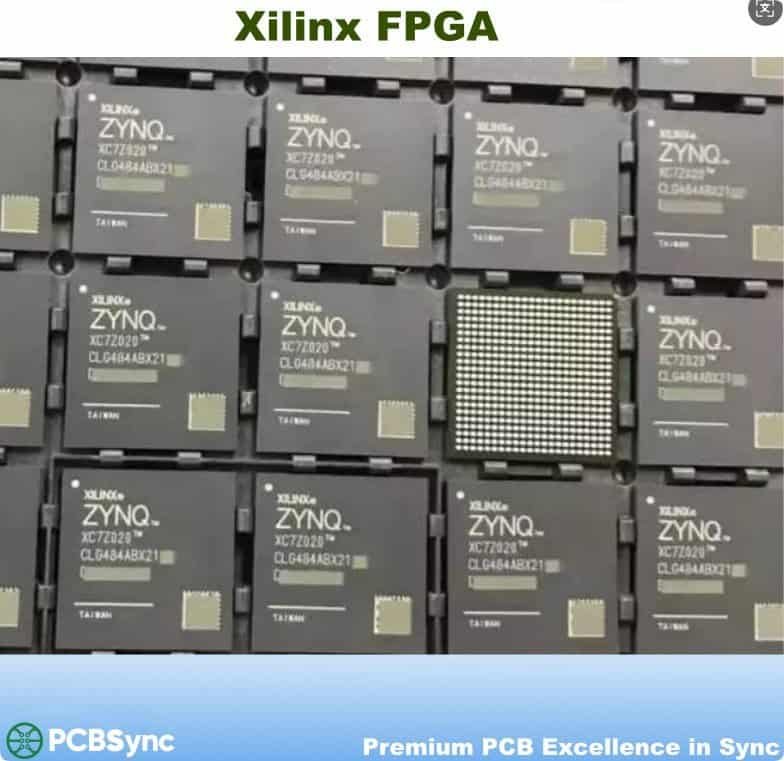
Overview of the XCV200E-6FG456C Field Programmable Gate Array
The XCV200E-6FG456C is a powerful field programmable gate array (FPGA) from AMD’s (formerly Xilinx) acclaimed Virtex-E family, engineered to deliver exceptional performance in programmable logic applications. This advanced FPGA combines high-capacity logic resources with cutting-edge 0.18µm CMOS process technology, making it an ideal solution for telecommunications, industrial automation, medical imaging, and high-speed digital signal processing applications.
As a member of the Virtex-E 1.8V series, the XCV200E-6FG456C represents a significant advancement in programmable logic design, offering designers the flexibility and performance needed for complex digital systems without the commitment of mask-programmed gate arrays.
Key Technical Specifications
Core Performance Specifications
| Specification |
Details |
| Part Number |
XCV200E-6FG456C |
| Manufacturer |
AMD (Xilinx) |
| Product Family |
Virtex-E 1.8V FPGAs |
| System Gates |
63,504K gates |
| Logic Cells |
5,292 cells |
| Configurable Logic Blocks (CLBs) |
1,176 CLBs |
| Maximum Frequency |
357 MHz |
| Process Technology |
0.18µm (180nm) CMOS |
| Operating Voltage |
1.8V nominal |
| Package Type |
456-Pin FBGA (Fine-pitch Ball Grid Array) |
| Package Dimensions |
23mm × 23mm |
| I/O Pins |
284 user I/O pins |
| Total RAM Bits |
57,344 bits |
| RoHS Compliance |
RoHS Compliant (Lead-Free) |
Advanced Memory Architecture
| Memory Feature |
Specification |
| Block RAM |
Distributed throughout CLB array |
| SelectRAM Resources |
Dual-port capabilities |
| Total Memory |
57,344 RAM bits |
| RAM Configuration |
Flexible distributed and block RAM options |
Packaging and Thermal Characteristics
| Parameter |
Value |
| Package |
FBGA-456 (Fine-pitch Ball Grid Array) |
| Pin Count |
456 pins |
| Operating Temperature Range |
0°C to +85°C (Commercial grade) |
| Speed Grade |
-6 (High-performance grade) |
| Mounting Type |
Surface Mount Technology (SMT) |
Architecture and Design Features
Advanced Virtex-E Architecture
The XCV200E-6FG456C leverages AMD’s revolutionary Virtex-E architecture, which incorporates several groundbreaking features:
Six-Layer Metal Process: The aggressive 6-layer metal 0.18µm CMOS process technology enables dramatic increases in silicon efficiency and routing density, allowing for more complex designs in a compact footprint.
Optimized CLB Structure: Each of the 1,176 Configurable Logic Blocks contains advanced lookup tables (LUTs), flip-flops, and dedicated carry logic, enabling efficient implementation of arithmetic functions and complex Boolean operations.
Hierarchical Interconnect: A rich hierarchy of fast, flexible interconnect resources ensures optimal signal routing with minimal delay, supporting high-speed operation up to 357 MHz.
Embedded Memory: Distributed SelectRAM resources throughout the FPGA fabric provide flexible memory options for FIFO buffers, data caching, and lookup table storage.
Clock Management and Timing
The XCV200E-6FG456C includes sophisticated clock management capabilities:
- Delay-Locked Loop (DLL) technology for precise clock distribution
- Multiple global clock networks for low-skew clock delivery
- Dedicated clock input pins for optimal performance
- Support for various clock frequencies up to 357 MHz
I/O Capabilities and Standards
With 284 user-configurable I/O pins, this Xilinx FPGA supports numerous industry-standard interfaces:
- LVTTL (Low Voltage Transistor-Transistor Logic)
- LVCMOS (Low Voltage CMOS) at various voltage levels
- PCI 33 MHz and 66 MHz compliance
- GTL/GTL+ for high-speed backplane applications
- SSTL and HSTL for memory interfaces
- Programmable drive strength and slew rate control
- Programmable pull-up and pull-down resistors
Application Areas and Use Cases
Telecommunications Infrastructure
The XCV200E-6FG456C excels in telecommunications applications including:
- Base station signal processing
- Network switching and routing equipment
- Protocol conversion and packet processing
- Software-defined radio (SDR) implementations
- Wireless infrastructure components
Industrial Automation and Control
Manufacturing and industrial systems benefit from:
- Real-time control systems
- Machine vision processing
- Motor control and servo systems
- Industrial protocol gateways
- Programmable logic controllers (PLC) enhancement
Medical Imaging Equipment
Healthcare applications leverage the FPGA’s processing power for:
- MRI signal processing
- Ultrasound imaging systems
- CT scan data reconstruction
- Digital X-ray image processing
- Diagnostic equipment signal analysis
High-Performance Computing
Research and computational applications include:
- Digital signal processing (DSP) acceleration
- Algorithm prototyping and testing
- Cryptographic processing
- Data compression engines
- Scientific instrumentation
Consumer Electronics
Modern consumer devices utilize the XCV200E-6FG456C for:
- High-definition video processing
- Audio signal processing and effects
- Gaming console logic
- Advanced display controllers
Design Tools and Development Environment
Xilinx ISE Design Suite
The XCV200E-6FG456C is supported by Xilinx’s comprehensive ISE (Integrated Software Environment) Design Suite, which includes:
- Synthesis Tools: For converting HDL code to gate-level netlists
- Implementation Tools: Place-and-route optimization
- Simulation Environment: Comprehensive timing and functional verification
- ChipScope Pro: Integrated logic analyzer for debugging
Hardware Description Language Support
Designers can develop applications using:
- VHDL: Industry-standard hardware description language
- Verilog: Popular HDL for digital design
- Schematic Entry: Visual design capture for block-level development
- IP Cores: Pre-verified intellectual property blocks
Programming and Configuration
Multiple configuration methods are supported:
- JTAG Configuration: For development and debugging
- Master Serial Mode: Using external PROM (e.g., XC1701L)
- Slave Serial Mode: For daisy-chain configurations
- SelectMAP: High-speed parallel configuration
- Boundary Scan: IEEE 1149.1 JTAG support
Performance Advantages
Silicon Efficiency
The Virtex-E architecture’s optimized place-and-route efficiency results in:
- Higher logic utilization rates
- Reduced design iterations
- Faster time-to-market
- Lower overall system costs
Speed and Throughput
With a maximum operating frequency of 357 MHz, designers can achieve:
- High-bandwidth data processing
- Real-time signal processing
- Low-latency system responses
- Multi-channel parallel processing
Power Efficiency
The 1.8V core voltage provides:
- Reduced power consumption compared to older generations
- Lower thermal dissipation
- Extended battery life in portable applications
- Improved system reliability
Quality and Reliability
Manufacturing Standards
The XCV200E-6FG456C is manufactured to the highest quality standards:
- Advanced 0.18µm CMOS process technology
- Rigorous testing and quality control
- Extended temperature range operation
- RoHS compliant for environmental responsibility
Long-Term Availability
While the Virtex-E family has been marked for obsolescence, existing inventory and authorized distributors continue to support:
- Legacy system maintenance
- Replacement component sourcing
- Form-fit-function compatible solutions
- Engineering change order (ECO) support
Comparison with Related Products
XCV200E Family Variants
| Part Number |
Package |
Pins |
Key Difference |
| XCV200E-6FG456C |
FBGA |
456 |
Standard commercial temperature |
| XCV200E-6FG456I |
FBGA |
456 |
Industrial temperature (-40°C to +100°C) |
| XCV200E-6PQ240C |
PQFP |
240 |
Smaller pin count, quad flat pack |
| XCV200E-6BG352C |
BGA |
352 |
Alternative ball grid array option |
Migration Path Considerations
For new designs, AMD offers migration paths to current FPGA families:
- Artix-7: Cost-optimized replacement
- Spartan-7: Low-power alternative
- Kintex-7: Enhanced performance option
- Zynq-7000: System-on-chip integration
Purchasing and Availability
Authorized Distribution Channels
The XCV200E-6FG456C is available through:
- Major electronic component distributors
- Authorized AMD/Xilinx resellers
- Specialized FPGA suppliers
- Electronic component marketplaces
Quality Assurance
When purchasing, verify:
- Authentic AMD/Xilinx packaging
- Date codes and lot traceability
- Anti-counterfeiting measures
- Warranty and return policies
- Storage and handling guidelines
Technical Support Resources
Documentation
Engineers can access comprehensive resources:
- Product datasheets and specifications
- Application notes and white papers
- Reference designs and example code
- PCB layout guidelines
- Thermal management guides
Design Assistance
Support channels include:
- AMD technical support forums
- FAE (Field Application Engineer) assistance
- Community knowledge bases
- Training webinars and workshops
- Design consultation services
Frequently Asked Questions
Q: Is the XCV200E-6FG456C suitable for new designs? A: While the Virtex-E family has been marked for obsolescence, the XCV200E-6FG456C remains an excellent choice for legacy system support, prototype development, and applications where the specific feature set aligns with project requirements. For new high-volume production, consider migrating to current-generation FPGA families.
Q: What programming tools are required? A: The XCV200E-6FG456C is programmed using Xilinx ISE Design Suite. You’ll also need a compatible JTAG programming cable or external configuration PROM for production deployment.
Q: What is the difference between the -6 speed grade and other grades? A: The -6 speed grade indicates high-performance operation with maximum frequencies up to 357 MHz. Lower numbers (e.g., -7, -8) represent faster speed grades with higher performance and typically higher cost.
Q: Can I replace an XCV200E-6FG456C with a newer FPGA? A: Direct pin-compatible replacements are generally not available. However, AMD offers migration tools and documentation to help transition designs to newer FPGA families while maintaining functional equivalence.
Q: What thermal management is required? A: Thermal requirements depend on design utilization and clock frequencies. Typical applications may require heatsinks or forced air cooling. Consult the thermal management application notes for specific guidance.
Conclusion
The XCV200E-6FG456C represents a proven, reliable FPGA solution for demanding digital design applications. With its combination of 63,504K system gates, 5,292 logic cells, and 357 MHz maximum operating frequency, this Virtex-E family member delivers the performance and flexibility needed for telecommunications, industrial, medical, and high-performance computing applications.
While newer FPGA families offer enhanced features and improved performance-per-watt ratios, the XCV200E-6FG456C continues to serve critical roles in legacy systems and applications where its specific characteristics provide optimal solutions. Its mature development tools, extensive documentation, and proven reliability make it a dependable choice for engineering teams worldwide.
Whether you’re maintaining existing systems, developing prototypes, or implementing specialized applications, the XCV200E-6FG456C offers the programmable logic capabilities necessary for success in modern digital design.