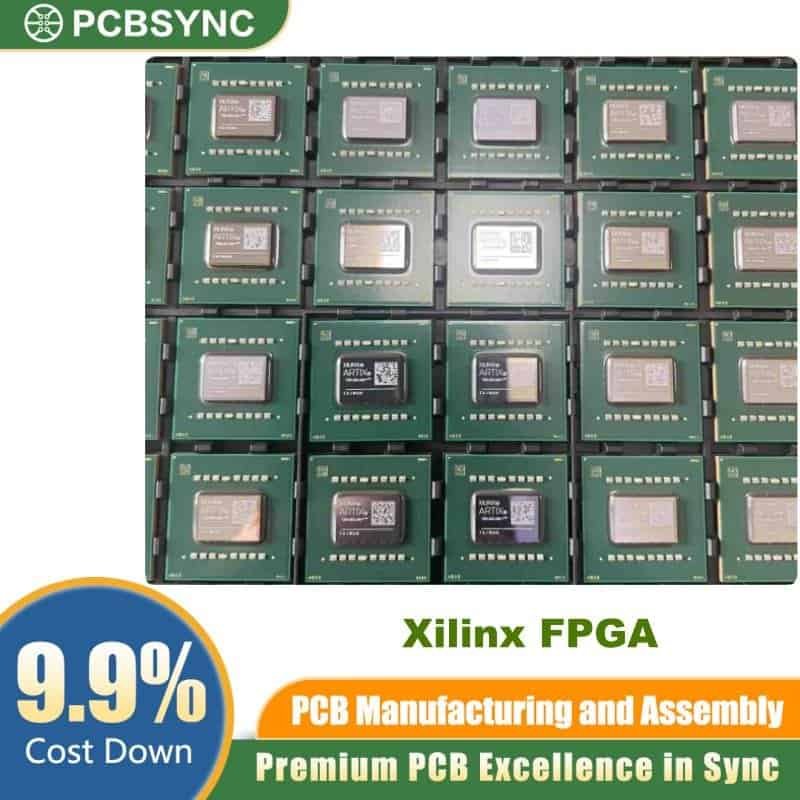
Overview of XCV2000E-8FG1156C FPGA Technology
The XCV2000E-8FG1156C is a powerful Field-Programmable Gate Array (FPGA) from AMD’s (formerly Xilinx) Virtex-E family, designed to deliver exceptional performance in high-density programmable logic applications. This advanced FPGA solution combines cutting-edge 0.18 μm CMOS process technology with sophisticated architecture to meet the demands of complex digital designs.
As part of the industry-leading Xilinx FPGA product line, the XCV2000E-8FG1156C offers engineers a reliable and versatile platform for implementing sophisticated digital systems across telecommunications, industrial automation, and embedded computing applications.
Key Specifications and Technical Features
Core Technical Specifications
| Parameter |
Specification |
| Part Number |
XCV2000E-8FG1156C |
| Manufacturer |
AMD (Xilinx) |
| Product Family |
Virtex-E |
| Package Type |
1156-FBGA (Fine-Pitch Ball Grid Array) |
| Total I/O Pins |
804 User I/O |
| Pin Count |
1156 pins |
| Speed Grade |
-8 (High Performance) |
| Logic Cells |
655,360 system gates |
| Configurable Logic Blocks (CLBs) |
43,200 |
| Operating Temperature |
0°C to 85°C (Commercial Grade) |
| Supply Voltage |
1.71V to 1.89V (Core) |
Package Dimensions and Physical Characteristics
| Characteristic |
Value |
| Package Size |
34mm × 34mm |
| Package Height |
4.0mm (typical) |
| Ball Pitch |
1.0mm |
| Mounting Type |
Surface Mount Technology (SMT) |
| Package Material |
BGA substrate with solder balls |
Advanced Architecture and Performance Capabilities
High-Density Programmable Logic
The XCV2000E-8FG1156C FPGA delivers exceptional logic density with 2.5 million system gates, making it ideal for complex digital signal processing, communications protocols, and high-performance computing applications. The advanced 6-layer metal 0.18 μm CMOS process ensures optimal signal integrity and routing efficiency.
Speed Grade and Performance Metrics
With a speed grade of -8, this FPGA variant offers:
- Internal clock frequencies up to 130 MHz (four LUT levels)
- Fast interconnect routing for reduced propagation delays
- Optimized for high-performance applications requiring maximum throughput
- Enhanced timing margins for reliable operation
Input/Output Capabilities
The 804 user I/O pins support AMD’s SelectI/O technology, providing:
- Multiple I/O standards support (LVTTL, LVCMOS, SSTL, HSTL)
- PCI compliant 33/66 MHz operation
- Programmable drive strength and slew rate control
- Hot-swappable I/O capability
- Differential signaling support (LVDS, LVPECL)
Application Areas and Industry Use Cases
Telecommunications and Networking
The XCV2000E-8FG1156C excels in telecommunications infrastructure applications:
- Wireless base station processing
- Network routing and switching equipment
- Protocol conversion and bridging
- SDH/SONET frame processing
- Optical networking equipment
Industrial Automation and Control
Industrial applications benefit from the FPGA’s reliability:
- Motor control systems
- Industrial machine vision
- Process automation controllers
- Real-time monitoring systems
- Factory automation equipment
Embedded Computing Systems
The device serves as an ideal solution for:
- Advanced driver assistance systems (ADAS)
- High-performance embedded processors
- Digital signal processing platforms
- Video and image processing
- Custom computing accelerators
Communications Equipment
Communications infrastructure relies on this FPGA for:
- Data encryption/decryption engines
- Error correction coding
- Channel coding and modulation
- Baseband processing
- Software-defined radio implementations
Design Advantages and Engineering Benefits
Flexible Configuration Options
Engineers appreciate the XCV2000E-8FG1156C for its:
- Reprogrammability: Unlimited reconfiguration cycles for design iterations
- Partial Reconfiguration: Update portions of the design without affecting other sections
- Fast Configuration: Quick device programming for reduced downtime
- JTAG Boundary Scan: Built-in testing and debugging capabilities
Power Management Features
The 1.8V core voltage design provides:
- Reduced power consumption compared to previous generations
- Multiple power domains for optimized energy efficiency
- Sleep mode capabilities for low-power applications
- Thermal management compatibility
Development Tool Support
The FPGA integrates seamlessly with industry-standard design tools:
- AMD Vivado Design Suite compatibility
- ISE Design Suite support (legacy)
- Simulation and verification tools integration
- IP core library access
- Timing analysis and optimization utilities
Package and Environmental Considerations
RoHS Compliance and Environmental Standards
| Environmental Parameter |
Status |
| RoHS Compliance |
Non-compliant (legacy product) |
| Lead-Free Status |
Contains lead |
| Halogen-Free |
No |
| REACH Compliance |
Compliant with restrictions |
| Product Status |
Obsolete (check availability) |
Storage and Handling Requirements
Proper handling ensures optimal performance:
- ESD Protection: Class 1 sensitive device, use anti-static precautions
- Moisture Sensitivity: MSL 3 (168 hours at ≤30°C/60% RH)
- Storage Temperature: -55°C to +150°C
- Baking Requirements: Follow IPC/JEDEC J-STD-033 standards
Comparison with Related Virtex-E Models
XCV2000E Family Variants
| Part Number |
Speed Grade |
Package |
I/O Count |
Application Focus |
| XCV2000E-6FG1156C |
-6 (Standard) |
1156-FBGA |
804 |
Cost-sensitive designs |
| XCV2000E-7FG1156C |
-7 (Enhanced) |
1156-FBGA |
804 |
Balanced performance |
| XCV2000E-8FG1156C |
-8 (Highest) |
1156-FBGA |
804 |
Maximum performance |
| XCV2000E-8FG860C |
-8 (Highest) |
860-FBGA |
660 |
Moderate I/O needs |
PCB Design Considerations
Layout Guidelines for XCV2000E-8FG1156C
Critical design considerations include:
- Power Plane Design: Implement robust power and ground planes with adequate decoupling
- Thermal Management: Ensure proper heat dissipation with heatsink or airflow
- Signal Integrity: Control impedance on high-speed traces
- BGA Routing: Follow escape routing guidelines for 1156-pin BGA
- Decoupling Capacitors: Place multiple capacitor values near power pins
Recommended PCB Stack-up
- Minimum 6-layer PCB for complex designs
- Dedicated power and ground planes
- Controlled impedance layers for high-speed signals
- Via-in-pad technology for BGA connections
Procurement and Availability Information
Product Lifecycle Status
Important Note: The XCV2000E-8FG1156C is currently classified as an obsolete product by AMD. Engineers should consider:
- Checking authorized distributor inventory for remaining stock
- Evaluating migration paths to newer FPGA families (Virtex-7, UltraScale)
- Securing lifetime buy quantities for legacy system support
- Consulting with AMD for recommended alternative solutions
Authorized Distribution Channels
Source genuine XCV2000E-8FG1156C devices through:
- Authorized electronic component distributors
- AMD direct sales channels
- Franchise semiconductor suppliers
- Verified excess inventory specialists (with proper authentication)
Technical Support and Design Resources
Documentation and Reference Materials
Access comprehensive technical resources:
- Datasheet: Complete electrical and timing specifications
- User Guides: Detailed configuration and operation instructions
- Application Notes: Design implementation best practices
- Reference Designs: Proven design examples and templates
- Errata Documents: Known issues and workarounds
CAD and Development Resources
Engineers can leverage:
- PCB Footprints: Accurate land pattern files for layout
- Symbol Libraries: Schematic capture symbols
- 3D STEP Models: Mechanical design verification
- IBIS Models: Signal integrity simulation
- Timing Models: Static timing analysis files
Competitive Advantages of Virtex-E Architecture
Why Choose XCV2000E-8FG1156C?
The Virtex-E FPGA family offers distinct advantages:
- Proven Technology: Battle-tested in thousands of deployed systems
- Long-term Reliability: Established track record in harsh environments
- Design Reuse: Leverage existing IP and design methodologies
- Cost-effective Performance: Excellent performance-per-dollar ratio
- Wide Temperature Support: Commercial and industrial grade options
Technology Differentiation
Key technological innovations include:
- Advanced routing architecture for improved place-and-route efficiency
- Hierarchical interconnect resources for optimal timing closure
- Block RAM resources for efficient memory implementation
- Dedicated carry chains for high-speed arithmetic operations
- Clock management resources with DCM (Digital Clock Manager)
Migration and Alternative Solutions
Modern Replacement Options
For new designs, consider these contemporary alternatives:
- Virtex-7 Series: Enhanced performance and lower power consumption
- UltraScale Architecture: Latest generation with highest performance
- Kintex Series: Cost-optimized for mid-range applications
- Artix Series: Budget-friendly option for lower complexity designs
Design Migration Strategies
Successfully transition from XCV2000E-8FG1156C:
- Analyze existing design resource utilization
- Map I/O requirements to modern device packages
- Leverage migration tools from AMD for automated porting
- Validate timing closure with new device families
- Update IP cores to contemporary versions
Quality Assurance and Testing
Reliability and Quality Standards
The XCV2000E-8FG1156C meets rigorous quality requirements:
- Military Temperature Grade variants available (-40°C to +100°C)
- Automotive Quality (AEC-Q100 grade available for specific variants)
- JEDEC Standards: Compliant with industry specifications
- Burn-in Testing: Available for critical applications
- Traceability: Full manufacturing lot tracking
Testing and Validation
Comprehensive testing ensures product quality:
- 100% functional testing during manufacturing
- Boundary scan (JTAG) testing capability
- Built-in self-test (BIST) features
- Configuration memory verification
- Parametric testing to datasheet specifications
Frequently Asked Questions
What is the maximum operating frequency?
The XCV2000E-8FG1156C supports internal frequencies up to 130 MHz for typical four-LUT-level logic paths. Actual achievable frequency depends on design implementation and routing.
Is this FPGA suitable for new designs?
As an obsolete product, it’s recommended for legacy system support or redesigns only. New projects should consider current-generation AMD FPGA families for better long-term availability and support.
What development tools are compatible?
The device works with AMD ISE Design Suite (versions up to 14.7) and has limited support in newer Vivado versions through compatibility modes.
Can I source replacement parts?
Limited availability exists through authorized distributors’ existing inventory and verified excess stock channels. Contact AMD for migration guidance to current products.
Conclusion: Enterprise-Grade FPGA Solution
The XCV2000E-8FG1156C represents a mature, high-performance FPGA solution from AMD’s proven Virtex-E architecture. With 804 I/O pins, 2.5 million system gates, and speed grade -8 performance capabilities, this device continues to serve critical roles in legacy telecommunications, industrial automation, and embedded systems.
While classified as obsolete, the XCV2000E-8FG1156C maintains relevance for:
- System Maintenance: Supporting existing deployed infrastructure
- Spares Procurement: Replacement parts for critical systems
- Legacy Redesigns: Cost-effective updates to proven designs
- IP Reuse: Leveraging validated intellectual property
Engineers specifying this component should plan appropriate migration strategies to ensure long-term product supportability while maximizing the value of existing designs and expertise.