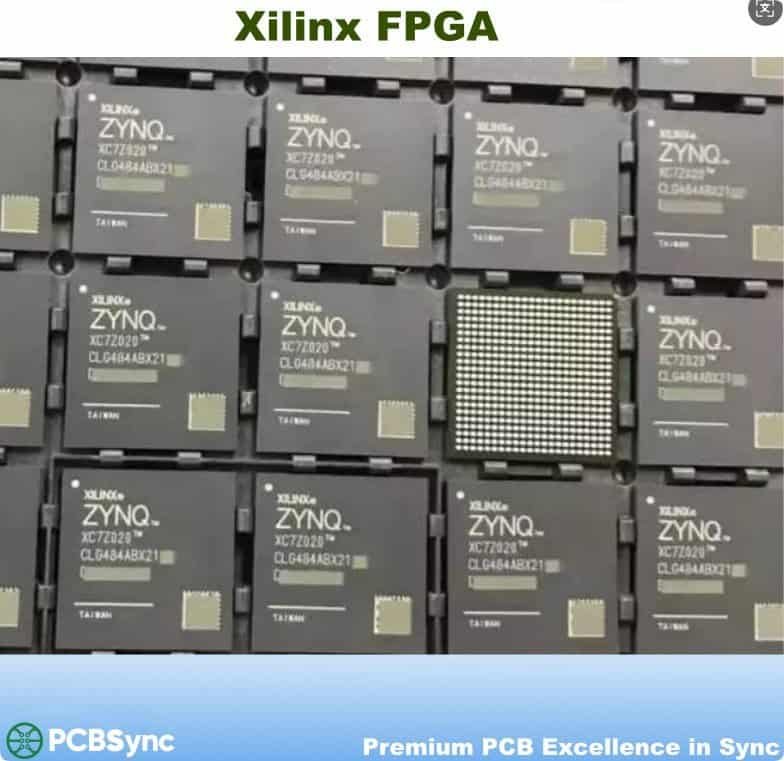
Overview of XCV100E-6FG256C Field Programmable Gate Array
The XCV100E-6FG256C is a powerful Virtex-E family FPGA manufactured by AMD (formerly Xilinx), designed to deliver exceptional programmable logic performance for demanding industrial and embedded system applications. This field-programmable gate array features 176 user I/O pins in a compact 256-ball Fine-pitch Ball Grid Array (FBGA) package, making it an ideal choice for applications requiring high gate density and flexible digital logic implementation.
Built on advanced 0.18 μm CMOS process technology with six metal layers, the XCV100E-6FG256C represents a significant evolution in programmable logic design, offering engineers a cost-effective alternative to traditional ASIC solutions while maintaining design flexibility and faster time-to-market.
Key Technical Specifications
Core Architecture Features
| Parameter |
Specification |
| Part Number |
XCV100E-6FG256C |
| Manufacturer |
AMD (Xilinx) |
| Product Family |
Virtex-E |
| Logic Elements/Cells |
2,700 |
| System Gates |
100,000 (128,236 total gates) |
| Logic Array Blocks (LABs) |
600 |
| RAM Size |
10 kB embedded |
| Number of I/O Pins |
176 user I/O |
| Total Pin Count |
256 pins |
Electrical and Environmental Characteristics
| Parameter |
Value |
| Operating Supply Voltage |
1.8V core |
| Speed Grade |
-6 (6ns performance) |
| Operating Temperature Range |
0°C to +85°C (Commercial) |
| Package Type |
256-FBGA (Fine-pitch BGA) |
| Mounting Type |
Surface Mount |
| RoHS Compliance |
RoHS Non-Compliant (contains lead) |
| Product Status |
Obsolete (not recommended for new designs) |
XCV100E-6FG256C Architecture and Design Benefits
Virtex-E Family Innovation
The XCV100E-6FG256C belongs to the renowned Virtex-E FPGA series, which introduced groundbreaking improvements in silicon efficiency and programmable logic density. Key architectural advantages include:
- Enhanced Place-and-Route Efficiency: Optimized architecture allows for better utilization of logic resources
- Six-Layer Metal Process: Advanced 0.18 μm CMOS technology enables higher performance and lower power consumption
- Flexible Interconnect Hierarchy: Rich routing resources provide superior signal integrity and timing performance
- Embedded Block RAM: 10 kB of dedicated RAM for data buffering and storage applications
Performance Capabilities
With a speed grade of -6, this FPGA delivers reliable performance for mid-range applications requiring:
- Digital signal processing (DSP) functions
- Protocol bridging and conversion
- Custom peripheral interfaces
- Industrial control logic
- Data acquisition systems
XCV100E-6FG256C Applications and Use Cases
Primary Application Areas
The XCV100E-6FG256C excels in diverse industrial and commercial applications:
Industrial Automation
- Programmable logic controllers (PLCs)
- Motion control systems
- Factory automation interfaces
- Process monitoring equipment
Power Delivery Systems
- Smart grid controllers
- Power management circuits
- Energy monitoring solutions
- Renewable energy converters
Enterprise Systems
- Data center equipment
- Server interface cards
- Network processing units
- Storage controllers
Consumer Electronics
- Digital projectors
- Set-top boxes
- Gaming consoles
- Multimedia processors
Embedded Computing
- Edge computing devices
- IoT gateways
- Medical instruments
- Test and measurement equipment
Package Information and Pin Configuration
256-FBGA Package Details
The XCV100E-6FG256C utilizes a 256-ball Fine-pitch Ball Grid Array package offering:
- Compact Form Factor: Optimized for space-constrained PCB designs
- 176 User-Configurable I/O: Maximum flexibility for custom interfaces
- Excellent Thermal Performance: Efficient heat dissipation for reliable operation
- Surface Mount Technology: Compatible with modern PCB assembly processes
I/O Capabilities
The 176 I/O pins support various voltage standards and can be configured for:
- TTL/CMOS logic levels
- LVTTL (Low Voltage TTL)
- LVCMOS (Low Voltage CMOS)
- Various differential signaling standards
Comparison with Related Xilinx FPGA Products
Virtex-E Family Comparison Table
| Feature |
XCV50E |
XCV100E-6FG256C |
XCV200E |
XCV300E |
| System Gates |
50,000 |
100,000 |
200,000 |
300,000 |
| Logic Cells |
1,536 |
2,700 |
4,704 |
6,912 |
| RAM (kB) |
6 |
10 |
16 |
24 |
| Max I/O (256-BGA) |
176 |
176 |
N/A |
N/A |
| Typical Applications |
Entry-level |
Mid-range |
High-density |
Advanced systems |
Design Considerations for XCV100E-6FG256C
Power Supply Requirements
Engineers implementing the XCV100E-6FG256C should consider:
- Core Voltage: Stable 1.8V supply with low noise
- I/O Voltage: Configurable based on interface requirements (typically 3.3V or 2.5V)
- Decoupling: Adequate capacitance near power pins for signal integrity
- Power Sequencing: Proper startup sequence to prevent latch-up
Thermal Management
With an operating temperature range of 0°C to +85°C:
- Ensure adequate PCB copper area for heat spreading
- Consider heatsinks for high-utilization applications
- Monitor junction temperature during operation
- Design with appropriate thermal derating
PCB Layout Best Practices
For optimal performance:
- Use controlled impedance routing for high-speed signals
- Minimize stub lengths on critical paths
- Provide solid ground and power planes
- Follow manufacturer’s BGA escape routing guidelines
- Maintain adequate clearance for BGA solder balls
Programming and Configuration
Configuration Options
The XCV100E-6FG256C supports multiple configuration modes:
- Master Serial Mode: FPGA controls configuration PROM
- Slave Serial Mode: External processor controls configuration
- JTAG Boundary Scan: For debugging and programming
- SelectMAP Mode: Parallel configuration for faster loading
Development Tool Support
Design entry and implementation require:
- Xilinx ISE Design Suite (legacy software)
- FPGA Editor for manual placement
- ChipScope for in-circuit debugging
- Impact for device programming
- Compatible with Verilog and VHDL languages
Availability and Ordering Information
Product Status Notice
Important: The XCV100E-6FG256C is classified as obsolete by AMD/Xilinx and is not recommended for new designs. Current applications should consider modern alternatives from the following families:
- Spartan-7: Cost-optimized replacement option
- Artix-7: Mid-range performance upgrade
- Kintex UltraScale: High-performance successor
- Zynq SoC: Integrated ARM processor + FPGA
Packaging Options
- Standard Packaging: Tray (for automated pick-and-place)
- Lead-Free Status: Contains lead (not RoHS compliant)
- Quality Grade: Commercial temperature range
Quality and Reliability
Manufacturing Standards
As a legacy Xilinx product, the XCV100E-6FG256C was manufactured under strict quality controls:
- ISO 9001 certified production facilities
- Comprehensive electrical testing
- Burn-in screening available
- Full traceability documentation
Warranty and Support
When sourcing XCV100E-6FG256C units:
- Verify authenticity through authorized distributors
- Request date code and lot traceability
- Confirm storage conditions for older inventory
- Typical warranty: 6-12 months from authorized suppliers
Technical Support Resources
Documentation
Essential resources for working with XCV100E-6FG256C:
- Product Datasheet: Complete electrical specifications (233 pages)
- User Guide: Virtex-E FPGA family architecture reference
- Application Notes: Design guidelines and best practices
- PCB Footprint: CAD models for layout (FBGA-256)
- IBIS Models: For signal integrity simulation
Design Assistance
For technical questions regarding implementation:
- Consult Xilinx ISE documentation archives
- Reference legacy Virtex-E design tutorials
- Utilize EDA vendor FPGA libraries
- Consider migration guides for newer devices
Frequently Asked Questions (FAQs)
Q: Is the XCV100E-6FG256C suitable for new product designs?
A: No, this device is obsolete and not recommended for new designs. Consider Spartan-7 or Artix-7 families for new projects.
Q: What is the difference between XCV100E-6FG256C and XCV100E-6FGG256C?
A: The “FGG” designation typically indicates a specific package variant. Verify exact specifications with the manufacturer.
Q: Can I use 3.3V I/O with this FPGA?
A: Yes, the I/O banks support multiple voltage standards including 3.3V LVTTL/LVCMOS when properly configured.
Q: What development software is required?
A: Xilinx ISE Design Suite (legacy version) is required for design entry and bitstream generation.
Q: How many user I/O pins are actually usable?
A: The 256-FBGA package provides 176 user-configurable I/O pins; the total pin count includes power, ground, and dedicated configuration pins.
Q: Is this device radiation-hardened?
A: No, the XCV100E-6FG256C is a commercial-grade device without radiation hardening.
Conclusion
The XCV100E-6FG256C represents a mature FPGA solution from AMD’s Virtex-E family, offering 100,000 system gates and 176 I/O in a compact 256-FBGA package. While obsolete for new designs, it continues to serve existing applications in industrial automation, power delivery, enterprise systems, and embedded computing.
Engineers maintaining legacy systems can still source this component through authorized distributors, though long-term availability is limited. For new projects, modern FPGA families offer superior performance, lower power consumption, and active manufacturer support.
Understanding the XCV100E-6FG256C’s capabilities, limitations, and proper design practices ensures successful implementation in both legacy system maintenance and evaluation of migration paths to current-generation devices.
For the latest Xilinx FPGA solutions and comprehensive component support, consult with authorized distributors and semiconductor suppliers specializing in programmable logic devices.