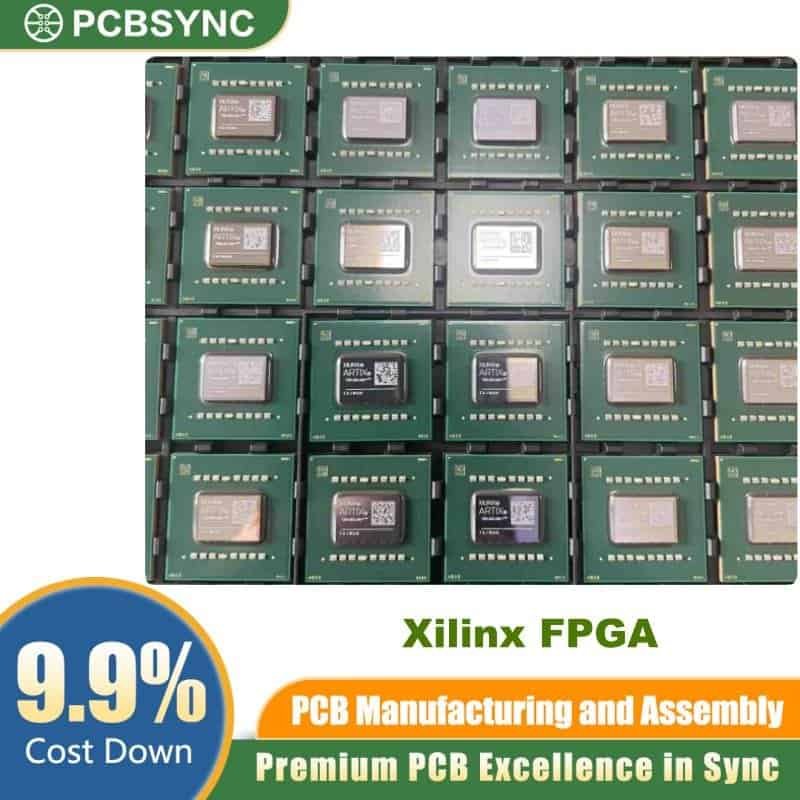
The XCV1000E-7FG680I is a high-performance, industry-grade Xilinx FPGA from the AMD Xilinx Virtex-E family. Designed for demanding embedded, industrial, and communications applications, this device delivers exceptional logic density, fast speed grades, and robust I/O flexibility in a 680-ball Fine-Pitch BGA package — making it an ideal choice for engineers who require reliable, scalable programmable logic in harsh environments.
What Is the XCV1000E-7FG680I?
The XCV1000E-7FG680I is a member of AMD Xilinx’s Virtex-E series, a generation of FPGAs that extended the original Virtex architecture with enhanced block RAM, faster clock speeds, and expanded I/O capabilities. The “I” suffix in the part number denotes industrial temperature range, ensuring stable operation from –40°C to +100°C — well beyond the commercial-grade XCV1000E-7FG680C.
This FPGA is widely deployed in:
- High-speed signal processing
- Telecommunications infrastructure
- Industrial control systems
- Military and aerospace prototyping
- Scientific instrumentation
XCV1000E-7FG680I Key Specifications
Core FPGA Specifications
| Parameter |
Value |
| Part Number |
XCV1000E-7FG680I |
| Manufacturer |
AMD (Xilinx) |
| Family |
Virtex-E |
| Speed Grade |
-7 |
| Temperature Range |
Industrial: –40°C to +100°C |
| Package Type |
FG680 (Fine-Pitch Ball Grid Array) |
| Package Size |
680-ball FBGA |
| Number of Logic Cells |
27,648 |
| System Gates |
~1,000,000 (1M) |
| CLB Array |
96 × 72 CLBs |
| Flip-Flops |
26,624 |
| Maximum User I/O Pins |
512 |
Memory & Block RAM
| Parameter |
Value |
| Block RAM Bits |
393,216 bits (384 Kb) |
| Block RAM Blocks |
24 × 4Kb blocks (configurable as 8K × 1, 4K × 2, 2K × 4, 1K × 9) |
| Distributed RAM |
Up to 98,304 bits |
Performance & Clock
| Parameter |
Value |
| Speed Grade |
-7 (fastest in Virtex-E series) |
| System Clock Frequency |
Up to 200+ MHz |
| DLL (Delay-Locked Loop) |
4 × on-chip DLLs |
| Clock Skew Management |
Yes (global and local networks) |
I/O & Electrical
| Parameter |
Value |
| Max User I/Os |
512 |
| I/O Standards Supported |
LVTTL, LVCMOS, GTL+, SSTL, CTT, AGP, HSTL, PCI |
| 3-State Buffers (GTS) |
Yes |
| Global Set/Reset (GSR) |
Yes |
| VCC Core Voltage |
1.8V |
| VCCO I/O Voltage |
1.5V – 3.3V (bank-configurable) |
Package Information
| Parameter |
Value |
| Package Code |
FG680 |
| Ball Count |
680 |
| Package Body Size |
31 mm × 31 mm |
| Ball Pitch |
1.00 mm |
| Height (max) |
2.55 mm |
| Moisture Sensitivity Level (MSL) |
3 |
XCV1000E-7FG680I vs XCV1000E-7FG680C: Industrial vs Commercial
A common sourcing question is the difference between the XCV1000E-7FG680I (industrial) and the XCV1000E-7FG680C (commercial). Here is a direct comparison:
| Feature |
XCV1000E-7FG680I |
XCV1000E-7FG680C |
| Temperature Range |
–40°C to +100°C |
0°C to +85°C |
| Use Case |
Industrial, military, harsh environments |
Commercial, lab, office environments |
| Speed Grade |
-7 |
-7 |
| Package |
FG680 |
FG680 |
| Logic Cells |
27,648 |
27,648 |
| Typical Cost |
Higher (industrial premium) |
Lower |
| Availability |
Specialized distributors |
Broader distribution |
Recommendation: Choose the XCV1000E-7FG680I when your design must operate reliably across wide temperature swings, in outdoor enclosures, or in industrial automation environments. The commercial variant (XCV1000E-7FG680C) is sufficient for controlled, office or lab-temperature deployments.
XCV1000E-7FG680I Architecture Overview
Configurable Logic Blocks (CLBs)
The Virtex-E CLB architecture organizes logic resources into slices, each containing:
- Two 4-input Look-Up Tables (LUTs) — also usable as 16-bit distributed shift registers or 16×1-bit RAM
- Two edge-triggered D flip-flops
- Fast carry and arithmetic logic
- Wide multiplexers for routing
With 96 × 72 CLBs and 4 slices per CLB, the XCV1000E-7FG680I provides 27,648 logic cells, enabling complex state machines, arithmetic units, and parallel data paths.
Block SelectRAM+
The 24 dual-port block RAMs (4 Kb each) are independently configurable in depth and width. They support:
- True dual-port access (two independent read/write ports)
- Synchronous read/write operation
- Built-in output registers for pipelined performance
- Data widths from 1 to 18 bits per port
Dedicated DLL Clock Management
Four on-chip Delay-Locked Loops (DLLs) enable:
- Zero-propagation-delay clock distribution
- Clock multiplication and division
- Phase shifting (0°, 90°, 180°, 270°)
- Input jitter filtering
This makes the XCV1000E-7FG680I highly suitable for high-speed synchronous designs where clock integrity is critical.
SelectI/O Technology
The 512 user I/O pins support a wide range of single-ended and differential I/O standards. I/Os are organized into banks, each with its own VCCO supply rail, allowing different voltage domains within the same device. This simplifies mixed-voltage board designs.
Applications for the XCV1000E-7FG680I
Industrial Automation & Control
With its –40°C to +100°C operating range, the XCV1000E-7FG680I integrates seamlessly into programmable logic controllers (PLCs), motor drives, and industrial vision systems where temperature stability and long operational life are mandatory.
Telecommunications & Networking
The high logic density and fast -7 speed grade support line-rate protocol processing, forward error correction (FEC), and custom MAC layer implementations for telecom infrastructure equipment.
Test & Measurement Equipment
Benchtop oscilloscopes, logic analyzers, and RF test equipment benefit from the XCV1000E-7FG680I’s high I/O count and large on-chip memory for deep capture buffers and real-time signal processing.
Defense & Aerospace (COTS)
While not radiation-hardened, this industrial-grade FPGA is used in COTS (Commercial Off-The-Shelf) defense applications for prototyping, ground-based systems, and non-flight hardware that still requires broad temperature tolerance.
Medical Imaging
High-throughput imaging pipelines — including ultrasound beamforming, CT reconstruction pre-processing, and retinal scanning — leverage the device’s parallel processing architecture and deep block RAM.
Programming & Configuration
Configuration Modes
The XCV1000E-7FG680I supports multiple configuration interfaces:
| Configuration Mode |
Interface |
Use Case |
| Master Serial |
PROM / SPI |
Standalone boot from serial flash |
| Slave Serial |
External controller |
Controlled system boot |
| Slave Parallel |
External bus |
Fast multi-device configuration |
| JTAG (Boundary Scan) |
IEEE 1149.1 |
In-system programming & debug |
| SelectMAP |
8-bit parallel bus |
Fast single or daisy-chain config |
Design Tool Support
| Tool |
Version |
Support Status |
| Xilinx ISE Design Suite |
14.7 |
Full support (recommended legacy) |
| Vivado Design Suite |
N/A |
Not supported (Virtex-E predates Vivado) |
| ModelSim / QuestaSim |
All |
RTL simulation |
| Synplify Pro |
All |
Third-party synthesis |
Note: The Virtex-E family requires ISE Design Suite 14.7, the final release of ISE. Vivado does not support pre-7-series Xilinx devices.
Ordering Information
| Part Number |
Package |
Speed Grade |
Temperature |
Status |
| XCV1000E-7FG680I |
FG680 |
-7 |
Industrial (–40°C to +100°C) |
Obsolete / End-of-Life |
| XCV1000E-7FG680C |
FG680 |
-7 |
Commercial (0°C to +85°C) |
Obsolete / End-of-Life |
| XCV1000E-6FG680I |
FG680 |
-6 |
Industrial |
Obsolete / End-of-Life |
| XCV1000E-8FG680I |
FG680 |
-8 |
Industrial |
Obsolete / End-of-Life |
Important: The XCV1000E series has reached End-of-Life (EOL) status with AMD Xilinx. New designs should consider migration to Spartan-7, Artix-7, or Kintex-7 families. However, the XCV1000E-7FG680I remains widely available through authorized distributors and specialty component brokers for legacy system repair, maintenance, and production continuity.
Migration & Replacement Guide
For new designs requiring similar logic density, consider these modern AMD Xilinx alternatives:
| Legacy Device |
Modern Replacement |
Logic Cells |
Advantage |
| XCV1000E-7FG680I |
XC7A100T-2FGG676I |
101,440 |
3.7× more logic, lower power |
| XCV1000E-7FG680I |
XC7K70T-2FBG676I |
65,600 |
Kintex-7 performance |
| XCV1000E-7FG680I |
XC7S50-2FTGB196I |
52,160 |
Spartan-7, ultra-low cost |
Modern 7-series devices offer dramatically higher logic density, embedded DSP slices, high-speed serial transceivers (up to 12.5 Gbps), and PCIe hard IP — all while consuming less power and being supported by Vivado.
Frequently Asked Questions (FAQ)
Is the XCV1000E-7FG680I still in production?
No. AMD Xilinx has officially discontinued the Virtex-E family. The XCV1000E-7FG680I is an End-of-Life (EOL) component. Units are available through authorized distributors and secondary market brokers for legacy support.
What is the difference between XCV1000E and XCV1000?
The XCV1000E belongs to the enhanced Virtex-E family with 1.8V core voltage and larger block RAM. The original XCV1000 uses 2.5V core voltage and has smaller block RAMs. The two are not pin-compatible.
Can I use the XCV1000E-7FG680I with Vivado?
No. Vivado only supports 7-series and later Xilinx devices. The XCV1000E-7FG680I requires Xilinx ISE Design Suite 14.7 for synthesis, implementation, and bitstream generation.
What does the “-7” speed grade mean?
The -7 speed grade is the fastest commercial speed grade available for the XCV1000E series. A lower number (e.g., -6) indicates a slower device with more timing margin, while -7 is characterized for the highest achievable clock frequencies.
How do I store the XCV1000E-7FG680I?
Due to its MSL-3 rating, unopened reels or trays should be stored in original moisture barrier bags with desiccant at ≤30°C / 60% RH. Once opened, baking may be required per IPC/JEDEC J-STD-033 if the floor life limit is exceeded before soldering.
Summary
The XCV1000E-7FG680I delivers 1 million system gates, 512 user I/Os, 384 Kb of block RAM, and industrial-temperature operation in the proven FG680 package. While it is an End-of-Life part, it remains a cornerstone of legacy industrial and communications systems worldwide. Engineers maintaining these platforms will find the XCV1000E-7FG680I an essential component for board repairs, production continuity, and system upgrades — and those beginning new designs have a clear migration path to the modern AMD Xilinx 7-series portfolio.