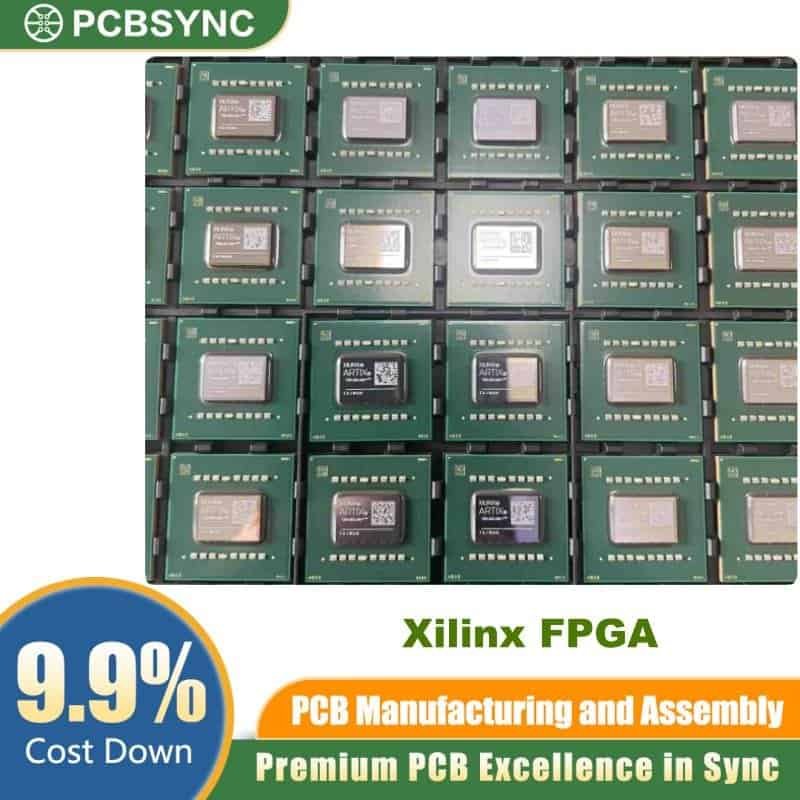
The XCV1000E-7FG680C is a high-performance Field Programmable Gate Array (FPGA) from the Xilinx Virtex®-E family, manufactured under AMD Xilinx. Designed for demanding programmable logic applications, this device combines a 1.8V supply voltage, 0.18 µm CMOS process technology, and an aggressive 680-pin Fine-Pitch Thin Enhanced Ball Grid Array (FTEBGA) package to deliver one of the most capable FPGAs of its generation. Whether you are designing for telecommunications, industrial automation, military systems, or high-speed signal processing, the XCV1000E-7FG680C offers the logic density, I/O count, and speed grade to meet your project’s requirements.
For engineers seeking a broad selection of compatible devices, explore our full range of Xilinx FPGA solutions.
What Is the XCV1000E-7FG680C? Understanding the Part Number
The part number XCV1000E-7FG680C encodes critical information about the device:
| Segment |
Meaning |
| XCV |
Xilinx Virtex FPGA family |
| 1000E |
Virtex-E series, ~1,000,000 system gates capacity |
| -7 |
Speed grade -7 (400 MHz max frequency) |
| FG680 |
680-pin Fine-Pitch Ball Grid Array (FBGA) package |
| C |
Commercial temperature range (0°C to +85°C) |
This naming convention makes it straightforward to identify the device’s family, density, speed, package, and temperature grade at a glance.
XCV1000E-7FG680C Key Specifications and Technical Parameters
The table below provides the complete technical specifications for the XCV1000E-7FG680C as sourced from the AMD Xilinx datasheet and distributor data.
Core Electrical and Logic Specifications
| Parameter |
Value |
| Manufacturer |
AMD Xilinx (formerly Xilinx, Inc.) |
| Series |
Virtex®-E |
| Part Number |
XCV1000E-7FG680C |
| Description |
IC FPGA 512 I/O 680FTEBGA |
| Number of Logic Cells |
27,648 |
| Number of CLBs (Configurable Logic Blocks) |
6,144 |
| Total Equivalent Gates |
~1,569,178 (system gates) |
| Total RAM Bits |
393,216 bits |
| Number of User I/Os |
512 |
| Maximum Operating Frequency |
400 MHz |
| Supply Voltage (VCC) |
1.71 V – 1.89 V (nominal 1.8 V) |
| Process Technology |
0.18 µm 6-layer metal CMOS |
| Operating Temperature |
0°C to +85°C (TJ) — Commercial Grade |
Package and Mounting Specifications
| Parameter |
Value |
| Package Type |
680-FTEBGA (Fine-Pitch Thin Enhanced BGA) |
| Package Dimensions |
40 mm × 40 mm |
| Pin Count |
680 pins |
| Mounting Type |
Surface Mount Technology (SMT) |
| Packaging Format |
Tray |
| RoHS Status |
See current distributor listing for compliance details |
Product Status and Classification
| Parameter |
Value |
| Product Status |
Obsolete (Not Recommended for New Designs) |
| Category |
Embedded – FPGAs (Field Programmable Gate Array) |
| DigiKey Part Number |
122-1219-ND |
| Distributor |
Available via independent and legacy distributors |
XCV1000E-7FG680C Architecture Overview: Virtex-E Family Deep Dive
What Makes the Virtex-E Architecture Powerful?
The XCV1000E-7FG680C belongs to Xilinx’s Virtex-E family, which represents a major architectural evolution from the original Virtex platform. The Virtex-E family was engineered to maximize silicon efficiency, with optimizations made specifically for place-and-route performance on a state-of-the-art 0.18 µm CMOS process using 6 layers of metal interconnect. This enabled significantly higher logic density, faster routing, and lower power consumption compared to the prior 0.22 µm Virtex generation.
Configurable Logic Blocks (CLBs) and Logic Cells
The XCV1000E-7FG680C contains 6,144 Configurable Logic Blocks (CLBs), each comprising four slices. Each slice includes two 4-input Look-Up Tables (LUTs), flip-flops, carry logic, and dedicated arithmetic functions. This yields 27,648 logic cells total, supporting complex designs including state machines, arithmetic pipelines, and data path logic.
Block RAM Architecture
With 393,216 bits (384 Kb) of on-chip block RAM, the XCV1000E-7FG680C supports a wide range of memory-intensive applications. Block RAM can be configured as:
| RAM Mode |
Description |
| Single-Port |
One read/write port per RAM block |
| Dual-Port |
Simultaneous read and write access |
| ROM |
Hardcoded initialization for lookup tables |
| FIFO |
First-In-First-Out buffer implementations |
DLL (Delay-Locked Loop) Clock Management
The Virtex-E family integrates on-chip Delay-Locked Loop (DLL) circuits for superior clock distribution and management. DLLs eliminate clock skew, enable clock multiplication/division, and support phase shifting — critical for synchronous high-speed designs.
I/O Standards Support
The 512 user I/O pins of the XCV1000E-7FG680C support a rich set of programmable I/O standards, providing design flexibility when interfacing with external memory, buses, and peripherals:
| I/O Standard |
Description |
| LVTTL |
Low Voltage TTL (3.3V) |
| LVCMOS 3.3V / 2.5V / 1.8V |
Low voltage CMOS logic |
| GTL / GTL+ |
Gunning Transceiver Logic |
| HSTL |
High-Speed Transceiver Logic (for DDR memory) |
| SSTL2 / SSTL3 |
Stub Series Terminated Logic |
| PCI / PCI-X |
Peripheral Component Interconnect bus standard |
| AGP |
Accelerated Graphics Port |
| CTT |
Center-Tap Terminated |
XCV1000E-7FG680C Performance Characteristics
Speed Grade -7 Explained
The -7 speed grade designation indicates the performance tier of this FPGA variant. Within the XCV1000E family, the -7 grade achieves a maximum clock frequency of 400 MHz, making it one of the faster variants suited for time-critical logic functions. Higher speed grades (e.g., -8) may support up to 416 MHz, while slower grades (-6) are rated for 357 MHz.
Propagation Delays and Timing
The Virtex-E -7 speed grade provides competitive internal propagation delays for its generation:
| Timing Parameter |
Typical Value |
| LUT propagation delay |
~0.6 ns |
| Flip-flop clock-to-output |
~0.7 ns |
| Internal routing delay |
Application-dependent |
| Maximum clock frequency |
400 MHz |
Exact timing values should be obtained from the official Xilinx XCV1000E datasheet and confirmed with timing analysis tools.
Typical Applications of the XCV1000E-7FG680C FPGA
Given its combination of high gate count, large block RAM, extensive I/O, and proven Virtex-E architecture, the XCV1000E-7FG680C is well-suited for a broad range of applications:
Communications and Networking
- Protocol bridging: Implementing proprietary or standard communication protocols
- Packet processing: Multi-channel data routing and filtering
- Framing and error correction: FEC encoder/decoder implementations
- High-speed serial interfaces: LVDS and differential signaling support
Signal Processing and DSP
- FIR/IIR digital filters: Multi-tap filter banks leveraging block RAM
- FFT engines: Fast Fourier Transform pipelines for radar and audio
- Video processing: Real-time pixel manipulation and pipeline acceleration
Industrial and Military Systems
- Motor control: Precise PWM generation and encoder feedback processing
- Sensor fusion: Multi-channel ADC data aggregation and filtering
- Ruggedized computing: Deterministic logic processing for safety-critical environments
- Custom ASIC prototyping: Gate-level verification before tape-out
Legacy System Maintenance and Repair
Because the XCV1000E-7FG680C is an obsolete part no longer in production, it is frequently sourced for:
- Board repair and component replacement on existing installed systems
- Military and aerospace MRO (Maintenance, Repair, and Overhaul)
- Industrial equipment upgrades with form-fit-function compatibility requirements
XCV1000E-7FG680C vs. Related Xilinx Virtex-E Variants
Understanding how the XCV1000E-7FG680C compares to closely related variants helps engineers select the correct part or identify suitable substitutes.
Speed Grade Variants (Same Package)
| Part Number |
Speed Grade |
Max Frequency |
Package |
| XCV1000E-6FG680C |
-6 |
357 MHz |
680 FBGA |
| XCV1000E-7FG680C |
-7 |
400 MHz |
680 FBGA |
| XCV1000E-8FG1156C |
-8 |
416 MHz |
1156 FBGA |
Package Variants (Same Speed Grade)
| Part Number |
Package |
Pin Count |
I/O Count |
| XCV1000E-7BG728C |
BG728 |
728 |
~516 |
| XCV1000E-7FG680C |
FG680 |
680 |
512 |
| XCV1000E-6BG560I |
BG560 (Industrial) |
560 |
~404 |
Density Comparison Within Virtex-E Family
| Part |
Logic Cells |
CLBs |
RAM Bits |
User I/Os |
| XCV50E |
2,352 |
588 |
65,536 |
176 |
| XCV300E |
6,912 |
1,728 |
131,072 |
316 |
| XCV600E |
15,552 |
3,888 |
262,144 |
512 |
| XCV1000E |
27,648 |
6,144 |
393,216 |
512 |
| XCV2000E |
46,080 |
11,520 |
655,360 |
660 |
| XCV3200E |
73,728 |
18,432 |
786,432 |
756 |
The XCV1000E sits in the mid-to-upper tier of the Virtex-E density range, offering a balanced combination of logic and memory for demanding mid-range applications.
Design Tools and Programming for XCV1000E-7FG680C
Supported EDA Design Software
The XCV1000E-7FG680C is supported by legacy Xilinx design tools. Because this is an older generation device, it is best served by:
| Tool |
Version |
Notes |
| Xilinx ISE Design Suite |
14.7 (final release) |
Primary recommended toolchain for Virtex-E |
| Vivado Design Suite |
Not recommended |
Vivado does not support legacy Virtex-E devices |
| ModelSim / Questa |
Any compatible version |
For RTL and gate-level simulation |
| Synplify Pro |
Legacy versions |
Third-party synthesis support |
Configuration Interfaces
The XCV1000E-7FG680C supports multiple configuration modes for flexible board integration:
| Configuration Mode |
Description |
| Slave Serial |
Simple single-bit serial interface |
| Master Serial |
Self-timed serial using on-chip oscillator |
| Slave Parallel (SelectMAP) |
Fast 8-bit parallel loading |
| JTAG (IEEE 1149.1) |
Boundary scan and in-circuit debugging |
| Master Parallel |
External memory boot configuration |
Recommended Configuration Companion ICs
- Xilinx Platform Flash (XCF): Dedicated serial configuration ROM for Virtex-E
- Xilinx XC17 series: Parallel configuration PROM
- Standard SPI Flash: Usable with appropriate interface logic
Power Supply Requirements for XCV1000E-7FG680C
Proper power supply design is critical for reliable FPGA operation. The XCV1000E-7FG680C requires multiple supply rails:
| Power Rail |
Voltage Range |
Nominal |
Purpose |
| VCCINT |
1.71 V – 1.89 V |
1.8 V |
Core internal logic |
| VCCO |
1.5 V – 3.3 V (bank-dependent) |
Various |
I/O output drivers |
| VCCAUX |
3.135 V – 3.465 V |
3.3 V |
DLL and auxiliary circuits |
Key power design considerations:
- VCCINT must be stable within ±5% of 1.8 V for reliable operation
- VCCO must match the target I/O standard for each I/O bank
- Sufficient decoupling capacitors must be placed close to the BGA package
- Power sequencing: VCCINT should be applied before or simultaneously with VCCO
PCB Design Guidelines for the 680-FTEBGA Package
The 40 mm × 40 mm, 680-ball BGA package of the XCV1000E-7FG680C presents specific PCB layout challenges that must be addressed carefully.
BGA Escape Routing
| Parameter |
Recommendation |
| Via type |
Blind vias or through-hole microvias preferred |
| Trace width (signal) |
4–5 mil minimum |
| Ball pitch |
1.0 mm (standard BGA pitch) |
| Layer stack |
Minimum 8-layer PCB recommended |
| Impedance control |
50 Ω for high-speed differential pairs |
Thermal Management
- Junction temperature must remain below +85°C under full load
- Consider heat spreader or heatsink attachment for high-utilization designs
- Thermal simulation recommended for dense or fanout-heavy configurations
Ordering Information for XCV1000E-7FG680C
| Field |
Details |
| Full Part Number |
XCV1000E-7FG680C |
| Manufacturer |
AMD Xilinx |
| DigiKey Part # |
122-1219-ND |
| Package |
680-FTEBGA, Tray |
| Product Status |
Obsolete – available through independent distributors |
| Temperature Range |
Commercial: 0°C to +85°C |
| RoHS |
Verify with distributor at time of purchase |
Note: As an obsolete component, the XCV1000E-7FG680C is no longer in production by AMD Xilinx. Availability depends on authorized independent distributors, spot market inventory, and MRO supply channels. Always verify authenticity and provenance when purchasing discontinued ICs.
Frequently Asked Questions About XCV1000E-7FG680C
Is the XCV1000E-7FG680C still in production?
No. The XCV1000E-7FG680C has been classified as obsolete by AMD Xilinx. It is not recommended for new designs. However, the part remains widely available through independent electronics distributors for legacy system maintenance and repair.
What is the difference between XCV1000E-7FG680C and XCV1000E-6FG680C?
The primary difference is the speed grade: the -7 version operates at up to 400 MHz, while the -6 version is rated for up to 357 MHz. All other specifications (logic cells, RAM, I/O count, package) remain identical.
What software do I need to program the XCV1000E-7FG680C?
Xilinx ISE Design Suite 14.7 is the recommended toolchain. Vivado does not support Virtex-E family devices. ISE 14.7 is the final version and includes the iMPACT programmer, XST synthesizer, and PAR (Place and Route) tools.
Can the XCV1000E-7FG680C be used in industrial temperature applications?
The “C” suffix indicates a commercial temperature grade (0°C to +85°C). For industrial temperature range (-40°C to +100°C), you would need the “I” suffix variant if available. Verify specifications before deploying in extended temperature environments.
What are the closest modern replacements for XCV1000E-7FG680C?
While there is no direct pin-compatible modern replacement, the Xilinx Virtex-5, Virtex-6, or Kintex-7 families offer far superior performance and density for new designs. Any migration will require schematic and PCB redesign due to different packages and architectures.
Summary: Why Choose XCV1000E-7FG680C for Your Application
The XCV1000E-7FG680C remains a capable FPGA for legacy system support and specialized applications requiring its specific I/O count, logic density, and package footprint. Its 27,648 logic cells, 512 user I/Os, 393,216-bit block RAM, and 400 MHz operation deliver robust performance for mid-to-high complexity programmable logic designs.
For new projects, AMD Xilinx’s current families are recommended. For maintenance, repair, or existing design continuation, the XCV1000E-7FG680C continues to be sourced successfully through the global independent component distribution network.
Browse the complete catalog of Xilinx FPGA devices to find the right solution for your project — from legacy Virtex-E parts to the latest UltraScale+ platforms.