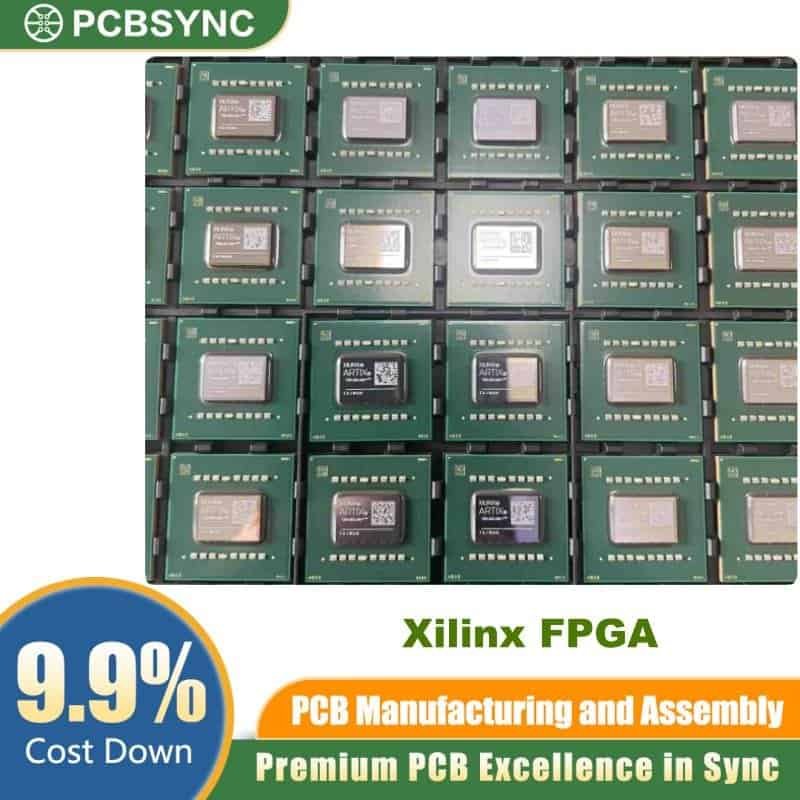
The XCV1000E-7BG728C is a high-performance Xilinx FPGA from the Virtex-E 1.8V family, manufactured by AMD Xilinx. Designed for demanding logic-intensive applications, this device delivers 331,776 system gates, 27,648 logic cells, and a maximum operating frequency of 400 MHz — all in a compact BG728 BGA package. Whether you are designing for telecom, aerospace, industrial control, or high-speed data processing, the XCV1000E-7BG728C provides the reconfigurability and density required for complex FPGA designs.
What Is the XCV1000E-7BG728C?
The XCV1000E-7BG728C belongs to Xilinx’s Virtex-E series — an enhanced generation of the original Virtex family — built on a 0.18 µm, 5-layer-metal CMOS process. The “E” in Virtex-E signifies the enhanced architecture, which includes deeper on-chip BlockRAM resources, improved routing, and a 1.8V core voltage supply that reduces power consumption compared to the 2.5V Virtex predecessor.
The part number decodes as follows:
| Segment |
Meaning |
| XCV1000E |
Virtex-E family, approximately 1,000,000 system gates |
| -7 |
Speed grade 7 (commercial performance tier) |
| BG728 |
Ball Grid Array package, 728 balls |
| C |
Commercial temperature range (0°C to +85°C) |
XCV1000E-7BG728C Key Specifications
Core Logic & Processing
| Parameter |
Value |
| FPGA Family |
Virtex-E 1.8V |
| Manufacturer |
AMD Xilinx |
| System Gates |
331,776 |
| Logic Cells |
27,648 |
| Configurable Logic Blocks (CLBs) |
3,456 |
| CLB Slices |
6,912 |
| Maximum Distributed RAM |
221,184 bits |
Electrical Characteristics
| Parameter |
Value |
| Core Supply Voltage (VCCINT) |
1.8V |
| I/O Supply Voltage (VCCO) |
1.5V – 3.3V (programmable per bank) |
| Maximum Frequency |
400 MHz |
| Logic Process Technology |
0.18 µm CMOS |
| Metal Layers |
5-layer metal |
| Static Current (IccINT, typical) |
Per datasheet operating conditions |
Package & Thermal
| Parameter |
Value |
| Package Type |
BGA (Ball Grid Array) |
| Package Code |
BG728 |
| Total Ball Count |
728 |
| Temperature Grade |
Commercial (C): 0°C to +85°C |
| Moisture Sensitivity Level (MSL) |
MSL 3 (per JEDEC J-STD-020) |
Memory Resources
| Resource |
Quantity |
| BlockRAM (18Kb blocks) |
28 |
| Total BlockRAM Capacity |
524,288 bits |
| Distributed RAM Bits |
221,184 |
I/O Resources
| Parameter |
Value |
| Maximum User I/O Pins |
512 |
| I/O Banks |
8 |
| Differential Pair Support |
Yes (LVDS, LVPECL) |
| Supported I/O Standards |
LVTTL, LVCMOS, GTL, GTL+, PCI, LVDS, SSTL, AGP |
Configuration
| Parameter |
Value |
| Configuration Modes |
Master Serial, Slave Serial, SelectMAP (x8), JTAG |
| JTAG (IEEE 1149.1) |
Yes |
| Configuration Memory |
External Flash / PROM |
| Dedicated Configuration Pins |
DONE, INIT, PROG_B, M[2:0] |
XCV1000E-7BG728C Part Number Comparison
The XCV1000E device is available in multiple speed grades and packages. The table below compares common variants to help you select the correct part for your design:
| Part Number |
Speed Grade |
Package |
Pins |
Temp Range |
Max Frequency |
| XCV1000E-6BG560C |
-6 |
BG560 |
560 |
Commercial |
357 MHz |
| XCV1000E-6BG560I |
-6 |
BG560 |
560 |
Industrial |
357 MHz |
| XCV1000E-7BG728C |
-7 |
BG728 |
728 |
Commercial |
400 MHz |
| XCV1000E-7FG680C |
-7 |
FG680 |
680 |
Commercial |
400 MHz |
| XCV1000E-8FG1156C |
-8 |
FG1156 |
1156 |
Commercial |
416 MHz |
Note: Higher speed grade numbers (e.g., -8) indicate faster performance in the Virtex-E naming convention.
XCV1000E-7BG728C Architecture Overview
Configurable Logic Blocks (CLBs)
The Virtex-E CLB architecture organizes logic into slices, each containing two 4-input Look-Up Tables (LUTs) and two flip-flops. Each CLB contains 2 slices (4 LUTs total). The CLBs support:
- Implementation of any 4-input Boolean function
- Combination of two LUTs for 5- or 6-input functions
- Synchronous 16×1-bit or 32×1-bit distributed RAM
- Shift registers for data buffering
- F5/F6 multiplexers for wide logic functions
BlockRAM (Dual-Port 18Kb)
The XCV1000E-7BG728C includes 28 dual-port BlockRAM blocks, each 18 Kb. These support:
- Independent read/write port widths (1 to 18 bits per port)
- Synchronous read and write operations
- True dual-port mode (simultaneous read/write on both ports)
- Configurable as ROM or RAM
Clock Management
The device integrates Delay-Locked Loop (DLL) circuits for precise clock management:
- Up to 4 global clock networks
- DLL-based clock deskew and multiplication
- Low-skew global routing trees
- Support for external clock synchronization
I/O Block (IOB) Features
Each I/O pin is supported by a programmable IOB that includes:
- Input flip-flop / latch
- Output flip-flop with 3-state control
- Programmable drive strength (2 mA to 24 mA)
- Slew-rate control (fast / slow)
- Programmable pull-up/pull-down resistors
- LVDS and differential signaling support
Supported I/O Standards
The XCV1000E-7BG728C supports a wide range of industry-standard I/O interfaces:
| I/O Standard |
Type |
Voltage |
| LVTTL |
Single-ended |
3.3V |
| LVCMOS33 / 25 / 18 |
Single-ended |
3.3V / 2.5V / 1.8V |
| PCI / PCI-X |
Single-ended |
3.3V |
| GTL / GTL+ |
Open-drain |
1.2V / 1.5V |
| SSTL2 / SSTL3 |
Stub-Series |
2.5V / 3.3V |
| AGP |
Single-ended |
3.3V |
| LVDS |
Differential |
2.5V |
| LVPECL |
Differential |
3.3V |
XCV1000E-7BG728C Applications
Due to its high gate count, large I/O capacity, and flexible architecture, the XCV1000E-7BG728C is well-suited for:
- Telecommunications: Line card processing, protocol bridging, SDH/SONET framers
- High-Speed Networking: Packet classification, traffic management, switching fabrics
- Military & Aerospace: Radar signal processing, sensor fusion (Commercial temp range; for harsh environments, consider the -I industrial variant)
- Industrial Automation: Real-time motor control, machine vision preprocessing
- Test & Measurement: Logic analyzer backends, high-speed data acquisition
- Video & Imaging: Image pipeline processing, frame buffering, format conversion
- Embedded Computing: Custom processors, hardware accelerators, DSP co-processing
Configuration Modes Explained
The XCV1000E-7BG728C supports four primary configuration modes, enabling flexible system-level integration:
| Mode |
Description |
Use Case |
| Master Serial |
FPGA drives CCLK, reads bitstream from serial PROM |
Single-device standalone systems |
| Slave Serial |
External clock drives CCLK, daisy-chain support |
Multi-FPGA chained configurations |
| SelectMAP (Byte-Wide) |
Parallel 8-bit interface for fast configuration |
Processor-controlled boot systems |
| Boundary Scan (JTAG) |
IEEE 1149.1 compliant, in-system programming |
Debug and production testing |
Design Tools & Software Support
The XCV1000E-7BG728C is supported by Xilinx ISE Design Suite (the legacy toolchain for older Virtex devices). Recommended tools include:
| Tool |
Purpose |
| Xilinx ISE Foundation |
Full RTL design, synthesis, implementation, and bitfile generation |
| XST (Xilinx Synthesis Technology) |
HDL synthesis engine |
| TRCE Static Timing Analyzer |
Timing constraint closure and analysis |
| ChipScope Pro |
In-system logic debugging via JTAG |
| iMPACT |
Device programming and configuration |
Note: This device is NOT recommended for new designs (NRND). For new projects, consider migrating to Xilinx Virtex-6, Virtex-7, or UltraScale families with Vivado toolchain support.
Ordering Information
| Parameter |
Details |
| Part Number |
XCV1000E-7BG728C |
| Manufacturer |
AMD Xilinx (formerly Xilinx, Inc.) |
| Category |
Programmable Logic – FPGA |
| Package |
BG728 (728-ball BGA) |
| Speed Grade |
-7 |
| Temperature Grade |
Commercial (0°C to +85°C) |
| RoHS Compliance |
Consult current manufacturer documentation |
| Lifecycle Status |
Not Recommended for New Designs (NRND) |
Frequently Asked Questions (FAQs)
What is the XCV1000E-7BG728C used for?
The XCV1000E-7BG728C is a high-density programmable logic device used in telecommunications, industrial automation, military electronics, video processing, and high-speed networking equipment where custom digital logic is required.
What does the “-7” speed grade mean on the XCV1000E?
In the Virtex-E naming convention, the speed grade indicates relative timing performance. A -7 grade supports operation up to 400 MHz, while a slower -6 grade supports up to 357 MHz. Higher numbers indicate faster devices.
What package does the XCV1000E-7BG728C use?
This part uses a 728-ball BGA (Ball Grid Array) package, designated BG728. It offers a higher I/O pin count compared to the BG560 package variant, allowing more signal connections for complex board designs.
Is the XCV1000E-7BG728C still in production?
The XCV1000E-7BG728C is classified as Not Recommended for New Designs (NRND) by AMD Xilinx. It remains available through authorized distributors and component brokers for legacy system maintenance and repair.
What is the difference between XCV1000E-7BG728C and XCV1000E-7FG680C?
Both parts use the same XCV1000E die at speed grade -7, but differ in package: the BG728 has 728 BGA balls with up to 512 user I/Os, while the FG680 has 680 BGA balls. The BG728 is suited for designs requiring a higher number of I/O connections.
What power supply does the XCV1000E-7BG728C require?
The core logic (VCCINT) operates at 1.8V, while I/O banks (VCCO) are independently programmable from 1.5V to 3.3V depending on the I/O standard selected per bank.
Summary
The XCV1000E-7BG728C is a proven, high-performance Virtex-E FPGA offering 331,776 gates, 27,648 logic cells, 28 BlockRAMs, 512 user I/Os, and 400 MHz operating speed in a 728-ball BGA package. While classified as NRND for new designs, it remains an indispensable component for sustaining legacy systems in aerospace, telecom, and industrial applications. Engineers sourcing this part for maintenance or retrofit designs will find comprehensive technical support available through the Xilinx ISE toolchain and existing Virtex-E documentation.